논문 해설
Auditing a Learned Simulator for Legged Robots: The Robotic World Model on ANYmal D
다리 로봇을 위한 학습형 시뮬레이터 감사: ANYmal D에서의 Robotic World Model
- 연구 문제 한 단계 앞 검사는 긴 롤아웃의 시뮬레이터 품질을 제대로 드러내지 못합니다.
- 연구 방법 공개 RWM을 재구현해 출력과 기울기를 맞춘 뒤, 롤아웃 학습과 교사 강제, 불확실성, 압축을 긴 구간에서 비교했습니다.
학습된 시뮬레이터의 한 단계 검사의 한계
학습된 시뮬레이터는 신경망이 다음 상태를 예측하고 그 출력을 다시 입력으로 넣어 실행합니다. 그런데 보통은 한 단계 앞 예측으로만 검사하지만, 정책은 100단계 이상의 롤아웃 안에서 이 모델을 씁니다. 이 논문은 공개된 RWM과 RWM-U를 대상으로, 학습 방식 선택, 불확실성 추정, 압축, 그리고 정책의 보행 성공까지 긴 구간에서 검증합니다. 실험은 ANYmal D 한 대, 트로트 보행, 평지, 시뮬레이션 데이터로 한정되며 GPU 없이 2017년 노트북에서 수행되었습니다.
롤아웃 학습과 교사 강제의 비교
교사 강제는 각 단계를 실제 이전 상태에서 예측하고, 롤아웃 학습은 모델 자신의 다단계 예측으로 학습합니다. 저자들은 기록된 다섯 분할에서 에피소드마다 한 번씩 보류하여 20개의 독립 궤적을 만들었습니다. 368단계에서 교사 강제의 상대 L1 오차는 롤아웃 학습보다 +2.2 [+1.4, +3.5] 큽니다. 이는 5.9배에 해당하며 10개 에피소드 모두에서 롤아웃 학습이 유리했습니다. 한 단계 앞에서는 순서가 뒤집혀 교사 강제가 더 나았습니다. 각 방법은 분할마다 3개 시드로 2,500 반복 학습했으므로, 이 결과는 그 설정에서의 비교입니다.
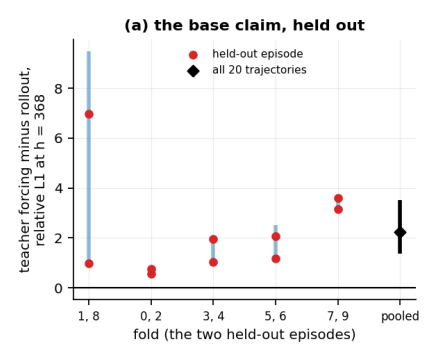
Figure 2 .Teacher forcing’s error minus rollout training’s at 368 steps (relative L1), for each of the five splits. Each red dot is one held-out episode, and every dot is above zero. The black diamond is the difference pooled over all 20 trajectories, with its 95% interval.
원문 · CC BY 4.0 · Singh, Joyjeet · Auditing a Learned Simulator for Legged Robots: The Robotic World Model on ANYmal D · 원문 그림 인용 · 원본 PDF 9쪽에서 그림 영역을 추출했습니다.불확실성의 순위와 크기
RWM-U는 다섯 헤드의 불일치를 정책 보상에서 빼는 페널티로 사용합니다. 공개 체크포인트에서 이 불일치는 100단계 오차와 +0.90의 순위 상관을 보였지만, 한 시그마 포함률은 4.6%에 그쳤습니다. 보정된 추정치는 68%를 기대하므로 크기는 크게 잘못되었습니다. 저자들은 각 헤드의 분산이 학습 손실 구조 때문에 0으로 붕괴한다고 해석합니다. 공개 체크포인트의 학습 데이터가 공개되지 않아 이 표의 모든 수치가 보류 데이터라고 확정할 수는 없습니다.
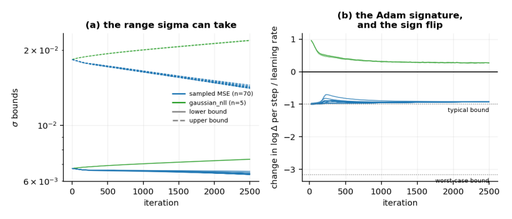
Figure 5 .The collapse during training, in 75 logged runs of 2,500 iterations: 70 with the released loss (blue) and 5 with the likelihood loss (green). (a) The lowest (solid) and highest (dashed) standard deviation the head can output. Under the released loss both fall; under the likelihood loss both rise. (b) How fast the gap between the two bounds changes, in learning rates per iteration, beside the optimiser’s typical and largest step. The likelihood loss flips the sign.
원문 · CC BY 4.0 · Singh, Joyjeet · Auditing a Learned Simulator for Legged Robots: The Robotic World Model on ANYmal D · 원문 그림 인용 · 원본 PDF 13쪽에서 그림 영역을 추출했습니다.정책의 보행 여부와 fine-tuning
시뮬레이터 안에서 학습한 정책을 MuJoCo 물리 모델에서 실행해 걷기 점수로 평가했습니다. 공개 모델에서 가지치기 30%를 하면 한 단계 앞 기술 유지율은 90%로 보였지만 2초 지점에서는 39%였고, 짧은 fine-tuning으로 기술이 회복되었습니다. 공개 모델을 짧게 미세 조정한 18개 복사본 중 13개는 실패한 정책을 만들었습니다. 원래 학습률에서 20단계, 또는 학습률의 10분의 1에서 160단계의 미세 조정만으로 공개 모델이 걷는 정책을 만들지 못하게 되었습니다. 처음부터 학습한 시뮬레이터는 모두 넘어지거나 제자리에 서 있는 정책만 만들었습니다.
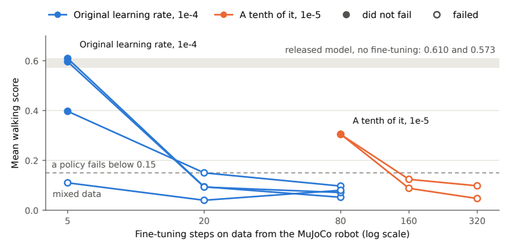
Figure 12 .Policies stop walking after 20 fine-tuning steps, or 160 at a tenth of the learning rate. The adaptation ladder. Each point is one copy of the released model fine-tuned on data from our MuJoCo robot for the given number of steps, placed at the mean walking score of its two or three policies; lines join copies saved from one run. Filled points: the simulator did not fail. Open points: at least two of its policies failed, so the simulator failed. The open point at 0.15 and 20 steps is the run with one-step windows: its mean rounds to the threshold, but two of its three policies scored below it. The band marks the released model’s own two policies. Descriptive.
원문 · CC BY 4.0 · Singh, Joyjeet · Auditing a Learned Simulator for Legged Robots: The Robotic World Model on ANYmal D · 원문 그림 인용 · 원본 PDF 25쪽에서 그림 영역을 추출했습니다.한계
이 연구는 ANYmal D 한 대의 트로트 보행과 평지, 시뮬레이션 데이터로 한정되며 실제 로봇에서 실행되지 않았습니다. 걷기 점수의 임계값 0.15는 첫 로봇 수준 연구 뒤에 저자들이 정한 값입니다.
논문 정보
- 저자
- Singh, Joyjeet
- 학회·저널
- arXiv · 프리프린트
- 최초 공개일
- 2026년 11월 17일
- 등록일
- 2026년 11월 20일
- 수정일
- 2026년 11월 17일
- 버전
- v1
- arXiv
- 2611.23118
- 분류
- cs.RO · cs.LG
- 원문 이용 조건
- CC BY 4.0
- 제공 범위
- 논문 정보, 해설, 허용된 원문 그림
AI 해설은 논문 원문과 별개의 설명이며 오류가 있을 수 있습니다. 원문과 그림은 각 출처의 이용 조건과 따로 표시된 권리를 따릅니다.
초록
A legged robot can learn to walk inside a learned simulator: a neural network that predicts the robot's next state and is run forward on its own predictions. They are usually trained and checked one step ahead, although a policy uses them for a hundred steps or more. We audit one published system end to end, without a GPU: the dynamics model of the Robotic World Model (RWM) for the ANYmal D quadruped, and the uncertainty estimate of its follow-up, RWM-U. We rebuilt the model to match the released code's outputs, losses and gradients exactly, measured 101 trained simulators, 200 compressed copies and 38 simulators of three other architectures, and trained policies inside simulators that we tested in a hand-built MuJoCo model of the robot. Training on the model's own rollouts beat one-step training at 368 steps on all ten held-out episodes (registered), although one-step training was better one step ahead. One-step checks therefore misjudge design choices: pruning 30% of the weights kept 90% of the model's skill one step ahead and 39% at 2 s. Ensemble disagreement ranked rollout error well (Spearman +0.90 at 100 steps), yet covered 4.6% of outcomes at one sigma, against 68% for a calibrated estimate, as each network's own variance collapses under the implemented loss. Two checks that need no recorded future ranked some pools of simulators well, but neither was shown better than 8-step error in a primary test. At the robot level, accuracy has not predicted walking: all 18 fine-tuned copies we tested predicted better than the released model one and eight steps ahead, yet 13 gave failing policies, and registered tests of whether any check ranks simulators by their policies were not settled. In a secondary test, running the authors' policy inside each simulator ranked them well. We also report nine of our own claims that we withdrew. Scope: one robot, one gait, simulated data, no hardware.
원문 인용
Singh, Joyjeet (2026). Auditing a Learned Simulator for Legged Robots: The Robotic World Model on ANYmal D. arXiv:2611.23118v1. https://arxiv.org/abs/2611.23118v1
BibTeX
@misc{joyjeet2026auditing,
  title = {{Auditing a Learned Simulator for Legged Robots: The Robotic World Model on ANYmal D}},
  author = {Singh, Joyjeet},
  year = {2026},
  eprint = {2611.23118},
  archivePrefix = {arXiv},
  url = {https://arxiv.org/abs/2611.23118v1}
}