논문 해설
One Stone, Two Birds: Enhancing Adversarial Defense Through the Lens of Distributional Discrepancy
돌 하나로 새 마리 잡기: 분포 불일치의 관점에서 본 적대적 방어 강화
- 연구 문제 적대적 예제를 탐지하는 통계적 방법은 탐지된 배치를 버려 깨끗한 정보까지 잃는다는 한계가 있습니다.
- 연구 방법 MMD-OPT로 잡음 제거기를 학습하고, 같은 통계량으로 깨끗한 배치와 적대적 배치를 나누어 두 갈래로 처리합니다.
- 주요 결과 CIFAR-10 적응형 백색상자 PGD+EOT ℓ∞(ϵ=8/255) 설정에서 DAD는 깨끗한 정확도 94.16%와 강건 정확도 67.53%를 보고합니다.
통계적 탐지 방어의 한계
적대적 예제는 깨끗한 입력에 눈에 띄지 않는 잡음을 더해 분류기를 잘못 예측하게 만듭니다. 통계적 적대적 데이터 탐지(SADD)는 입력 배치가 깨끗한 분포와 얼마나 다른지를 측정하여 적대적 예제가 섞였는지를 판단합니다. 이 방식은 탐지된 배치를 버리기 때문에, 배치 안에 섞인 깨끗한 예제의 정보까지 함께 잃는다는 한계가 있습니다. 본 논문은 이 한계를 다루기 위해 분포 차이를 줄이는 것이 적대적 위험을 줄이는 근거가 될 수 있는지를 먼저 이론적으로 살펴봅니다.
분포 차이와 적대적 위험의 관계
논문은 L1 분포 차이 d1을 정의하고, 가설 h와 적대적 분포 DA에 대해 R(h, fA, DA)가 R(h, fC, DC)와 d1(DC, DA)의 합으로 상계된다는 정리 1을 제시합니다. 이 상계는 가정 1과 가정 2 및 이진 분류와 0-1 손실 설정에서 제시된 결과입니다. 가정 1과 2는 공격이 허용된 섭동 범위 안에서 라벨을 바꾸지 않는다는 조건이며, 이로부터 깨끗한 라벨링 함수와 적대적 라벨링 함수가 모든 x에서 같다는 따름정리 1이 도출됩니다. 따라서 분포 차이를 줄이면 적대적 도메인의 기대 손실을 직접 줄일 수 있다는 것이 저자의 논증입니다. 이는 상수 항을 추가로 두는 일반 도메인 적응 상계와 구별됩니다.
MMD-OPT의 커널 최적화
DAD는 분포 차이를 측정하는 통계량으로 최대평균불일치(MMD)를 사용합니다. 논문은 커널 평균 임베딩 기반 MMD 추정량에서 커널 kω를 최적화하여 테스트 파워를 높이는 방식을 택합니다. 학습 데이터의 깨끗한 샘플과 적대적 샘플로 목적 J를 근사하는 추정량을 최대화하고, 그 결과 얻은 최적 커널 k*ω로 정의되는 MMD 추정량을 MMD-OPT라고 부릅니다. 이 값은 이후 잡음 제거기 학습의 지도 신호와 추론 단계의 판별기로 함께 사용됩니다.
잡음 제거기 학습과 두 갈래 추론
학습 단계에서는 적대적 예제 S_A에 평균 0, 표준편차 0.25의 가우시안 잡음을 더해 S_noise를 만들고, DUNET 기반 잡음 제거기 g_θ가 이를 정제하도록 합니다. 손실은 MMD-OPT(S_C, g_θ(S_noise))와 교차 엔트로피 손실을 α로 가중하여 함께 최소화하는 형태입니다. 추론 단계에서는 검증 배치 S_V와 테스트 배치 S_T의 MMD-OPT 값을 임계값 t와 비교합니다. 값이 t보다 작으면 S_T를 깨끗한 배치로 보고 분류기에 직접 입력하고, 그렇지 않으면 학습된 잡음 제거기를 거친 뒤 분류기에 입력합니다. 이 두 갈래 처리 덕분에 탐지된 배치를 버리지 않습니다.
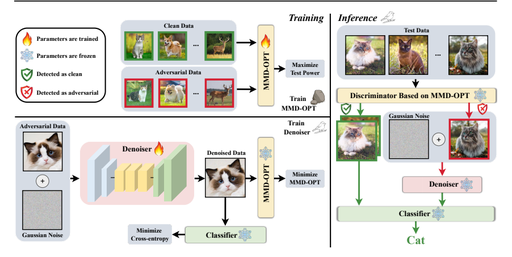
Figure 1 . The illustration of Distributional-discrepancy-based Adversarial Defense (DAD). DAD first optimizes the test power of the maximum mean discrepancy (MMD) to derive MMD-OPT, which is a stone that kills two birds. MMD-OPT first serves as a guiding signal to minimize the distributional discrepancy between CEs and AEs to train a denoiser. In the inference stage, it also serves as a discriminator to differentiate CEs and AEs during inference. Then, our method applies a two-pronged process: (1) directly feeding the detected CEs into the classifier, and (2) removing noise from the detected AEs by the well-trained denoiser.
원문 · CC BY 4.0 · Jiacheng Zhang, Benjamin I. P. Rubinstein, Jingfeng Zhang, Feng Liu · One Stone, Two Birds: Enhancing Adversarial Defense Through the Lens of Distributional Discrepancy · 원문 그림 인용 · 원본 PDF 4쪽에서 그림 영역을 추출했습니다.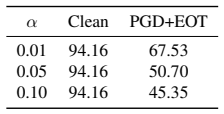
Table 7 . Sensitivity of DAD to the regularization term α on CIFAR-10. We report clean and robust accuracy (%) against adaptive white-box PGD+EOT (ϵ = 8/255). The classifier used is WRN-28-10.
원문 · CC BY 4.0 · Jiacheng Zhang, Benjamin I. P. Rubinstein, Jingfeng Zhang, Feng Liu · One Stone, Two Birds: Enhancing Adversarial Defense Through the Lens of Distributional Discrepancy · 원문 그림 인용 · 원본 PDF 16쪽에서 그림 영역을 추출했습니다.
Table 9 . Clean and robust accuracy (%) of our method with and without the two-pronged process against adaptive white-box PGD+EOT ℓ∞(ϵ = 8 /255) and ℓ2(ϵ = 0 .5) on CIFAR-10. We report averaged results and standard deviations of 5 runs. We show the most successful defense in bold.
원문 · CC BY 4.0 · Jiacheng Zhang, Benjamin I. P. Rubinstein, Jingfeng Zhang, Feng Liu · One Stone, Two Birds: Enhancing Adversarial Defense Through the Lens of Distributional Discrepancy · 원문 그림 인용 · 원본 PDF 16쪽에서 그림 영역을 추출했습니다.CIFAR-10 적응형 공격에서의 결과
CIFAR-10에서 WRN-28-10을 대상으로 ℓ∞(ϵ=8/255) 적응형 백색상자 PGD+EOT 공격을 적용했을 때, DAD는 깨끗한 정확도 94.16 ± 0.08%와 강건 정확도 67.53 ± 1.07%를 보고합니다. 이 수치는 5회 실행의 평균과 표준편차이며, MMD-OPT와 잡음 제거기는 ℓ∞ MMA 공격으로 학습되었습니다. 같은 표에서 AP 기준선 중 가장 높은 강건 정확도는 55.82%로 보고되어 있으므로, 이 비교는 해당 설정에서의 결과입니다.
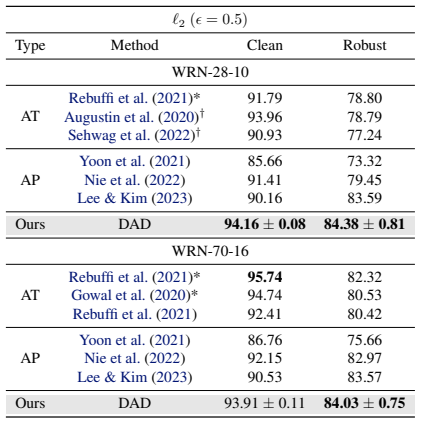
Table 1 . Clean and robust accuracy (%) against adaptive white-box attacks (left: ℓ∞ (ϵ = 8/255), right: ℓ2 (ϵ = 0.5)) on CIFAR-10. † means this method uses WideResNet-34-10. * means this method is trained with extra data. We report averaged results and standard deviations of our method for 5 runs. We show the most successful defense in bold.
원문 · CC BY 4.0 · Jiacheng Zhang, Benjamin I. P. Rubinstein, Jingfeng Zhang, Feng Liu · One Stone, Two Birds: Enhancing Adversarial Defense Through the Lens of Distributional Discrepancy · 원문 그림 인용 · 원본 PDF 7쪽에서 그림 영역을 추출했습니다.ImageNet-1K 적응형 공격에서의 결과
ImageNet-1K에서 RN-50을 대상으로 ℓ∞(ϵ=4/255) 적응형 백색상자 PGD+EOT 공격을 적용했을 때, DAD는 깨끗한 정확도 78.61 ± 0.04%와 강건 정확도 53.85 ± 0.23%를 보고합니다. 이 결과는 3회 실행의 평균과 표준편차입니다. 논문은 이 차이가 대규모 데이터셋에서 밀도 추정 대신 분포 차이를 식별하는 것이 더 실용적이라는 저자의 해석과 연결된다고 설명합니다.
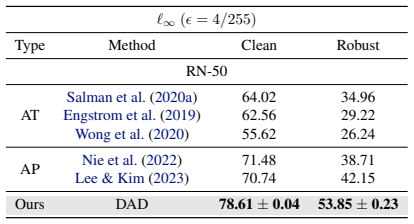
Table 2 . Clean and robust accuracy (%) against adaptive white-box attacks ℓ∞ (ϵ = 4 /255) on ImageNet-1K. We report averaged results and standard deviations of our method for 3 runs. We show the most successful defense in bold.
원문 · CC BY 4.0 · Jiacheng Zhang, Benjamin I. P. Rubinstein, Jingfeng Zhang, Feng Liu · One Stone, Two Birds: Enhancing Adversarial Defense Through the Lens of Distributional Discrepancy · 원문 그림 인용 · 원본 PDF 7쪽에서 그림 영역을 추출했습니다.혼합 배치 실험과 한계
논문은 각 배치에 깨끗한 예제와 적대적 예제를 섞는 혼합 배치 실험을 수행했습니다. CIFAR-10에서 적대적 예제 비율을 0%에서 100%로 바꿀 때 혼합 정확도는 90%대 초반에서 약 70%대로 낮아지는 경향을 보입니다. 또한 DAD는 분포 차이 통계량을 위해 배치 단위 입력을 필요로 하며, 배치 크기가 작아지면 안정성이 영향을 받습니다. 사용자 추론에서는 샘플을 큐에 모아 배치를 만든 뒤 처리하는 방안을 저자가 제시하며, 이 경우 대기 시간이 비용이 된다고 설명합니다.
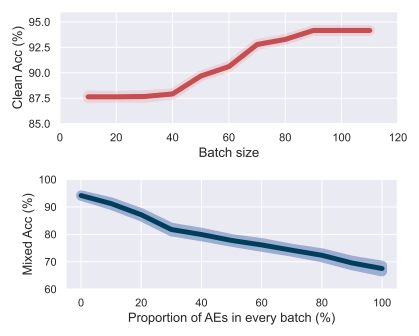
Figure 2 . Top: clean accuracy (%) vs. batch size; Bottom: mixed accuracy (%) vs. proportion of AEs in a batch (%). We plot averaged results and standard deviations of 5 runs.
원문 · CC BY 4.0 · Jiacheng Zhang, Benjamin I. P. Rubinstein, Jingfeng Zhang, Feng Liu · One Stone, Two Birds: Enhancing Adversarial Defense Through the Lens of Distributional Discrepancy · 원문 그림 인용 · 원본 PDF 8쪽에서 그림 영역을 추출했습니다.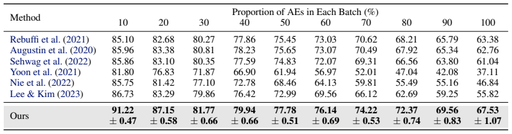
Table 5 . Mixed accuracy (%) of defense methods against adaptive white-box attacks ℓ∞(ϵ = 8 /255) on CIFAR-10 under different proportions of AEs. The target model is WRN-28-10. We report averaged results and standard deviations of 5 runs. We show the most successful defense in bold.
원문 · CC BY 4.0 · Jiacheng Zhang, Benjamin I. P. Rubinstein, Jingfeng Zhang, Feng Liu · One Stone, Two Birds: Enhancing Adversarial Defense Through the Lens of Distributional Discrepancy · 원문 그림 인용 · 원본 PDF 15쪽에서 그림 영역을 추출했습니다.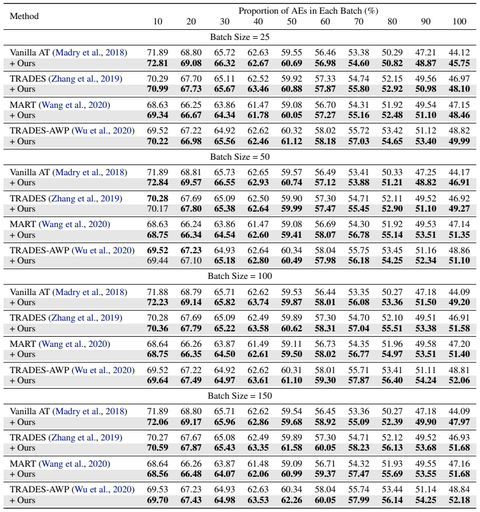
Table 12 . Mixed accuracy (%) our method with and without different adversarial training methods under different proportions of AEs in each batch and different batch sizes against PGD+EOT ℓ∞(ϵ = 8/255). We show the most successful defense in bold.
원문 · CC BY 4.0 · Jiacheng Zhang, Benjamin I. P. Rubinstein, Jingfeng Zhang, Feng Liu · One Stone, Two Birds: Enhancing Adversarial Defense Through the Lens of Distributional Discrepancy · 원문 그림 인용 · 원본 PDF 17쪽에서 그림 영역을 추출했습니다.논문 정보
- 저자
- Jiacheng Zhang, Benjamin I. P. Rubinstein, Jingfeng Zhang, Feng Liu
- 학회·저널
- arXiv · 프리프린트
- 최초 공개일
- 2025년 3월 4일
- 등록일
- 2026년 10월 29일
- 수정일
- 2025년 6월 6일
- 버전
- v2
- arXiv
- 2503.02169
- 분류
- cs.LG · cs.CR
- 원문 이용 조건
- CC BY 4.0
- 제공 범위
- 논문 정보, 해설, 허용된 원문 그림
AI 해설은 논문 원문과 별개의 설명이며 오류가 있을 수 있습니다. 원문과 그림은 각 출처의 이용 조건과 따로 표시된 권리를 따릅니다.
초록
Statistical adversarial data detection (SADD) detects whether an upcoming batch contains adversarial examples (AEs) by measuring the distributional discrepancies between clean examples (CEs) and AEs. In this paper, we explore the strength of SADD-based methods by theoretically showing that minimizing distributional discrepancy can help reduce the expected loss on AEs. Despite these advantages, SADD-based methods have a potential limitation: they discard inputs that are detected as AEs, leading to the loss of useful information within those inputs. To address this limitation, we propose a two-pronged adversarial defense method, named Distributional-discrepancy-based Adversarial Defense (DAD). In the training phase, DAD first optimizes the test power of the maximum mean discrepancy (MMD) to derive MMD-OPT, which is a stone that kills two birds. MMD-OPT first serves as a guiding signal to minimize the distributional discrepancy between CEs and AEs to train a denoiser. Then, it serves as a discriminator to differentiate CEs and AEs during inference. Overall, in the inference stage, DAD consists of a two-pronged process: (1) directly feeding the detected CEs into the classifier, and (2) removing noise from the detected AEs by the distributional-discrepancy-based denoiser. Extensive experiments show that DAD outperforms current state-of-the-art (SOTA) defense methods by simultaneously improving clean and robust accuracy on CIFAR-10 and ImageNet-1K against adaptive white-box attacks. Codes are publicly available at: https://github.com/tmlr-group/DAD.
원문 인용
Jiacheng Zhang, Benjamin I. P. Rubinstein, Jingfeng Zhang, Feng Liu (2025). One Stone, Two Birds: Enhancing Adversarial Defense Through the Lens of Distributional Discrepancy. arXiv:2503.02169v2. https://arxiv.org/abs/2503.02169v2
BibTeX
@misc{zhang2025stone,
  title = {{One Stone, Two Birds: Enhancing Adversarial Defense Through the Lens of Distributional Discrepancy}},
  author = {Jiacheng Zhang and Benjamin I. P. Rubinstein and Jingfeng Zhang and Feng Liu},
  year = {2025},
  eprint = {2503.02169},
  archivePrefix = {arXiv},
  url = {https://arxiv.org/abs/2503.02169v2}
}