논문 해설
Reproducible LoRA Inference Through Deterministic Split-K Reduction
결정론적 Split-K 리덕션을 통한 재현 가능한 LoRA 추론
- 연구 문제 LoRA를 쓰는 언어 모델의 반복 추론은 같은 입력에서도 결과가 달라질 수 있어 감사와 반복 평가에 문제가 됩니다.
- 연구 방법 LoRA shrink의 Split-K 부분 결과를 원자적 덧셈 대신 타일별 완료 카운터와 고정 순서 FP32 합산으로 결합하는 결정론적 Triton 커널을 제시합니다.
LoRA 추론에서 생기는 재현성 문제
LoRA 어댑터를 붙인 언어 모델은 반복 평가와 감사, 의사결정에 쓰이므로 같은 입력에서 같은 출력이 나오는 것이 중요합니다. 그런데 Split-K 커널은 저랭크 LoRA 곱셈에서 병렬성을 높이기 위해 사용되며, 부분 결과를 부동소수점 원자적 덧셈으로 합칠 때 수치적 비결정성을 일으킬 수 있습니다. 이 논문은 vLLM의 LoRA shrink 연산에서 이 문제를 조사하고, 같은 병렬성을 유지하면서 결과를 고정 순서로 합치는 결정론적 Triton Split-K 구현을 제시합니다. 연구 범위는 GSM8K 수학 추론, MBPP 코드 생성, Civil Comments 독성 분류 실험입니다.
Split-K 축약과 결정론적 합산
Split-K는 축약 차원 H를 여러 부분집합으로 나누어 각 스레드 블록이 부분 결과를 계산하게 합니다. 원자적 구현에서는 이 부분 결과들이 FP32 원자적 덧셈으로 누적되므로, 덧셈 순서가 GPU 스케줄링에 따라 달라질 수 있습니다. 원문은 부동소수점 덧셈이 결합법칙을 일반적으로 만족하지 않는다는 예시를 제시하며, 이 차이가 같은 입력에서도 다른 중간값을 만들 수 있다고 설명합니다.
결정론적 Split-K=8 구현은 같은 8-way 병렬성을 유지하되, 각 타일의 8개 부분 결과를 scratch 버퍼에 저장하고 타일별 정수 완료 카운터로 마지막 블록을 식별합니다. 마지막 블록은 부분 결과를 파티션 순서대로 FP32로 합산하고 LoRA 스케일을 곱한 뒤 출력 타일을 씁니다. 정수 원자 연산은 완료 순서를 조정하는 데만 쓰이고 부분 결과를 누적하지 않습니다.
동일 입력 재생과 반복 생성의 변동
Split-K=1과 Deterministic Split-K=8에서는 같은 연산에서 관찰된 차이가 없었습니다.
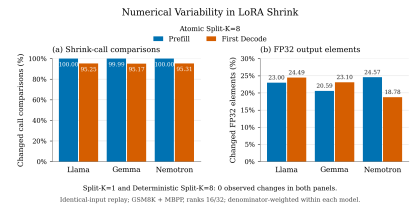
Figure 3 . Run-to-run numerical variability in the LoRA shrink op- eration during prefill and first decode. Atomic Split-K=8 exhibits numerical variation under identical inputs, while Split-K=1 and Deterministic Split-K=8 show no observed differences.
원문 · CC BY 4.0 · Dhayaneshwar Balusamy, Ankur Mohan · Reproducible LoRA Inference Through Deterministic Split-K Reduction · 원문 그림 인용 · 원본 PDF 7쪽에서 그림 영역을 추출했습니다.반복 greedy 생성에서는 GSM8K와 MBPP 각각 2,700개 비교 중 Atomic Split-K=8이 467개(17.30%)와 404개(14.96%)에서 토큰 시퀀스를 바꿨습니다. GSM8K에서는 151개 비교에서 추출된 최종 답이 달랐고 이 중 84개가 정답성을 바꿨으며, MBPP에서는 53개 비교에서 공개 테스트 통과 여부가 바뀌었습니다. Split-K=1과 Deterministic Split-K=8은 같은 반복 실행에서 출력 차이를 보이지 않았습니다.
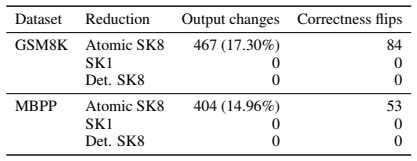
Table 1 . Output and correctness changes under repeated greedy inference. Each reduction method has 2,700 comparisons per dataset, using repetitions 1-9 against repetition 0.
원문 · CC BY 4.0 · Dhayaneshwar Balusamy, Ankur Mohan · Reproducible LoRA Inference Through Deterministic Split-K Reduction · 원문 그림 인용 · 원본 PDF 9쪽에서 그림 영역을 추출했습니다.차이가 KV 캐시와 토큰 선택으로 전파되는 과정
사례 연구에서는 Llama-3.2-3B-Instruct와 rank-16 GSM8K 어댑터를 사용했습니다. 두 Atomic Split-K=8 실행은 처음 35개 토큰을 공유했지만 36번째 위치에서 다른 토큰을 선택했고, 최종 답은 각각 7과 8이었습니다. 첫 전파 차이는 prompt 위치 47의 layer-2 MLP up-projection에서 나타났으며, 두 FP32 shrink 값은 BF16 반올림 경계 양쪽으로 갈려 서로 다른 BF16 값이 되었습니다.
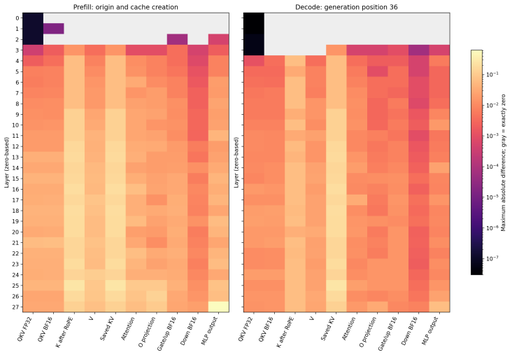
Figure 4 . Numerical differences between two Atomic Split-K=8 executions during prefill and decode at generated token 36. Colors indicate maximum absolute tensor differences on a logarithmic scale; gray denotes exact agreement. The first propagating difference appears in layer 2, with cached K/V differences from layer 3 onward. Subsequent differences reflect both accumulated state variation and numerical variation during later operations.
원문 · CC BY 4.0 · Dhayaneshwar Balusamy, Ankur Mohan · Reproducible LoRA Inference Through Deterministic Split-K Reduction · 원문 그림 인용 · 원본 PDF 8쪽에서 그림 영역을 추출했습니다.원문은 이 shrink 차이만 주입한 실험에서는 layer-3 K/V 차이가 재현되었지만 후속 토큰 전환은 재현되지 않았다고 보고합니다. 반대로 36번째 토큰 직전의 atomic 실행 KV 캐시를 Split-K=1 연속 실행에 넣었을 때는 There의 logit이 21.625로 낮아져 Each가 선택되었습니다. 따라서 이 결과는 KV 캐시 차이가 해당 토큰 결정을 바꿀 수 있음을 보여주지만, 개별 shrink 섭동이 충분하다는 증명은 별도 실험에 의존합니다.
구조화 결정 인터페이스의 확률과 이진 결정
Civil Comments 실험은 vLLM의 noul 인터페이스에서 Qwen3-0.6B rank-16 LoRA 어댑터를 사용해 독성 확률을 반환받는 방식입니다. 1,000개 댓글을 한 엔진에서 10회 순차 평가하여 각 방법마다 9,000개 비교를 얻었습니다. Atomic Split-K=8은 9,000개 비교 중 7,332개(81.47%)에서 반환 확률이 달랐고, 평균 절대 차이는 0.00143, 최댓값은 0.05672였습니다.
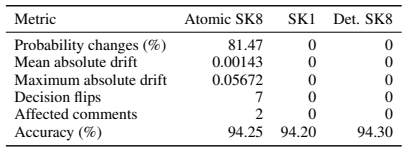
Table 2 . Probability and decision stability on Civil Comments. Each reduction method has 9,000 comparisons across 1,000 com- ments.
원문 · CC BY 4.0 · Dhayaneshwar Balusamy, Ankur Mohan · Reproducible LoRA Inference Through Deterministic Split-K Reduction · 원문 그림 인용 · 원본 PDF 10쪽에서 그림 영역을 추출했습니다.그러나 이진 분류가 바뀐 경우는 7건으로 0.078%였고 두 댓글에서만 발생했습니다. 이 두 댓글의 초기 확률은 정확히 0.5였고, 뒤집힌 반복에서는 약 0.46879로 낮아졌습니다.
지연 시간 비용과 배치 크기의 한계
성능 실험은 12개 모델-데이터셋-랭크 구성에서 각 50개 순차 요청을 생성하고, 요청마다 정확히 150개 토큰을 생성하며 5회 독립 엔진 시험을 수행했습니다. 결정론적 Split-K=8은 Split-K=1 대비 16.8-21.1%의 지연 시간 기반 속도 향상을 보였고 평균은 19.2%였습니다. Atomic Split-K=8 대비 지연 시간 오버헤드는 1.02-2.62%, 평균은 1.69%였습니다.
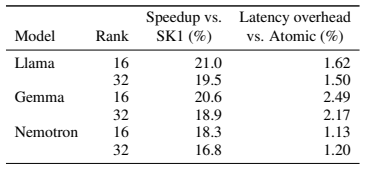
Table 4 . End-to-end latency comparison of Deterministic Split- K=8 against SK1 and Atomic Split-K=8, averaged across GSM8K and MBPP.
원문 · CC BY 4.0 · Dhayaneshwar Balusamy, Ankur Mohan · Reproducible LoRA Inference Through Deterministic Split-K Reduction · 원문 그림 인용 · 원본 PDF 10쪽에서 그림 영역을 추출했습니다.배치 크기 실험에서 Atomic Split-K=8은 모든 배치 크기에서 출력 변동을 보였습니다. Split-K=1과 결정론적 구현은 같은 고정 배치 크기 안에서는 반복 출력이 같았지만, 배치 크기 1과 다른 배치 크기의 첫 실행을 비교하면 각각 39.58%와 39.06%에서 출력이 달랐습니다. 따라서 축약 커널의 결정성이 전체 시스템의 배치 불변성을 보장하지는 않습니다.
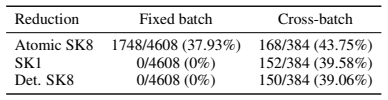
Table 3 . Output differences under fixed and changing batch sizes, aggregated across LoRA ranks 16 and 32.
원문 · CC BY 4.0 · Dhayaneshwar Balusamy, Ankur Mohan · Reproducible LoRA Inference Through Deterministic Split-K Reduction · 원문 그림 인용 · 원본 PDF 10쪽에서 그림 영역을 추출했습니다.논문 정보
- 저자
- Dhayaneshwar Balusamy, Ankur Mohan
- 학회·저널
- arXiv · 프리프린트
- 최초 공개일
- 2026년 11월 7일
- 등록일
- 2026년 11월 10일
- 수정일
- 2026년 11월 7일
- 버전
- v1
- arXiv
- 2611.10334
- 분류
- cs.LG · cs.AI · cs.DC · cs.PF
- 원문 이용 조건
- CC BY 4.0
- 제공 범위
- 논문 정보, 해설, 허용된 원문 그림
AI 해설은 논문 원문과 별개의 설명이며 오류가 있을 수 있습니다. 원문과 그림은 각 출처의 이용 조건과 따로 표시된 권리를 따릅니다.
초록
Reproducibility is important for LoRA-adapted language models used in repeated evaluation, auditing, and decision-making. However, Split-K kernels used to introduce parallelism in low-rank LoRA multiplications can have the unintended consequence of numerical nondeterminism when partial results are combined using floating-point atomic additions. We investigate this non-determinism in vLLM across GSM8K mathematical reasoning, MBPP code generation, and Jev-style structured toxicity decisions on Civil Comments and introduce a deterministic Triton Split-K implementation. Under identical-input replay, Atomic Split-K=8 produces different FP32 shrink outputs in 97.61% of comparisons, while our Deterministic Split-K=8 shows no observed variation. Repeated atomic inference changes generated outputs in 17.30% of GSM8K and 14.96% of MBPP comparisons, sometimes altering task correctness. Structured-decision probabilities vary in 81.47% of atomic comparisons, with decision flips. Controlled tracing demonstrates how shrink-output differences propagate into the KV cache and how accumulated cache differences can change token decisions and final answers. Our deterministic Triton Split-K=8 implementation preserves parallelism, achieving 16.8-21.1% latency-based speedup over unsplit reduction with only 1.02-2.62% additional latency relative to Atomic Split-K=8.
원문 인용
Dhayaneshwar Balusamy, Ankur Mohan (2026). Reproducible LoRA Inference Through Deterministic Split-K Reduction. arXiv:2611.10334v1. https://arxiv.org/abs/2611.10334v1
BibTeX
@misc{balusamy2026reproducible,
  title = {{Reproducible LoRA Inference Through Deterministic Split-K Reduction}},
  author = {Dhayaneshwar Balusamy and Ankur Mohan},
  year = {2026},
  eprint = {2611.10334},
  archivePrefix = {arXiv},
  url = {https://arxiv.org/abs/2611.10334v1}
}