논문 해설
A Cost-Effective Person-Following System for Assistive Unmanned Vehicles with Deep Learning at the Edge
엣지에서 딥러닝을 활용한 보조 무인 차량용 저비용 사람 추종 시스템
- 연구 문제 고령자를 돕는 서비스 로봇이 집 안에서 사람을 검출하고 따라가려면, 외부 연산 장치 없이 저비용 임베디드 장치에서 실시간으로 동작해야 합니다.
- 연구 방법 COCO로 사전 학습된 YOLOv3-tiny를 person 클래스 검출용으로 재학습하고, RGB-D 깊이 값과 바운딩 박스 위치로 선속도와 각속도 명령을 계산합니다.
- 주요 결과 재학습으로 AP50이 19.21%에서 49.30%로 30.09%p 향상되었고, Jetson AGX Xavier는 최대 전력 30W에서 30+ fps를 보고했습니다. 정수 양자화는 AP50을 22% 낮춥니다.
고령자 지원을 위한 사람 추종 로봇의 과제
고령자가 집에서 자립적으로 생활하도록 돕는 서비스 로봇에는 사람을 검출하고 그 사람을 따라 이동하는 능력이 필요합니다. 이 논문은 외부 연산 장치 없이 저전력 임베디드 장치에서 동작하는 저비용 사람 추종 시스템을 다룹니다.
기존 연구에서는 레이저 거리계가 만드는 2차원 점군 기반의 다리·몸통 검출이 쉽게 불안정해지고, 여러 센서를 융합하면 정확도는 올라가지만 비용과 연산 부담이 커진다는 문제가 있습니다. 이 논문은 이러한 이유로 저비용 RGB-D 카메라 한 대만을 감지 장치로 선택합니다.
또한 검출 결과는 로봇이 따라갈 선속도와 각속도 명령으로 바뀌어야 하므로, 검출 속도와 전력 소모가 함께 고려되어야 합니다. 이 연구는 이 두 조건을 함께 다룬다는 점에서 범위가 정해집니다.
YOLOv3-tiny 재학습과 검출 기반 제어
제안 방법은 COCO로 사전 학습된 YOLOv3-tiny를 출발점으로 삼아 person 클래스만 검출하도록 재학습합니다. 재학습에는 transfer learning이 쓰였고, 이 과정은 학습 단계에서 수행됩니다. 추론 단계에서는 RGB-D 프레임에서 검출된 사람의 바운딩 박스 중심과 깊이 값을 이용해 로봇 기준 위치를 계산합니다.
제어는 두 축으로 나뉩니다. 선속도는 깊이 값으로 얻은 사람과의 거리에 따라 정해지며, 일정 구간에서는 정지하고 너무 가까우면 후진합니다. 각속도는 바운딩 박스 중심의 수평 위치 dx에 따라 포물선 형태로 정해집니다. 저자들은 추적기나 추가 필터 없이 검출을 매 단계 반복하는 것만으로 충분하다고 봅니다. 이 판단은 추종 대상이 고령자이고 이동 속도가 느리다는 가정에 근거합니다.
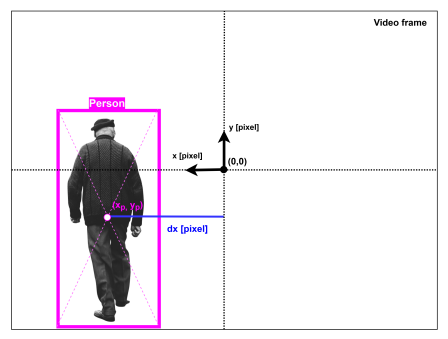
Fig. 3 : The RGB frame of the camera showing how the dx value, adopted in the computation of the angular velocity, is obtained. This value is equal to the horizontal coordinate of the center of the bounding box detecting the person in the frame.
원문 · CC BY 4.0 · Anna Boschi, Francesco Salvetti, Vittorio Mazzia, Marcello Chiaberge · A Cost-Effective Person-Following System for Assistive Unmanned Vehicles with Deep Learning at the Edge · 원문 그림 인용 · 원본 PDF 7쪽에서 그림 영역을 추출했습니다.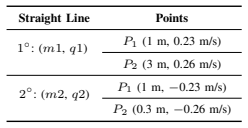
원문 그림 TABLE VI: The values m1, q1, m2, q2 identified, after a test phase, as the best choice of the linear control algorithm, taking into account the robot adopted in our case study, are here reported.
원문 · CC BY 4.0 · Anna Boschi, Francesco Salvetti, Vittorio Mazzia, Marcello Chiaberge · A Cost-Effective Person-Following System for Assistive Unmanned Vehicles with Deep Learning at the Edge · 원문 그림 인용 · 원본 PDF 10쪽에서 그림 영역을 추출했습니다.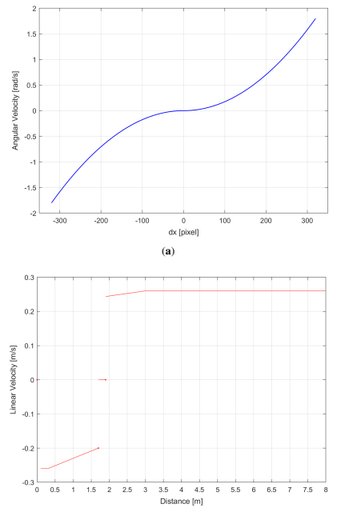
Fig. 5 : In ( a) is the angular velocity control plot, computed considering 640 × 480 as the resolution of the camera frame and the limit value of the angular velocity ±1.8 rad/s. In- stead, in ( b) is shown the linear velocity control function, computed considering the depth camera range (from 0.105 m to 8 m), the limit value of the linear velocity of the robotic platform ±0.26 m/s and the safety distance respected inside the interval between 1.7 and 1.9 m.
원문 · CC BY 4.0 · Anna Boschi, Francesco Salvetti, Vittorio Mazzia, Marcello Chiaberge · A Cost-Effective Person-Following System for Assistive Unmanned Vehicles with Deep Learning at the Edge · 원문 그림 인용 · 원본 PDF 10쪽에서 그림 영역을 추출했습니다.최적화는 학습 후에 적용됩니다. TensorRT로 가지치기를 수행해 정확도 손실을 작게 유지하고, Coral 장치를 위해 TensorFlow Lite로 완전 정수 모델을 만듭니다.
재학습 효과와 최적화 비용
재학습 전후의 person 클래스 검출 성능은 IOU 0.5 기준 평균 정밀도 AP50으로 비교됩니다. 재학습 전 YOLOv3-tiny는 19.21%, person 전용 재학습 모델은 49.30%이며, 그 차이는 30.09%입니다. 이 비교의 대상은 OIDv4에서 추출한 person 이미지로 학습한 모델이며, 600장의 테스트 세트를 사용합니다.
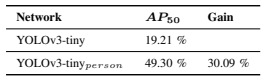
원문 그림 TABLE III: Average precision at 0.5 IOU for person class before and after re-training. It is clear how transfer learning is so effective at improving the performance of the tiny version of the YOLOv3 model, increasing the metric score by more than 30%.
원문 · CC BY 4.0 · Anna Boschi, Francesco Salvetti, Vittorio Mazzia, Marcello Chiaberge · A Cost-Effective Person-Following System for Assistive Unmanned Vehicles with Deep Learning at the Edge · 원문 그림 인용 · 원본 PDF 8쪽에서 그림 영역을 추출했습니다.정수 양자화를 포함한 최적화에서는 가지치기만 적용했을 때 정확도 손실이 미미하다고 원문이 보고합니다. 8비트 정밀도에서는 원래 AP50의 22%를 잃으며, 어두운 장면, 부분 가림, 작은 대상이 잘 검출되지 않습니다. 저자들은 이 손실이 Coral 장치 호환을 위한 정수 모델에서 나타난다고 설명합니다.
엣지 장치별 전력과 추론 속도
여러 엣지 장치에서 측정한 결과는 전력과 fps의 절충으로 읽어야 합니다. Jetson AGX Xavier는 30W 실행 모드에서 30+ fps를 보고하며, 이는 최대 전력에서 얻은 값입니다. Coral USB Accelerator는 int8 가중치 정밀도로 실행한 모델에서 30+ fps를 보였습니다. 이 Coral 결과는 Jetson의 부동소수 정밀도 결과와 같은 조건이 아니므로 직접 비교하지 않습니다.
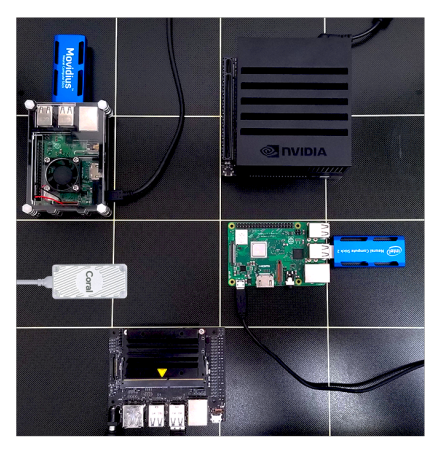
Fig. 1 : The analyzed embedded devices to deploy deep neural networks at the edge. Top left: Raspberry Pi 3 B+ with Intel NCS. Top right: NVIDIA Jetson AGX Xavier. Center left : Coral USB Accelerator. Center right: Raspberry Pi 3 B+ with Movidius NCS2. Bottom: NVIDIA Jetson Nano.
원문 · CC BY 4.0 · Anna Boschi, Francesco Salvetti, Vittorio Mazzia, Marcello Chiaberge · A Cost-Effective Person-Following System for Assistive Unmanned Vehicles with Deep Learning at the Edge · 원문 그림 인용 · 원본 PDF 3쪽에서 그림 영역을 추출했습니다.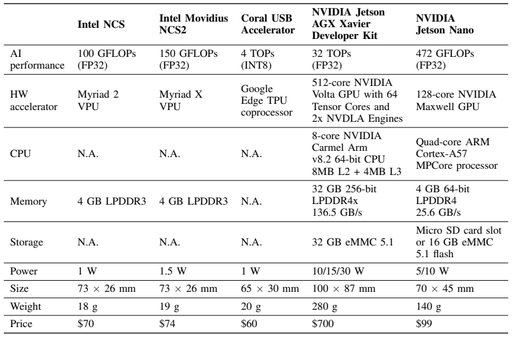
원문 그림 TABLE I: The main specifications of the embedded HW for edge AI taken into account for the experimentation. The price indicated for each device is referred to the commercial value at the time of the publication.
원문 · CC BY 4.0 · Anna Boschi, Francesco Salvetti, Vittorio Mazzia, Marcello Chiaberge · A Cost-Effective Person-Following System for Assistive Unmanned Vehicles with Deep Learning at the Edge · 원문 그림 인용 · 원본 PDF 4쪽에서 그림 영역을 추출했습니다.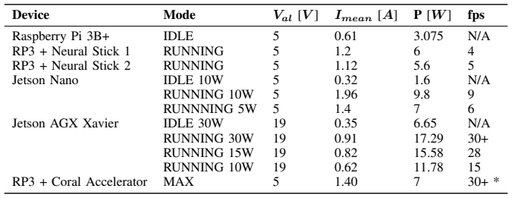
원문 그림 TABLE IV: Comparison between different devices’ power consumption levels and performances achieved with the re-trained and modified version of YOLOv3-tiny. The fps * achieved with the Coral Accelerator are obtained with an int8 weights precision.
원문 · CC BY 4.0 · Anna Boschi, Francesco Salvetti, Vittorio Mazzia, Marcello Chiaberge · A Cost-Effective Person-Following System for Assistive Unmanned Vehicles with Deep Learning at the Edge · 원문 그림 인용 · 원본 PDF 9쪽에서 그림 영역을 추출했습니다.로봇 실험에서는 Jetson AGX Xavier를 온보드 PC로 사용했고, 검출 알고리즘은 실시간으로 동작하며 제어 주기는 18에서 27Hz 사이였습니다. 원문은 네트워크 출력을 모두 사용하면 제어 입력이 계속 바뀌어 움직임이 불규칙해지므로 명령 속도를 2Hz로 갱신했을 때 부드러움이 개선되었다고 보고합니다.
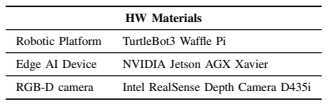
원문 그림 TABLE V: Hardware configuration adopted for practical sim- ulations. Jetson AGX Xavier and Coral USB Accelerator are used to run the model onboard.
원문 · CC BY 4.0 · Anna Boschi, Francesco Salvetti, Vittorio Mazzia, Marcello Chiaberge · A Cost-Effective Person-Following System for Assistive Unmanned Vehicles with Deep Learning at the Edge · 원문 그림 인용 · 원본 PDF 8쪽에서 그림 영역을 추출했습니다.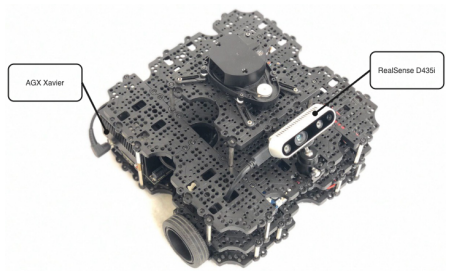
Fig. 4 : TurtleBot3 Waffle platform with NVIDIA Jetson AGX Xavier and Intel RealSense Depth camera D435i onboard.
원문 · CC BY 4.0 · Anna Boschi, Francesco Salvetti, Vittorio Mazzia, Marcello Chiaberge · A Cost-Effective Person-Following System for Assistive Unmanned Vehicles with Deep Learning at the Edge · 원문 그림 인용 · 원본 PDF 9쪽에서 그림 영역을 추출했습니다.적용 범위와 한계
이 시스템은 실내 가정 환경에서 고령자가 혼자 생활하는 상황을 전제로 설계되었습니다. 여러 사람이 동시에 검출되면 로봇은 정해진 시간 동안 멈춥니다. 원문은 사무실처럼 여러 사람이 있는 환경으로 바꾸면 추적 알고리즘이나 추가 필터를 다시 고려해야 한다고 설명합니다.
또한 속도 제한은 ±0.26 m/s와 ±1.8 rad/s로 정해져 있어 더 빠른 사람을 따르는 용도에는 그대로 적용하기 어렵습니다. 저자들은 더 높은 속도가 필요하면 제어 규칙을 조정할 수 있다고 밝힙니다. 따라서 이 결과는 특정 로봇 플랫폼과 실내 저속 추종 조건에서 얻은 것입니다.
논문 정보
- 저자
- Anna Boschi, Francesco Salvetti, Vittorio Mazzia, Marcello Chiaberge
- 학회·저널
- arXiv · 프리프린트
- 최초 공개일
- 2020년 8월 31일
- 등록일
- 2026년 11월 6일
- 수정일
- 2020년 8월 31일
- 버전
- v1
- arXiv
- 2008.13474
- DOI
- 10.3390/machines8030049
- 분류
- cs.RO
- 원문 이용 조건
- CC BY 4.0
- 제공 범위
- 논문 정보, 해설, 허용된 원문 그림
AI 해설은 논문 원문과 별개의 설명이며 오류가 있을 수 있습니다. 원문과 그림은 각 출처의 이용 조건과 따로 표시된 권리를 따릅니다.
초록
The vital statistics of the last century highlight a sharp increment of the average age of the world population with a consequent growth of the number of older people. Service robotics applications have the potentiality to provide systems and tools to support the autonomous and self-sufficient older adults in their houses in everyday life, thereby avoiding the task of monitoring them with third parties. In this context, we propose a cost-effective modular solution to detect and follow a person in an indoor, domestic environment. We exploited the latest advancements in deep learning optimization techniques, and we compared different neural network accelerators to provide a robust and flexible person-following system at the edge. Our proposed cost-effective and power-efficient solution is fully-integrable with pre-existing navigation stacks and creates the foundations for the development of fully-autonomous and self-contained service robotics applications.
원문 인용
Anna Boschi, Francesco Salvetti, Vittorio Mazzia, Marcello Chiaberge (2020). A Cost-Effective Person-Following System for Assistive Unmanned Vehicles with Deep Learning at the Edge. arXiv:2008.13474v1. https://doi.org/10.3390/machines8030049
BibTeX
@article{boschi2020cost,
  title = {{A Cost-Effective Person-Following System for Assistive Unmanned Vehicles with Deep Learning at the Edge}},
  author = {Anna Boschi and Francesco Salvetti and Vittorio Mazzia and Marcello Chiaberge},
  year = {2020},
  eprint = {2008.13474},
  archivePrefix = {arXiv},
  doi = {10.3390/machines8030049},
  url = {https://arxiv.org/abs/2008.13474v1}
}