논문 해설
Adversarial Skill Chaining for Long-Horizon Robot Manipulation via Terminal State Regularization
종단 상태 정규화를 통한 장기 과제 로봇 조작을 위한 적대적 스킬 체이닝
- 연구 문제 여러 부분 과제 정책을 순차적으로 연결할 때 초기 상태 집합이 체인을 따라 무한히 커지는 문제를 다룹니다.
- 연구 방법 T-STAR는 이전 정책의 종료 상태를 다음 정책의 초기 상태 집합 근처로 유도하는 정규화 보상을 적대적 판별기로 구현합니다.
- 주요 결과 두 가구 조립 과제에서 T-STAR는 Policy Sequencing보다 높은 평균 진행도와 성공률을 보고했습니다.
순차 실행 정책의 시작 상태 문제
여러 부분 과제(subtask) 정책을 순서대로 실행하는 스킬 체이닝은 장기 과제를 단순하게 나누는 방법입니다. 그러나 한 정책의 종료 상태가 다음 정책이 성공적으로 실행될 수 있는 초기 상태 집합에 포함되지 않으면 연결이 실패합니다. 이 논문은 로봇 조작, 특히 IKEA 가구 조립처럼 물체 배치가 넓게 퍼질 수 있는 과제에서 이 문제가 특히 크다고 설명합니다.
기존 접근은 다음 정책의 초기 상태 집합을 넓혀 이전 정책의 종료 상태를 포함시키거나, 전이 정책을 학습하거나, 옵션을 발견하는 방식으로 대응해 왔습니다. 그러나 초기 상태 집합을 넓히면 그 정책의 종료 상태 집합도 함께 커지고, 이 확장이 체인을 따라 누적됩니다. 이 논문은 초기 상태 집합을 무한히 넓히지 않고 종료 상태 분포를 다음 정책의 초기 상태 집합 근처로 제한하는 방향을 제안합니다.
종료 상태 정규화 보상
제안 방법 T-STAR는 각 부분 과제 정책 π_i의 보상에 두 항을 더합니다. 먼저 GAIL 판별기 출력으로 계산되는 모방 보상과 환경 보상을 가중합하여 부분 과제를 학습합니다. 이어서 초기 상태 집합 판별기 D_{i+1}를 이전 정책의 종료 상태와 다음 정책의 초기 상태 집합을 구분하도록 학습합니다. 정규화 항 R^i_TSR은 정책의 종료 상태 s가 β_i에 속할 때 D_{i+1}(s)를 보상으로 주는 형태입니다.
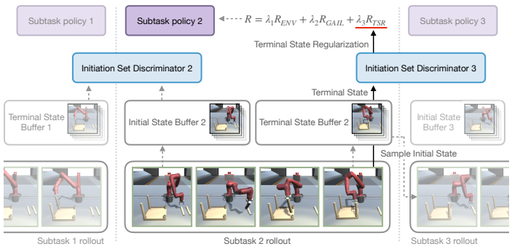
Figure 2 : Our adversarial skill chaining framework regularizes the terminal state distribution to be close to the initiation set of the subsequent subtask. The initiation set discriminator models the initiation set distribution by discerning the initiation set and states in agent trajectories, while the policy learns to reach states close to the initiation set by augmenting the reward with the discriminator output, dubbed terminal state regularization. Our method jointly trains all policies and initiation set discriminators, pushing the termination set close to the initiation set of the next policy, which leads to smaller changes required for the policies that follow, especially effective in a long chain of skills.
원문 · CC BY 4.0 · Youngwoon Lee, Joseph J. Lim, Anima Anandkumar, Yuke Zhu · Adversarial Skill Chaining for Long-Horizon Robot Manipulation via Terminal State Regularization · 원문 그림 인용 · 원본 PDF 4쪽에서 그림 영역을 추출했습니다.즉 정책이 다음 정책의 초기 상태 집합에 가까운 곳에서 끝나도록 보상이 유도됩니다. 전체 보상은 λ1 R_ENV, λ2 R_GAIL, λ3 R_TSR의 합으로 표현되며, 논문은 λ3를 정규화 항의 가중치로 설명합니다. 학습은 먼저 제한된 초기 상태 집합에서 정책을 사전 학습하고, 이후 체인에 필요한 초기 상태에서 판별기와 정책을 번갈아 미세 조정하는 절차로 진행됩니다.
가구 조립 과제의 비교 실험
실험은 IKEA 가구 조립 환경의 TABLE LACK과 CHAIR INGOLF 두 과제에서 수행되었습니다. 각 과제는 네 개의 부분 과제로 나뉩니다. 평가 지표는 부분 과제 하나를 0.25로 계산하는 평균 진행도이며, 평균과 표준편차는 5개 시드에서 계산되었습니다.
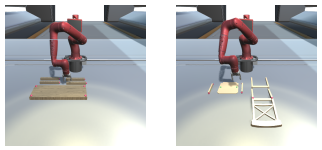
Figure 3 : Two furniture assembly tasks [17] consist of four subtasks (four table legs for TABLE LACK ; two seat supports, chair seat, and front legs for CHIAR INGOLF ).
원문 · CC BY 4.0 · Youngwoon Lee, Joseph J. Lim, Anima Anandkumar, Yuke Zhu · Adversarial Skill Chaining for Long-Horizon Robot Manipulation via Terminal State Regularization · 원문 그림 인용 · 원본 PDF 6쪽에서 그림 영역을 추출했습니다.Policy Sequencing 기준선은 부분 과제 정책을 독립적으로 학습한 뒤 이전 정책의 종료 상태를 덮도록 미세 조정하는 방법입니다. T-STAR는 부분 과제 정책을 동시에 학습하고 종료 상태 정규화를 적용합니다. 두 방법 모두 동일한 구조와 학습 설정을 쓰도록 구성되었으며, 기준선으로 BC, PPO, GAIL, GAIL + PPO, SPiRL도 함께 비교되었습니다.
진행도와 성공률의 변화
평균 진행도는 TABLE LACK에서 T-STAR 0.90±0.07, Policy Sequencing 0.63±0.28이었습니다. CHAIR INGOLF에서는 T-STAR 0.89±0.04, Policy Sequencing 0.77±0.12였습니다. 단일 정책 기준선인 BC, GAIL, SPiRL은 한 부품도 안정적으로 집어 조립하지 못했고 PPO는 드물게 한 부품을 조립했습니다. GAIL + PPO는 한 부품 조립은 가능했지만 이후 부품으로 확장되지 못했습니다.
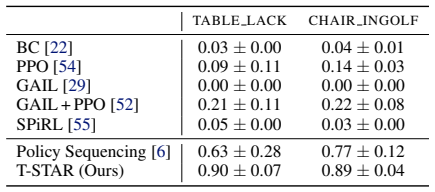
Table 1 : Average progress of the furniture assembly task. Each subtask amounts to 0.25 progress. Hence, 1 represents successful execution of all four subtasks while 0 means the agent does not achieve any subtask. Our method learns to complete all four subtasks in sequence and outperforms the policy sequencing baseline and standard RL and IL methods. We report the mean and standard deviation across 5 seeds.
원문 · CC BY 4.0 · Youngwoon Lee, Joseph J. Lim, Anima Anandkumar, Yuke Zhu · Adversarial Skill Chaining for Long-Horizon Robot Manipulation via Terminal State Regularization · 원문 그림 인용 · 원본 PDF 7쪽에서 그림 영역을 추출했습니다.성공률은 Policy Sequencing에서 CHAIR INGOLF 0%에서 T-STAR 56%로, TABLE LACK 59%에서 87%로 바뀌었다고 보고됩니다. 이 개선은 같은 비교에서 종료 집합과 다음 부분 과제의 초기 집합 차이가 줄어든 결과로 해석됩니다.
종료 집합 변화의 시각화
정성적 분석에서는 CHAIR INGOLF의 세 번째 부분 과제 정책이 종료 상태를 얼마나 넓게 퍼뜨리는지 비교합니다. 종료 상태는 객체 구성을 PCA로 2차원에 투영하여 시각화되었습니다. Policy Sequencing은 학습이 진행될수록 종료 집합이 가로와 세로로 퍼지는 반면, T-STAR의 종료 상태 분포는 제한되는 모습으로 보고됩니다.
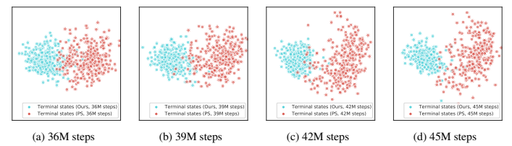
Figure 4 : To demonstrate the benefit of our terminal state regularization, we visualize the changes in termination sets over training of the third subtask policy on CHAIR INGOLF . We plot each terminal state by projecting its object configuration into 2D space using PCA. Through 36M to 45M training steps, both the policy sequencing baseline [ 6] and our method successfully learn to cover most terminal states from the second subtask. However, without regularization, the policy sequencing method (red) shows the increasing size of the termination set (e.g. spread over horizontally at 39M and vertically at 42M steps) as more initial states are covered by the policy. In contrast, in our approach (blue), the terminal state distribution is bounded, which shows that the terminal state regularization can effectively prevent the terminal state distribution diverging. This bounded termination set makes learning of the following skills efficient, and thus helps chaining a long sequence of skills.
원문 · CC BY 4.0 · Youngwoon Lee, Joseph J. Lim, Anima Anandkumar, Yuke Zhu · Adversarial Skill Chaining for Long-Horizon Robot Manipulation via Terminal State Regularization · 원문 그림 인용 · 원본 PDF 8쪽에서 그림 영역을 추출했습니다.이 결과는 시각화된 특정 과제와 학습 단계에 대한 관찰입니다. 종료 집합이 제한된다는 해석은 저자의 해석이며, 이 시각화만으로 모든 과제에서 같은 효과가 나타났다고 볼 수는 없습니다.
적용 범위와 남은 과제
이 논문의 검증은 시뮬레이션 환경의 두 가구 조립 과제에 제한됩니다. 저자들은 실제 로봇 시스템으로의 전이, 비전 기반 정책 학습, 샘플 효율 개선을 향후 과제로 제시합니다. 부분 과제 분해는 환경에서 주어진 것으로 가정되며, 환경이 각 부분 과제의 성공 지시자를 제공하고 최종 상태에서 성공을 추론할 수 있다는 가정이 필요합니다.
또한 적대적 학습은 불안정할 수 있어 최종 평가에서는 50 업데이트마다 평가한 체크포인트 중 성능이 좋은 것을 보고했다고 설명됩니다. 부분 과제 수가 늘어날수록 새로 연결된 과제의 성공률이 낮아지는 경향도 보고되었습니다.
논문 정보
- 저자
- Youngwoon Lee, Joseph J. Lim, Anima Anandkumar, Yuke Zhu
- 학회·저널
- arXiv · 프리프린트
- 최초 공개일
- 2021년 11월 15일
- 등록일
- 2026년 11월 6일
- 수정일
- 2021년 11월 15일
- 버전
- v1
- arXiv
- 2111.07999
- 분류
- cs.LG · cs.AI · cs.RO
- 원문 이용 조건
- CC BY 4.0
- 제공 범위
- 논문 정보, 해설, 허용된 원문 그림
AI 해설은 논문 원문과 별개의 설명이며 오류가 있을 수 있습니다. 원문과 그림은 각 출처의 이용 조건과 따로 표시된 권리를 따릅니다.
초록
Skill chaining is a promising approach for synthesizing complex behaviors by sequentially combining previously learned skills. Yet, a naive composition of skills fails when a policy encounters a starting state never seen during its training. For successful skill chaining, prior approaches attempt to widen the policy's starting state distribution. However, these approaches require larger state distributions to be covered as more policies are sequenced, and thus are limited to short skill sequences. In this paper, we propose to chain multiple policies without excessively large initial state distributions by regularizing the terminal state distributions in an adversarial learning framework. We evaluate our approach on two complex long-horizon manipulation tasks of furniture assembly. Our results have shown that our method establishes the first model-free reinforcement learning algorithm to solve these tasks; whereas prior skill chaining approaches fail. The code and videos are available at https://clvrai.com/skill-chaining
원문 인용
Youngwoon Lee, Joseph J. Lim, Anima Anandkumar, Yuke Zhu (2021). Adversarial Skill Chaining for Long-Horizon Robot Manipulation via Terminal State Regularization. arXiv:2111.07999v1. https://arxiv.org/abs/2111.07999v1
BibTeX
@misc{lee2021adversarial,
  title = {{Adversarial Skill Chaining for Long-Horizon Robot Manipulation via Terminal State Regularization}},
  author = {Youngwoon Lee and Joseph J. Lim and Anima Anandkumar and Yuke Zhu},
  year = {2021},
  eprint = {2111.07999},
  archivePrefix = {arXiv},
  url = {https://arxiv.org/abs/2111.07999v1}
}