논문 해설
Multi-step retrieval and reasoning improves radiology question answering with large language models
다단계 검색과 추론이 대규모 언어 모델의 영상의학 질의응답 성능을 향상시킨다
- 연구 문제 방사선 질의응답에서 기존 단일 단계 RAG는 복합적인 임상 추론에 한계가 있으며, 이 연구는 질문을 진단 선택지별로 나누어 근거를 반복 검색하는 RaR을 제안하고 그 효과를 검증합니다.
- 연구 방법 RaR은 Mistral Large로 진단 개념을 추출한 뒤 supervisor와 research 모듈이 선택지별로 Radiopaedia 근거를 검색하고 종합한 보고서를 최종 답변 선택에 추가하는 다단계 프레임워크입니다.
- 주요 결과 104문항 RadioRAG 벤치마크에서 평균 정확도는 zero-shot 67%에서 RaR 75%로 높아졌고(P = 1.1 × 10⁻⁷), 독립 내부 데이터셋에서도 81%에서 88%로 높아졌습니다(P = 0.002). 효과는 소형 및 중형 모델에서 두드러졌고 대형 모델 집단에서는 유의하지 않았습니다.
단일 단계 검색의 한계
방사선 질의응답에서 LLM은 임상 추론에 도움을 줄 수 있지만, 학습 데이터의 정적 특성 때문에 지식이 오래되거나 편향될 수 있습니다. 이를 보완하려고 외부 자료를 검색해 답변에 근거를 주는 검색 증강 생성(RAG)이 쓰이지만, 기존 온라인 RAG 시스템은 대개 한 번의 검색과 생성으로 끝나므로 여러 부분으로 이루어진 복합적인 임상 질문을 다루기 어렵습니다. 이 연구는 질문을 진단 선택지별로 나누고 근거를 반복 검색하며 종합하는 다단계 검색·추론 프레임워크인 radiology Retrieval and Reasoning(RaR)을 제안하고, 이 방식이 zero-shot 및 기존 온라인 RAG보다 정확도를 높이는지 검증합니다.
평가 대상은 텍스트 기반 방사선 질의응답으로 한정됩니다.
RaR의 구성과 검색 흐름
RaR은 먼저 Mistral Large가 질문에서 핵심 진단 개념을 짧은 키워드 요약으로 추출하고, 이 요약을 검색 질의로 사용합니다. 이후 supervisor 모듈이 진단 선택지마다 연구 계획을 세우고, 각 선택지를 담당하는 research 모듈이 SearXNG 기반 검색 도구로 Radiopaedia.org에서 근거를 찾습니다. 질의는 선택지 용어만으로 시작해 임상 특징을 더한 문맥 질의로 확장되며, 근거가 부족하면 용어를 단순화하거나 동의어로 바꿉니다. 각 연구 모듈은 지지 근거와 반박 근거를 함께 정리하고, supervisor가 이를 종합한 보고서를 만들어 대상 모델의 최종 답변 선택에 추가합니다.
이때 GPT-4o-mini는 오케스트레이션 제어기로만 쓰이며 최종 답변 모델로 평가되지 않습니다.
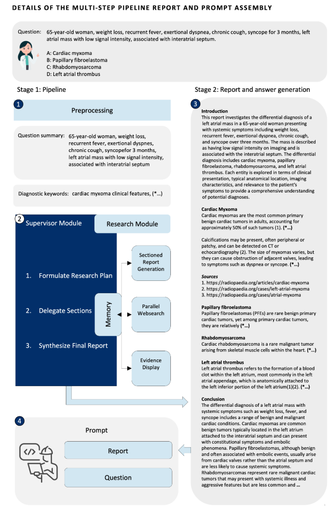
Figure 2 : Representative example of the RaR process for a radiology question answering item. This figure shows the full RaR workflow for a representative question (RSNA -RadioQA-Q53) involving a patient with systemic symptoms and a low signal intensity left atrial mass associated with the interatrial septum. The pipeline begins with keyword -based summarization to guide retrieval , followed by parallel evidence searches for each diagnostic option using Radiopaedia.org. Retrieved content is synthesized into a structured report, including an introduction, citation -backed analyses of all options (cardiac myxoma, papillary fibroelastoma, rhabdomyosarcoma, and left atrial thrombus), and a neutral conclusion. The approach supports interpretable, evidence-grounded radiology question answering.
원문 · CC BY 4.0 · Sebastian Wind, Jeta Sopa, Daniel Truhn, Mahshad Lotfinia, Tri-Thien Nguyen, Keno Bressem, Lisa Adams, Mirabela Rusu, Harald Köstler, Gerhard Wellein, Andreas Maier, Soroosh Tayebi Arasteh · Multi-step retrieval and reasoning improves radiology question answering with large language models · 원문 그림 인용 · 원본 PDF 7쪽에서 그림 영역을 추출했습니다.기준선과 평가 설정
비교 기준은 세 가지입니다. zero-shot 프롬프트는 외부 근거 없이 질문과 선택지만 제시합니다. conventional online RAG는 GPT-3.5-turbo로 키워드를 추출하고, Radiopaedia 문서를 1,000 토큰 조각으로 나눈 뒤 임베딩 유사도로 상위 세 조각을 가져와 답변을 생성하는 단일 단계 방식입니다. 주 벤치마크는 RSNA-RadioQA 80문항과 ExtendedQA 24문항을 합친 104문항의 객관식 RadioRAG 데이터셋입니다. 정확도는 응답에 정답 선택지가 포함되는지를 Mistral Large 판정자가 이진으로 채점해 계산합니다. 모델별 비교는 McNemar 검정과 FDR 보정을 사용하고, 집단 수준 비교는 짝지은 t 검정을 사용합니다.
독립 내부 데이터셋은 독일 전문의 자격 기준에 맞춘 65문항 보드형 질문입니다.
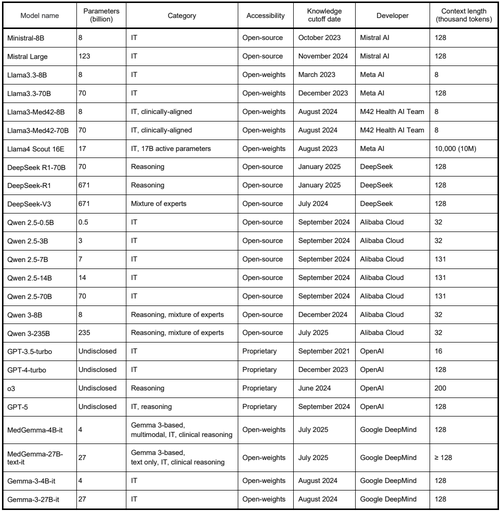
Table 1 : Specifications of the language models evaluated in this study. Summary of the 25 LLMs assessed across zero-shot prompting, conventional online RAG, and the proposed radiology Retrieval and Reasoning (RaR). Listed for each model are parameter count (in billions), training category (e.g., instruction -tuned (IT), reasoni ng-optimized), accessibility, knowledge cutoff date, developer, and context length (in thousand tokens). Evaluations were conducted between July 1 – August 22, 2025. Note: GPT -5 is included as a widely used system -level benchmark rather than a single fixed model architecture, as it dynamically routes queries across underlying models depending on the task.
원문 · CC BY 4.0 · Sebastian Wind, Jeta Sopa, Daniel Truhn, Mahshad Lotfinia, Tri-Thien Nguyen, Keno Bressem, Lisa Adams, Mirabela Rusu, Harald Köstler, Gerhard Wellein, Andreas Maier, Soroosh Tayebi Arasteh · Multi-step retrieval and reasoning improves radiology question answering with large language models · 원문 그림 인용 · 원본 PDF 5쪽에서 그림 영역을 추출했습니다.전체 정확도와 근거 관련성 부분집합의 결과
104문항 RadioRAG 벤치마크에서 25개 LLM의 평균 정확도는 zero-shot 67%에서 RaR 75%로 높아졌고, 이 비교의 P 값은 1.1 × 10⁻⁷입니다. 같은 집단에서 conventional online RAG는 zero-shot 대비 작은 차이를 보였고, RaR은 conventional online RAG보다도 유의하게 높았습니다(P = 1.9 × 10⁻⁶). 검색 근거가 임상적으로 관련된 것으로 판정된 48문항에서 RaR의 정확도는 68%에서 81%로 높아졌고, 이 부분집합의 P 값은 5.1 × 10⁻⁹입니다. 저자들은 이를 RaR의 효과가 정확한 근거가 없을 때만 나타나는 것이 아니라는 해석으로 제시합니다.
독립 내부 데이터셋에서는 zero-shot 81%에서 RaR 88%로 높아졌고(P = 0.002), 이 결과는 주 벤치마크의 전반적 경향을 재현하는 것으로 보고됩니다.
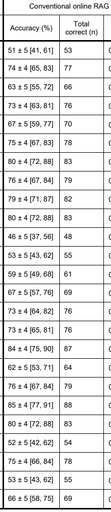
Table 2 : Accuracy of language models across zero-shot prompting, conventional online RAG, and RaR on the RadioRAG dataset. Accuracy is reported in percentage as mean ± standard deviation, with 95% confidence intervals shown in brackets. Results are based on 104 questions, using bootstrapping with 1,000 repetitions and replacement while preserving pairing. P-values were calculated for each model using McNemar’s test on paired outcomes relative to RaR and adjusted for multiple comparisons using the false disc overy rate. A p -value < 0.05 was considered statistically significant. Accuracy is presented alongside total correct answers per method.
원문 · CC BY 4.0 · Sebastian Wind, Jeta Sopa, Daniel Truhn, Mahshad Lotfinia, Tri-Thien Nguyen, Keno Bressem, Lisa Adams, Mirabela Rusu, Harald Köstler, Gerhard Wellein, Andreas Maier, Soroosh Tayebi Arasteh · Multi-step retrieval and reasoning improves radiology question answering with large language models · 원문 그림 인용 · 원본 PDF 8쪽에서 그림 영역을 추출했습니다.모델 규모에 따른 효과의 차이
효과는 모델 규모에 따라 달랐습니다. 소형 모델 집단에서는 기존 온라인 RAG가 zero-shot보다 유의하게 높았고(P = 0.002), RaR은 두 기준선보다 추가로 높았습니다. 개별 모델에서는 Qwen 2.5-7B와 Ministral-8B만 zero-shot 대비 통계적으로 유의한 향상을 보였습니다. 중형 모델 집단에서는 기존 RAG가 유의하지 않았지만 RaR은 zero-shot 대비(P = 0.001)와 기존 RAG 대비(P = 0.002) 모두 유의하게 높았습니다. 대형 모델 집단(DeepSeek-R1, DeepSeek-V3, o3, Qwen 3-235B, GPT-4-turbo, GPT-5)은 zero-shot만으로도 76%에서 86%의 정확도를 보였고, 기존 RAG(P = 0.999)와 RaR(P = 0.147) 모두 의미 있는 개선을 보이지 않았습니다.
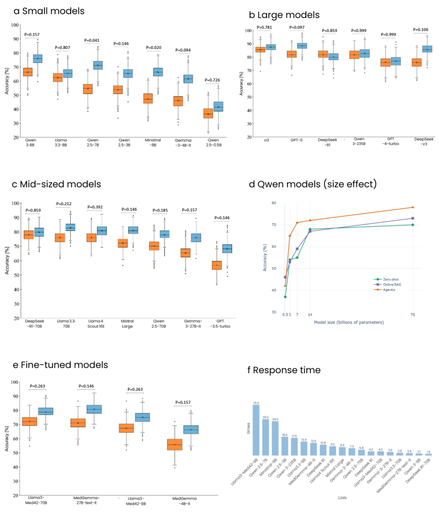
Figure 4 : Comparative accuracy distributions and inference ‑time multipliers for zero ‑shot versus RaR strategies across model groups (RadioRAG dataset) . Accuracy results are shown for (a) small‑scale models, (b) large, (c) mid‑sized models, (d) across Qwen 2.5 family for different parameter sizes: Qwen 2.5 ‑70B, 14B, 7B, 3B and 0.5B, and (e) medically fine -tuned models. (f) Distribution of RaR‑to‑zero‑shot runtime multipliers (× slower/faster) across all models. comparisons were performed on the RadioRAG benchmark dataset (n = 104). Line chart shows mean accuracy versus model size for
원문 · CC BY 4.0 · Sebastian Wind, Jeta Sopa, Daniel Truhn, Mahshad Lotfinia, Tri-Thien Nguyen, Keno Bressem, Lisa Adams, Mirabela Rusu, Harald Köstler, Gerhard Wellein, Andreas Maier, Soroosh Tayebi Arasteh · Multi-step retrieval and reasoning improves radiology question answering with large language models · 원문 그림 인용 · 원본 PDF 14쪽에서 그림 영역을 추출했습니다.임상 fine-tuning 모델과 근거의 역할
임상 fine-tuning 모델 네 개(MedGemma-27B-text-it, MedGemma-4B-it, Llama3-Med42-70B, Llama3-Med42-8B)는 평균적으로 zero-shot 67%에서 RaR 75%로 향상되었고(P = 0.001), 기존 온라인 RAG는 zero-shot 대비 유의하지 않았습니다. 개별 모델의 향상은 각각 통계적으로 유의하지는 않았지만, 집단 수준에서 RaR이 기존 RAG보다도 높았습니다(P = 0.034). 이 결과는 임상 fine-tuning이 외부 검색의 유용성을 없애지 않는다는 해석을 뒷받침하지만, fine-tuning 자체가 같은 규모의 일반 모델보다 항상 정확하지는 않았습니다.
환각과 근거 관련성의 해석
환각은 관련 근거가 제공되었는데도 답이 틀린 경우로 정의되며, 104문항 전체에서 평균 9.4% ± 5.9로 보고되었습니다. 임상적으로 관련된 근거는 104문항 중 48문항(46%)에서만 검색되었습니다. 따라서 근거가 관련 없을 때도 정답이 나오는 경우가 평균 37.4%였으며, 이 현상은 Qwen 3-235B처럼 내부 지식이 강한 모델에서 두드러졌습니다. 반대로 소형 모델은 근거가 없을 때 정답을 맞히기 어려웠습니다. 저자들은 이를 내부 지식과 검색 근거가 함께 작동한다는 신호로 해석하며, 근거가 없는 정답을 검색이 설명한 것으로 단정하지 않습니다.
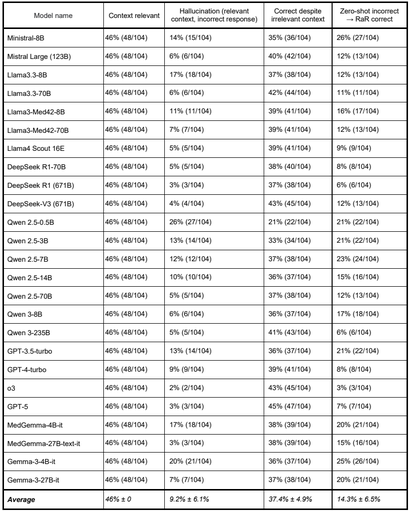
Table 3 : Hallucination and relevance metrics for RaR -powered responses on the RadioRAG dataset (n = 104) . "Context relevant" was evaluated at the dataset level: each question was labeled as having relevant or irrelevant retrieved context, and the same label was applied across all models (48/104 questions were judged to have clinically appropriate context). “Ha llucination” refers to incorrect model answers despite relevant context. “Correct despite irrelevant context” captures correct answers when the retrieved context was not clinically useful. The final column reports the percentage of questions that were incorrect in zero-shot prompting but answered correctly using RaR.
원문 · CC BY 4.0 · Sebastian Wind, Jeta Sopa, Daniel Truhn, Mahshad Lotfinia, Tri-Thien Nguyen, Keno Bressem, Lisa Adams, Mirabela Rusu, Harald Köstler, Gerhard Wellein, Andreas Maier, Soroosh Tayebi Arasteh · Multi-step retrieval and reasoning improves radiology question answering with large language models · 원문 그림 인용 · 원본 PDF 10쪽에서 그림 영역을 추출했습니다.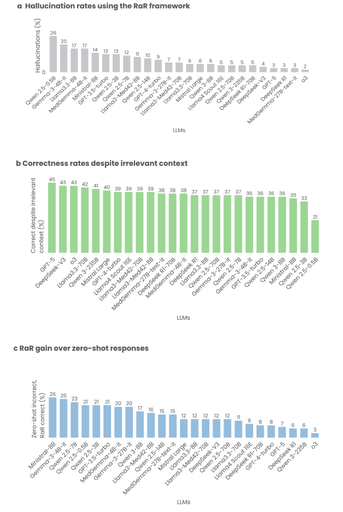
Figure 3 : Factuality assessment of LLM responses on the RadioRAG dataset. Each bar plot shows the proportion of cases per model falling into a specific factuality category, with models ordered by descending percentage. Comparisons were based on the RadioRAG benchmark dataset (n = 104). (a) Hallucinations: Cases in which the provided context was relevant, but the model still generated an incorrect response (context = 1, response = 0). (b) Context irrelevance tolerance: Cases where the model produced a correct response despite the retrieved context being unhelpful or irrelevant (context = 0, response = 1). (c) RaR correction: Instances where the zero ‑shot response was incorrect but RaR strategy successfully produced a correct response (zero‑shot = 0, RaR = 1).
원문 · CC BY 4.0 · Sebastian Wind, Jeta Sopa, Daniel Truhn, Mahshad Lotfinia, Tri-Thien Nguyen, Keno Bressem, Lisa Adams, Mirabela Rusu, Harald Köstler, Gerhard Wellein, Andreas Maier, Soroosh Tayebi Arasteh · Multi-step retrieval and reasoning improves radiology question answering with large language models · 원문 그림 인용 · 원본 PDF 12쪽에서 그림 영역을 추출했습니다.방사선 전문의 대조 실험
RaR이 제공한 검색 근거가 사람의 진단 정확도도 높이는지 확인하려고, 한 명의 전문의(TTN)가 같은 104문항을 근거 없이 풀었을 때 정확도는 51%였습니다. 같은 전문의가 RaR이 검색한 근거를 함께 보고 풀었을 때는 68%로 높아졌고, 이 차이는 유의했습니다(P = 0.010). 이는 검색이 판단에 쓸 수 있는 정보를 제공한다는 관찰이지만, 한 명의 전문의 결과이므로 일반적인 임상 효과로 확대하지 않습니다. 내부 데이터셋에서는 같은 설정의 향상이 유의하지 않았습니다(74%에서 85%, P = 0.065).
지연 시간과 계산 비용
RaR은 질문당 응답 시간을 크게 늘렸습니다. 전체 평균은 zero-shot 54 ± 28초에서 RaR 324 ± 270초로 증가했고, 상대 증가율은 6.71배입니다. 증가율은 모델 집단마다 달랐으며, 소형 모델 집단은 평균 6.04배, 3~4B 미니 모델은 평균 11.10배였습니다. 대형 모델 집단은 평균 13.27배로 가장 큰 절대 지연을 보였지만 RaR의 정확도 향상은 거의 없었습니다. 반면 DeepSeek MoE 집단은 평균 4.19배로 비교적 효율적이었습니다. 이 수치는 측정 환경에서 얻은 상대적 지표로, 하드웨어와 부하가 달라지면 절대값은 달라질 수 있습니다.
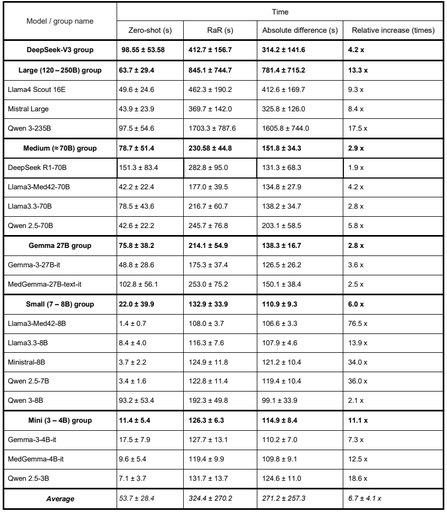
Table 4 : Response time comparison between zero-shot and RaR strategies on the RadioRAG dataset. Average per-question response times (n = 104) are reported in seconds as mean ± standard deviation for both individual models and aggregated model groups. On the RadioRAG dataset, a fixed overhead of 10,554.6 seconds per model, corresponding to context gen eration, was evenly distributed across all questions, contributing approximately 101.5 seconds per question. For time analysis, models were grouped based on par ameter scale and architectural characteristics into six categories: the DeepSeek mixture of experts (MoE) group, the large model group (120 –250B), the medium-scale group (~70B), the Gemma-27B group, the small model group (7–8B), and the mini model group (3– 4B). “Absolute difference” denotes the increase in average response time per question introduced by the RaR method, and “Relative increase” refers to the ratio of mean RaR time to mean zero -shot time per group. Final statistics are computed at the group level.
원문 · CC BY 4.0 · Sebastian Wind, Jeta Sopa, Daniel Truhn, Mahshad Lotfinia, Tri-Thien Nguyen, Keno Bressem, Lisa Adams, Mirabela Rusu, Harald Köstler, Gerhard Wellein, Andreas Maier, Soroosh Tayebi Arasteh · Multi-step retrieval and reasoning improves radiology question answering with large language models · 원문 그림 인용 · 원본 PDF 17쪽에서 그림 영역을 추출했습니다.적용 범위와 한계
이 연구의 근거는 텍스트 기반 객관식 질의응답에 한정되며, 이미지 입력과 실제 임상 워크플로에서의 평가는 포함하지 않았습니다. 주 벤치마크는 104문항이고 독립 데이터셋은 65문항이어서 통계적 검정력이 제한됩니다. 검색 소스는 Radiopaedia 하나에 의존합니다. 지연 시간은 응답 시간이 길어 긴급 진단 상황에는 적용하기 어려울 수 있습니다. 또한 모델 간 효과 차이의 원인은 아키텍처, 지시 튜닝, pre-training 데이터, 프롬프트 설계 등 여러 요인이 섞여 있어 하나의 원인으로 확정되지 않습니다. 저자들은 GPT-4o-mini의 오케스트레이션 역할과 o3 기반 distractor 생성이 자기 선호 편향을 만들 가능성을 검토했지만, 완전한 모델 계열 독립성은 향후 연구의 과제로 남겼습니다.
논문 정보
- 저자
- Sebastian Wind, Jeta Sopa, Daniel Truhn, Mahshad Lotfinia, Tri-Thien Nguyen, Keno Bressem, Lisa Adams, Mirabela Rusu, Harald Köstler, Gerhard Wellein, Andreas Maier, Soroosh Tayebi Arasteh
- 학회·저널
- arXiv · 프리프린트
- 최초 공개일
- 2025년 8월 1일
- 등록일
- 2026년 11월 6일
- 수정일
- 2025년 12월 30일
- 버전
- v4
- arXiv
- 2508.00743
- DOI
- 10.1038/s41746-025-02250-5
- 분류
- cs.CL · cs.AI · cs.LG
- 원문 이용 조건
- CC BY 4.0
- 제공 범위
- 논문 정보, 해설, 허용된 원문 그림
AI 해설은 논문 원문과 별개의 설명이며 오류가 있을 수 있습니다. 원문과 그림은 각 출처의 이용 조건과 따로 표시된 권리를 따릅니다.
초록
Clinical decision-making in radiology increasingly benefits from artificial intelligence (AI), particularly through large language models (LLMs). However, traditional retrieval-augmented generation (RAG) systems for radiology question answering (QA) typically rely on single-step retrieval, limiting their ability to handle complex clinical reasoning tasks. Here we propose radiology Retrieval and Reasoning (RaR), a multi-step retrieval and reasoning framework designed to improve diagnostic accuracy, factual consistency, and clinical reliability of LLMs in radiology question answering. We evaluated 25 LLMs spanning diverse architectures, parameter scales (0.5B to >670B), and training paradigms (general-purpose, reasoning-optimized, clinically fine-tuned), using 104 expert-curated radiology questions from previously established RSNA-RadioQA and ExtendedQA datasets. To assess generalizability, we additionally tested on an unseen internal dataset of 65 real-world radiology board examination questions. RaR significantly improved mean diagnostic accuracy over zero-shot prompting and conventional online RAG. The greatest gains occurred in small-scale models, while very large models (>200B parameters) demonstrated minimal changes (<2% improvement). Additionally, RaR retrieval reduced hallucinations (mean 9.4%) and retrieved clinically relevant context in 46% of cases, substantially aiding factual grounding. Even clinically fine-tuned models showed gains from RaR (e.g., MedGemma-27B), indicating that retrieval remains beneficial despite embedded domain knowledge. These results highlight the potential of RaR to enhance factuality and diagnostic accuracy in radiology QA, warranting future studies to validate their clinical utility. All datasets, code, and the full RaR framework are publicly available to support open research and clinical translation.
원문 인용
Sebastian Wind, Jeta Sopa, Daniel Truhn, Mahshad Lotfinia, Tri-Thien Nguyen, Keno Bressem, Lisa Adams, Mirabela Rusu, Harald Köstler, Gerhard Wellein, Andreas Maier, Soroosh Tayebi Arasteh (2025). Multi-step retrieval and reasoning improves radiology question answering with large language models. arXiv:2508.00743v4. https://doi.org/10.1038/s41746-025-02250-5
BibTeX
@article{wind2025multi,
  title = {{Multi-step retrieval and reasoning improves radiology question answering with large language models}},
  author = {Sebastian Wind and Jeta Sopa and Daniel Truhn and Mahshad Lotfinia and Tri-Thien Nguyen and Keno Bressem and Lisa Adams and Mirabela Rusu and Harald Köstler and Gerhard Wellein and Andreas Maier and Soroosh Tayebi Arasteh},
  year = {2025},
  eprint = {2508.00743},
  archivePrefix = {arXiv},
  doi = {10.1038/s41746-025-02250-5},
  url = {https://arxiv.org/abs/2508.00743v4}
}