논문 해설
A Survey on Arabic Named Entity Recognition: Past, Recent Advances, and Future Trends
아랍어 개체명 인식에 관한 서베이: 과거, 최근 발전, 그리고 향후 동향
- 연구 문제 아랍어는 대문자 단서가 없고 교착적 형태와 단모음 생략으로 인해 NER이 어려우며, 이 설문은 그 발전 과정을 정리합니다.
- 연구 방법 규칙 기반, 기계학습, 딥러닝, pre-training 언어모델의 네 패러다임으로 아랍어 NER 방법과 데이터셋을 분류해 검토합니다.
- 주요 결과 ANERCorp에서 JABER는 선형 디코더 설정에서 84.20 F1을, CANERCorpus에서 BERT-BiGRU-CRF는 94.76 F1을 보고합니다.
아랍어 개체명 인식의 어려움
아랍어 텍스트가 인터넷에서 빠르게 늘면서 문서에서 인물, 장소, 조직 같은 개체를 자동으로 찾아내는 개체명 인식(NER)의 필요성이 커지고 있습니다. 영어 NER에서는 고유명사가 대문자로 시작하는 단서를 쓸 수 있지만, 아랍어에는 이런 대문자 표지가 없어 사전 조회만으로는 개체를 찾기 어렵습니다. 아랍어는 접두사, 어간, 접미사가 결합하는 교착적 형태 구조를 가지며, 전치사나 접속사가 개체 표기에 붙는 경우도 많습니다. 또한 단모음 표기가 대부분 생략되어 같은 철자가 문맥에 따라 다른 뜻을 가지는 모호성도 있습니다. 이 논문은 이러한 특성을 고려해 아랍어 NER의 발전 과정을 정리하는 설문입니다.
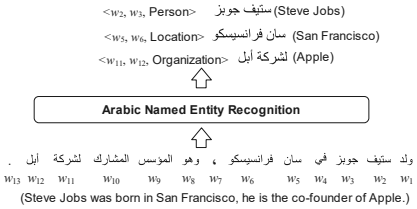
Fig. 2 : An illustration of the Arabic NER task.
원문 · CC BY 4.0 · Xiaoye Qu, Yingjie Gu, Qingrong Xia, Zechang Li, Zhefeng Wang, Baoxing Huai · A Survey on Arabic Named Entity Recognition: Past, Recent Advances, and Future Trends · 원문 그림 인용 · 원본 PDF 2쪽에서 그림 영역을 추출했습니다.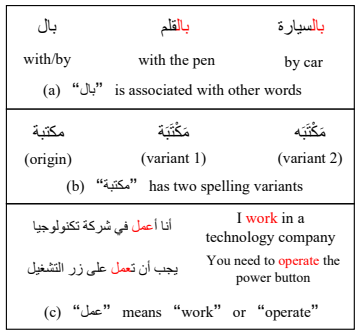
Fig. 3 : Three examples of the challenges of Arabic NER.
원문 · CC BY 4.0 · Xiaoye Qu, Yingjie Gu, Qingrong Xia, Zechang Li, Zhefeng Wang, Baoxing Huai · A Survey on Arabic Named Entity Recognition: Past, Recent Advances, and Future Trends · 원문 그림 인용 · 원본 PDF 3쪽에서 그림 영역을 추출했습니다.네 가지 패러다임으로 본 연구 흐름
이 설문은 아랍어 NER 방법을 규칙 기반, 기계학습, 딥러닝, pre-training 언어모델의 네 가지 패러다임으로 나눕니다. 규칙 기반 방법은 전문가가 만든 문법 규칙과 사전을 사용하며, 기계학습 방법은 대량의 주석 데이터로 개체 태깅 결정을 학습합니다. 딥러닝 방법은 입력 표현, 문맥 인코더, 레이블 디코더의 세 관점에서 정리되며, BiLSTM 문맥 인코더와 CRF 디코더를 결합한 구조가 자주 쓰입니다. pre-training 언어모델 단계에서는 AraBERT, AraELECTRA, MARBERT 같은 아랍어 모델이 다루어집니다. 저자들은 데이터셋과 평가 방식도 함께 정리합니다.
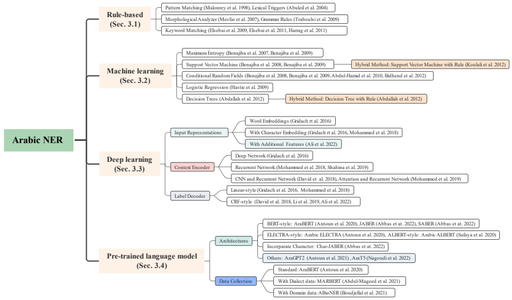
Fig. 4 : The taxonomy of Arabic NER methods based on different methods. The rule-based method and machine learning method will be introduced in Sections 3.1 and 3.2. The methods of deep learning and pre-trained language model for Arabic NER will be described in Sections 3.3 and 3.4. In deep learning methods, we present the development of Arabic NER from three perspectives, including input representations, context encoder, and label decoder. In the pre-trained language model, we illustrate the Arabic NER methods according to their architectures and data collection scope.
원문 · CC BY 4.0 · Xiaoye Qu, Yingjie Gu, Qingrong Xia, Zechang Li, Zhefeng Wang, Baoxing Huai · A Survey on Arabic Named Entity Recognition: Past, Recent Advances, and Future Trends · 원문 그림 인용 · 원본 PDF 5쪽에서 그림 영역을 추출했습니다.데이터셋과 평가 조건
ANERcorp는 316개 기사로 구성된 아랍어 NER 데이터셋이며, 2020년 CAMeL Lab이 원 저자와 협의해 정한 분할을 표준 평가 분할로 제안합니다. 이 데이터셋은 여러 연구에서 서로 다른 분할로 나뉘어 있었기 때문에 직접 비교가 어려웠습니다. AQMAR는 아랍어 위키피디아 기반의 소규모 데이터셋이며 도메인별 개체 범주를 포함합니다. CANERCorpus는 고전 아랍어를 대상으로 이슬람 주제의 개체 범주를 주석한 데이터셋입니다. 평가 지표로는 경계와 유형이 모두 맞아야 하는 엄격 일치 지표와 경계 겹침을 허용하는 완화 일치 지표가 설명되며, 이 설문의 주요 비교는 F1 점수 기준으로 정리됩니다.
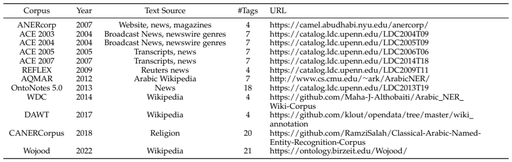
TABLE 2 : List of annotated datasets for Arabic NER. “#Tags” refers to the number of entity types.
원문 · CC BY 4.0 · Xiaoye Qu, Yingjie Gu, Qingrong Xia, Zechang Li, Zhefeng Wang, Baoxing Huai · A Survey on Arabic Named Entity Recognition: Past, Recent Advances, and Future Trends · 원문 그림 인용 · 원본 PDF 4쪽에서 그림 영역을 추출했습니다.데이터셋별 주요 결과 비교
ANERCorp 결과 표에서 JABER는 선형 디코더를 사용할 때 84.20의 F1 점수를 보고합니다. 이 값은 해당 연구가 사용한 설정에서의 결과이며, 데이터 분할이 서로 다른 다른 연구의 점수와 동일한 조건에서 비교된 값으로 볼 수 없습니다. CANERCorpus에서는 BERT가 94.45, BERT-CRF가 94.68, BERT-BiGRU-CRF가 94.76의 F1 점수를 보고합니다. 다중 작업 학습을 적용한 Wojood 실험에서는 전체 F1 88.40이 보고됩니다. 이 결과들은 각각 다른 데이터셋과 모델 구성에서 얻은 것입니다.
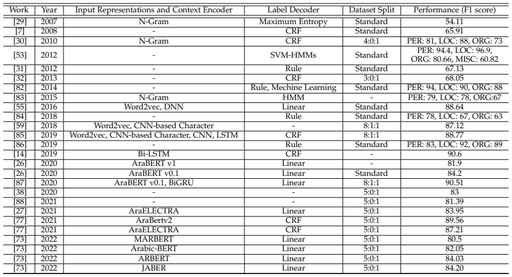
TABLE 3 : Comparison of Arabic NER systems on ANERCorp. The results are reported on four kinds of entities, including person, location, organization and miscellaneous. “Standard” in the Dataset Split means the methods use the official dataset split instead of splitting the dataset by themselves. As traditional rule-based and machine learning methods do not have a specific context encoder, we merge columns “Input representations” and “Context encoder”. “-” symbols in the table indicate the corresponding item is not described in the original paper.
원문 · CC BY 4.0 · Xiaoye Qu, Yingjie Gu, Qingrong Xia, Zechang Li, Zhefeng Wang, Baoxing Huai · A Survey on Arabic Named Entity Recognition: Past, Recent Advances, and Future Trends · 원문 그림 인용 · 원본 PDF 10쪽에서 그림 영역을 추출했습니다.비교의 한계와 방언 데이터의 문제
저자들은 여러 연구가 데이터 분할 방식을 달리해 결과를 직접 비교하기 어렵다고 지적합니다. 그래서 ANERCorp와 AQMAR의 결과를 정리하는 것이 비교의 공정성을 높이는 시도로 제시됩니다. AraBERT는 주로 현대 표준 아랍어 코퍼스로 학습되어, 트위터 기반의 TWEETS 데이터셋에서 AQMAR나 NEWS 데이터셋보다 낮은 성능을 보였습니다. 이는 방언 데이터에 대한 적응이 필요함을 보여 주는 사례이며, 같은 모델이 다른 방언이나 과제 전반에서 같은 수준을 보인다는 결론은 아닙니다.
논문 정보
- 저자
- Xiaoye Qu, Yingjie Gu, Qingrong Xia, Zechang Li, Zhefeng Wang, Baoxing Huai
- 학회·저널
- arXiv · 프리프린트
- 최초 공개일
- 2023년 2월 7일
- 등록일
- 2026년 11월 6일
- 수정일
- 2023년 8월 8일
- 버전
- v3
- arXiv
- 2302.03512
- 분류
- cs.CL
- 원문 이용 조건
- CC BY 4.0
- 제공 범위
- 논문 정보, 해설, 허용된 원문 그림
AI 해설은 논문 원문과 별개의 설명이며 오류가 있을 수 있습니다. 원문과 그림은 각 출처의 이용 조건과 따로 표시된 권리를 따릅니다.
초록
As more and more Arabic texts emerged on the Internet, extracting important information from these Arabic texts is especially useful. As a fundamental technology, Named entity recognition (NER) serves as the core component in information extraction technology, while also playing a critical role in many other Natural Language Processing (NLP) systems, such as question answering and knowledge graph building. In this paper, we provide a comprehensive review of the development of Arabic NER, especially the recent advances in deep learning and pre-trained language model. Specifically, we first introduce the background of Arabic NER, including the characteristics of Arabic and existing resources for Arabic NER. Then, we systematically review the development of Arabic NER methods. Traditional Arabic NER systems focus on feature engineering and designing domain-specific rules. In recent years, deep learning methods achieve significant progress by representing texts via continuous vector representations. With the growth of pre-trained language model, Arabic NER yields better performance. Finally, we conclude the method gap between Arabic NER and NER methods from other languages, which helps outline future directions for Arabic NER.
원문 인용
Xiaoye Qu, Yingjie Gu, Qingrong Xia, Zechang Li, Zhefeng Wang, Baoxing Huai (2023). A Survey on Arabic Named Entity Recognition: Past, Recent Advances, and Future Trends. arXiv:2302.03512v3. https://arxiv.org/abs/2302.03512v3
BibTeX
@misc{qu2023survey,
  title = {{A Survey on Arabic Named Entity Recognition: Past, Recent Advances, and Future Trends}},
  author = {Xiaoye Qu and Yingjie Gu and Qingrong Xia and Zechang Li and Zhefeng Wang and Baoxing Huai},
  year = {2023},
  eprint = {2302.03512},
  archivePrefix = {arXiv},
  url = {https://arxiv.org/abs/2302.03512v3}
}