논문 해설
DiffPO: Diffusion-styled Preference Optimization for Efficient Inference-Time Alignment of Large Language Models
DiffPO: 대규모 언어 모델의 효율적인 추론 시점 정렬을 위한 확산 방식 선호 최적화
- 연구 문제 대규모 언어 모델의 추론 시점 정렬은 파라미터를 바꾸지 않아 효율적이지만, 정책별 가치 함수에 의존하고 토큰 단위 생성으로 지연이 크다는 한계가 있습니다.
- 연구 방법 DIFFPO는 불정렬 문장을 문장 단위 denoising 과정으로 정렬하는 plug-and-play 모듈이며, 병렬 디코딩으로 문장 전이를 예측합니다.
- 주요 결과 Llama-3-SFT (8B) 설정에서 DIFFPO-9B를 적용하면 MT-bench GPT-4 점수가 6.21에서 7.45로 올라갑니다. 이는 해당 설정에서 관찰된 결과입니다.
정렬 추론의 지연과 정책 종속성 문제
대규모 언어 모델을 사람의 선호에 맞추는 방법으로 RLHF와 DPO 같은 훈련 기반 접근이 널리 쓰입니다. 그러나 이 방식들은 정책마다 최적화를 다시 수행해야 하므로 학습 자원 부담이 큽니다. 추론 시점 정렬은 모델 파라미터를 바꾸지 않고 출력 분포를 직접 조정하여 이 부담을 피하지만, 정책별 가치 함수에 의존하여 확장성이 제한되고 토큰 단위 생성으로 인해 추론 지연이 크다는 문제가 남습니다. 이 논문은 이 두 가지 한계를 함께 줄이는 것을 목표로 합니다.
문장 단위 denoising으로서의 DIFFPO
DIFFPO는 정렬을 토큰이 아니라 문장 전체 단위의 denoising 과정으로 재구성합니다. 기반 모델이 만든 불정렬 문장 y(0)을 여러 단계를 거쳐 정렬 문장 y(T)로 바꾸며, 이 전이를 병렬 디코딩으로 한 번에 예측합니다. 학습 시에는 기반 모델들의 생성 문장을 보상 모델 ArmoRM으로 점수화하여 가장 높은 응답을 y(T)로, 나머지를 y(0:T-1)로 구성한 궤적을 사용합니다. 목적 함수는 중간 생성을 정렬 생성으로 대응시키는 Consistency Loss와 생성 품질을 지키는 AR Loss의 가중 합입니다. 추론 시에는 학습된 DIFFPO를 기반 모델의 vanilla 생성 위에 적용하므로 기반 모델의 파라미터에는 접근하지 않습니다.
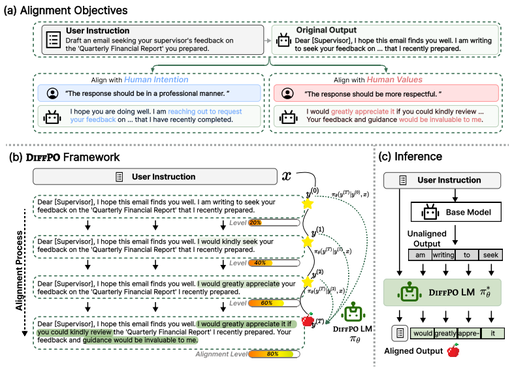
Figure 2 : Illustration of the DIFFPO Framework. (a) The objective of LLM alignment is to adjust the output of LLMs to reflect human values and intentions. In this process, preferences are considered at the sentence level, focusing on aspects such as the style and format of the complete output. (b) We propose Diffusion-style Preference Optimization (DIFFPO), which reconceptualizes the alignment process as a sentence-level denoising process, where the goal is to transform an unaligned sentence y(0) into an aligned sentence y(T ) step by step. (c) Designed as a plug-and-play module, DIFFPO can be directly integrated with the base model output and yield better alignment.
원문 · CC BY 4.0 · Ruizhe Chen, Wenhao Chai, Zhifei Yang, Xiaotian Zhang, Joey Tianyi Zhou, Tony Quek, Soujanya Poria, Zuozhu Liu · DiffPO: Diffusion-styled Preference Optimization for Efficient Inference-Time Alignment of Large Language Models · 원문 그림 인용 · 원본 PDF 2쪽에서 그림 영역을 추출했습니다.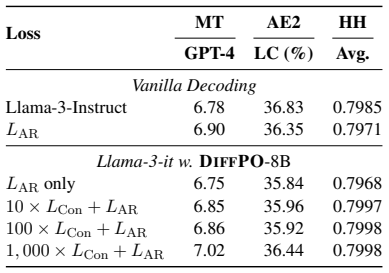
Table 5 : Loss and Hyperparameter Ablation. We re- port the results of vanilla decoding from the base model and the optimized DIFFPO model. The results indicate that applying DIFFPO to the base model yields outper- forming performance than single models, demonstrating the effectiveness of DIFFPO strategy.
원문 · CC BY 4.0 · Ruizhe Chen, Wenhao Chai, Zhifei Yang, Xiaotian Zhang, Joey Tianyi Zhou, Tony Quek, Soujanya Poria, Zuozhu Liu · DiffPO: Diffusion-styled Preference Optimization for Efficient Inference-Time Alignment of Large Language Models · 원문 그림 인용 · 원본 PDF 8쪽에서 그림 영역을 추출했습니다.기준선과 비교한 검증 설정
DIFFPO는 MT-Bench, AlpacaEval 2, HH-RLHF에서 평가되었습니다. MT-Bench는 GPT-4를 판정 모델로 쓰는 대화 능력 벤치마크이고, AlpacaEval 2는 원시 승률 WR과 길이 보정 승률 LC를 GPT-4 기준 모델과 비교하여 보고합니다. HH-RLHF는 ArmoRM으로 도움됨과 무해함 점수를 측정합니다. 비교 기준은 훈련 기반의 DPO와 SimPO, 추론 시점의 BPO, ARGS, Best-of-N 샘플링, Aligner, MetaAligner입니다. 주요 실험은 Llama-3-SFT와 Llama-3-Instruct 등 8B 계열에서 이루어졌으며, 부록에서는 Qwen2.5 계열로 추가 비교를 수행했습니다.
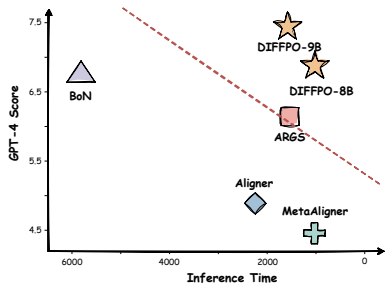
Figure 1 : Comparison with Inference-Time Methods. Points closer to the top-right indicate a superior trade- off between performance and inference time.
원문 · CC BY 4.0 · Ruizhe Chen, Wenhao Chai, Zhifei Yang, Xiaotian Zhang, Joey Tianyi Zhou, Tony Quek, Soujanya Poria, Zuozhu Liu · DiffPO: Diffusion-styled Preference Optimization for Efficient Inference-Time Alignment of Large Language Models · 원문 그림 인용 · 원본 PDF 1쪽에서 그림 영역을 추출했습니다.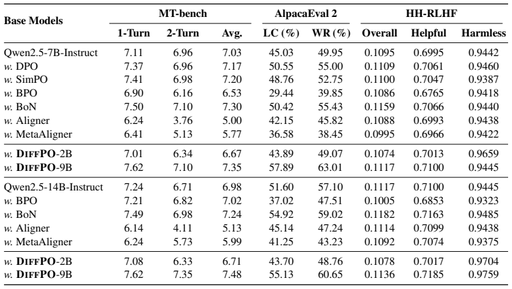
Table 6 : Comparison results of DIFFPO models. The experiments are conducted on base models of Qwen-2.5-7B and 14B. It shows that DIFFPO consistently achieves superior performance across various base models.
원문 · CC BY 4.0 · Ruizhe Chen, Wenhao Chai, Zhifei Yang, Xiaotian Zhang, Joey Tianyi Zhou, Tony Quek, Soujanya Poria, Zuozhu Liu · DiffPO: Diffusion-styled Preference Optimization for Efficient Inference-Time Alignment of Large Language Models · 원문 그림 인용 · 원본 PDF 14쪽에서 그림 영역을 추출했습니다.주요 결과와 적용 범위
Llama-3-SFT (8B) 설정에서 DIFFPO-9B를 적용한 모델의 MT-bench GPT-4 점수는 7.45이며, 기반 모델의 6.21보다 높습니다. 같은 설정의 AlpacaEval 2 WR은 49.72이고 HH-RLHF의 도움됨과 무해함 점수는 각각 0.71과 0.98로 보고됩니다. 이 결과는 Llama-3 계열의 특정 설정에서 얻은 값이며, 다른 백본이나 과제로 일반화된 결과로 읽지 않습니다. 추론 지연 측면에서 저자들은 DIFFPO가 성능과 시간의 절충에서 유리하다고 보고합니다. 하이브리드 디코딩에서는 블록 크기를 조절하여 디코딩 시간을 줄이는 결과가 제시됩니다.
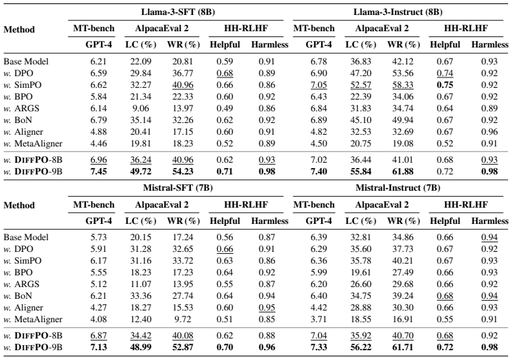
Table 1 : Comparison results with baseline methods. DIFFPO achieves the superior alignment performance across all benchmarks, outperforming the training-based baselines (i.e., SimPO and DPO) in various settings. Notably, DIFFPO requires only a single training session and is applicable to multiple base models. The best result is highlighted in bold, while the second-best result is highlighted with underline.
원문 · CC BY 4.0 · Ruizhe Chen, Wenhao Chai, Zhifei Yang, Xiaotian Zhang, Joey Tianyi Zhou, Tony Quek, Soujanya Poria, Zuozhu Liu · DiffPO: Diffusion-styled Preference Optimization for Efficient Inference-Time Alignment of Large Language Models · 원문 그림 인용 · 원본 PDF 6쪽에서 그림 영역을 추출했습니다.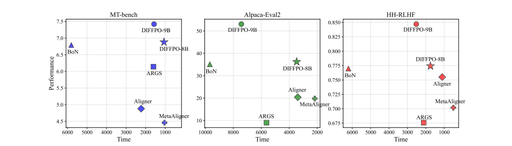
Figure 3 : Comparison of Inference-Time Efficiency.We compare DIFFPO with existing inference-time alignment techniques, evaluating both alignment performance and execution time. Points located closer to the top-right corner indicate a better trade-off. When considering both aspects, DIFFPO demonstrates a surpassing performance- efficiency trade-off on all three datasets.
원문 · CC BY 4.0 · Ruizhe Chen, Wenhao Chai, Zhifei Yang, Xiaotian Zhang, Joey Tianyi Zhou, Tony Quek, Soujanya Poria, Zuozhu Liu · DiffPO: Diffusion-styled Preference Optimization for Efficient Inference-Time Alignment of Large Language Models · 원문 그림 인용 · 원본 PDF 8쪽에서 그림 영역을 추출했습니다.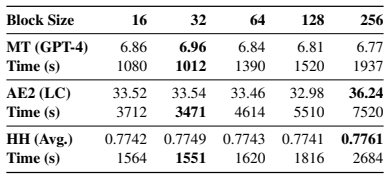
Table 3 : Performance Under Hybrid Decoding. We segment the vanilla generation into blocks of varying sizes and sequentially apply DIFFPO-8B to each block. This approach allows DIFFPO decoding to be parallel within blocks and auto-regressive between blocks. Hy- brid decoding significantly reduces the decoding time, indicating a feasible trade-off for performance.
원문 · CC BY 4.0 · Ruizhe Chen, Wenhao Chai, Zhifei Yang, Xiaotian Zhang, Joey Tianyi Zhou, Tony Quek, Soujanya Poria, Zuozhu Liu · DiffPO: Diffusion-styled Preference Optimization for Efficient Inference-Time Alignment of Large Language Models · 원문 그림 인용 · 원본 PDF 8쪽에서 그림 영역을 추출했습니다.추가 모델의 비용과 이론적 분석의 공백
저자들은 DIFFPO가 정렬을 위한 추가 모델을 사용하므로 여전히 추론 지연을 추가로 도입한다고 밝힙니다. 또한 DIFFPO의 성능이 모델 크기에 따라 증가하는 경향이 있어 배포 비용 측면의 부담이 될 수 있다고 적습니다. 이론적 분석은 아직 충분하지 않으며, 저자들은 그 효과를 완전히 설명하려면 더 엄밀한 이론 분석이 필요하다고 봅니다. 이 한계는 주로 비용과 이론에 관한 것이며, 실험 설정 자체의 전면적 부재를 뜻하지 않습니다.
논문 정보
- 저자
- Ruizhe Chen, Wenhao Chai, Zhifei Yang, Xiaotian Zhang, Joey Tianyi Zhou, Tony Quek, Soujanya Poria, Zuozhu Liu
- 학회·저널
- arXiv · 프리프린트
- 최초 공개일
- 2025년 3월 6일
- 등록일
- 2026년 11월 5일
- 수정일
- 2025년 5월 25일
- 버전
- v3
- arXiv
- 2503.04240
- 분류
- cs.CL
- 원문 이용 조건
- CC BY 4.0
- 제공 범위
- 논문 정보, 해설, 허용된 원문 그림
AI 해설은 논문 원문과 별개의 설명이며 오류가 있을 수 있습니다. 원문과 그림은 각 출처의 이용 조건과 따로 표시된 권리를 따릅니다.
초록
Inference-time alignment provides an efficient alternative for aligning LLMs with humans. However, these approaches still face challenges, such as limited scalability due to policy-specific value functions and latency during the inference phase. In this paper, we propose a novel approach, Diffusion-styled Preference Optimization (\model), which provides an efficient and policy-agnostic solution for aligning LLMs with humans. By directly performing alignment at sentence level, \model~avoids the time latency associated with token-level generation. Designed as a plug-and-play module, \model~can be seamlessly integrated with various base models to enhance their alignment. Extensive experiments on AlpacaEval 2, MT-bench, and HH-RLHF demonstrate that \model~achieves superior alignment performance across various settings, achieving a favorable trade-off between alignment quality and inference-time latency. Furthermore, \model~demonstrates model-agnostic scalability, significantly improving the performance of large models such as Llama-3-70B.
원문 인용
Ruizhe Chen, Wenhao Chai, Zhifei Yang, Xiaotian Zhang, Joey Tianyi Zhou, Tony Quek, Soujanya Poria, Zuozhu Liu (2025). DiffPO: Diffusion-styled Preference Optimization for Efficient Inference-Time Alignment of Large Language Models. arXiv:2503.04240v3. https://arxiv.org/abs/2503.04240v3
BibTeX
@misc{chen2025diffpo,
  title = {{DiffPO: Diffusion-styled Preference Optimization for Efficient Inference-Time Alignment of Large Language Models}},
  author = {Ruizhe Chen and Wenhao Chai and Zhifei Yang and Xiaotian Zhang and Joey Tianyi Zhou and Tony Quek and Soujanya Poria and Zuozhu Liu},
  year = {2025},
  eprint = {2503.04240},
  archivePrefix = {arXiv},
  url = {https://arxiv.org/abs/2503.04240v3}
}