논문 해설
PyTDC: A multimodal machine learning training, evaluation, and inference platform for biomedical foundation models
PyTDC: 생의학 파운데이션 모델을 위한 다중 모달 기계 학습 훈련, 평가 및 추론 플랫폼
- 연구 문제 PyTDC는 다중 모달 생의학 데이터와 치료 과제를 위한 종단간 학습·평가·추론 플랫폼을 제시하며, 단일세포 약물 표적 지명을 사례로 기존 방법의 한계를 보고합니다.
- 연구 방법 PyTDC는 API-first 아키텍처로 이질적 데이터 소스를 통합하고, 모델 서버로 가중치 접근과 표준화된 추론 엔드포인트를 제공합니다.
- 주요 결과 사례 연구에서 PINNACLE은 맥락 특이 지표에서 GAT보다 우수하지만, 저자들은 기존 방법이 미관찰 세포 유형에 일반화하지 못한다고 보고합니다.
연구 문제와 기존 평가의 한계
PyTDC는 다중 모달 생의학 데이터와 다양한 치료 과제를 다루는 학습, 평가, 추론의 종단간 인프라가 부족하다는 문제에서 출발합니다. 저자들은 기존 벤치마크가 세포 유형 군집화나 주석 같은 기초 생물학 과제에 치우쳐 있어 질병 기전이나 치료 표적 발굴 같은 치료적 관련성을 충분히 측정하지 못한다고 설명합니다. 이 논문은 이러한 공백을 메우는 플랫폼을 제시하고, 그 적용 사례로 단일세포 약물 표적 지명(tdc ml.scDTN) 과제를 다룹니다. 이 사례에서 저자들은 최신 그래프 표현 학습 방법과 도메인 특화 방법이 낮은 성능을 보인다고 보고합니다.
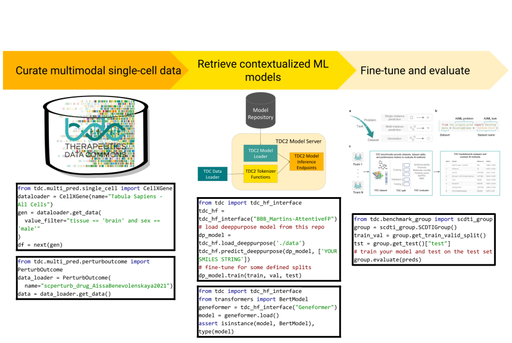
Figure 1 . We present PyTDC, a machine-learning platform providing streamlined training, evaluation, and inference software for single-cell biological foundation models to accelerate research in transfer learning method development in therapeutics (Theodoris, 2024). PyTDC introduces an API-first (Beaulieu et al., 2022) architecture (sections 3.1 and B) that unifies heterogeneous, continuously updated data sources. The platform introduces a model server, which provides unified access to model weights across distributed repositories and standardized inference endpoints (sections 3.2, B.3.3, and C). The model server accelerates research workflows (Kahn et al., 2022) by exposing state-of-the-art, research-ready models and training setups for biomedical representation learning models across modalities. Building upon Therapeutic Data Commons (Huang et al., 2021; 2022; Velez-Arce et al., 2024), we present single-cell therapeutics tasks, datasets, and benchmarks for model development and evaluation (sections 4 and A).
원문 · CC BY 4.0 · Alejandro Velez-Arce, Jesus Caraballo, Marinka Zitnik · PyTDC: A multimodal machine learning training, evaluation, and inference platform for biomedical foundation models · 원문 그림 인용 · 원본 PDF 4쪽에서 그림 영역을 추출했습니다.API-first 아키텍처와 모델 서버
PyTDC는 이질적이고 지속적으로 갱신되는 데이터 소스를 API-first 아키텍처로 통합합니다. 이 구조는 모델-뷰-컨트롤러 설계 패턴으로 구현되어 데이터 검색을 다중 모달 데이터 뷰로 제공합니다. 모델 서버는 Hugging Face Model Hub와 TDC 저장소에 있는 모델 가중치에 통합 접근을 제공하고, 표준화된 추론 엔드포인트를 통해 임베딩을 추출합니다. 원문은 이 흐름에서 한 워크플로가 수백에서 수천 줄의 코드로 구현될 수 있는 것을 30줄 미만으로 줄인다고 설명합니다. 본 해설에서 이 절감은 원문의 예시 워크플로에 한정된 주장으로 읽어야 합니다.
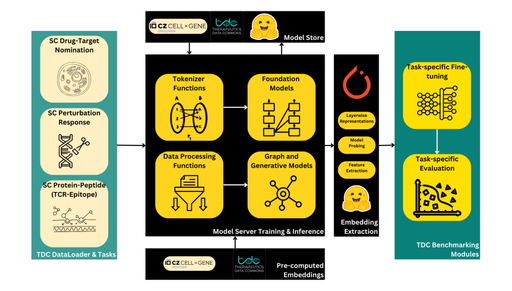
Figure 2 . AI inferencing and model evaluation components.The PyTDC model server (sections 3.2 and C) streamlines retrieval, inferencing, and training setup for an array of context-aware biological foundation models and models spanning multiple modalities. A model store retrieval API provides unified access to model weights stored in the Hugging Face Model Hub (https://huggingface.co/apliko), Chan-Zuckerberg CELLxGENE Census fine-tuned models, and TDC (Huang et al., 2021; 2022; Velez-Arce et al., 2024) storage. The model server also provides access to model classes, tokenizer functions, and inference endpoints supporting PyTorch (Paszke et al., 2019) and Hugging Face Transformers (Wolf et al., 2020). Extracted embeddings, from either model server inference or pre-computed embedding storage, are ready for downstream use by task-specific benchmarking modules.
원문 · CC BY 4.0 · Alejandro Velez-Arce, Jesus Caraballo, Marinka Zitnik · PyTDC: A multimodal machine learning training, evaluation, and inference platform for biomedical foundation models · 원문 그림 인용 · 원본 PDF 5쪽에서 그림 영역을 추출했습니다.맥락 특이 지표와 사례 평가 설정
PyTDC의 사례 연구는 세포 유형 특이적 서브그래프에서 모델 성능을 측정하기 위해 맥락 특이 지표를 정의합니다. 상위 K개 세포 유형에 대해 AP@R은 순위 R에서의 평균 정밀도를 계산하고, 세포 유형별 AUROC는 샘플 수로 가중하여 집계합니다. 저자들은 RA와 IBD의 치료 표적 레이블을 Open Targets Platform에서 가져와 PINNACLE, GAT와 같은 모델을 비교합니다. 데이터는 Cold Split으로 나뉘며, 학습·검증·시험 단백질은 대략 80%, 10%, 10%입니다. 이 지표 정의와 분할은 해당 사례 연구의 설정이며, 다른 과제나 데이터에 그대로 일반화되는 것은 아닙니다.

Table 4 . Cell-type specific target nomination for two therapeutic areas, rheumatoid arthritis (RA) and inflammatory bowel diseases (IBD).Cell-type specific context metrics (definitions in Section 4.2): AP@5 Top-20 CT - average precision at k= 5 for the 20 best-performing cell types (CT); AUROC Top-1 CT - AUROC for top-performing cell type; AUROC Top-10 CT and AUROC Top-20 CT - weighted average AUROC for top-10 and top-20 performing cell types, respectively, each weighted by the number of samples in each cell type; AP@5/AUROC CF - context-free AP@5/AUROC integrated across all cell types. Shown are results from models run on ten independent seeds. N/A - not applicable.
원문 · CC BY 4.0 · Alejandro Velez-Arce, Jesus Caraballo, Marinka Zitnik · PyTDC: A multimodal machine learning training, evaluation, and inference platform for biomedical foundation models · 원문 그림 인용 · 원본 PDF 21쪽에서 그림 영역을 추출했습니다.표적 지명 결과와 기준선 비교
표 2에서 PINNACLE(RA)의 AP@5 값은 0.917±0.057로 보고됩니다. 같은 표에서 Label Propagation(RA)의 AUROC Top-1 값은 0.451±0.003이며, 저자들은 RA에서 label propagation이 무작위보다 낮은 성능을 보였다고 해석합니다. PINNACLE은 맥락 특이 지표에서 GAT보다 크게 우수하다고 보고되며, 맥락 비특이 지표에서는 낮게 나타난다고 설명됩니다. 이 결과는 해당 사례의 데이터, 지표, 모델 설정에 한정되어 있으며, 저자들은 이를 기존 방법이 미관찰 세포 유형에 일반화하기 어렵다는 근거로 제시합니다.
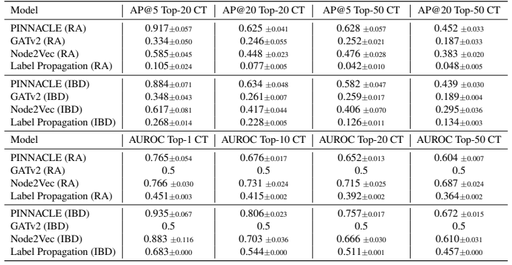
Table 2 . Cell-type specific target nomination for two therapeutic areas, rheumatoid arthritis (RA) and inflammatory bowel diseases (IBD).Cell-type specific context metrics (see 3.3 and definitions in Section 4.2) are used to benchmark (Grover & Leskovec, 2016; Aridhi et al., 2017; Brody et al., 2022; Li et al., 2024). Average precision for ranks 5 and 20 for top 20 and 50 cell types is used. AUROC at top 1, 10, 20, and 50 cell types is used.
원문 · CC BY 4.0 · Alejandro Velez-Arce, Jesus Caraballo, Marinka Zitnik · PyTDC: A multimodal machine learning training, evaluation, and inference platform for biomedical foundation models · 원문 그림 인용 · 원본 PDF 8쪽에서 그림 영역을 추출했습니다.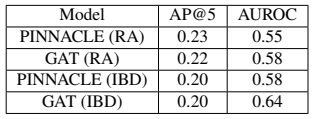
Table 3 . RA and IBD results for PINNACLE and a Graph Attention Network without cell-type-specific context metrics. These are results obtained after evaluating 10 seeds.
원문 · CC BY 4.0 · Alejandro Velez-Arce, Jesus Caraballo, Marinka Zitnik · PyTDC: A multimodal machine learning training, evaluation, and inference platform for biomedical foundation models · 원문 그림 인용 · 원본 PDF 20쪽에서 그림 영역을 추출했습니다.섭동 반응 예측과 모델 서버 사례
부록 A.2의 섭동 반응 예측 벤치마크는 scPerturb 데이터를 사용하여 미관찰 섭동에 대한 일반화를 평가합니다. 유전자 섭동에서 GEARS는 Replogle RPE1 데이터셋에서 MSE@20DEG 0.110±0.003을 보고하며, no-perturb 기준선의 0.164±0.000보다 낮습니다. 화학 섭동에서 chemCPA는 BMS 섭동에 대해 seen 섭동 R2 0.943±0.006, unseen 섭동 R2 0.906±0.006을 보고합니다. 원문은 chemCPA의 성능이 네 섭동에서 평균 15% 하락했다고 설명하며, 이는 해당 cold split 설정에서의 결과입니다.
데이터 출처와 접근 범위
PyTDC는 CZ CellXGene의 단일세포 데이터를 TileDB-SOMA 기반으로 메모리 효율적으로 질의할 수 있게 하며, PrimeKG 지식 그래프와 외부 API를 함께 연결합니다. 이 자원들은 데이터 검색 뷰를 통해 제공됩니다. 저자들은 생의학 데이터와 모델의 라이선스가 PyTDC 자체의 MIT 라이선스와 다를 수 있으며, PyTDC가 이를 엄격히 강제할 수 없다고 밝힙니다. 따라서 공개된 데이터셋과 모델의 이용 조건은 각 원자원의 라이선스를 따라야 합니다.
한계와 남은 질문
저자들은 사례 연구에서 기존 방법들이 미관찰 세포 유형에 일반화하지 못하고, 추가 모달리티를 통합하기 어렵다고 결론짓습니다. TCR-epitope 결합 예측에서도 RN과 ET 설정의 모든 모델은 성능이 낮다고 보고되며, NA 설정에서는 여러 모델이 높은 AUROC를 보입니다. 이 결과는 실험 설정에 따라 크게 달라지므로, 한 설정의 결과를 모든 negative 샘플 생성 방식으로 확대할 수 없습니다. 또한 데이터셋과 벤치마크의 과적합 가능성과 편향 위험도 저자들이 함께 지적합니다.
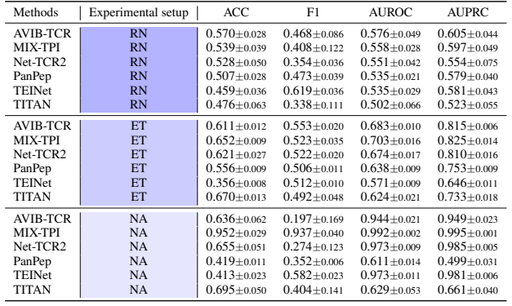
Table 7 . TCR-epitope binding interaction binary classification performance.All models perform poorly under realistic but challenging RN and ET experimental setups. The best-performing model in RN is A VIB-TCR, with an average of 0.576 (AUROC). The best-performing model in ET is MIX-TPI, with an average of 0.700 (AUROC). For NA, 4 of 6 models achieve near-perfect AUROC.
원문 · CC BY 4.0 · Alejandro Velez-Arce, Jesus Caraballo, Marinka Zitnik · PyTDC: A multimodal machine learning training, evaluation, and inference platform for biomedical foundation models · 원문 그림 인용 · 원본 PDF 27쪽에서 그림 영역을 추출했습니다.논문 정보
- 저자
- Alejandro Velez-Arce, Jesus Caraballo, Marinka Zitnik
- 학회·저널
- arXiv · 프리프린트
- 최초 공개일
- 2025년 5월 8일
- 등록일
- 2026년 10월 30일
- 수정일
- 2026년 1월 21일
- 버전
- v2
- arXiv
- 2505.05577
- 분류
- cs.LG · cs.AI
- 원문 이용 조건
- CC BY 4.0
- 제공 범위
- 논문 정보, 해설, 허용된 원문 그림
AI 해설은 논문 원문과 별개의 설명이며 오류가 있을 수 있습니다. 원문과 그림은 각 출처의 이용 조건과 따로 표시된 권리를 따릅니다.
초록
Existing biomedical benchmarks do not provide end-to-end infrastructure for training, evaluation, and inference of models that integrate multimodal biological data and a broad range of machine learning tasks in therapeutics. We present PyTDC, an open-source machine-learning platform providing streamlined training, evaluation, and inference software for multimodal biological AI models. PyTDC unifies distributed, heterogeneous, continuously updated data sources and model weights and standardizes benchmarking and inference endpoints. This paper discusses the components of PyTDC's architecture and, to our knowledge, the first-of-its-kind case study on the introduced single-cell drug-target nomination ML task. We find state-of-the-art methods in graph representation learning and domain-specific methods from graph theory perform poorly on this task. Though we find a context-aware geometric deep learning method that outperforms the evaluated SoTA and domain-specific baseline methods, the model is unable to generalize to unseen cell types or incorporate additional modalities, highlighting PyTDC's capacity to facilitate an exciting avenue of research developing multimodal, context-aware, foundation models for open problems in biomedical AI.
원문 인용
Alejandro Velez-Arce, Jesus Caraballo, Marinka Zitnik (2025). PyTDC: A multimodal machine learning training, evaluation, and inference platform for biomedical foundation models. arXiv:2505.05577v2. https://arxiv.org/abs/2505.05577v2
BibTeX
@misc{velezarce2025pytdc,
  title = {{PyTDC: A multimodal machine learning training, evaluation, and inference platform for biomedical foundation models}},
  author = {Alejandro Velez-Arce and Jesus Caraballo and Marinka Zitnik},
  year = {2025},
  eprint = {2505.05577},
  archivePrefix = {arXiv},
  url = {https://arxiv.org/abs/2505.05577v2}
}