논문 해설
A Survey on Uncertainty Quantification of Large Language Models: Taxonomy, Open Research Challenges, and Future Directions
대형 언어 모델의 불확실성 정량화에 관한 서베이: 분류 체계, 미해결 연구 과제, 향후 연구 방향
- 연구 문제 LLM은 환각을 생성하면서도 높은 확신을 표현하여, 응답의 신뢰도를 판단하기 어렵습니다.
- 연구 방법 논문은 LLM 불확실성 정량화 방법을 토큰 수준, 자기 언어화, 의미 유사성, 기계적 해석 가능성의 네 범주로 분류합니다.
- 주요 결과 토큰 기반 지표는 긴 응답에서 확률의 곱이 줄어드는 한계를 보이며, 일관성과 엔트로피는 사실성과 같지 않습니다.
LLM 불확실성의 필요성
LLM은 그럴듯하지만 사실이 아닌 응답, 즉 환각을 생성할 수 있으며, 이때 응답이 매우 확신에 찬 형태로 나타나 사용자가 사실성을 잘못 가정하기 쉽습니다. 원문은 Figure 1 예시에서 LLM이 '100% confident'라고 말했지만 사실 검증을 통과하지 못하는 상황을 보여 줍니다. 따라서 LLM이 응답에 대해 얼마나 확신하는지를 추정하는 불확실성 정량화(UQ) 방법이 필요합니다. 이 논문은 방법이 급증한 상황에서 연구 범위를 파악하기 어렵다는 문제를 해결하기 위해, 기존 UQ 방법을 하나의 분류 체계로 정리합니다.
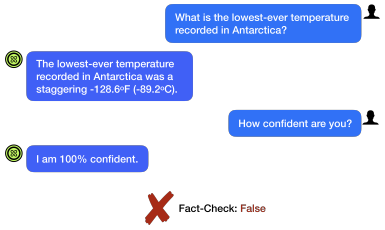
Fig. 1 . A user asks an LLM the question: What is the lowest-ever temperature recorded in Antarctica?; in response, the LLM answers definitively. Afterwards, the user asks the LLM how confident the LLM is. Although the LLM states that it is “100% confident, " the LLM’s response fails to pass a fact-check test. Confidence scores provided by LLMs are generally miscalibrated. UQ methods seek to provide calibrated estimates of the confidence of LLMs in their interaction with users.
원문 · CC BY 4.0 · Ola Shorinwa, Zhiting Mei, Justin Lidard, Allen Z. Ren, Anirudha Majumdar · A Survey on Uncertainty Quantification of Large Language Models: Taxonomy, Open Research Challenges, and Future Directions · 원문 그림 인용 · 원본 PDF 2쪽에서 그림 영역을 추출했습니다.불확실성과 신뢰도의 구분
논문은 불확실성을 aleatoric 불확실성과 epistemic 불확실성으로 나눕니다. aleatoric 불확실성은 결과 과정에 내재된 무작위성에서 생기며 데이터를 늘려도 줄지 않습니다. epistemic 불확실성은 모델의 지식 부족에서 생기며 더 많은 데이터나 적절한 모델 선택으로 줄어들 수 있습니다. 원문은 이 구분을 바탕으로 이후 논의에서는 불확실성과 신뢰도를 대체로 상호 교환 가능한 개념으로 다룬다고 밝힙니다.
토큰 수준 방법과 긴 응답의 한계
토큰 수준 UQ는 LLM이 토큰마다 계산한 확률분포를 이용하여 응답의 불확실성을 추정합니다. 엔트로피와 평균 로그 확률, 퍼플렉시티 같은 지표가 여기에 속합니다. 그러나 응답이 길어지면 토큰 확률의 곱이 작아져 의미상 같은 응답도 낮은 확률을 얻는 문제가 생깁니다. 이를 완화하기 위해 길이 정규화 점수나 주장 조건부 확률(CCP)처럼 응답을 주장 단위로 나누는 방법이 제안되었습니다.
자기 언어화 방법
자기 언어화 UQ는 LLM이 자연어 표현이나 수치 확신도로 자신의 신뢰도를 직접 드러내도록 학습하거나 유도합니다. 원문은 '~인 것 같다' 같은 인식적 표지나 수치적 확신도를 예로 듭니다. 그러나 여러 연구에서 LLM은 확신을 과대 표현하는 경향을 보였으며, 원문은 토큰 기반 추정치가 자기 언어화 추정치보다 더 잘 보정되는 경향이 있다고 보고한 연구를 인용합니다.
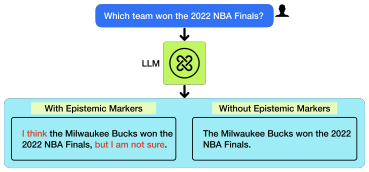
Fig. 10 . The LLM provides an incorrect response, but communi- cates its uncertainty using epistemic markers, e.g., “I think. "
원문 · CC BY 4.0 · Ola Shorinwa, Zhiting Mei, Justin Lidard, Allen Z. Ren, Anirudha Majumdar · A Survey on Uncertainty Quantification of Large Language Models: Taxonomy, Open Research Challenges, and Future Directions · 원문 그림 인용 · 원본 PDF 13쪽에서 그림 영역을 추출했습니다.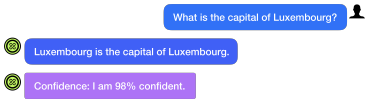
Fig. 11 . LLMs can be trained or fine-tuned to provide numeric estimates of their confidence in the factuality of their response.
원문 · CC BY 4.0 · Ola Shorinwa, Zhiting Mei, Justin Lidard, Allen Z. Ren, Anirudha Majumdar · A Survey on Uncertainty Quantification of Large Language Models: Taxonomy, Open Research Challenges, and Future Directions · 원문 그림 인용 · 원본 PDF 13쪽에서 그림 영역을 추출했습니다.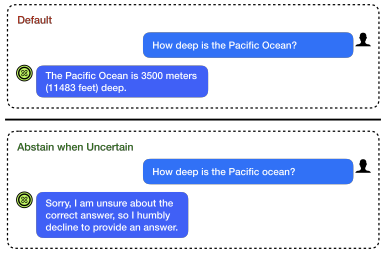
Fig. 12 . Some self-verbalized UQ methods fine-tune an LLM to refrain from answering when it is uncertain about the answer.
원문 · CC BY 4.0 · Ola Shorinwa, Zhiting Mei, Justin Lidard, Allen Z. Ren, Anirudha Majumdar · A Survey on Uncertainty Quantification of Large Language Models: Taxonomy, Open Research Challenges, and Future Directions · 원문 그림 인용 · 원본 PDF 14쪽에서 그림 영역을 추출했습니다.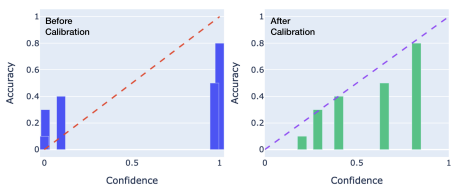
Fig. 15 . The confidence estimates provided by many UQ methods are not always calibrated, i.e., the observed frequencies do not match the estimates. Calibration techniques correct these confidence estimates for better alignment with the observed accuracy.
원문 · CC BY 4.0 · Ola Shorinwa, Zhiting Mei, Justin Lidard, Allen Z. Ren, Anirudha Majumdar · A Survey on Uncertainty Quantification of Large Language Models: Taxonomy, Open Research Challenges, and Future Directions · 원문 그림 인용 · 원본 PDF 18쪽에서 그림 영역을 추출했습니다.의미 유사성 기반 방법
의미 유사성 UQ는 같은 질의에 대해 생성된 여러 응답을 표면 형태가 아니라 의미 내용으로 비교합니다. 예를 들어 같은 답이 다른 어순으로 표현되면 토큰 확률은 달라도 의미는 같습니다. 이 계열은 NLI 모델의 함의 확률을 사용하거나 응답을 의미 군집으로 묶고, 군집의 엔트로피를 Semantic Entropy처럼 계산합니다. 원문은 이러한 방법이 응답 간 유사도 계산에 모델 의존성이 있다는 점을 중심 과제로 봅니다.
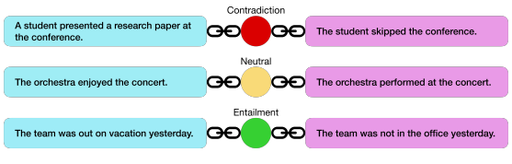
Fig. 7 . Natural-language inference models characterize the relationship between a pair of texts, namely: a premise and a hypothesis. The possible relations include: (1) an entailment where the hypothesis can be inferred from the premise; (2) a contradiction, where the hypothesis is more likely false given the premise; and (3) a neutral relation, where the veracity of the hypothesis cannot be determined from the premise.
원문 · CC BY 4.0 · Ola Shorinwa, Zhiting Mei, Justin Lidard, Allen Z. Ren, Anirudha Majumdar · A Survey on Uncertainty Quantification of Large Language Models: Taxonomy, Open Research Challenges, and Future Directions · 원문 그림 인용 · 원본 PDF 8쪽에서 그림 영역을 추출했습니다.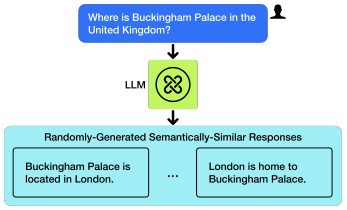
Fig. 13 . When prompted to answer a question, e.g., “Where is Buckingham Palace in the United Kingdom?”, an LLM might generate many variations of the same sentence. Although the form of each response may differ at the token-level, the semantic meaning of the sentences remains consistent. Semantic-similarity UQ techniques exploit semantic clustering to derive UQ methods that are robust to these variations in the form of the responses.
원문 · CC BY 4.0 · Ola Shorinwa, Zhiting Mei, Justin Lidard, Allen Z. Ren, Anirudha Majumdar · A Survey on Uncertainty Quantification of Large Language Models: Taxonomy, Open Research Challenges, and Future Directions · 원문 그림 인용 · 원본 PDF 15쪽에서 그림 영역을 추출했습니다.기계적 해석 가능성과 불확실성
기계적 해석 가능성(MI)은 LLM 내부 구성 요소가 어떤 특징을 표현하고 그 특징들이 어떻게 연결되는지를 연구합니다. 원문은 중첩된 특징을 분리하기 위해 희소 오토인코더(SAE)를 소개합니다. SAE는 활성값을 더 높은 차원의 희소 표현으로 사상한 뒤 원래 활성값을 복원하도록 학습합니다. 그러나 원문은 MI와 불확실성 정량화의 연결이 아직 충분히 탐색되지 않았다고 지적합니다.
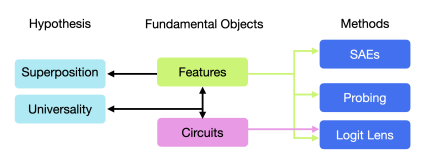
Fig. 14 . Taxonomy of Mechanistic Interpretability [172].
원문 · CC BY 4.0 · Ola Shorinwa, Zhiting Mei, Justin Lidard, Allen Z. Ren, Anirudha Majumdar · A Survey on Uncertainty Quantification of Large Language Models: Taxonomy, Open Research Challenges, and Future Directions · 원문 그림 인용 · 원본 PDF 16쪽에서 그림 영역을 추출했습니다.일관성과 엔트로피의 한계
원문은 일관성이 사실성과 같지 않다고 지적합니다. 예를 들어 GPT-4가 같은 잘못된 답을 여러 번 생성하면, 일관성 기반 방법은 잘못된 응답에 높은 확신을 줄 수 있습니다. 또한 엔트로피와 토큰 기반 지표도 사실성과 항상 일치하지 않으며, 학습 데이터가 부족하면 잘못된 답에 높은 확률이 배정될 수 있습니다. 따라서 이 논문에서 제시한 방법들은 사실성 보장을 자동으로 제공하지 않습니다.
논문 정보
- 저자
- Ola Shorinwa, Zhiting Mei, Justin Lidard, Allen Z. Ren, Anirudha Majumdar
- 학회·저널
- arXiv · 프리프린트
- 최초 공개일
- 2024년 12월 7일
- 등록일
- 2026년 11월 6일
- 수정일
- 2025년 7월 1일
- 버전
- v2
- arXiv
- 2412.05563
- 분류
- cs.CL · cs.AI
- 원문 이용 조건
- CC BY 4.0
- 제공 범위
- 논문 정보, 해설, 허용된 원문 그림
AI 해설은 논문 원문과 별개의 설명이며 오류가 있을 수 있습니다. 원문과 그림은 각 출처의 이용 조건과 따로 표시된 권리를 따릅니다.
초록
The remarkable performance of large language models (LLMs) in content generation, coding, and common-sense reasoning has spurred widespread integration into many facets of society. However, integration of LLMs raises valid questions on their reliability and trustworthiness, given their propensity to generate hallucinations: plausible, factually-incorrect responses, which are expressed with striking confidence. Previous work has shown that hallucinations and other non-factual responses generated by LLMs can be detected by examining the uncertainty of the LLM in its response to the pertinent prompt, driving significant research efforts devoted to quantifying the uncertainty of LLMs. This survey seeks to provide an extensive review of existing uncertainty quantification methods for LLMs, identifying their salient features, along with their strengths and weaknesses. We present existing methods within a relevant taxonomy, unifying ostensibly disparate methods to aid understanding of the state of the art. Furthermore, we highlight applications of uncertainty quantification methods for LLMs, spanning chatbot and textual applications to embodied artificial intelligence applications in robotics. We conclude with open research challenges in uncertainty quantification of LLMs, seeking to motivate future research.
원문 인용
Ola Shorinwa, Zhiting Mei, Justin Lidard, Allen Z. Ren, Anirudha Majumdar (2024). A Survey on Uncertainty Quantification of Large Language Models: Taxonomy, Open Research Challenges, and Future Directions. arXiv:2412.05563v2. https://arxiv.org/abs/2412.05563v2
BibTeX
@misc{shorinwa2024survey,
  title = {{A Survey on Uncertainty Quantification of Large Language Models: Taxonomy, Open Research Challenges, and Future Directions}},
  author = {Ola Shorinwa and Zhiting Mei and Justin Lidard and Allen Z. Ren and Anirudha Majumdar},
  year = {2024},
  eprint = {2412.05563},
  archivePrefix = {arXiv},
  url = {https://arxiv.org/abs/2412.05563v2}
}