논문 해설
Detect Faces Efficiently: A Survey and Evaluations
얼굴을 효율적으로 검출하기: 서베이와 평가
- 연구 문제 얼굴 검출은 AP가 높은 수준에 이르렀지만, 성능 향상이 다중 스케일 테스트와 계산량 증가에 얼마나 기대는지 불분명합니다.
- 연구 방법 논문은 딥러닝 기반 얼굴 검출기를 구조별로 정리하고, 계산 비용을 FLOPs 기준으로 재며, 주요 검출기의 AP와 FLOPs, latency를 비교합니다.
- 주요 결과 PyramidBox의 단일 스케일 AP와 DSFD의 계산량 차이처럼, 정확도가 비슷해도 계산 비용이 크게 다를 수 있음을 보고합니다. FLOPs는 latency와 선형으로 대응하지 않습니다.
얼굴 검출은 아직 풀린 문제인가
얼굴 검출은 이미지에서 얼굴이 있을 만한 모든 영역을 탐색하고 얼굴의 위치와 크기를 찾아내는 과제입니다. 얼굴 인식, 표정 인식, 얼굴 추적, 머리 자세 추정 같은 응용은 대부분 얼굴의 위치와 크기가 이미 알려져 있다고 가정하므로, 검출기의 성능이 이후 단계의 전제를 좌우합니다.
원문은 PASCAL Face, AFW, FDDB 같은 데이터셋에서 평균 정밀도(AP)가 2017년 이후 0.990에 도달하거나 넘었다고 보고합니다. WIDER Face의 hard 테스트 세트에서도 AP는 0.921에 이르렀습니다. 그러나 연도별 최고 AP 그래프에서 최근 3년의 향상은 느리며, 따라서 성능이 포화에 가까운 상태라는 점이 이 논문의 출발점입니다.
이 논문은 정확도 향상이 더 무거운 백본에서 왔는지, 아니면 여러 스케일을 합치는 다중 스케일 테스트에서 왔는지를 구분해야 한다고 문제를 제기합니다. 다중 스케일 테스트는 같은 이미지를 여러 배율로 검출한 뒤 결과를 합치므로 계산량을 크게 늘릴 수 있습니다. 논문은 대부분의 벤치마크가 계산 비용을 평가하지 않는다는 점을 함께 지적합니다.
계산 비용을 재는 FLOPs 기준과 검출기 구조 분류
논문은 딥러닝 기반 얼굴 검출기를 다단계, 두 단계, 단일 단계 프레임워크로 나누어 검토합니다. CascadeCNN은 슬라이딩 윈도우를 여러 단계의 CNN으로 줄여 가는 다단계 구조이며, MTCNN은 P-Net, R-Net, O-Net의 3개 하위 네트워크로 후보 창을 만들고 얼굴 박스와 랜드마크를 출력합니다. 두 단계 구조인 CMS-RCNN은 Faster R-CNN 계열 RPN에 여러 스케일의 특징을 결합합니다.
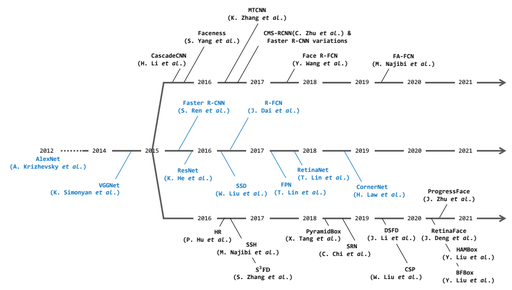
Fig. 3 : Timeline of milestone face detectors [10], [12], [13], [14], [17], [18], [19], [20], [21], [25], [36], [37], [38], [39], [40], [41], [42], and remarkable works from object recognition [43], [44] and object detection [6], [8], [11], [15], [16], [45] (marked as blue, attached to the middle branch). Since the proposal of AlexNet [46], various face detection works inspired by deep learning techniques from object recognition and object detection were published in the 2012-post deep learning-based face detection era. The top branch is two/multi-stage face detectors, while the bottom branch is one-stage detectors, which has become the most popular network design adopted by researchers.
원문 · CC BY 4.0 · Yuantao Feng, Shiqi Yu, Hanyang Peng, Yan-Ran Li, Jianguo Zhang · Detect Faces Efficiently: A Survey and Evaluations · 원문 그림 인용 · 원본 PDF 4쪽에서 그림 영역을 추출했습니다.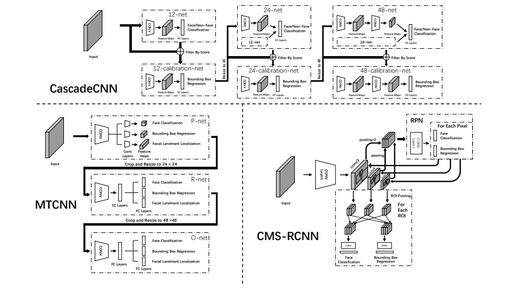
Fig. 4 : Diagrams of milestone multi/two-stage face detectors [12], [36], [38], [38]. Others share similar architectures as the three.
원문 · CC BY 4.0 · Yuantao Feng, Shiqi Yu, Hanyang Peng, Yan-Ran Li, Jianguo Zhang · Detect Faces Efficiently: A Survey and Evaluations · 원문 그림 인용 · 원본 PDF 5쪽에서 그림 영역을 추출했습니다.단일 단계 검출기는 특징 추출, 후보 생성, 얼굴 검출을 하나의 네트워크에서 수행합니다. HR은 ResNet-101 기반으로 앵커를 쓰는 검출기이며, SSH는 VGG-16 위에서 여러 수준의 특징에 SSH 모듈을 적용합니다. S3FD는 VGG-16을 확장하여 stride를 4에서 128까지 늘려 여러 스케일을 덮고, PyramidBox는 S3FD 백본에 FPN과 확장된 SSH 모듈을 결합합니다.
계산 비용의 기준으로 논문은 FLOPs를 제안합니다. 여기서 FLOPs는 합성곱, 활성화, 정규화, 풀링 등 신경망 층의 연산만을 계산하며 전·후처리는 제외합니다. 덧셈·뺄셈·곱셈·나눗셈·지수 연산은 모두 1 FLOPs로 세며, 예를 들어 합성곱 층의 계산량은 CoutHoutWout(2CinK²−1)로 정리됩니다. 이 기준은 입력 얼굴 수에 따른 계산량 변화를 드러내는 데 쓰입니다.
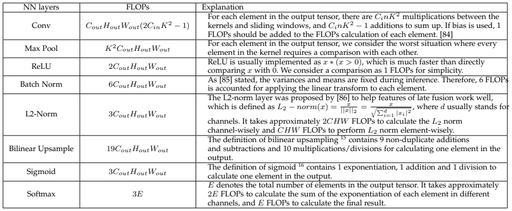
TABLE 4 : Equations of FLOPs calculation of different layers.
원문 · CC BY 4.0 · Yuantao Feng, Shiqi Yu, Hanyang Peng, Yan-Ran Li, Jianguo Zhang · Detect Faces Efficiently: A Survey and Evaluations · 원문 그림 인용 · 원본 PDF 13쪽에서 그림 영역을 추출했습니다.다중 스케일 테스트와 단일 스케일 비교
다중 스케일 테스트에서는 같은 이미지를 여러 배율로 바꿔 검출하고, 결과를 NMS로 합칩니다. 원문은 이 방식이 가능한 얼굴 크기의 범위를 넓히지만, 평가 시 어느 얼굴이 학습 범위 밖인지 알 수 없어서 모든 이미지에 배율을 적용해야 하므로 이미지당 FLOPs가 배수로 늘어난다고 설명합니다.
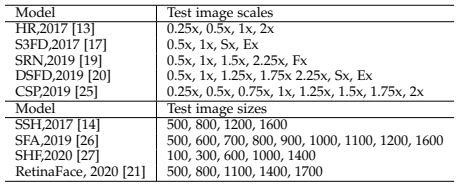
TABLE 1 : Different models adopt different ranges and differ- ent presets of test scales. ’0.25x’ denotes shrinking the width and height by 0.25, and others follow. Specifically, ’Sx’ and ’Ex’ are shrinking and enlarging images accordingly, while ’Fx’ is enlarging the image into a fixed size. Test image sizes stand for re-scaling the smaller side of the image to the given value, and the other side follows the same ratio.
원문 · CC BY 4.0 · Yuantao Feng, Shiqi Yu, Hanyang Peng, Yan-Ran Li, Jianguo Zhang · Detect Faces Efficiently: A Survey and Evaluations · 원문 그림 인용 · 원본 PDF 2쪽에서 그림 영역을 추출했습니다.단일 스케일 실험에서 PyramidBox는 scale 1 기준으로 WIDER Face 검증 세트에서 easy 0.947, medium 0.936, hard 0.875의 AP를 보고하며 TFLOPs는 1.387입니다. 같은 scale 1 조건에서 DSFD는 easy 0.949, medium 0.936, hard 0.845이고 TFLOPs는 1.532입니다. 저자들은 PyramidBox의 큰 전반적 향상이 FPN 모듈과 SSH 계열 문맥 강화에서 왔다고 해석하며, 두 모델의 AP가 비슷하면서 계산량 차이가 있다는 점을 강조합니다.
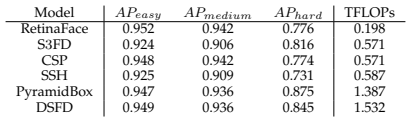
TABLE 8 : AP and FLOPs of different models on scale 1.
원문 · CC BY 4.0 · Yuantao Feng, Shiqi Yu, Hanyang Peng, Yan-Ran Li, Jianguo Zhang · Detect Faces Efficiently: A Survey and Evaluations · 원문 그림 인용 · 원본 PDF 15쪽에서 그림 영역을 추출했습니다.다중 스케일 설정에서는 HR, SSH, S3FD, PyramidBox, SRN, CSP, DSFD를 비교합니다. 원문은 DSFD가 SRN과 CSP보다 약 3배 이상의 FLOPs를 쓰면서 AP는 비슷하다고 보고하며, RetinaFace는 가장 높은 AP를 보이면서 계산 비용은 다른 대부분의 방법보다 낮다고 설명합니다.
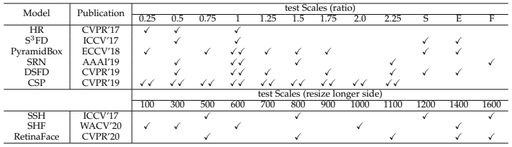
TABLE 5 : Test scales used by open-source one-stage face detectors [13], [14], [17], [18], [19], [20], [25]. Note that the double check marks denote image flipping vertically in addition to the image at the current scale. SSH shrinks and enlarges images to several preset fixed sizes. Since S 3FD, two adaptive test scales are used to save GPU memory, one of which is ”S” for adaptive shrinking, the other of which is ”E” for recursively adaptive enlarging. Scale ”F” denotes enlarging the image to the preset largest size.
원문 · CC BY 4.0 · Yuantao Feng, Shiqi Yu, Hanyang Peng, Yan-Ran Li, Jianguo Zhang · Detect Faces Efficiently: A Survey and Evaluations · 원문 그림 인용 · 원본 PDF 13쪽에서 그림 영역을 추출했습니다.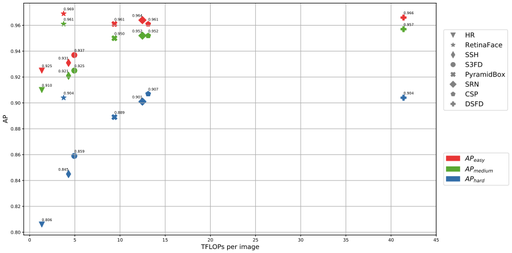
Fig. 10 : The FLOPs vs. multi-scale AP of WIDER Face validation set. 7 models from the WIDER Face result page are listed, which are HR [13], SSH [14], S3FD [17], PyramidBox [18], SRN [19], DSFD [20], CSP [25]. (The TFLOPs for some speed-focusing face detectors are listed in Table 10 because the TFLOPs are in a much smaller scale and cannot fit in this figure. )
원문 · CC BY 4.0 · Yuantao Feng, Shiqi Yu, Hanyang Peng, Yan-Ran Li, Jianguo Zhang · Detect Faces Efficiently: A Survey and Evaluations · 원문 그림 인용 · 원본 PDF 14쪽에서 그림 영역을 추출했습니다.FLOPs와 latency의 차이와 적용 범위
논문은 FLOPs와 실제 latency를 함께 측정합니다. 측정은 ONNXRUNTIME에서 RetinaFace, CSP, SRN, DSFD를 대상으로 했으며, 원문의 표 9는 720P 이미지에 대해 GPU와 CPU의 forward 지연과 post-processing 지연을 각각 보고합니다. RetinaFace의 평균 FLOPs는 SRN의 약 5분의 1이지만, forward 지연은 SRN의 거의 절반 수준이라고 원문은 설명합니다. 따라서 FLOPs와 latency는 선형으로 대응하지 않으며, 구현·하드웨어·메모리 효율에 따라 차이가 생깁니다.
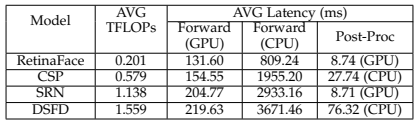
TABLE 9 : State-of-the-art open-source models tested with a 720P image containing several faces at scale=1.0 only. We average the FLOPs (AVG TFLOPs) and latency (AVG Latency) by running the test for each model 100 times. Note that ’Post-Proc’ denotes post-processing stages, such as decoding from anchors, NMS and so on. For this stage, we adopt the original processing code of each model.
원문 · CC BY 4.0 · Yuantao Feng, Shiqi Yu, Hanyang Peng, Yan-Ran Li, Jianguo Zhang · Detect Faces Efficiently: A Survey and Evaluations · 원문 그림 인용 · 원본 PDF 15쪽에서 그림 영역을 추출했습니다.이 결과는 특정 하드웨어와 특정 네 개 모델에 대한 측정입니다. 원문은 DSFD와 CSP의 post-processing 지연이 크게 증가하는 이유로 GPU 가속 NMS를 쓰지 않은 점을 들며, 이것도 구현 조건에 따른 관찰로 봐야 합니다.
또한 주요 벤치마크들은 정확도만 평가하고 효율은 평가하지 않는다는 한계가 있습니다. 논문은 이 때문에 AP가 포화된 뒤에는 효율을 함께 평가해야 한다고 주장합니다. 다만 이 주장도 저자의 해석이며, 다른 데이터셋이나 다른 하드웨어에서 같은 순서가 항상 나타난다는 증명은 아닙니다.
논문 정보
- 저자
- Yuantao Feng, Shiqi Yu, Hanyang Peng, Yan-Ran Li, Jianguo Zhang
- 학회·저널
- arXiv · 프리프린트
- 최초 공개일
- 2021년 12월 3일
- 등록일
- 2026년 11월 6일
- 수정일
- 2021년 12월 3일
- 버전
- v1
- arXiv
- 2112.01787
- DOI
- 10.1109/tbiom.2021.3120412
- 분류
- cs.CV · cs.AI
- 원문 이용 조건
- CC BY 4.0
- 제공 범위
- 논문 정보, 해설, 허용된 원문 그림
AI 해설은 논문 원문과 별개의 설명이며 오류가 있을 수 있습니다. 원문과 그림은 각 출처의 이용 조건과 따로 표시된 권리를 따릅니다.
초록
Face detection is to search all the possible regions for faces in images and locate the faces if there are any. Many applications including face recognition, facial expression recognition, face tracking and head-pose estimation assume that both the location and the size of faces are known in the image. In recent decades, researchers have created many typical and efficient face detectors from the Viola-Jones face detector to current CNN-based ones. However, with the tremendous increase in images and videos with variations in face scale, appearance, expression, occlusion and pose, traditional face detectors are challenged to detect various "in the wild" faces. The emergence of deep learning techniques brought remarkable breakthroughs to face detection along with the price of a considerable increase in computation. This paper introduces representative deep learning-based methods and presents a deep and thorough analysis in terms of accuracy and efficiency. We further compare and discuss the popular and challenging datasets and their evaluation metrics. A comprehensive comparison of several successful deep learning-based face detectors is conducted to uncover their efficiency using two metrics: FLOPs and latency. The paper can guide to choose appropriate face detectors for different applications and also to develop more efficient and accurate detectors.
원문 인용
Yuantao Feng, Shiqi Yu, Hanyang Peng, Yan-Ran Li, Jianguo Zhang (2021). Detect Faces Efficiently: A Survey and Evaluations. arXiv:2112.01787v1. https://doi.org/10.1109/tbiom.2021.3120412
BibTeX
@article{feng2021detect,
  title = {{Detect Faces Efficiently: A Survey and Evaluations}},
  author = {Yuantao Feng and Shiqi Yu and Hanyang Peng and Yan-Ran Li and Jianguo Zhang},
  year = {2021},
  eprint = {2112.01787},
  archivePrefix = {arXiv},
  doi = {10.1109/tbiom.2021.3120412},
  url = {https://arxiv.org/abs/2112.01787v1}
}