논문 해설
Toward Agentic Robotics: A Large-Scale Study of Harness Design for Robot-Use Agents
X-Harness: 로봇 에이전트 하네스 설계를 대규모로 비교
- 연구 문제 VLM은 3D 그리퍼 포즈를 잘 예측하지 못하고, VLA와 WAM은 도메인이 바뀌면 무너집니다. 둘을 잇는 하네스 설계는 수천 가지라 비교가 어렵습니다.
- 연구 방법 X-Harness는 VLM이 정책 코드를 진화시켜 도구와 VLA를 호출하게 하고, 테스트 때는 실패 지점에서만 VLM을 부릅니다.
- 주요 결과 X-Harness는 가중치 업데이트 없이 메모리, 추론, 도메인 변화 과제에서 기준 정책을 최대 42.8포인트 끌어올렸습니다.
VLM 로봇 에이전트가 막히는 지점
VLM은 장면을 이해하고 과거 사건을 떠올리며 policy code와 도구로 로봇을 제어할 수 있지만, 정밀 조작에서는 자주 실패합니다. 추론을 길게 늘리고 motion planner를 붙여도 3D gripper pose를 잘 예측하지 못했고, VLM을 루프 안에서 매번 호출하면 로봇이 멈춰 섰습니다. 반대로 VLA와 WAM은 학습한 과제에서는 빠르고 부드럽게 제어하지만, 도메인이 바뀌거나 장기 기억과 추론이 필요한 과제에서는 무너집니다.
Agentic robot은 이 둘의 약점을 서로 메우려고 VLM의 추론과 인식에 정밀한 VLA나 WAM 제어를 결합합니다. 두 모델을 잇는 것이 policy harness이며, VLM이 어떤 문맥을 받는지, 루프 안에서 직접 행동하는지 아니면 policy code(자유 형식 Python 또는 기호 템플릿)를 쓰는지, 그리고 언제 호출되는지를 정합니다. 문제는 같은 VLM과 행동 정책을 쓰더라도 harness 설계가 수천 가지 구성에 걸쳐 있고, 성공률이 수십 포인트씩 달라진다는 점입니다. 설계 하나를 시험하는 데도 수천 번의 롤아웃과 많은 API 및 GPU 비용이 들기 때문에, 기존 연구는 단일 harness에 머물거나 한 가지 상황과 벤치마크에서만 ablation을 하는 경우가 많았습니다.
이 논문은 그 공백을 메우려고 4,000개가 넘는 설정과 470,000회가 넘는 롤아웃을 돌렸습니다. 대상은 여덟 개 시뮬레이션 벤치마크(267개 과제), 여섯 VLM, 15개 VLA/WAM 체크포인트였고(Figure 1), 시뮬레이션이라 같은 seed 위에서 한 번에 한 요인만 바꾸는 ablation이 가능했습니다. 이 결과는 양손 로봇에서의 물리 검증(Appendix J)으로 보완했습니다. 테스트 시점에는 어느 벤치마크도 시뮬레이터의 ground-truth 물체 포즈나 마스크를 쓰지 않았고, RGB 박스, 마스크, 트랙은 Grounding DINO, SAM 2, CoTracker3에서 얻었으며 로봇 링크의 깊이는 가렸습니다.
일곱 벤치마크에서는 VLA가 RGB를 받고 3D 도구가 카메라 깊이를 읽었으며, RoboDojo는 깊이 센서가 없는 순수 RGB 환경이었습니다. 각 셀은 과제 하나, VLM 하나, VLA 하나, harness 설계 하나를 짝지어 최소 20개 테스트 에피소드에서 돌렸고, 4,025개 셀에서 489,380회가 기록되었습니다(Table 5, Figure 11). 핵심 비교는 두 단계 paired bootstrap과 Holm 보정으로 검정했습니다(α = 0.05).
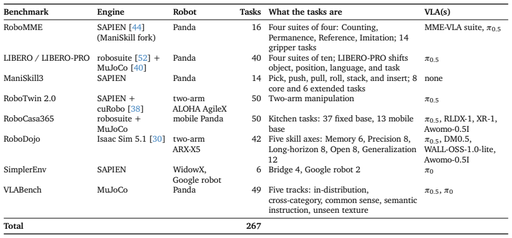
Table 3 | Eight simulation benchmarks with 267 tasks.Engine, robot, number of tasks, task content, and the VLAs used. ManiSkill3 has no public multi-task, language-conditioned VLA checkpoint, so it tests the harness with perception tools and motion primitives alone.
원문 · CC BY 4.0 · Yuxiang Lai, Jike Zhong, Yu-Jhe Li, Lan Wang, Chengzhi Liu, Youbao Tang, Ming Li, Xi Xiao, Xiaofeng Yang, Liang Zhao, Zheda Mai, Ruixi Fan · Toward Agentic Robotics: A Large-Scale Study of Harness Design for Robot-Use Agents · 원문 그림 인용 · 원본 PDF 16쪽에서 그림 영역을 추출했습니다.
Figure 11 | 4,025 evaluated configurations across eight benchmarks.Each tile represents one cell (one task under a specific VLM, VLA, and harness configuration), grouped by benchmark and sorted by test success rate from low to high. The LIBERO-PRO block includes standard LIBERO cells.
원문 · CC BY 4.0 · Yuxiang Lai, Jike Zhong, Yu-Jhe Li, Lan Wang, Chengzhi Liu, Youbao Tang, Ming Li, Xi Xiao, Xiaofeng Yang, Liang Zhao, Zheda Mai, Ruixi Fan · Toward Agentic Robotics: A Large-Scale Study of Harness Design for Robot-Use Agents · 원문 그림 인용 · 원본 PDF 16쪽에서 그림 영역을 추출했습니다.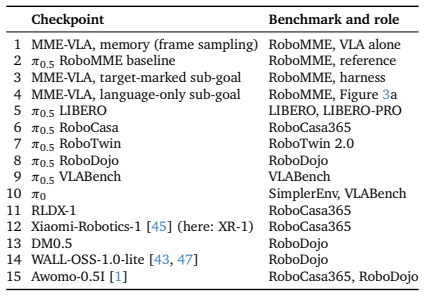
Table 4 | Fifteen VLA checkpoints.Where each is used. Rows 1, 3, and 4 are from the MME-VLA suite. Row 2 alone scores 18.6 on the 16 RoboMME tasks. Row 14 is the public WALL-OSS-1.0-lite checkpoint for RoboDojo, used in the last row of Table 2. Rows 10 and 15 each count one model:𝜋0 has three public fine-tunes, and Awomo-0.5I its official weights for RoboCasa365 and for RoboDojo.
원문 · CC BY 4.0 · Yuxiang Lai, Jike Zhong, Yu-Jhe Li, Lan Wang, Chengzhi Liu, Youbao Tang, Ming Li, Xi Xiao, Xiaofeng Yang, Liang Zhao, Zheda Mai, Ruixi Fan · Toward Agentic Robotics: A Large-Scale Study of Harness Design for Robot-Use Agents · 원문 그림 인용 · 원본 PDF 17쪽에서 그림 영역을 추출했습니다.정책 하네스와 일곱 가지 설계 축
정책 하네스는 다섯 요소로 이루어집니다. VLM은 지시문, 카메라 프레임이나 영상, 도구 출력, 그리고 규약을 정하는 선택적 task note를 문맥으로 받습니다. 정책 코드는 세 종류의 도구를 호출합니다. 첫째는 객체를 탐지하고 분할하고 추적하며 깊이를 돌려주는 perception 도구입니다. 둘째는 그리퍼를 열고 닫고 계획된 경로를 따라 목표 포즈로 옮기는 motion primitive입니다. 셋째는 language sub-goal과 step limit을 받는 VLA입니다. 정책 코드는 자유 형식 Python일 수도 있고 behavior tree나 PDDL 같은 고정 템플릿을 채운 형태일 수도 있으며, 라이브 이미지와 로봇 상태를 읽으면 폐루프, 고정된 순서를 실행하면 개루프가 됩니다.
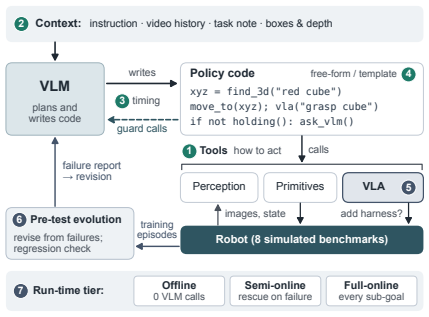
Figure 2 | Overview of the policy harness and our seven design studies.Badges mark each studied aspect, starting from VLMs (green, §4) and VLAs (gray, §5); the dashed arrow is a guardthat calls the VLM on failure.
원문 · CC BY 4.0 · Yuxiang Lai, Jike Zhong, Yu-Jhe Li, Lan Wang, Chengzhi Liu, Youbao Tang, Ming Li, Xi Xiao, Xiaofeng Yang, Liang Zhao, Zheda Mai, Ruixi Fan · Toward Agentic Robotics: A Large-Scale Study of Harness Design for Robot-Use Agents · 원문 그림 인용 · 원본 PDF 3쪽에서 그림 영역을 추출했습니다.테스트 전에는 정책 코드가 학습 에피소드에서 기본 10개를 대상으로 진화합니다. 매 라운드마다 VLM은 실패 보고를 바탕으로 코드를 고치고, 학습 진단 정보는 테스트 때 쓰지 않습니다. 선택 게이트는 학습 성공률이 오르고 큰 회귀가 없을 때만 수정안을 남기므로, 테스트 데이터를 보지 않고도 개선을 검증하게 됩니다. 테스트 시 VLM 호출은 세 단계로 나뉩니다. Offline은 VLM을 0번 호출하고 고정된 정책 코드를 그대로 실행합니다. Semi-online은 실패 신호가 있을 때만 호출하며, 한 번의 takeover나 여러 턴의 rescue에 쓰입니다. Full-online은 모든 sub-goal마다 호출하는데, 호출할 때마다 지연 시간과 API 토큰이 듭니다.
진화의 이득은 대부분 4라운드 안에서 나왔습니다. 1회만 수정하는 one-shot evolution도 15개 중 14개 설정에서 도움이 됐고(Figure 8d), 성공률은 4라운드 무렵 가파르게 올랐다가 8라운드 무렵 평탄해졌습니다. 16라운드와 32라운드까지 늘렸을 때 정확도는 약 1포인트 움직였습니다. 약한 코더인 Flash와 Sonnet은 8라운드까지 더 많이 얻어서 Opus와의 차이를 좁혔습니다. 시뮬레이터 진단 없이 action 로그와 이진 성공 여부만 써도 진화 이득이 대부분 유지됐고, Opus는 거의 전부 유지했습니다.
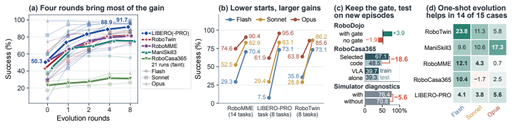
Figure 8 | Study 6 / Takeaway 6: A few rounds of pre-test evolution, guarded by a regression check, lift weak and strong VLMs alike. (a)Offline test success across rounds (0: initial code; faint: 21 runs; bold: benchmark means) rises steeply by round 4 and plateaus by round 8.(b)Weaker coders (Flash, Sonnet) gain more by round 8, narrowing the gap to Opus.(c)Dropping the regression check hurts test success on RoboDojo (top, GPT-6 Astra); training-only selection generalizes to blind RoboCasa365 tests (middle, Opus); and evolution stays strong without simulator diagnostics (bottom). (d)One-shot evolution improves nearly all settings (bold: significant).
원문 · CC BY 4.0 · Yuxiang Lai, Jike Zhong, Yu-Jhe Li, Lan Wang, Chengzhi Liu, Youbao Tang, Ming Li, Xi Xiao, Xiaofeng Yang, Liang Zhao, Zheda Mai, Ruixi Fan · Toward Agentic Robotics: A Large-Scale Study of Harness Design for Robot-Use Agents · 원문 그림 인용 · 원본 PDF 8쪽에서 그림 영역을 추출했습니다.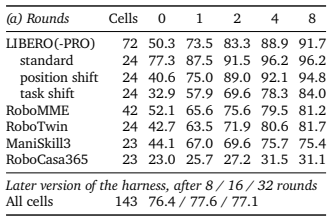
Table23 | Fourroundsbringmostofthegain(Figure8a,b). Offline test success (%) after each number of evolution rounds. Round0istheVLM’sinitialfree-formpolicycode. Thelastrow of (a) pools 143 cells under the later version of the harness (§B).
원문 · CC BY 4.0 · Yuxiang Lai, Jike Zhong, Yu-Jhe Li, Lan Wang, Chengzhi Liu, Youbao Tang, Ming Li, Xi Xiao, Xiaofeng Yang, Liang Zhao, Zheda Mai, Ruixi Fan · Toward Agentic Robotics: A Large-Scale Study of Harness Design for Robot-Use Agents · 원문 그림 인용 · 원본 PDF 26쪽에서 그림 영역을 추출했습니다.게이트를 뺀 실험에서는 수정이 테스트 성능을 떨어뜨렸습니다. RoboDojo에서 GPT-6 Astra는 검증 없이 고친 코드로 테스트 정확도가 낮아졌습니다. 반면 학습 성공률만으로 고르는 방식은 RoboCasa365의 blind 테스트, 즉 보지 못한 에피소드에서도 이득이 이어졌습니다(Opus, Figure 8c). 저자들은 같은 방식을 쓰면서 초기 정책 코드는 고정하고 지각과 행동 보조 함수를 모은 공유 도구 뱅크를 4라운드 진화시키는 쪽을 시험했는데, 이 방식이 정책 코드를 8라운드 진화시킨 것과 맞먹었습니다(Figure 16c).
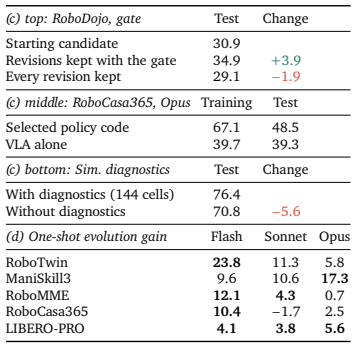
Table 24 | The selection gate and one-shot evolution both raise test success (Figure 8c,d).(c) Success (%). (d) Gain (points); bold: significant. Tier: Offline; (c) top also Semi-online.
원문 · CC BY 4.0 · Yuxiang Lai, Jike Zhong, Yu-Jhe Li, Lan Wang, Chengzhi Liu, Youbao Tang, Ming Li, Xi Xiao, Xiaofeng Yang, Liang Zhao, Zheda Mai, Ruixi Fan · Toward Agentic Robotics: A Large-Scale Study of Harness Design for Robot-Use Agents · 원문 그림 인용 · 원본 PDF 26쪽에서 그림 영역을 추출했습니다.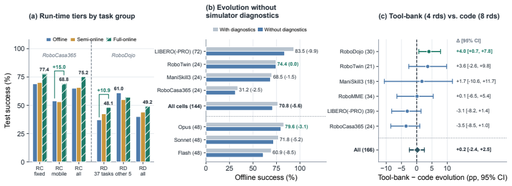
Figure 16 | Group-level tier progression, diagnostics-free evolution, and tool-bank parity. (a)Run-time tier success (%) with Gemini 4 Argon and Awomo-0.5I by task group: RoboCasa365 fixed (510/519/573 of 740), mobile (140/138/179 of 260), all (650/657/752 of 1,000); RoboDojo 37 tasks (275/314/356 of 740), remaining 5 tasks already solved at≥ 85% by DM0.5 alone (61/55/57 of 100), all (336/369/413 of 840).(b)Eight-round Offline success without vs. with simulator diagnostics across 144 cells (2,880 test episodes/arm; label shows score without diagnostics and change).(c)Four-round tool-bank evolution around frozen policy code minus eight-round full policy-code evolution across 166 non-saturated cells (95% paired bootstrap CIs; RoboDojo+4.0strictly above zero).
원문 · CC BY 4.0 · Yuxiang Lai, Jike Zhong, Yu-Jhe Li, Lan Wang, Chengzhi Liu, Youbao Tang, Ming Li, Xi Xiao, Xiaofeng Yang, Liang Zhao, Zheda Mai, Ruixi Fan · Toward Agentic Robotics: A Large-Scale Study of Harness Design for Robot-Use Agents · 원문 그림 인용 · 원본 PDF 34쪽에서 그림 영역을 추출했습니다.VLM 행동 수준: 포즈 예측과 sub-goal 위임
VLM이 그리퍼를 직접 제어해야 하는지, 아니면 저수준 움직임을 VLA에 맡겨야 하는지가 이 절의 첫 질문입니다. 저자들은 VLM이 무엇을 해야 할지는 잘 판단하지만 어떻게 움직일지를 정밀하게 정하는 데는 약하다고 봅니다. 그래서 그림 3은 VLM이 3D 그리퍼 포즈를 직접 내는 방식, 핵심 포즈와 모션 플래너를 쓰는 방식, 언어 sub-goal을 VLA에 넘기는 방식을 나란히 비교합니다. 그 결과 VLM이 그리퍼 포즈를 직접 예측하는 방식은 대부분의 에피소드에서 실패했고, 포즈를 한 번에 하나만 내도 마찬가지였습니다. Opus를 high reasoning effort로 키워도 핵심 포즈 방식과 다른 방식 사이의 격차는 좁혀지지 않았습니다.
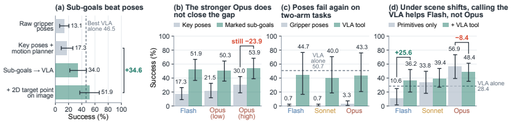
Figure 3 | Study 1 / Takeaway 1: Direct VLM pose predictions fail; VLMs should delegate via VLA sub-goals or query 3D tools in code. (a)On RoboMME (Flash), language sub-goals beat gripper or key poses, and marking a 2D target point lifts the VLA past its standalone baseline (dashed).(b)Scaling to Opus with high reasoning effort does not close the key-pose gap.(c)On two-arm RoboDojo, direct gripper poses fail across VLMs, while calling𝜋0.5 restores execution.(d) Under LIBERO-PRO shifts, calling the VLA helps weaker VLMs, whereas Opus excels with 3D-tool primitives. Error bars: 95% CIs.
원문 · CC BY 4.0 · Yuxiang Lai, Jike Zhong, Yu-Jhe Li, Lan Wang, Chengzhi Liu, Youbao Tang, Ming Li, Xi Xiao, Xiaofeng Yang, Liang Zhao, Zheda Mai, Ruixi Fan · Toward Agentic Robotics: A Large-Scale Study of Harness Design for Robot-Use Agents · 원문 그림 인용 · 원본 PDF 4쪽에서 그림 영역을 추출했습니다.언어 sub-goal을 VLA에 위임하는 쪽은 훨씬 자주 성공했습니다. 특히 VLM이 이미지 위에 2D 목표점을 표시한 target-marked sub-goal에서 성공률이 가장 높았습니다. 포즈를 짐작하는 대신 policy code가 감지기와 깊이 정보를 질의해 3D primitive 목표를 얻는 방법도 대안으로 비교했습니다. LIBERO-PRO 변화에서 VLA가 어려움을 겪을 때 VLA 호출은 Flash와 Sonnet을 여전히 도왔고, Opus는 3D primitive에서 더 나은 결과를 보였습니다. 접촉이 많은 동작, 노이즈가 있는 깊이 정보(§4.2), 약한 코더에서는 sub-goal이 여전히 가장 좋았습니다.
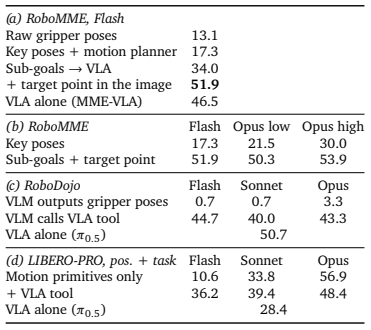
Table 6 | Sub-goals carried out by VLAs beat poses that VLMs read from images (Figure 3).Success (%). (a–c) VLM in the loop; (d) code per episode. VLA alone: dashed lines in the figure.
원문 · CC BY 4.0 · Yuxiang Lai, Jike Zhong, Yu-Jhe Li, Lan Wang, Chengzhi Liu, Youbao Tang, Ming Li, Xi Xiao, Xiaofeng Yang, Liang Zhao, Zheda Mai, Ruixi Fan · Toward Agentic Robotics: A Large-Scale Study of Harness Design for Robot-Use Agents · 원문 그림 인용 · 원본 PDF 18쪽에서 그림 영역을 추출했습니다.시간 축에서는 VLM을 에피소드 중간에 자주 부르면 로봇이 기다리느라 제어 주기가 크게 떨어집니다. 그래서 저자들은 폐루프 정책 코드가 실시간 피드백을 처리하고, VLM은 가드가 실패를 감지했을 때만 부르는 구조를 더 나은 선택으로 봅니다.
참조 레시피 X-Harness의 벤치마크 결과
X-Harness는 일곱 가지 원칙을 가중치 업데이트 없이 결합한 참조 레시피입니다. 이 레시피는 과제마다 학습 에피소드 5개에서 40개를 받아 닫힌 루프 Python 정책 코드를 진화시킵니다. 여덟 벤치마크 267개 과제 가운데 여섯 개는 Offline으로만 돌렸고, 가장 긴 호흡을 요구하는 두 스위트에는 트리거가 걸릴 때만 작동하는 Semi-online rescue를 더했습니다.
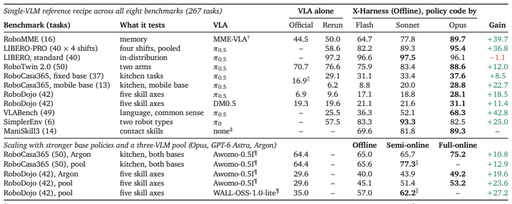
Table 2 | The takeaways compose: one reference recipe on eight benchmarks.Test success (%) of VLAs alone and in X-Harness.Official: leaderboard;Rerun: same VLA, our protocol. Top: Offline code after eight evolution rounds;Gain: Opus minusRerun(unrounded). Bottom: tiers of §5.3;pool: added tools, one training-selected candidate per task;Gain: best tier minusOfficial. Bold: best.
원문 · CC BY 4.0 · Yuxiang Lai, Jike Zhong, Yu-Jhe Li, Lan Wang, Chengzhi Liu, Youbao Tang, Ming Li, Xi Xiao, Xiaofeng Yang, Liang Zhao, Zheda Mai, Ruixi Fan · Toward Agentic Robotics: A Large-Scale Study of Harness Design for Robot-Use Agents · 원문 그림 인용 · 원본 PDF 9쪽에서 그림 영역을 추출했습니다.RoboMME에서 차이가 가장 크게 났습니다. 공식 리더보드의 MME-VLA 점수는 44.5였고 같은 VLA를 같은 프로토콜로 다시 돌린 Rerun 점수는 50.0이었습니다. 기준 정책이 명시적 메모리를 갖지 않는 곳에서 이득이 몰리고, 이미 잘하는 분포 안의 과제에서는 정확도가 거의 그대로 남았습니다.
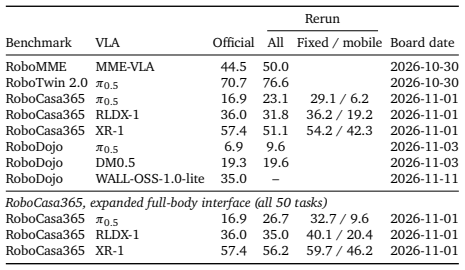
Table36 |WhereverTable2reportsbothscores,ourRerunmeets or exceeds the official leaderboard score.Official leaderboard and Rerun VLA-alone success (%; –: not rerun). Top: standard interface used in Table 2 and Figure 7. Bottom: expanded full-body RoboCasa365 interface (all 50 tasks, 1,000 episodes per VLA) used in Figure 8c.
원문 · CC BY 4.0 · Yuxiang Lai, Jike Zhong, Yu-Jhe Li, Lan Wang, Chengzhi Liu, Youbao Tang, Ming Li, Xi Xiao, Xiaofeng Yang, Liang Zhao, Zheda Mai, Ruixi Fan · Toward Agentic Robotics: A Large-Scale Study of Harness Design for Robot-Use Agents · 원문 그림 인용 · 원본 PDF 34쪽에서 그림 영역을 추출했습니다.코딩 VLM만 바꾸면서 267개 과제 전체를 돌린 결과도 같은 방향이었습니다. Flash, Sonnet, Opus 가운데 어떤 VLM을 써도 기준 정책보다 높아졌고, 코딩 능력이 강할수록 이득이 더 커졌습니다. 다만 이 수치는 모두 Offline 정책 코드 기준입니다.
Semi-online 복구와 토큰 비용
VLM을 테스트 시점에 어떻게 호출할지는 성능과 비용을 동시에 따져야 하는 문제입니다. Full-online은 하위 목표(sub-goal)마다 VLM을 호출하는 방식으로, RoboCasa365에서 76.8%의 성공률을 기록했습니다. 대신 한 에피소드당 VLM을 약 열 번 호출했고, 그 토큰 비용은 Semi-online의 4배에서 17배에 이르렀습니다. 이 방식의 이득은 기존 정책 코드가 학습 에피소드의 절반 이상에서 실패하는 어려운 과제에 거의 몰려 있었습니다.
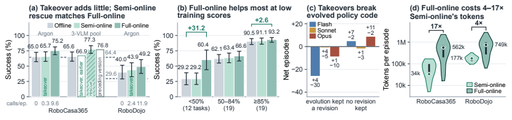
Figure 9 | Study 7 / Takeaway 7: After evolution, Semi-online multi-turn rescue matches Full-online at much lower cost, outperforming one-shot takeovers. (a)With Awomo-0.5I (dashed: VLA alone), one-shot takeovers add little over Offline code, whereas Semi-online multi-turn rescue (hatched) matches Full-online with fewer calls.(b)On RoboCasa365, Full-online helps mainly on hard tasks (< 50%training score) and adds little when Offline code is reliable (≥ 85%).(c) One-shot takeovers break more evolved episodes than they rescue (labels:+/− counts).(d)Full-online uses4–17 × more tokens than Semi-online takeovers (violins: tasks with calls; diamonds: means; 95% CIs).
원문 · CC BY 4.0 · Yuxiang Lai, Jike Zhong, Yu-Jhe Li, Lan Wang, Chengzhi Liu, Youbao Tang, Ming Li, Xi Xiao, Xiaofeng Yang, Liang Zhao, Zheda Mai, Ruixi Fan · Toward Agentic Robotics: A Large-Scale Study of Harness Design for Robot-Use Agents · 원문 그림 인용 · 원본 PDF 8쪽에서 그림 영역을 추출했습니다.Semi-online 방식은 진화된 정책 코드를 먼저 그대로 실행하고, 가드가 물리적 실패 신호를 낼 때만 VLM을 부릅니다. 이때 VLM은 단계마다 이미지와 행동 결과를 확인한 뒤 다음 복구 단계를 고르는 다회 턴(multi-turn) rescue로 동작합니다. 테스트 에피소드의 51.4%는 복구 턴 없이 끝났습니다. 저자들은 이 결과를 두고, 진화된 코드를 덮어쓰지 않고 실패 지점에서 조언만 받는 구조가 비용을 줄이면서도 성공률을 지키는 핵심이라고 봅니다.
반면 실패가 생길 때마다 VLM이 코드 전체를 한 번에 다시 써서 덮어쓰는 일회성 takeover는 효과가 작았습니다. 세 VLM 모두에서 일회성 takeover는 구제한 에피소드보다 망가뜨린 에피소드가 많았습니다. 약한 모델일수록 가드를 과도하게 발동시켰고, Flash 모델은 가드 발동의 95%에서 takeover를 했습니다. 검증되지 않은 새 코드가 이미 잘 돌아가던 진화된 정책 코드를 깨뜨린 셈입니다. 그래서 저자들은 VLM을 정책 코드를 대체하는 주체보다 실패 지점에서 조언하는 역할로 쓰는 편이 낫다고 봅니다.
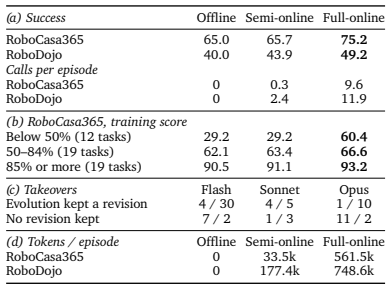
Table 25 | Runtime VLM calls help most on harder low-training-score tasks, while evolved Offline code should avoid one-shot takeovers (Figure 9).(a, b) Suc- cess (%) per run-time tier. (c) Episodes rescued / broken. (d) VLM tokens per episode, over all test episodes.
원문 · CC BY 4.0 · Yuxiang Lai, Jike Zhong, Yu-Jhe Li, Lan Wang, Chengzhi Liu, Youbao Tang, Ming Li, Xi Xiao, Xiaofeng Yang, Liang Zhao, Zheda Mai, Ruixi Fan · Toward Agentic Robotics: A Large-Scale Study of Harness Design for Robot-Use Agents · 원문 그림 인용 · 원본 PDF 27쪽에서 그림 영역을 추출했습니다.시뮬레이션 중심 검증의 한계
이 연구의 주요 평가는 시뮬레이션 벤치마크에서 이루어졌습니다. 실제 로봇 검증은 쌍팔 YAM 로봇에서 수행한 보충 실험으로 제시되며, 그 범위는 두 가지 메모리·상태 의존 과제에 한정됩니다. 또한 결과 표의 많은 수치는 특정 VLM 세트와 특정 VLA 체크포인트에 따라 달라지며, 다른 모델 조합에서 같은 크기의 이득이 나온다고 보장하지는 않습니다. 저자들은 이 결과가 설계 원칙의 방향을 보여 주는 증거로서 가치가 있다고 봅니다.
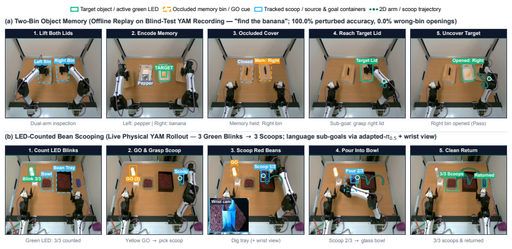
Figure 18 | Real-robot visual grounding, memory tracking, and sub-goal execution on a bimanual YAM platform. (a)Offline replay on a blind-test Two-Bin Object Memory recording (“find the banana”): policy code lifts both lids, remembers the occluded target bin, and uncovers the banana (100.0%perturbed accuracy under RGB + DINO/SAM,0.0% wrong-bin openings; Table 37).(b)Live physical LED-Counted Bean Scooping rollout (3 green blinks→ 3 scoops) driving the unmodified adapted-𝜋0.5 server via language sub-goals across all three scoop-and-pour cycles.
원문 · CC BY 4.0 · Yuxiang Lai, Jike Zhong, Yu-Jhe Li, Lan Wang, Chengzhi Liu, Youbao Tang, Ming Li, Xi Xiao, Xiaofeng Yang, Liang Zhao, Zheda Mai, Ruixi Fan · Toward Agentic Robotics: A Large-Scale Study of Harness Design for Robot-Use Agents · 원문 그림 인용 · 원본 PDF 36쪽에서 그림 영역을 추출했습니다.논문 정보
- 저자
- Yuxiang Lai, Jike Zhong, Yu-Jhe Li, Lan Wang, Chengzhi Liu, Youbao Tang, Ming Li, Xi Xiao, Xiaofeng Yang, Liang Zhao, Zheda Mai, Ruixi Fan
- 학회·저널
- arXiv · 프리프린트
- 최초 공개일
- 2026년 11월 25일
- 등록일
- 2026년 11월 27일
- 수정일
- 2026년 11월 25일
- 버전
- v1
- arXiv
- 2611.34778
- 분류
- cs.RO
- 원문 이용 조건
- CC BY 4.0
- 제공 범위
- 논문 정보, 해설, 허용된 원문 그림
AI 해설은 논문 원문과 별개의 설명이며 오류가 있을 수 있습니다. 원문과 그림은 각 출처의 이용 조건과 따로 표시된 권리를 따릅니다.
초록
Recent vision-language models (VLMs) can act as robot-use agents that understand diverse scenes and control robots through policy code and tools. However, they predict 3D gripper poses poorly even with extended reasoning, struggling with precise manipulation. Vision-language-action (VLA) and world-action (WAM) models are the opposite: they execute fast, smooth control on trained tasks, yet fail under domain shifts or when tasks require long-horizon memory and reasoning. Agentic robots therefore combine VLM reasoning and perception with precise VLA/WAM control through a policy harness. Yet harness design spans thousands of configurations, shifting success by tens of points with the same models. Moreover, testing even one design takes thousands of rollouts at high API and GPU cost, so prior works often commit to a single design chosen from few alternatives. To guide harness design, we evaluate over 470,000 rollouts across eight simulation benchmarks, six VLMs, and 15 VLA/WAM checkpoints. Seven controlled studies show effective harnesses must adapt to both VLM and VLA/WAM capabilities. Our findings specify what structure the VLM's policy code needs, where VLA manipulation needs help from tools and policy code, and when to involve the VLM at test time. The reference recipe X-Harness shows that these findings compose without weight updates, lifting base policies up to $+42.8$ points across memory, reasoning, and domain shifts.
원문 인용
Yuxiang Lai, Jike Zhong, Yu-Jhe Li, Lan Wang, Chengzhi Liu, Youbao Tang, Ming Li, Xi Xiao, Xiaofeng Yang, Liang Zhao, Zheda Mai, Ruixi Fan (2026). Toward Agentic Robotics: A Large-Scale Study of Harness Design for Robot-Use Agents. arXiv:2611.34778v1. https://arxiv.org/abs/2611.34778v1
BibTeX
@misc{lai2026toward,
  title = {{Toward Agentic Robotics: A Large-Scale Study of Harness Design for Robot-Use Agents}},
  author = {Yuxiang Lai and Jike Zhong and Yu-Jhe Li and Lan Wang and Chengzhi Liu and Youbao Tang and Ming Li and Xi Xiao and Xiaofeng Yang and Liang Zhao and Zheda Mai and Ruixi Fan},
  year = {2026},
  eprint = {2611.34778},
  archivePrefix = {arXiv},
  url = {https://arxiv.org/abs/2611.34778v1}
}