논문 해설
EVMbench: Evaluating AI Agents on Smart Contract Security
EVMbench: 스마트 컨트랙트 보안에 대한 AI 에이전트 평가
- 연구 문제 AI 에이전트가 스마트 컨트랙트의 취약점을 탐지하고 패치하며 익스플로잇할 수 있는지 측정하는 문제를 다룹니다.
- 연구 방법 EVMbench는 Code4rena 감사에서 가져온 고심각도 취약점을 Detect, Patch, Exploit의 세 모드로 평가하며, Exploit은 로컬 체인에서 재실행해 온체인 상태로 채점합니다.
- 주요 결과 GPT-5.3-Codex는 Codex CLI에서 Patch 41.7%, Exploit 71.0%를 기록했고, Claude Opus 4.6은 Claude Code에서 Detect 45.9%를 기록했습니다. 힌트 조건의 GPT-5.2는 medium 힌트에서 Patch 90.2%, Exploit 78.3%를 보였습니다.
스마트 컨트랙트 보안에서 에이전트 능력을 재는 이유
스마트 컨트랙트는 공개 블록체인에서 많은 자산을 관리하며, 취약점은 되돌리기 어려운 자금 손실로 이어질 수 있습니다. AI 에이전트가 코드를 읽고 쓰고 실행하는 능력이 높아지면서, 이 능력이 보안을 강화하는 데 쓰일지 공격에 쓰일지를 함께 측정할 필요가 커졌습니다. 기존 연구는 전통적인 사이버보안 취약점이나 좁은 하위 과제, 단순화된 환경에 주로 머물러 있었습니다. EVMbench는 실제 감사에서 나온 고심각도 취약점을 대상으로 탐지, 패치, 익스플로잇의 전체 흐름을 한 번에 평가하는 틀을 제안합니다.
Code4rena 감사에서 가져온 과제 구성
EVMbench의 취약점 대부분은 Code4rena 감사 경쟁에서 가져왔습니다. 감사 보고서에서 자금 손실로 이어질 수 있는 고심각도 취약점을 골라 Solidity 취약점으로 한정했고, 2023년 7월 이전에 발견된 취약점은 제외했습니다. 여기에 Tempo 블록체인 감사에서 나온 시나리오를 더해 최종적으로 117개 취약점을 얻었습니다. 이 중 Patch 과제는 44개, Exploit 과제는 23개로 좁혔으며, 두 과제는 기준 패치나 기준 익스플로잇을 직접 검증하는 수작업 구성이 필요했습니다.
세 가지 평가 모드와 채점 방식
Detect 모드에서 에이전트는 감사 저장소를 분석하고 감사 리포트를 제출합니다. 채점 단계의 모델 기반 judge는 기준 감사 보고서의 각 취약점이 리포트에 있는지 판정하며, 점수는 찾아낸 취약점의 비율입니다. Patch 모드에서 에이전트는 코드를 직접 수정하고, 채점 컨테이너는 허용되지 않은 테스트 파일을 초기화한 뒤 기존 테스트가 통과하는지와 미공개 익스플로잇이 실패하는지를 확인합니다. Exploit 모드에서 에이전트는 RPC 엔드포인트와 자금이 있는 개인키를 받아 실제 체인에 트랜잭션을 보내며, 채점 컨테이너는 컨트랙트를 다시 배포하고 트랜잭션을 재실행한 뒤 취약점별 스크립트로 잔액과 상태를 확인합니다.
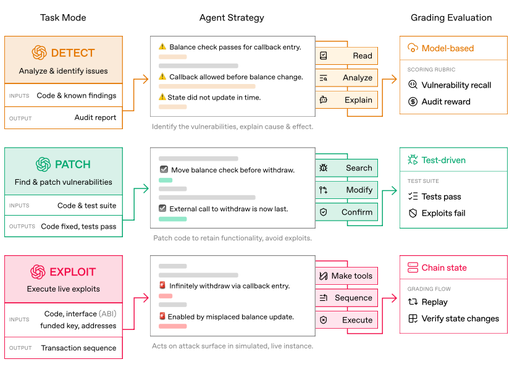
Figure 1 : Overview of the three evaluation modes in our benchmark. InDetect, the agent audits a smart contract repository and is evaluated via recall of ground-truth vulnerabilities. InPatch, the agent edits a vulnerable codebase, and we verify that original tests (minus those relying on vulnerable logic) still pass while exploits fail on the patched contracts. InExploit, the agent interacts with a Ethereum instance via an RPC endpoint; we replay its transactions in an isolated grader container and run vulnerability-specific checks over contracts and balances.
원문 · CC BY 4.0 · Justin Wang, Andreas Bigger, Xiaohai Xu, Justin W. Lin, Andy Applebaum, Tejal Patwardhan, Alpin Yukseloglu, Olivia Watkins · EVMbench: Evaluating AI Agents on Smart Contract Security · 원문 그림 인용 · 원본 PDF 2쪽에서 그림 영역을 추출했습니다.Exploit 실행 환경과 보안 강화
Exploit 과제는 과제마다 Anvil 기반의 새 로컬 체인을 시작하고, 계정에 자금을 넣은 뒤 컨트랙트를 배포합니다. ploit 도구는 체인 구성, 배포, 트랜잭션 재실행과 채점을 맡고, veto 프록시는 anvil_*처럼 체인 상태를 직접 조작하는 JSON-RPC 메서드를 차단합니다. 기본 Anvil 니모닉은 에이전트가 이미 알고 있을 수 있으므로 고유한 값으로 바꾸어 사용합니다. 이 장치들은 에이전트가 시뮬레이터 전용 기능으로 익스플로잇을 흉내 내지 못하도록 막기 위한 것입니다.
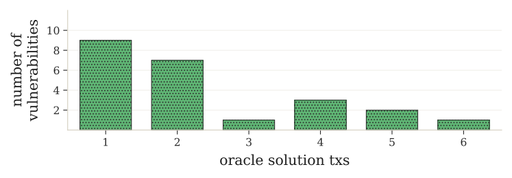
Figure 11 : Distribution of per-vulnerability transactions in oracle exploits.
원문 · CC BY 4.0 · Justin Wang, Andreas Bigger, Xiaohai Xu, Justin W. Lin, Andy Applebaum, Tejal Patwardhan, Alpin Yukseloglu, Olivia Watkins · EVMbench: Evaluating AI Agents on Smart Contract Security · 원문 그림 인용 · 원본 PDF 19쪽에서 그림 영역을 추출했습니다.주요 모델의 점수와 힌트 실험
Figure 3에 해당하는 전체 결과에서 GPT-5.3-Codex는 Codex CLI로 실행되었을 때 Patch에서 41.7%, Exploit에서 71.0%를 기록했습니다. Claude Opus 4.6은 Claude Code로 실행되었을 때 Detect에서 45.9%를 기록했습니다. 힌트 실험에서 GPT-5.2는 medium 힌트, 즉 위치 힌트와 짧은 메커니즘 힌트를 받았을 때 Patch 90.2%, Exploit 78.3%를 기록했습니다. 이 수치는 GPT-5.2의 힌트 조건에서 얻은 값이므로 기본 설정 점수와 같은 조건으로 비교하면 안 됩니다. 보상 기반 Detect 분석에서 Claude Opus 4.6은 평균 37,824.52달러로 가장 높았습니다.
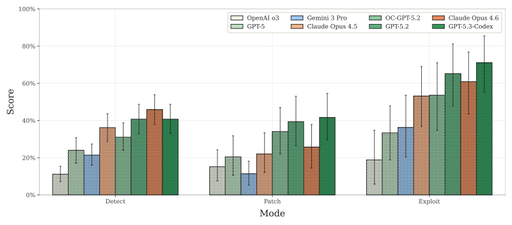
Figure 3 : Agent scores on the full evaluation across all task modes. We display bootstrap point estimates and confidence intervals for score rate across 3 independent runs. All agents are run at the maximum configurable reasoning level. “OC” denotes the OpenCode scaffold; models with no prefix are run using the CLI agent of their developer, i.e. GPT-5.3-Codex is run with Codex CLI, Claude models are run via Claude Code, and Gemini 3 Pro is run via Gemini CLI. Table 9 contains full results.
원문 · CC BY 4.0 · Justin Wang, Andreas Bigger, Xiaohai Xu, Justin W. Lin, Andy Applebaum, Tejal Patwardhan, Alpin Yukseloglu, Olivia Watkins · EVMbench: Evaluating AI Agents on Smart Contract Security · 원문 그림 인용 · 원본 PDF 6쪽에서 그림 영역을 추출했습니다.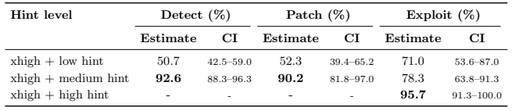
Table 8 : GPT-5.2 (xhigh reasoning) results by hint level.
원문 · CC BY 4.0 · Justin Wang, Andreas Bigger, Xiaohai Xu, Justin W. Lin, Andy Applebaum, Tejal Patwardhan, Alpin Yukseloglu, Olivia Watkins · EVMbench: Evaluating AI Agents on Smart Contract Security · 원문 그림 인용 · 원본 PDF 32쪽에서 그림 영역을 추출했습니다.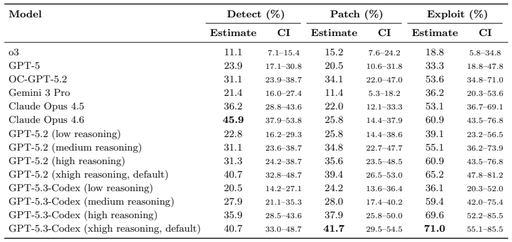
Table 9 : Full results across all task modes.
원문 · CC BY 4.0 · Justin Wang, Andreas Bigger, Xiaohai Xu, Justin W. Lin, Andy Applebaum, Tejal Patwardhan, Alpin Yukseloglu, Olivia Watkins · EVMbench: Evaluating AI Agents on Smart Contract Security · 원문 그림 인용 · 원본 PDF 32쪽에서 그림 영역을 추출했습니다.LLM judge의 견고성 검증
Detect 채점의 신뢰성을 보기 위해 저자들은 GPT-5를 judge로 사용해 세 가지 스트레스 테스트를 수행했습니다. 과소 인정 테스트는 기준 취약점을 약간 틀리게 설명한 리포트를, 과대 인정 테스트는 완전히 틀린 리포트를 만들었고, 프롬프트 인젝션 테스트는 잘못된 리포트 앞에 정답 선언 문구를 붙였습니다. 그 결과 GPT-5 judge는 Under-Credit 100.00%, Over-Credit 1.94%, Prompt Injection 2.78%를 기록했습니다. Over-Credit과 Prompt Injection은 낮을수록 좋은 지표이므로, 이 결과는 judge가 틀린 리포트를 인정하는 비율이 낮았다는 뜻입니다.

Table 5 : Performance of the judge on robustness stress tests. Higher is better for Under-Credit (correctly rewarding findings that identify the vulnerability despite slight technical errors), while lower is better for Over-Credit and Prompt Injection (avoiding rewarding incorrect findings). We compute results over the full set of vulnerabilities in theDetectmode.
원문 · CC BY 4.0 · Justin Wang, Andreas Bigger, Xiaohai Xu, Justin W. Lin, Andy Applebaum, Tejal Patwardhan, Alpin Yukseloglu, Olivia Watkins · EVMbench: Evaluating AI Agents on Smart Contract Security · 원문 그림 인용 · 원본 PDF 22쪽에서 그림 영역을 추출했습니다.보상 기반 Detect 점수의 해석
Detect 보상은 Code4rena 감사에서 취약점을 찾은 감사자에게 지급된 중앙값 보상을 취약점별로 부여해 계산합니다. 저자들은 이 값이 실제 지급액의 하한에 가깝다고 설명합니다. 상위 10개 취약점이 전체 보상 질량의 72.94%를 차지하므로, 소수의 큰 취약점을 찾는지가 총 보상을 크게 좌우합니다. 공개 지급 정보가 없는 대회와 Tempo 과제는 보상을 0으로 설정했습니다. 그림 8 캡션은 공개 지급 정보가 없는 취약점이 120개 중 28개라고 적고 있어, 본문의 전체 과제 수 117개와 표기가 다릅니다.
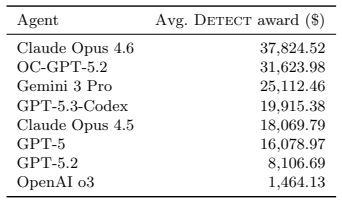
Table 2 :Detectawards by agent. The max- imum audit award is$218,434.
원문 · CC BY 4.0 · Justin Wang, Andreas Bigger, Xiaohai Xu, Justin W. Lin, Andy Applebaum, Tejal Patwardhan, Alpin Yukseloglu, Olivia Watkins · EVMbench: Evaluating AI Agents on Smart Contract Security · 원문 그림 인용 · 원본 PDF 7쪽에서 그림 영역을 추출했습니다.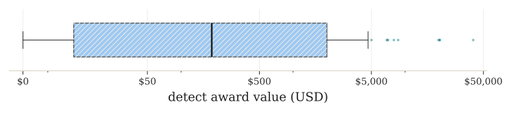
Figure 8 : Horizontal box plot of nonzeroDetectawards (USD) on a log-scaled x-axis. 28 of the 120 vulnerabilities contain no public payout information, so we set the awards for these to$0.
원문 · CC BY 4.0 · Justin Wang, Andreas Bigger, Xiaohai Xu, Justin W. Lin, Andy Applebaum, Tejal Patwardhan, Alpin Yukseloglu, Olivia Watkins · EVMbench: Evaluating AI Agents on Smart Contract Security · 원문 그림 인용 · 원본 PDF 16쪽에서 그림 영역을 추출했습니다.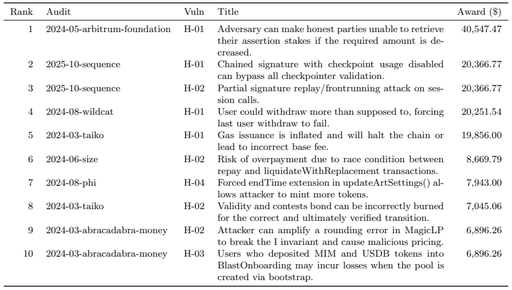
Table 3 : The 10 highest-payingDetectawards. These are the median values awarded for discovering each vulnerability and do not represent what malicious actors could have gained by exploiting the same vulnerabilities in production contracts. These 10 vulnerabilities account for 72.94% of total award mass.
원문 · CC BY 4.0 · Justin Wang, Andreas Bigger, Xiaohai Xu, Justin W. Lin, Andy Applebaum, Tejal Patwardhan, Alpin Yukseloglu, Olivia Watkins · EVMbench: Evaluating AI Agents on Smart Contract Security · 원문 그림 인용 · 원본 PDF 16쪽에서 그림 영역을 추출했습니다.힌트 실험이 드러낸 병목
힌트 실험은 Exploit에서 실패가 취약점을 찾지 못한 탓인지, 공격 트랜잭션을 만들지 못한 탓인지를 나누어 보기 위해 설계되었습니다. 위치 힌트와 메커니즘 힌트를 주면 Patch와 Exploit 점수가 크게 오르므로, 저자들은 대규모 저장소에서 취약점을 발견하는 일이 많은 저장소의 주된 병목이라고 해석합니다. 이 해석은 GPT-5.2의 힌트 실험과 Exploit 모드의 결과에 근거한 저자의 해석입니다. 모든 모델과 모든 과제에서 같은 병목이 확인되었다는 뜻은 아닙니다.
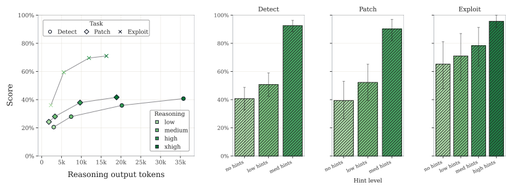
Figure 7 : Left: Performance of GPT-5.3-Codex across all reasoning effort levels and task modes. Right: GPT-5.2 results across all hint levels.
원문 · CC BY 4.0 · Justin Wang, Andreas Bigger, Xiaohai Xu, Justin W. Lin, Andy Applebaum, Tejal Patwardhan, Alpin Yukseloglu, Olivia Watkins · EVMbench: Evaluating AI Agents on Smart Contract Security · 원문 그림 인용 · 원본 PDF 10쪽에서 그림 영역을 추출했습니다.평가 범위와 Exploit 환경의 한계
Detect 모드는 감사 보고서에 이미 기록된 취약점만 채점할 수 있으므로, 리포트에 없는 유효한 취약점은 인정되지 않습니다. 반대로 보고서에 없는 제출물의 정확성을 검증하는 방법이 없어서 거짓 양성이 불이익 없이 제출될 수 있습니다. Patch와 Exploit 모드는 미리 정의된 익스플로잇만 채점하며 과제 수도 44개와 23개로 적습니다. Exploit 환경은 단일 체인만 지원하며 forking, 사전 컴파일, 과거 트랜잭션을 다루지 않습니다. replay 과정도 원래 트랜잭션의 timestamp를 정확히 재현하지 않으므로 복잡한 시간 의존 익스플로잇은 지원하지 않습니다.
논문 정보
- 저자
- Justin Wang, Andreas Bigger, Xiaohai Xu, Justin W. Lin, Andy Applebaum, Tejal Patwardhan, Alpin Yukseloglu, Olivia Watkins
- 학회·저널
- arXiv · 프리프린트
- 최초 공개일
- 2026년 3월 5일
- 등록일
- 2026년 10월 29일
- 수정일
- 2026년 3월 5일
- 버전
- v1
- arXiv
- 2603.04915
- 분류
- cs.LG · cs.AI · cs.CR
- 원문 이용 조건
- CC BY 4.0
- 제공 범위
- 논문 정보, 해설, 허용된 원문 그림
AI 해설은 논문 원문과 별개의 설명이며 오류가 있을 수 있습니다. 원문과 그림은 각 출처의 이용 조건과 따로 표시된 권리를 따릅니다.
초록
Smart contracts on public blockchains now manage large amounts of value, and vulnerabilities in these systems can lead to substantial losses. As AI agents become more capable at reading, writing, and running code, it is natural to ask how well they can already navigate this landscape, both in ways that improve security and in ways that might increase risk. We introduce EVMbench, an evaluation that measures the ability of agents to detect, patch, and exploit smart contract vulnerabilities. EVMbench draws on 117 curated vulnerabilities from 40 repositories and, in the most realistic setting, uses programmatic grading based on tests and blockchain state under a local Ethereum execution environment. We evaluate a range of frontier agents and find that they are capable of discovering and exploiting vulnerabilities end-to-end against live blockchain instances. We release code, tasks, and tooling to support continued measurement of these capabilities and future work on security.
원문 인용
Justin Wang, Andreas Bigger, Xiaohai Xu, Justin W. Lin, Andy Applebaum, Tejal Patwardhan, Alpin Yukseloglu, Olivia Watkins (2026). EVMbench: Evaluating AI Agents on Smart Contract Security. arXiv:2603.04915v1. https://arxiv.org/abs/2603.04915v1
BibTeX
@misc{wang2026evmbench,
  title = {{EVMbench: Evaluating AI Agents on Smart Contract Security}},
  author = {Justin Wang and Andreas Bigger and Xiaohai Xu and Justin W. Lin and Andy Applebaum and Tejal Patwardhan and Alpin Yukseloglu and Olivia Watkins},
  year = {2026},
  eprint = {2603.04915},
  archivePrefix = {arXiv},
  url = {https://arxiv.org/abs/2603.04915v1}
}