논문 해설
Self-Retrospection Distillation: Turning Post-hoc Experiences into Prior Foresight
자기 회고 증류: 사후 경험을 사전 예지로 전환하기
- 연구 문제 RLVR은 그룹 내 모든 롤아웃이 같은 보상을 받으면 그룹 상대 이점이 0이 되어 학습 신호가 사라집니다. 이 논문은 완료된 궤적의 사후 정보를 상호작용 이전의 예측(foresight)을 학습시키는 데 사용할 수 있는지 묻습니다.
- 연구 방법 Self-Retrospection Distillation(SRD)은 같은 정책이 생성한 사전 예측과 사후 정보가 조건부로 주어진 교사 분포를 정렬하는 보조 손실을 기존 RLVR 및 자기 증류 목표에 더합니다.
- 주요 결과 Qwen3.5-4B와 9B 기준선에 SRD를 추가하면 여러 범주의 평균이 개선된다고 보고됩니다. 2B 코드 설정에서 all-failure 그룹이 많을 때 SRD를 추가하면 RLVR이 0.0%에 머무는 반면 60.6%에 도달한다고 보고됩니다.
보상 대비가 사라지는 문제
RLVR에서 GRPO 계열 목표는 같은 과제의 여러 롤아웃 사이 보상 차이로 이점을 계산합니다. 모든 롤아웃이 같은 보상을 받으면 이점이 0이 되어, 궤적에 담긴 정보가 있어도 정책 갱신에 쓰이지 않습니다. 이 논문은 이 공백을 사후 경험으로 채울 수 있는지를 묻습니다.
사후 정보를 사전 예측으로 옮기기
SRD는 같은 정책이 과제와 환경 문맥만 보고 만든 foresight 분포와, 완료된 궤적 정보를 추가로 본 hindsight 교사 분포를 함께 둡니다. 학생은 자신의 foresight 시퀀스를 샘플링하고, 정지 기울기 자기 교사가 같은 접두사에 대해 만든 분포와 토큰 단위 발산을 줄입니다. 주요 설정에서는 실패 궤적에서 유도된 PITFALL 관점만 증류합니다.
기준선별 주요 결과
표 1 기준으로 Qwen3.5-4B에서는 GRPO에 SRD를 추가했을 때 Math, Code, Search 평균이 각각 10.03, 8.33, 8.05pp 향상되었다고 보고됩니다. Qwen3.5-9B에서는 OPSD에 SRD를 추가했을 때 Math 평균이 39.70%에서 56.92%로 올라갔다고 보고됩니다. 이 개선은 같은 avg@8 지표와 같은 기준선 대비로 읽어야 하며, WebShop 9B OPSD 설정 하나는 퇴보했습니다.
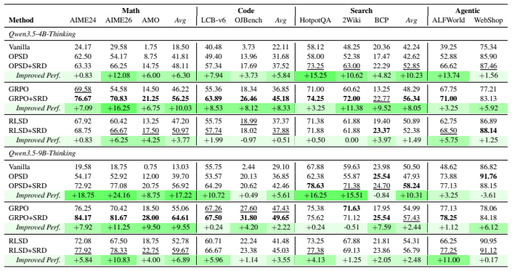
Table 1 : Main results on Math, Code, Search, and Agentic benchmarks, reported asavg@8pass rates in percent.Boldand underline mark the best and second-best result per column within each model scale.Improved Perf.rows give the absolute gain in points that+SRDcontributes over its own base algorithm, with a deeper green marking a larger gain.
원문 · CC BY 4.0 · Haoxiang Zhang, Qinglin Chen, Hiroaki Hayashi, Zhuofeng Li, Siming Zhang, Jiaxin Zhang, Jixuan Chen, Fang Wu, Pan Lu, Silvio Savarese, Julian McAuley, Chien-Sheng Wu · Self-Retrospection Distillation: Turning Post-hoc Experiences into Prior Foresight · 원문 그림 인용 · 원본 PDF 6쪽에서 그림 영역을 추출했습니다.PITFALL과 KNOWLEDGE 채널 비교
절제 실험에서 PITFALL만 증류한 설정이 KNOWLEDGE 채널을 더한 설정보다 비용이 적었습니다. 일부 KNOWLEDGE 추가 설정은 기준선보다 낮아졌습니다. 저자들은 KNOWLEDGE 채널의 발산이 학습 중 안정적으로 남아 중복적이라고 해석하지만, 이는 저자의 해석입니다.
적용 범위와 한계
본 결과는 제시된 모델 규모, 벤치마크, 평가 프로토콜에서 얻은 것입니다. 저자들은 SRD가 안전성, 공정성, 배포 신뢰성을 입증하지 않는다고 명시합니다. 상호작용 이전 예측을 추론 시 명시적으로 생성하는 방식은 별도 절제에서 다루며, 그 결과가 모든 설정에서 개선을 보장하지는 않습니다.
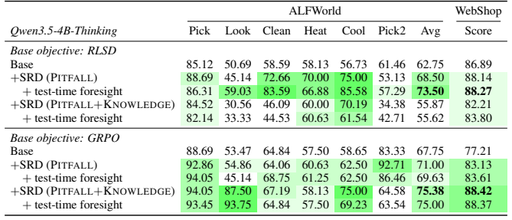
Table 3 : Making foresight explicit at inference, on Qwen3.5-4B-Thinking. Each+test-time fore- sightrow re-evaluates the checkpoint above it with the predicted KNOWLEDGE/PITFALLblocks emitted before acting. Benchmarks, splits and protocol are unchanged from §C.5, andAvgis on the same convention as Table 1. Cell shading is each value’s gain over the base of its own objective, on the scale of Table 1; base rows are unshaded.Bold: best per base objective.
원문 · CC BY 4.0 · Haoxiang Zhang, Qinglin Chen, Hiroaki Hayashi, Zhuofeng Li, Siming Zhang, Jiaxin Zhang, Jixuan Chen, Fang Wu, Pan Lu, Silvio Savarese, Julian McAuley, Chien-Sheng Wu · Self-Retrospection Distillation: Turning Post-hoc Experiences into Prior Foresight · 원문 그림 인용 · 원본 PDF 9쪽에서 그림 영역을 추출했습니다.논문 정보
- 저자
- Haoxiang Zhang, Qinglin Chen, Hiroaki Hayashi, Zhuofeng Li, Siming Zhang, Jiaxin Zhang, Jixuan Chen, Fang Wu, Pan Lu, Silvio Savarese, Julian McAuley, Chien-Sheng Wu
- 학회·저널
- arXiv · 프리프린트
- 최초 공개일
- 2026년 10월 6일
- 등록일
- 2026년 10월 20일
- 수정일
- 2026년 10월 14일
- 버전
- v3
- arXiv
- 2610.08077
- 분류
- cs.AI · cs.CL · cs.IR · cs.LG
- 원문 이용 조건
- CC BY 4.0
- 제공 범위
- 논문 정보, 해설, 허용된 원문 그림
AI 해설은 논문 원문과 별개의 설명이며 오류가 있을 수 있습니다. 원문과 그림은 각 출처의 이용 조건과 따로 표시된 권리를 따릅니다.
초록
Reinforcement learning with verifiable rewards (RLVR) turns agent experience into learning signals primarily through scalar outcome rewards after interaction. For group-relative objectives, however, this signal vanishes when all rollouts receive the same reward, even though their trajectories may reveal useful information about what the task requires and how the agent fails. We ask a complementary question: can hindsight teach an agent what it could have anticipated before acting? We introduce prospective learning, which uses post-hoc experience to supervise foresight predictions from the pre-interaction view, and instantiate it with Self-Retrospection Distillation (SRD). Intuitively, a completed trajectory reveals knowledge that would have been useful and pitfalls that should be avoided; SRD distills this privileged hindsight into trajectory-blind foresight of the same policy. Foresight serves only as a training target and need not be explicitly generated at inference time. Across 10 tool-integrated reasoning and long-horizon agentic tasks, SRD complements RLVR and self-distillation baselines with gains of up to 24.2 pp. Its advantage is especially pronounced when reward contrast is scarce: when 37--98% of rollout groups are reward-uniform across model scales, yet SRD can still exploit learning signal from sampled trajectories. In the 2B setting, where 98% of groups are all-failure, the RLVR training ends up at 0.0% success, while adding SRD reaches 60.6% under the same rollout budget. Our results suggest that post-hoc agent experience is useful not only for evaluating or improving behavior, but also for shaping predictive representations before available interaction. Training code can be found at https://github.com/SalesforceAIResearch/SRD.
원문 인용
Haoxiang Zhang, Qinglin Chen, Hiroaki Hayashi, Zhuofeng Li, Siming Zhang, Jiaxin Zhang, Jixuan Chen, Fang Wu, Pan Lu, Silvio Savarese, Julian McAuley, Chien-Sheng Wu (2026). Self-Retrospection Distillation: Turning Post-hoc Experiences into Prior Foresight. arXiv:2610.08077v3. https://arxiv.org/abs/2610.08077v3
BibTeX
@misc{zhang2026self,
  title = {{Self-Retrospection Distillation: Turning Post-hoc Experiences into Prior Foresight}},
  author = {Haoxiang Zhang and Qinglin Chen and Hiroaki Hayashi and Zhuofeng Li and Siming Zhang and Jiaxin Zhang and Jixuan Chen and Fang Wu and Pan Lu and Silvio Savarese and Julian McAuley and Chien-Sheng Wu},
  year = {2026},
  eprint = {2610.08077},
  archivePrefix = {arXiv},
  url = {https://arxiv.org/abs/2610.08077v3}
}