논문 해설
Is Data Shapley Not Better than Random in Data Selection? Ask NASH
데이터 Shapley는 데이터 선택에서 무작위 선택보다 낫지 않은가? NASH에게 물어보라
- 연구 문제 Data Shapley 기반 top-m 선택은 검증 정확도처럼 복잡한 효용에서 무작위 선택보다 못할 수 있습니다.
- 연구 방법 복잡한 효용을 검증 데이터별 Shapley-informative 성분으로 분해하고, 이들의 Shapley 합을 concave 함수로 비선형 집계하는 NASH 목적함수를 그리디로 최적화합니다.
- 주요 결과 일반 데이터 선택의 로지스틱 회귀 실험에서 NASH는 여러 선택 비율에서 Data Shapley와 무작위 선택보다 검증 정확도를 높였습니다.
Data Shapley의 top-m 선택이 실패하는 이유
데이터 선택은 제한된 크기 m의 학습 데이터 부분집합을 고르는 문제이며, 가장 흔한 방식은 각 데이터에 점수를 매기고 상위 m개를 고르는 top-m 휴리스틱입니다. Data Shapley는 각 데이터의 여러 부분집합에 대한 한계기여를 평균한 값을 점수로 쓰므로 데이터 사이의 상호작용을 고려한다는 장점이 있습니다. 그러나 최근 연구에서 검증 정확도 효용에 대해 Data Shapley로 고른 부분집합이 무작위 선택보다 못할 수 있다는 보고가 있었습니다. 이 논문은 Data Shapley가 어떤 효용 함수에서 잘 작동하는지, 그리고 검증 정확도처럼 복잡한 효용에서도 일관되게 효과를 내도록 만들 수 있는지를 질문합니다.
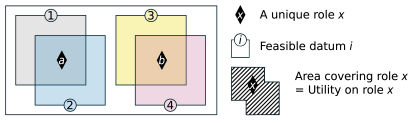
Figure 2 .Complex utility functions involving multiple roles (e.g., uV ) is not Shapley-informative.In this toy illustration, all data have the same Shapley value. Yet, if 1 has been selected, 3 would contribute more than 2 as rolebis uncovered.
원문 · CC BY 4.0 · Xiao Tian, Jue Fan, Rachael Hwee Ling Sim, Zixuan Wang, Nancy F. Chen, Bryan Kian Hsiang Low · Is Data Shapley Not Better than Random in Data Selection? Ask NASH · 원문 그림 인용 · 원본 PDF 4쪽에서 그림 영역을 추출했습니다.Shapley-informative 성분과 NASH 목적함수
이 논문은 효용 함수 u의 Shapley 값 합이 실제 효용을 확률적으로 나타내는 성질을 Shapley-informativeness로 정식화합니다. 검증 정확도 u_V는 여러 역할의 데이터 강점을 섞기 때문에 이 성질을 만족하기 어렵다고 설명합니다. 그래서 u_V를 검증 데이터별 prediction correctness u_v로 분해합니다. u_v는 Consistent Player 가정, 즉 각 학습 데이터가 특정 검증 데이터에 대해 일관되게 좋거나 나쁜 기여만 한다는 가정 아래 Shapley-informative하다고 증명됩니다. NASH는 이 성분들의 Shapley 합 ˆu_v(M)에 concave 함수 F_T를 적용하여 합산하는 목적함수 max Σ_v F_T(ˆu_v(M)) (|M|=m)를 씁니다.
F_T는 지수 법칙 기반으로 설정되며, 이는 F_T(x)=u_max−α exp(−λx)에서 λ 하나만 튜닝하는 형태로 정리됩니다.
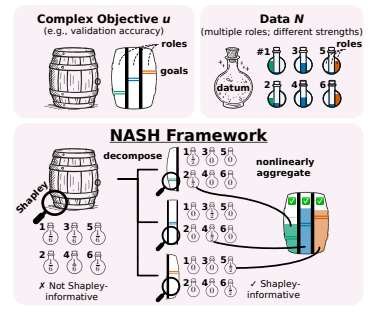
Figure 1 .Overview of NASH data selection framework.When the utility function (e.g., validation accuracy uV ) is complex and involves differentrolesof data (e.g., 3 roles in the figure), Shapley values fail to inform on data with different strengths (e.g., different columns of data in the figure), and thus may perform badly. To address this, our NASH first decomposes uV to simpler, fewer- role components where Shapley values are informative (i.e., each compartment in the figure). It then aggregates theseShapley- informative componentsnon-linearly to account for the interaction among selected data.
원문 · CC BY 4.0 · Xiao Tian, Jue Fan, Rachael Hwee Ling Sim, Zixuan Wang, Nancy F. Chen, Bryan Kian Hsiang Low · Is Data Shapley Not Better than Random in Data Selection? Ask NASH · 원문 그림 인용 · 원본 PDF 1쪽에서 그림 영역을 추출했습니다.
Table 3 .A set of games that are not distinguishable from their Shapley value vectors.x, y, z∈Rare arbitrary numbers.
원문 · CC BY 4.0 · Xiao Tian, Jue Fan, Rachael Hwee Ling Sim, Zixuan Wang, Nancy F. Chen, Bryan Kian Hsiang Low · Is Data Shapley Not Better than Random in Data Selection? Ask NASH · 원문 그림 인용 · 원본 PDF 20쪽에서 그림 영역을 추출했습니다.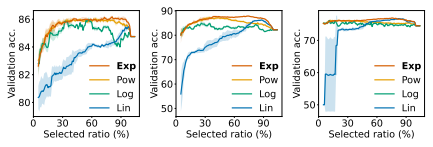
Figure 15 .Comparison across different choices ofF T .The exponential form (in the main paper) consistently gives the best result.
원문 · CC BY 4.0 · Xiao Tian, Jue Fan, Rachael Hwee Ling Sim, Zixuan Wang, Nancy F. Chen, Bryan Kian Hsiang Low · Is Data Shapley Not Better than Random in Data Selection? Ask NASH · 원문 그림 인용 · 원본 PDF 31쪽에서 그림 영역을 추출했습니다.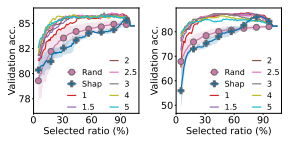
Figure 17 .NASH works well for a wide range ofλ’s (i.e., different numbers in the legends).
원문 · CC BY 4.0 · Xiao Tian, Jue Fan, Rachael Hwee Ling Sim, Zixuan Wang, Nancy F. Chen, Bryan Kian Hsiang Low · Is Data Shapley Not Better than Random in Data Selection? Ask NASH · 원문 그림 인용 · 원본 PDF 31쪽에서 그림 영역을 추출했습니다.그리디 최적화와 계산 비용
NASH 목적함수는 Shapley 값이 모두 음이 아닐 때 단조 부분모듈러이므로 그리디 알고리즘이 (1−1/e) 근사를 보장합니다. 실제 데이터에는 음의 Shapley 값이 있지만, 논문은 해로운 데이터를 제외하면 부분모듈러성 비율이 1에 가까워진다고 보고합니다. 알고리즘은 사전에 각 검증 데이터 v의 Shapley 벡터 ϕ_{u_v}를 계산한 뒤, 매 라운드 목적함수 증가량이 가장 큰 데이터를 추가합니다. 각 성분의 Shapley 값은 검증 정확도의 Shapley 값을 계산할 때 이미 얻는 u_v(S) 값으로 만들어지므로 추가 학습 비용은 거의 없다고 설명됩니다.
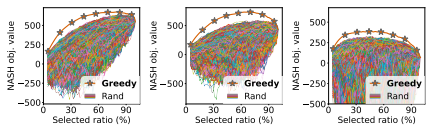
Figure 10 .Comparison of the objective value given by greedily selected subsets vs. randomly selected subsets.The greedy algorithm consistently gives a much higher objective value.
원문 · CC BY 4.0 · Xiao Tian, Jue Fan, Rachael Hwee Ling Sim, Zixuan Wang, Nancy F. Chen, Bryan Kian Hsiang Low · Is Data Shapley Not Better than Random in Data Selection? Ask NASH · 원문 그림 인용 · 원본 PDF 25쪽에서 그림 영역을 추출했습니다.
Table 5 .Empirical submodularity ratio as different proportions of low-quality data (indicated by low Shapley values) are removed from the feasible set on WD-LRs.
원문 · CC BY 4.0 · Xiao Tian, Jue Fan, Rachael Hwee Ling Sim, Zixuan Wang, Nancy F. Chen, Bryan Kian Hsiang Low · Is Data Shapley Not Better than Random in Data Selection? Ask NASH · 원문 그림 인용 · 원본 PDF 25쪽에서 그림 영역을 추출했습니다.일반 데이터 선택 실험
논문은 로지스틱 회귀 모델을 Wind(WD-LR), Pol(PO-LR), Phoneme(PM-LR) 데이터셋에서 평가했습니다. 비교 대상은 무작위 선택, vanilla Data Shapley, NASH이며, 선택 비율을 바꾸며 검증 정확도를 측정했습니다. 원문은 일반 데이터 선택에서 NASH가 여러 선택 비율에서 기준선보다 뚜렷하게 개선되었다고 보고합니다. 다만 Data Shapley와 무작위 선택의 상대 순서는 데이터셋에 따라 일관되지 않았습니다. 대형 언어 모델 fine-tuning 실험은 BERT와 Llama-2-7B를 쓰며 별도의 설정 아래에서 수행되었습니다.
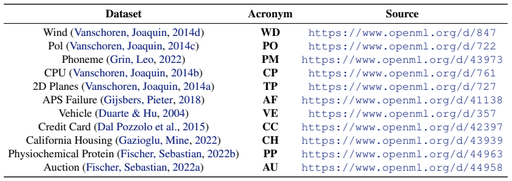
Table 6 .List of standard data valuation datasets used in this paper.
원문 · CC BY 4.0 · Xiao Tian, Jue Fan, Rachael Hwee Ling Sim, Zixuan Wang, Nancy F. Chen, Bryan Kian Hsiang Low · Is Data Shapley Not Better than Random in Data Selection? Ask NASH · 원문 그림 인용 · 원본 PDF 26쪽에서 그림 영역을 추출했습니다.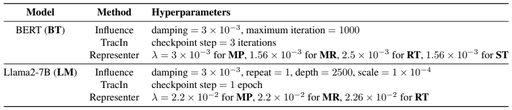
Table 9 .List of hyperparameters for baseline data valuation methods.
원문 · CC BY 4.0 · Xiao Tian, Jue Fan, Rachael Hwee Ling Sim, Zixuan Wang, Nancy F. Chen, Bryan Kian Hsiang Low · Is Data Shapley Not Better than Random in Data Selection? Ask NASH · 원문 그림 인용 · 원본 PDF 27쪽에서 그림 영역을 추출했습니다.적용 범위와 한계
이 결과는 논문이 실험한 로지스틱 회귀 모델과 해당 데이터셋, 그리고 검증 정확도 효용의 범위에서 얻은 것입니다. Consistent Player 가정은 실험으로 낮은 위반율이 확인되었지만, 이것이 모든 모델과 데이터에 성립한다는 증명은 아닙니다. 또한 무작위 선택과 Data Shapley의 비교 결과는 데이터셋에 따라 달라지며, 제시된 효율 수치는 해당 구현과 근사 방법 아래의 측정입니다.

Table 4 .Violation frequency of the Consistent Player assumption (WD-LR).The results are measured on theWD-LRdataset (Sec. D.1.1). We sample10,000marginal contributions for each pair of training datum and validation datum.
원문 · CC BY 4.0 · Xiao Tian, Jue Fan, Rachael Hwee Ling Sim, Zixuan Wang, Nancy F. Chen, Bryan Kian Hsiang Low · Is Data Shapley Not Better than Random in Data Selection? Ask NASH · 원문 그림 인용 · 원본 PDF 21쪽에서 그림 영역을 추출했습니다.논문 정보
- 저자
- Xiao Tian, Jue Fan, Rachael Hwee Ling Sim, Zixuan Wang, Nancy F. Chen, Bryan Kian Hsiang Low
- 학회·저널
- arXiv · 프리프린트
- 최초 공개일
- 2026년 5월 11일
- 등록일
- 2026년 10월 29일
- 수정일
- 2026년 5월 12일
- 버전
- v2
- arXiv
- 2605.10684
- 분류
- cs.LG · cs.AI
- 원문 이용 조건
- CC BY 4.0
- 제공 범위
- 논문 정보, 해설, 허용된 원문 그림
AI 해설은 논문 원문과 별개의 설명이며 오류가 있을 수 있습니다. 원문과 그림은 각 출처의 이용 조건과 따로 표시된 권리를 따릅니다.
초록
Data selection studies the problem of identifying high-quality subsets of training data. While some existing works have considered selecting the subset of data with top-$m$ Data Shapley or other semivalues as they account for the interaction among every subset of data, other works argue that Data Shapley can sometimes perform ineffectively in practice and select subsets that are no better than random. This raises the questions: (I) Are there certain "Shapley-informative" settings where Data Shapley consistently works well? (II) Can we strategically utilize these settings to select high-quality subsets consistently and efficiently? In this paper, we propose a novel data selection framework, NASH (Non-linear Aggregation of SHapley-informative components), which (I) decomposes the target utility function (e.g., validation accuracy) into simpler, Shapley-informative component functions, and selects data by optimizing an objective that (II) aggregates these components non-linearly. We demonstrate that NASH substantially boosts the effectiveness of Shapley/semivalue-based data selection with minimal additional runtime cost.
원문 인용
Xiao Tian, Jue Fan, Rachael Hwee Ling Sim, Zixuan Wang, Nancy F. Chen, Bryan Kian Hsiang Low (2026). Is Data Shapley Not Better than Random in Data Selection? Ask NASH. arXiv:2605.10684v2. https://arxiv.org/abs/2605.10684v2
BibTeX
@misc{tian2026data,
  title = {{Is Data Shapley Not Better than Random in Data Selection? Ask NASH}},
  author = {Xiao Tian and Jue Fan and Rachael Hwee Ling Sim and Zixuan Wang and Nancy F. Chen and Bryan Kian Hsiang Low},
  year = {2026},
  eprint = {2605.10684},
  archivePrefix = {arXiv},
  url = {https://arxiv.org/abs/2605.10684v2}
}