논문 해설
Before AI Agents Negotiate for Us: A Competitive Tournament of Rule-Based, Search, Optimization, Learned, and Language-Model Negotiators Under Scarcity
AI 에이전트가 우리를 대신해 협상하기 전에: 희소성 아래에서 규칙 기반, 탐색, 최적화, 학습, 언어 모델 협상자의 경쟁 토너먼트
- 연구 문제 여러 경쟁자가 동시에 있는 매칭 시장에서는 협상 전략의 가격 성과와 매칭 성공이 따로 움직일 수 있습니다.
- 연구 방법 아홉 개 협상 엔진을 같은 시장에서 동시에 실행하고, Gale-Shapley 매칭 뒤의 마진과 이익으로 비교했습니다.
매칭 시장에서 협상 전략이 필요한 이유
협상 에이전트는 두 가지 문제를 동시에 풀어야 합니다. 하나는 양자 테이블에서 좋은 가격을 얻는 것이고, 다른 하나는 모든 테이블의 결과를 안정 매칭에 넣었을 때 실제로 짝이 되는 것입니다. 이 논문은 화주와 운송사가 여러 테이블에서 동시에 가격을 협상하고 Gale-Shapley 지연 수락으로 매칭되는 시장을 설정합니다.
기존 비교는 고정된 상대와의 일대일 대결이거나 하나의 고정된 시장 조건에서 한 집단을 비교하는 방식이었습니다. 그래서 여러 경쟁 상대가 동시에 있을 때 전략이 어떻게 행동하는지, 공급과 수요 균형이 희소 쪽으로 기울 때 성과가 어떻게 바뀌는지는 드러나지 않습니다.
이 연구는 규칙 기반, 탐색 기반, 최적화, 모방 학습, 강화학습, 언어 모델 협상자를 같은 프로토콜에서 비교합니다.
Gale-Shapley 매칭과 협상 거리
각 협상은 화주 집합과 운송사 집합이 모든 쌍에서 테이블을 열고, 턴 기준으로 진행됩니다. 엔진은 자신의 테이블 상태와 같은 협상의 다른 열린 테이블 스냅샷을 봅니다. 운송사의 합법 제안 밴드는 참조 가격 평균에서 표준편차의 절반을 뺀 값과 더한 값 사이이며, 화주는 판매가에서 물품 원가를 뺀 상한과 목표 가격 사이에서 제안합니다.
닫힌 테이블만 Gale-Shapley 지연 수락 알고리즘에 들어갑니다. 교착된 테이블은 선호 목록에서 빠집니다. 매칭된 운송사의 마진은 실제 가격에서 경로의 참조 가격 평균을 뺀 값이고, 매칭된 화주의 이익은 판매가에서 가격과 물품 원가를 뺀 값입니다. 매칭되지 않은 경우 운송사 마진은 0, 화주 이익은 0으로 기록됩니다.
핵심 척도인 협상 거리는 가격 p를 밴드의 최저값 w와 목표 b 사이에서 정규화합니다. 값이 0이면 허용되는 가장 나쁜 거래이고 1이면 목표 거래입니다. 이 척도 위에서 R V와 IS는 수락과 계속 제안을 비교하고, OPT와 OPT2는 후보 가격에 대한 기대 협상 거리를 최대화하며, ML과 ML2는 이 척도로 예측한 제안을 사용합니다.
RL과 RL2의 학습 환경 차이
RL은 근접 정책 최적화로 학습되었고, 보상은 격리된 단일 테이블 환경에서 합법적인 거래가 닫힐 때만 주어졌습니다. 학습 중에는 경쟁하는 운송사가 없었습니다.
RL2는 같은 행동 방식과 같은 알고리즘을 쓰지만, 한두 명의 같은 쪽 경쟁자와 함께 Gale-Shapley 매칭을 거치는 작은 경쟁 하위 라운드에서 학습되었습니다. 교착에는 -0.5, 자기 테이블은 닫혔지만 매칭에서 상대가 다른 경쟁자에게 가면 -0.15, 매칭을 이기면 협상 거리 보상을 받았습니다.
배포 과정에서 RL2의 추론 경로가 점유 특성을 중립 기본값으로 고정한다는 확인된 버그가 드러났습니다. 학습 환경에서는 이 특성이 항상 중립값이었지만, 실제 배포에서는 여러 테이블을 동시에 협상하므로 값이 달라질 수 있습니다. 저자들은 이 불일치를 고치지 않고 배포된 그대로 평가했습니다.
희소 시장에서 매칭률의 붕괴
균형 시장의 상위 집단은 ML2, RL, OPT 엔진으로 통계적으로 구별되지 않았습니다.
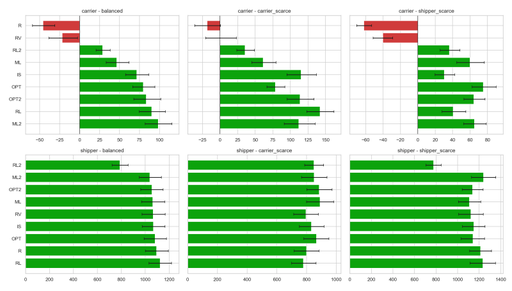
Figure 4 : Bootstrap mean outcome (margin for carriers, profit for shippers) by architecture, for all nine architectures under all three market conditions. Error bars are 95% percentile bootstrap confidence intervals.
원문 · CC BY 4.0 · Eduardo de Avila-Armenta, Raúl Alejandro Aquino-Ibarra, Jorge Octavio Nicolás-Díaz, Umberto Leon-Dominguez · Before AI Agents Negotiate for Us: A Competitive Tournament of Rule-Based, Search, Optimization, Learned, and Language-Model Negotiators Under Scarcity · 원문 그림 인용 · 원본 PDF 14쪽에서 그림 영역을 추출했습니다.RL2의 매칭률은 세 조건에서 0.92, 0.93, 0.92로 안정적이었습니다. 다만 R과 R V도 경쟁 훈련 없이 비슷하게 안정적이었으므로, 매칭률의 안정성만으로 RL2 훈련의 효과를 입증할 수는 없습니다.
균형 시장의 화주 쪽에서는 RL2가 여덟 개의 유의한 비교 모두에서 졌습니다. 이 결과는 경쟁 훈련이 매칭률 붕괴를 막았지만 실현 이익에서는 훈련과 배포의 특성 불일치 때문에 손해를 봤다는 해석을 뒷받침합니다.
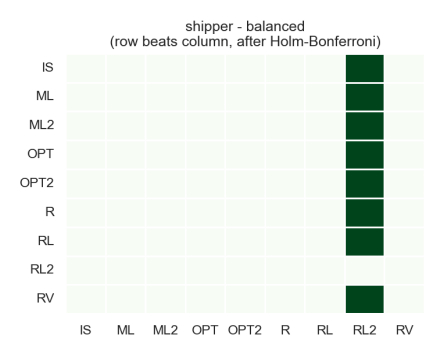
Figure 5 : Shipper-side win matrix, balanced market condition: a filled cell in rowi, columnj means architectureisignificantly outperforms architecturejafter Holm-Bonferroni correction. RL2 wins zero of its eight comparisons.
원문 · CC BY 4.0 · Eduardo de Avila-Armenta, Raúl Alejandro Aquino-Ibarra, Jorge Octavio Nicolás-Díaz, Umberto Leon-Dominguez · Before AI Agents Negotiate for Us: A Competitive Tournament of Rule-Based, Search, Optimization, Learned, and Language-Model Negotiators Under Scarcity · 원문 그림 인용 · 원본 PDF 15쪽에서 그림 영역을 추출했습니다.언어 모델 협상자와 고정 경쟁자 비교
언어 모델 협상자는 R, OPT2, ML2를 고정 경쟁자로 두고 같은 쪽의 시장에 배치되었습니다. 모델은 세 가지 계층의 아홉 개 모델이며, 역할별로 40 협상일을 사용했고 호출마다 90초 시간 제한이 있었습니다.
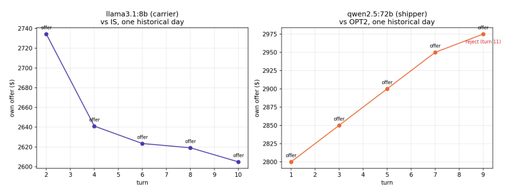
Figure 9 : Two ordinary negotiations, reconstructed from saved per-call logs. Left:llama3.1:8b (carrier) vs. IS, conceding from$2734.31 to$2604.91 over five turns. Right:qwen2.5:72b (shipper) vs. OPT2, conceding from$2800.00 to$2975.00 over five offers before being rejected at the final turn. Only the language model’s own emitted offers are shown; the counterpart’s offers were not separately persisted during data collection.
원문 · CC BY 4.0 · Eduardo de Avila-Armenta, Raúl Alejandro Aquino-Ibarra, Jorge Octavio Nicolás-Díaz, Umberto Leon-Dominguez · Before AI Agents Negotiate for Us: A Competitive Tournament of Rule-Based, Search, Optimization, Learned, and Language-Model Negotiators Under Scarcity · 원문 그림 인용 · 원본 PDF 21쪽에서 그림 영역을 추출했습니다.OPT2와 ML2를 상대로 한 비교에서 언어 모델은 36개 중 32개가 유의하게 졌고 이긴 비교는 없었습니다. R을 상대로는 유의한 패배 10개와 유의한 승리 4개가 있었지만, 이 승리 중 두 개는 매칭률이 낮은 모델이 강제 탈락의 0 점수를 받아 생긴 결과로 저자들은 해석합니다.
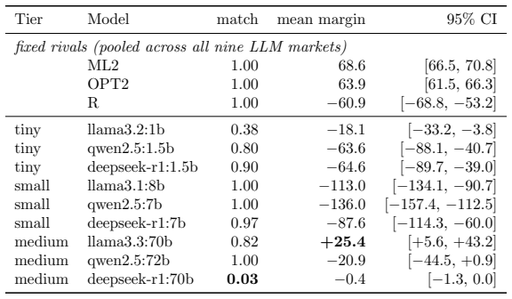
Table 4 : Carrier-side LLM results: match rate and bootstrap mean margin (95% CI), by tier and family, against the three fixed same-side rivals in the same markets.
원문 · CC BY 4.0 · Eduardo de Avila-Armenta, Raúl Alejandro Aquino-Ibarra, Jorge Octavio Nicolás-Díaz, Umberto Leon-Dominguez · Before AI Agents Negotiate for Us: A Competitive Tournament of Rule-Based, Search, Optimization, Learned, and Language-Model Negotiators Under Scarcity · 원문 그림 인용 · 원본 PDF 18쪽에서 그림 영역을 추출했습니다.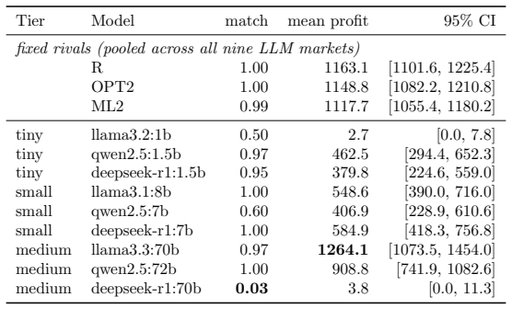
Table 5 : Shipper-side LLM results: match rate and bootstrap mean profit (95% CI).
원문 · CC BY 4.0 · Eduardo de Avila-Armenta, Raúl Alejandro Aquino-Ibarra, Jorge Octavio Nicolás-Díaz, Umberto Leon-Dominguez · Before AI Agents Negotiate for Us: A Competitive Tournament of Rule-Based, Search, Optimization, Learned, and Language-Model Negotiators Under Scarcity · 원문 그림 인용 · 원본 PDF 18쪽에서 그림 영역을 추출했습니다.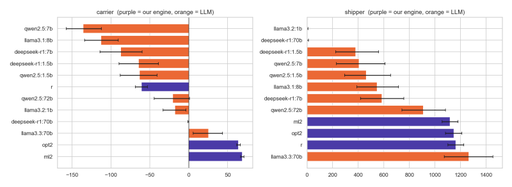
Figure 7 : Each language model’s bootstrap mean outcome against its three fixed same-side rivals (purple), by role. Orange bars are the nine language models.
원문 · CC BY 4.0 · Eduardo de Avila-Armenta, Raúl Alejandro Aquino-Ibarra, Jorge Octavio Nicolás-Díaz, Umberto Leon-Dominguez · Before AI Agents Negotiate for Us: A Competitive Tournament of Rule-Based, Search, Optimization, Learned, and Language-Model Negotiators Under Scarcity · 원문 그림 인용 · 원본 PDF 18쪽에서 그림 영역을 추출했습니다.llama3.3:70b는 상대 R을 두 역할 모두에서 이긴 유일한 모델이었습니다. deepseek-r1:70b는 매칭률이 2.5%에 그쳤는데, 호출 지연이 90초 시간 제한에 거의 닿아 있었습니다. 저자들은 이 결과를 이 워크스테이션의 배포 제약으로 보고 모델군 전체의 한계로 일반화하지 않습니다.
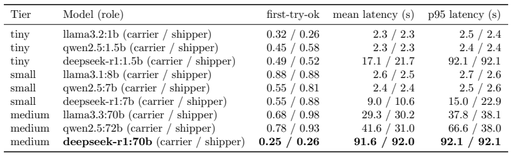
Table 6 : Structured-output compliance and latency, by tier, family, and role (DeepSeek-R1’s thinksetting differs by role; see the methodological note above).
원문 · CC BY 4.0 · Eduardo de Avila-Armenta, Raúl Alejandro Aquino-Ibarra, Jorge Octavio Nicolás-Díaz, Umberto Leon-Dominguez · Before AI Agents Negotiate for Us: A Competitive Tournament of Rule-Based, Search, Optimization, Learned, and Language-Model Negotiators Under Scarcity · 원문 그림 인용 · 원본 PDF 19쪽에서 그림 영역을 추출했습니다.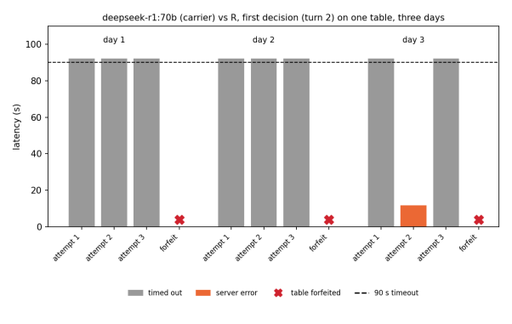
Figure 10 :deepseek-r1:70b(carrier) vs. R, the model’s first decision (turn 2) on one table on three successive logged days. Each bar is one call attempt: grey bars timed out near the 90 s request ceiling (dashed line), the orange bar failed earlier with a server-side error, and the red cross after each group of three attempts marks the table’s forfeit once the retry budget was exhausted. No attempt produced a usable response.
원문 · CC BY 4.0 · Eduardo de Avila-Armenta, Raúl Alejandro Aquino-Ibarra, Jorge Octavio Nicolás-Díaz, Umberto Leon-Dominguez · Before AI Agents Negotiate for Us: A Competitive Tournament of Rule-Based, Search, Optimization, Learned, and Language-Model Negotiators Under Scarcity · 원문 그림 인용 · 원본 PDF 22쪽에서 그림 영역을 추출했습니다.합성 시장과 통계 가정의 한계
시장 모델의 가격은 합성 데이터이며 실제 운송 시장 데이터에 맞춰 보정되지 않았습니다. 따라서 절대 크기는 실제 시장의 예측으로 쓰기 어렵고, 같은 합성 시장 안의 상대 비교가 이 논문의 결과입니다.
가격 과정은 연속된 협상 지수 사이에 상관을 만듭니다. 대응 Wilcoxon 검정의 독립 가정이 이 상관을 다루지 못하고, 동점 처리 방법도 보고되지 않았습니다. 쌍별 비교에서는 Holm-Bonferroni 보정 유의성만 보고했고 표준화된 효과 크기는 제시하지 않았습니다.
각 엔진은 고정된 하이퍼파라미터로 한 번 설정되었으므로 보고된 순위는 각 아키텍처의 최선 성능이 아닐 수 있습니다. 언어 모델 프롬프트도 한 가지 시스템 프롬프트로만 실행되었습니다.
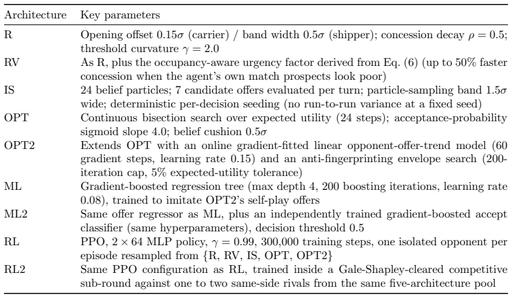
Table 1 : Governing hyperparameters for all nine architectures, held fixed across every market condition and role.
원문 · CC BY 4.0 · Eduardo de Avila-Armenta, Raúl Alejandro Aquino-Ibarra, Jorge Octavio Nicolás-Díaz, Umberto Leon-Dominguez · Before AI Agents Negotiate for Us: A Competitive Tournament of Rule-Based, Search, Optimization, Learned, and Language-Model Negotiators Under Scarcity · 원문 그림 인용 · 원본 PDF 11쪽에서 그림 영역을 추출했습니다.논문 정보
- 저자
- Eduardo de Avila-Armenta, Raúl Alejandro Aquino-Ibarra, Jorge Octavio Nicolás-Díaz, Umberto Leon-Dominguez
- 학회·저널
- arXiv · 프리프린트
- 최초 공개일
- 2026년 11월 11일
- 등록일
- 2026년 11월 13일
- 수정일
- 2026년 11월 11일
- 버전
- v1
- arXiv
- 2611.15838
- 분류
- cs.AI · cs.GT · cs.LG · cs.MA
- 원문 이용 조건
- CC BY 4.0
- 제공 범위
- 논문 정보, 해설, 허용된 원문 그림
AI 해설은 논문 원문과 별개의 설명이며 오류가 있을 수 있습니다. 원문과 그림은 각 출처의 이용 조건과 따로 표시된 권리를 따릅니다.
초록
Automated bilateral negotiation underlies two-sided matching markets such as freight brokering, where many shippers and carriers negotiate price before a matching mechanism decides who is paired with whom. Prior strategy comparisons typically use isolated one-on-one duels or a single fixed market, so they cannot show how a strategy behaves against several live rivals under a changing balance of supply and demand. We built nine negotiation architectures spanning rule-based, search-based, optimization-based, imitation-learning, and reinforcement-learning families, and ran all nine simultaneously on both sides of a Gale-Shapley matching market under a balanced condition and two scarcity conditions rotated across all 36 exclusion pairs. In the balanced carrier market, an imitation-learned engine (ML2), a reinforcement-learning policy trained only on isolated negotiations (RL), and an expected-utility optimization engine (OPT) formed a statistically tied top group, and no architecture led in every condition and role. RL beat all eight carrier rivals when carriers were scarce, but its match rate collapsed from 62% to 16% when shippers were scarce and it had to compete with the other carrier agents for demand. A second reinforcement-learning policy trained against rival agents (RL2) kept its match rate above 91% in every condition, yet lost on realized payoff to all eight shipper-side rivals in two of the three conditions, traced to a confirmed train/deployment feature mismatch. We also tested nine large language models (LLMs), from 1 to 72 billion parameters, under the same protocol: they lost significantly to the two strongest engines (OPT2 and ML2) in 32 of 36 comparisons and won none. These results show that isolated or single-condition evaluation can hide failure modes that a many-sided, scarcity-varying, statistically corrected tournament exposes directly.
원문 인용
Eduardo de Avila-Armenta, Raúl Alejandro Aquino-Ibarra, Jorge Octavio Nicolás-Díaz, Umberto Leon-Dominguez (2026). Before AI Agents Negotiate for Us: A Competitive Tournament of Rule-Based, Search, Optimization, Learned, and Language-Model Negotiators Under Scarcity. arXiv:2611.15838v1. https://arxiv.org/abs/2611.15838v1
BibTeX
@misc{avilaarmenta2026before,
  title = {{Before AI Agents Negotiate for Us: A Competitive Tournament of Rule-Based, Search, Optimization, Learned, and Language-Model Negotiators Under Scarcity}},
  author = {Eduardo de Avila-Armenta and Raúl Alejandro Aquino-Ibarra and Jorge Octavio Nicolás-Díaz and Umberto Leon-Dominguez},
  year = {2026},
  eprint = {2611.15838},
  archivePrefix = {arXiv},
  url = {https://arxiv.org/abs/2611.15838v1}
}