논문 해설
Looking Beyond Two Frames: End-to-End Multi-Object Tracking Using Spatial and Temporal Transformers
두 프레임을 넘어서: 공간 및 시간 트랜스포머를 이용한 엔드투엔드 다중 객체 추적
- 연구 문제 다중 객체 추적에서 트랙 초기화, 종료, 가림 처리를 두 프레임 기반 휴리스틱 없이 학습하는 문제를 다룹니다.
- 연구 방법 MO3TR은 시간 Transformer로 객체의 장기 임베딩 기록을 예측하고 공간 Transformer로 객체와 이미지의 상호작용을 정제하는 종단간 추적 구조입니다.
- 주요 결과 검증 집합에서 추적 기록 길이를 늘리면 MOTA가 55.4에서 58.9로 증가했다고 보고되며, 벤치마크 결과는 설정별 표에서 확인됩니다.
기존 MOT의 한계와 연구 질문
다중 객체 추적(MOT)은 시간에 따라 수가 변하는 객체를 영상에서 구분하고 각 객체의 궤적을 만드는 과제입니다. 기존의 많은 방법은 검출, 데이터 연관, 트랙 관리, 필터링을 여러 단계로 나누어 처리하며, 트랙 초기화와 종료, 가림 처리를 휴리스틱이나 후처리에 의존합니다. 또한 최근의 검출과 추적을 함께 학습하는 방법들도 두 연속 프레임만 보는 경우가 많아 장기 시간 정보를 충분히 활용하지 못합니다. 이 논문은 장기 시간 정보를 학습 가능한 구조로 다루어 데이터 연관 모듈 없이 종단간으로 추적을 학습할 수 있는지를 묻습니다.
MO3TR의 시간 및 공간 Transformer 구조
MO3TR은 각 객체의 과거 임베딩 기록인 track history를 입력으로 받습니다. 시간 Transformer는 위치 인코딩을 더한 과거 임베딩에 주의를 기울여 현재 시점의 객체 표현을 예측합니다. 이어서 공간 Transformer는 예측된 객체 표현과 학습된 초기화 질의, 입력 이미지의 특징을 결합하여 객체 사이의 상호작용을 self-attention으로, 객체와 이미지의 관계를 cross-attention으로 정제합니다. 정제된 임베딩은 분류와 바운딩 박스 회귀에 쓰이며, 확률이 0.5를 넘는 객체는 다음 시점의 track history에 추가됩니다. 이 구조에서 데이터 연관은 명시적 모듈로 분리되지 않고 임베딩 전달로 처리됩니다.
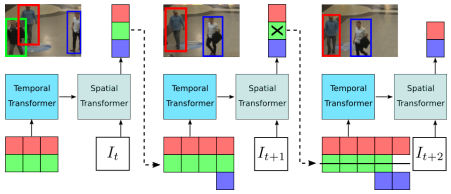
Fig. 1 . Looking beyond two frames with MO3TR: Temporal and spatial Transformers jointly pay attention to the current image It and the entire embedding history of the two tracked objects ( red and green, left). Detection of a previously untracked object (blue) causes initiation of new track (left → middle), while an object exiting the scene ( green) leads to track termination (middle → right). Embeddings encoding spatial and temporal interactions are accumulated over time to form individual object-track histories.
원문 · CC BY 4.0 · Tianyu Zhu, Markus Hiller, Mahsa Ehsanpour, Rongkai Ma, Tom Drummond, Ian Reid, Hamid Rezatofighi · Looking Beyond Two Frames: End-to-End Multi-Object Tracking Using Spatial and Temporal Transformers · 원문 그림 인용 · 원본 PDF 2쪽에서 그림 영역을 추출했습니다.집합 매칭과 다중 프레임 학습
학습 중 예측 집합과 정답 집합은 Hungarian algorithm으로 최소 비용의 이분 매칭을 구합니다. 매칭 비용은 클래스 확률과 바운딩 박스 유사도를 함께 사용하며, 박스 유사도에는 L1 거리와 generalized intersection over union을 조합합니다. 논문은 두 프레임 샘플링 대신 최대 30개의 연속 프레임을 사용해 가림, 초기화, 종료 상황이 학습 중 자연스럽게 나타나도록 합니다. 또한 임베딩 삭제, 거짓 양성 삽입, 시퀀스 길이 무작위화라는 증강을 적용해 데이터의 불균형을 줄입니다.
벤치마크 비교와 공개 검출 설정
MO3TR은 MOT16, MOT17, MOT20 벤치마크에서 평가되었습니다. 공개 검출 설정에서는 MOTChallenge가 제공한 검출 결과를 사용하며, 임베딩 기반인 MO3TR은 검출을 직접 입력으로 받지 않으므로 중심 거리(CD) 또는 교집합/합집합 비율(IoU)로 트랙 초기화를 필터링합니다. 결과의 주요 지표는 MOTA, IDF1, HOTA이며, 원문 표는 공개 검출 설정과 사설 검출 설정을 구분하여 보고합니다. 이 비교 결과는 각 표의 데이터와 검출 설정에 한정하여 읽어야 합니다.
절제 실험과 학습 전략의 효과
검증 집합에서 추적 기록 길이를 1, 10, 20, 30으로 바꾼 실험에서 MOTA는 55.4, 56.8, 57.8, 58.9로 증가했습니다. 같은 검증 집합의 학습 전략 실험에서는 두 프레임 Naive 설정의 MOTA가 12.2였고, 30 프레임 학습에 FN, RA, FP 증강을 모두 적용한 설정의 MOTA는 58.9였습니다. 이 결과는 장기 기록과 증강이 함께 성능을 바꾸었다는 관찰이며, 개별 구성요소의 효과는 해당 제거 실험의 조건 안에서만 읽어야 합니다.
설계 제한과 적용 범위
학습 시 최대 기록 길이는 30 프레임으로 설정되었고, 30 프레임 동안 다시 식별되지 않은 객체의 트랙은 종료된 것으로 처리되었습니다. 저자들은 이를 계산 자원을 고려한 설계 선택이라고 밝혔습니다. 따라서 이 설정은 더 긴 시퀀스에서의 성능을 보장하지 않으며, 원문은 자원이 허용되면 더 긴 시간 범위를 추적할 수 있다고 설명합니다.
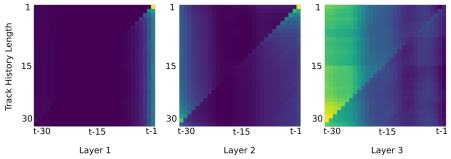
Fig. 4 . Temporal attention maps averaged over 100 randomly selected objects from the MOT20 dataset [79]. The vertical axis represents the maximum track history length, the horizontal axis the different embed- ding positions in the history. The displayed attention related the current query at time t to all the previous embeddings. Every row sums up to 1.
원문 · CC BY 4.0 · Tianyu Zhu, Markus Hiller, Mahsa Ehsanpour, Rongkai Ma, Tom Drummond, Ian Reid, Hamid Rezatofighi · Looking Beyond Two Frames: End-to-End Multi-Object Tracking Using Spatial and Temporal Transformers · 원문 그림 인용 · 원본 PDF 11쪽에서 그림 영역을 추출했습니다.논문 정보
- 저자
- Tianyu Zhu, Markus Hiller, Mahsa Ehsanpour, Rongkai Ma, Tom Drummond, Ian Reid, Hamid Rezatofighi
- 학회·저널
- arXiv · 프리프린트
- 최초 공개일
- 2021년 3월 27일
- 등록일
- 2026년 11월 6일
- 수정일
- 2022년 10월 7일
- 버전
- v4
- arXiv
- 2103.14829
- 분류
- cs.CV
- 원문 이용 조건
- CC BY 4.0
- 제공 범위
- 논문 정보, 해설, 허용된 원문 그림
AI 해설은 논문 원문과 별개의 설명이며 오류가 있을 수 있습니다. 원문과 그림은 각 출처의 이용 조건과 따로 표시된 권리를 따릅니다.
초록
Tracking a time-varying indefinite number of objects in a video sequence over time remains a challenge despite recent advances in the field. Most existing approaches are not able to properly handle multi-object tracking challenges such as occlusion, in part because they ignore long-term temporal information. To address these shortcomings, we present MO3TR: a truly end-to-end Transformer-based online multi-object tracking (MOT) framework that learns to handle occlusions, track initiation and termination without the need for an explicit data association module or any heuristics. MO3TR encodes object interactions into long-term temporal embeddings using a combination of spatial and temporal Transformers, and recursively uses the information jointly with the input data to estimate the states of all tracked objects over time. The spatial attention mechanism enables our framework to learn implicit representations between all the objects and the objects to the measurements, while the temporal attention mechanism focuses on specific parts of past information, allowing our approach to resolve occlusions over multiple frames. Our experiments demonstrate the potential of this new approach, achieving results on par with or better than the current state-of-the-art on multiple MOT metrics for several popular multi-object tracking benchmarks.
원문 인용
Tianyu Zhu, Markus Hiller, Mahsa Ehsanpour, Rongkai Ma, Tom Drummond, Ian Reid, Hamid Rezatofighi (2021). Looking Beyond Two Frames: End-to-End Multi-Object Tracking Using Spatial and Temporal Transformers. arXiv:2103.14829v4. https://arxiv.org/abs/2103.14829v4
BibTeX
@misc{zhu2021looking,
  title = {{Looking Beyond Two Frames: End-to-End Multi-Object Tracking Using Spatial and Temporal Transformers}},
  author = {Tianyu Zhu and Markus Hiller and Mahsa Ehsanpour and Rongkai Ma and Tom Drummond and Ian Reid and Hamid Rezatofighi},
  year = {2021},
  eprint = {2103.14829},
  archivePrefix = {arXiv},
  url = {https://arxiv.org/abs/2103.14829v4}
}