논문 해설
Memory-Efficient Speculative Decoding with Quantized Draft KV Cache
양자화된 드래프트 KV 캐시를 활용한 메모리 효율적 speculative decoding
- 연구 문제 Speculative decoding은 target과 draft 두 KV 캐시 때문에 메모리 부담이 커지는 문제를 다룹니다.
- 연구 방법 Target 캐시는 BF16으로 두고 draft 캐시만 채널별 키와 토큰별 값의 K4V4 양자화로 줄입니다.
두 개의 KV 캐시가 만드는 메모리 부담
Speculative decoding은 작은 draft 모델이 토큰을 제안하고 큰 target 모델이 이를 병렬로 검증해 생성 지연을 줄입니다. 그런데 이 구조에서는 target과 draft가 각각 KV 캐시를 유지하므로, 문맥 길이와 배치 크기가 커질수록 메모리 부담이 함께 커집니다. 이 논문은 target 캐시와 검증기를 BF16으로 그대로 두고, draft 캐시만 양자화하는 범위에서 이 문제를 다룹니다. 이렇게 하면 target의 수정 규칙은 바뀌지 않으면서 draft 쪽 메모리를 줄일 수 있는지가 핵심 질문이 됩니다.
키와 값에 비트를 어떻게 나눌 것인가
이 논문은 키와 값 중 어느 쪽에 더 많은 비트를 줘야 하는지를 먼저 묻습니다. 단순한 토큰별 대칭 양자화기에서는 K8V4가 K4V8보다 수락률이 10.87 pp 높아 키가 더 민감해 보입니다. 저자들은 이 결과를 키의 민감도가 어텐션 자체의 고유 성질이라기보다 양자화기의 기하 구조에서 생긴다고 해석합니다. 같은 모델에서 키 양자화기만 바꾼 Qwen 통제 실험에서도 K8V4와 K4V8의 차이가 -0.33 pp로 바뀌어, 선호하는 비트 배분이 뒤집혔습니다.
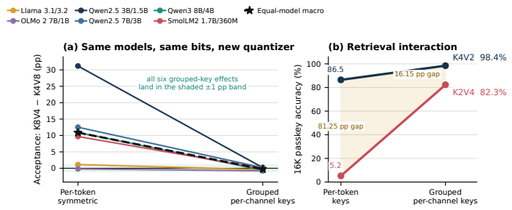
Figure 2 :Quantizer geometry changes the K/V conclusion.(a) Each line follows one model pair while models and bit budgets remain fixed. Positive values favor more key bits. (b) On 192 paired Qwen2.5 passkey examples, grouped per-channel keys recover most of the failure of K2V4 and sharply reduce the apparent key-bit advantage.
원문 · CC BY 4.0 · Saksham Gupta, Michael Li · Memory-Efficient Speculative Decoding with Quantized Draft KV Cache · 원문 그림 인용 · 원본 PDF 3쪽에서 그림 영역을 추출했습니다.
Table 4 : Qwen2.5 3B/1.5B key-axis intervention. Values are acceptance contrasts in pp with paired 95% CIs.
원문 · CC BY 4.0 · Saksham Gupta, Michael Li · Memory-Efficient Speculative Decoding with Quantized Draft KV Cache · 원문 그림 인용 · 원본 PDF 9쪽에서 그림 영역을 추출했습니다.채널별 키와 토큰별 값의 양자화 구조
최종 설계는 KIVI의 비대칭 구조를 따릅니다. 키는 32개 토큰 단위 그룹 안에서 채널마다 스케일과 zero-point를 공유하고, 값은 토큰과 헤드마다 나눕니다. 각 affine 그룹은 최솟값을 zero-point로 두고, 범위를 2^b-1 단계로 나눈 스케일로 값을 양자화합니다. 최근 128개의 키는 BF16 잔여 창에 남겨 두며, 키 그룹은 완성된 그룹에만 적용하고 불완전한 그룹은 패딩하거나 다시 양자화하지 않습니다.
K4V4의 메모리 절감과 수락률 변화
여섯 target과 draft 모델 쌍에서 K4V4는 draft 캐시 바이트를 66.20% 줄였습니다. target과 draft를 합친 KV 메모리는 23.95% 줄었고, 모델 쌍별 절감은 11.30%에서 33.17% 사이였습니다. 쌍별 수락률 변화의 신뢰구간은 네 쌍에서 0을 포함했고 Qwen3와 SmolLM2에서는 작은 손실이 확인되었습니다.
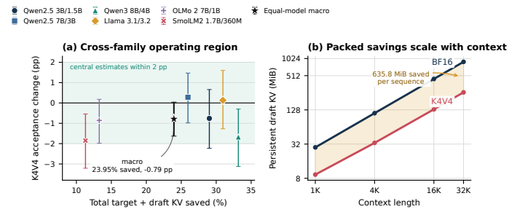
Figure 3 :Memory and acceptance.(a) K4V4 total KV saving and paired acceptance change across six target/draft pairs. Error bars are paired 95% CIs; the star is the equal-model macro. (b) Actual bit-packed draft cache storage, including quantizer metadata and the BF16 residual window. The absolute saving grows with retained context.
원문 · CC BY 4.0 · Saksham Gupta, Michael Li · Memory-Efficient Speculative Decoding with Quantized Draft KV Cache · 원문 그림 인용 · 원본 PDF 4쪽에서 그림 영역을 추출했습니다.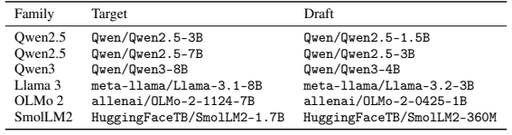
Table 1 : Primary speculative-decoding model pairs (Hugging Face checkpoint identifiers).
원문 · CC BY 4.0 · Saksham Gupta, Michael Li · Memory-Efficient Speculative Decoding with Quantized Draft KV Cache · 원문 그림 인용 · 원본 PDF 7쪽에서 그림 영역을 추출했습니다.긴 문맥과 검색 과제에서의 결과
16K 연관 검색 과제에서 Qwen2.5 draft는 키에 더 많은 비트를 줄 때 이득을 보였으나 Llama와 Qwen3에서는 같은 효과가 뚜렷하지 않았습니다.
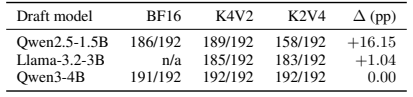
Table 5 : Associative-passkey accuracy at 16K with grouped per-channel keys.
원문 · CC BY 4.0 · Saksham Gupta, Michael Li · Memory-Efficient Speculative Decoding with Quantized Draft KV Cache · 원문 그림 인용 · 원본 PDF 10쪽에서 그림 영역을 추출했습니다.패킹 저장의 절감과 속도 비용
하지만 end-to-end 프로토타입은 BF16 speculative decoding보다 18%에서 33% 느렸고, 피크 GPU 메모리도 줄지 않았습니다. 이 프로토타입은 batched verifier가 target-only 출력을 2개에서 5개 프롬프트에서만 재현했으므로 시간 측정은 예비 결과로 다뤄야 합니다. 따라서 이 논문은 저장 절감을 확인했지만 서빙 속도 향상은 주장하지 않습니다.
Fake quantization과 검증 범위의 한계
양자화 품질 실험은 fake quantization을 사용했습니다. 이 방식은 역양자화된 값을 BF16 캐시에 다시 써 넣어 품질을 측정하므로 실제 생산 속도는 측정하지 않습니다. 또한 긴 문맥 실험은 프롬프트 수가 1K 연구보다 적고, 검색 과제는 일부 합성 구성입니다. 키 이상치는 직접 측정하지 않았으며, 키와 값이 본질적으로 다를 수 있는 다른 설정은 검증하지 않았습니다.
논문 정보
- 저자
- Saksham Gupta, Michael Li
- 학회·저널
- arXiv · 프리프린트
- 최초 공개일
- 2026년 11월 16일
- 등록일
- 2026년 11월 17일
- 수정일
- 2026년 11월 16일
- 버전
- v1
- arXiv
- 2611.20565
- 분류
- cs.LG · cs.AI
- 원문 이용 조건
- CC BY 4.0
- 제공 범위
- 논문 정보, 해설, 허용된 원문 그림
AI 해설은 논문 원문과 별개의 설명이며 오류가 있을 수 있습니다. 원문과 그림은 각 출처의 이용 조건과 따로 표시된 권리를 따릅니다.
초록
Speculative decoding reduces generation cost, but it stores two KV caches: one for the target model and one for the draft model. We reduce this extra memory by quantizing the draft cache. The target cache and verifier remain in BF16, so that compression cannot change the target model's final correction rule. We first study how to divide precision between keys and values. A naive per-token quantizer makes keys appear much more sensitive: splitting a 12-bit budget, K8V4 beats K4V8 in acceptance by 10.87pp. However, with grouped per-channel keys, the gap becomes -0.25pp. A controlled Qwen test confirms that changing only the key quantizer can erase or reverse the preferred bit split. Hence, following KIVI, we propose K4V4 quantization with per-channel keys and per-token values. Across six model pairs, our method reduces draft cache memory by 66.20%, and combined memory across both caches by 23.95%. Mean acceptance drops from 57.93% to 57.14%, only 1.36% relative. Overall, quantized draft caches can make speculative decoding more memory efficient; as a predictive principle for efficient AI design, key and value precision must be co-designed with the quantizer layout.
원문 인용
Saksham Gupta, Michael Li (2026). Memory-Efficient Speculative Decoding with Quantized Draft KV Cache. arXiv:2611.20565v1. https://arxiv.org/abs/2611.20565v1
BibTeX
@misc{gupta2026memory,
  title = {{Memory-Efficient Speculative Decoding with Quantized Draft KV Cache}},
  author = {Saksham Gupta and Michael Li},
  year = {2026},
  eprint = {2611.20565},
  archivePrefix = {arXiv},
  url = {https://arxiv.org/abs/2611.20565v1}
}