논문 해설
1-Bit Wonder: Improving QAT Performance in the Low-Bit Regime through K-Means Quantization
1-Bit Wonder: K-평균 양자화를 통한 저비트 영역에서의 QAT 성능 향상
- 연구 문제 고정된 추론 메모리 예산에서 파라미터 수와 가중치 정밀도를 어떻게 나눌지, 그리고 k-means 비선형 양자화가 균일 정수 형식보다 낮은 비트에서 유리한지를 묻는 연구입니다.
- 연구 방법 k-means 기반 가중치 양자화를 QAT에 적용하고, 정밀도 인지 스케일링 법칙으로 메모리 예산 안의 최적 비트 폭을 분석한 뒤 메모리를 맞춘 모델을 생성형 과제로 평가합니다.
- 주요 결과 스케일링 분석에서는 메모리 예산 아래 낮은 정밀도 쪽이 유리하다고 해석되었고, 메모리를 맞춘 비교에서는 31B 1-bit 모델이 대부분의 생성형 과제에서 12B 4-bit와 4B bf16 모델보다 높은 결과를 보였습니다.
고정 메모리 예산에서 파라미터 수와 비트 폭의 균형
이 논문이 다루는 문제는 추론 메모리 예산이 고정되어 있을 때 모델의 파라미터 수와 가중치 비트 폭을 어떻게 나눌지입니다. 양자화 인지 학습(Quantization-aware training, QAT)은 가중치 메모리를 크게 줄이면서 성능 저하를 제한할 수 있지만, 양자화 형식과 비트 폭을 고르는 일은 실무에서 쉽지 않습니다. 기존 비교는 주로 perplexity나 로그 확률 기반 평가에 의존해 생성형 하위 과제에서의 실제 성능을 충분히 보여주지 못했습니다. 이 논문은 저비트 영역의 QAT를 실험적으로 다시 살펴보며, 같은 메모리 안에서 더 많은 파라미터를 쓰는 것과 더 많은 비트를 쓰는 것 중 무엇이 유리한지를 묻습니다.
또한 균일 정수 형식 대신 가중치 분포에 맞춘 비선형 k-means 형식이 낮은 비트에서 더 나은지를 검증합니다.
블록 양자화 형식과 k-means 중심값의 작동
양자화 형식은 가중치 텐서를 실수값으로 바꾸는 스케일 함수와 양자화기의 쌍으로 정의됩니다. 이 논문은 가중치를 크기 B=64의 블록으로 나누고 블록마다 16비트 스케일을 저장합니다. 이때 평균 비트 폭은 \(P_w = n + m/B\)로 계산되어, 4비트 원소와 16비트 스케일이면 4.25비트가 됩니다. 균일 정수 형식은 등간격 중심값을 쓰며 2비트 이하에서는 absmax 대신 absmean으로 스케일을 잡습니다. 반면 k-means 형식은 정규화된 가중치에 1차원 k-means 군집화를 적용해 중심값을 학습하므로 가중치 분포에 맞춰 중심이 배치됩니다. QAT에서는 순전파에 양자화된 가중치를 쓰고, 역전파는 정지 기울기 연산 SG를 거쳐 비양자화 가중치를 기울기 계산에 사용합니다.
학습은 1000 스텝의 bf16 워밍업 뒤 양자화를 켜며, k-means 중심값은 QAT가 시작되는 시점에 학습한 뒤 고정합니다. 저자들은 이 고정 설정이 중심값의 학습 불안정을 줄인다고 설명합니다.
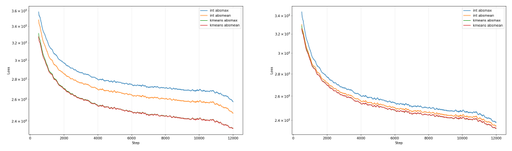
Figure 4 .Normalization ablation.Training loss curves with logarithmic y-axis for different block-wise normalization strategies.Left: 2-bit quantization, where absmean scaling leads to substantially more stable optimization.Right: 4-bit quantization, where absmax scaling becomes favorable. K-means quantization remains largely insensitive to this choice.
원문 · CC BY 4.0 · Sohir Maskey, Constantin Eichenberg, Johannes Messner, Douglas Orr · 1-Bit Wonder: Improving QAT Performance in the Low-Bit Regime through K-Means Quantization · 원문 그림 인용 · 원본 PDF 16쪽에서 그림 영역을 추출했습니다.정밀도 인지 스케일링 법칙과 최적 비트 선택
스케일링 실험은 Nemotron-CC 기반 데이터에서 0.8B, 1.4B, 3.9B 모델을 여러 토큰 예산과 정밀도 조건으로 학습하고 pre-training 손실을 측정합니다. 저자들은 손실을 모델 항 \(A N_{\text{eff}}^{-\alpha}\), 데이터 항 \(B D^{-\beta}\), 상수 \(E\)의 합으로 두고, 유효 파라미터 수 \(N_{\text{eff}} = N f(P_w)\)를 도입합니다. 여기서 포화 함수는 \(f(P_w) = 1-\exp(-P_w/\gamma_w)\)이며, 비트 폭이 커질수록 \(f(P_w)\)가 1에 가까워집니다. 적합 결과 k-means는 α≈0.63, β≈0.40, γ_w≈3.32였고 uniform은 α≈0.55, β≈0.46, γ_w≈3.71이었습니다.
적합의 R²는 0.96 이상이며 RMSE는 uniform 0.0305, k-means 0.0391로 보고됩니다. 고정 메모리 \(M = N P_w\)에서는 \(g(P_w) = f(P_w)/P_w\)를 최대화하는 문제가 되며, 저자들은 g가 P_w가 커질수록 줄어 낮은 정밀도 쪽에서 파라미터를 더 늘리는 편이 유리하다고 해석합니다. 이 결론은 0.8B에서 3.9B까지의 적합 범위와 이 형식들의 적합 결과에 근거한 것입니다.
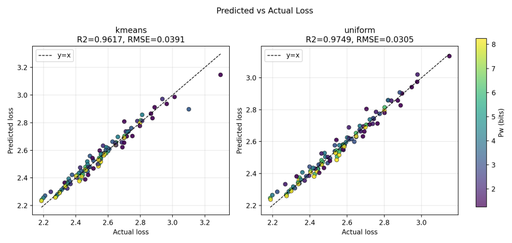
Figure 6 . Predicted vs. actual loss for k-means (left) and uniform (right) quantization formats. Points are colored by precision Pw (bits). Both methods achieve strong fits with R 2 > 0.96, with uniform quantization showing slightly better predictive accuracy (RMSE = 0.0305) compared to k-means (RMSE = 0.0391). The dashed line indicates perfect prediction (y = x).
원문 · CC BY 4.0 · Sohir Maskey, Constantin Eichenberg, Johannes Messner, Douglas Orr · 1-Bit Wonder: Improving QAT Performance in the Low-Bit Regime through K-Means Quantization · 원문 그림 인용 · 원본 PDF 18쪽에서 그림 영역을 추출했습니다.메모리를 맞춘 모델의 생성형 과제 결과
스케일링 분석의 예측을 확인하기 위해 저자들은 bf16 4B 모델을 150B 토큰으로 학습하고, 같은 가중치 메모리에 맞춘 12B 4-bit 모델과 31B 1-bit 모델을 비교했습니다. 4B 기준 모델은 약 7.8GB의 가중치 메모리를 쓰고, 12B와 31B 모델은 모두 k-means QAT로 학습되었습니다. 세 모델은 Tulu 3 SFT 혼합으로 미세조정된 뒤 로그 확률 과제와 생성형 과제에서 평가되었습니다. MMLU는 4B 모델 33.21, 12B 모델 50.86, 31B 모델 51.61이며, HellaSwag는 31B 모델이 54.70, 12B 모델이 55.41입니다. 생성형 과제에서는 31B 1-bit 모델이 MBPP 30.00, HumanEval 18.29 등 대부분의 코드·지식 과제에서 가장 높았고, GSM8K는 12B 4-bit 모델이 48.52로 31B 모델의 45.26보다 높았습니다.
이 결과는 같은 메모리 예산에서 더 많은 파라미터가 생성형 성능을 높인다는 설명을 지지하지만, 모든 과제에서 우위가 일관되지는 않습니다.
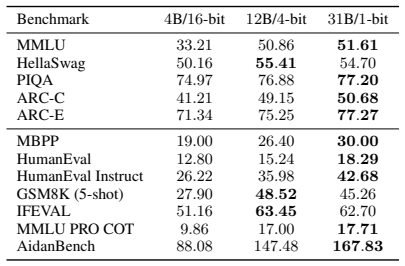
Table 1 .Memory-matched scaling evaluation results across model sizes and bit-widths.
원문 · CC BY 4.0 · Sohir Maskey, Constantin Eichenberg, Johannes Messner, Douglas Orr · 1-Bit Wonder: Improving QAT Performance in the Low-Bit Regime through K-Means Quantization · 원문 그림 인용 · 원본 PDF 6쪽에서 그림 영역을 추출했습니다.커널 속도와 토큰 생성 측정
메모리 예산 분석은 하드웨어 구현을 고려하지 않으므로, 저자들은 추론 속도를 별도로 측정했습니다. 이론 모델에서는 메모리 전송이 지배하는 작은 batch size에서 속도 향상이 비트 폭의 비율로 정해지며, L40S GPU에서 4.25비트는 최대 3.8배, 1.25비트는 최대 12.8배로 예측됩니다. 실제 Triton 커널은 h=8192, batch size 1의 마이크로벤치마크에서 4.25비트 49.5µs(3.7배), 1.25비트 24.0µs(7.6배)를 기록했습니다. 토큰 생성 실험에서는 4B bf16 모델이 88.8 tokens/s, 12B 4.25비트 Triton 모델이 79.3 tokens/s로 측정되어 12B 모델이 약 10% 느립니다.
31B 1.25비트 모델은 35.4 tokens/s로 4B bf16보다 느리지만, 메모리 용량 이점은 유지됩니다. 저자들은 batch size 256에서는 속도 향상이 관찰되지 않는다고 보고합니다.
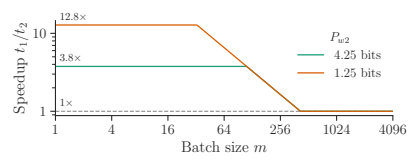
Figure 3 .A theoretical model for speedup of1-bit and 4-bit formats versus bf16, when decoded to bf16 in software on an L40S GPU.
원문 · CC BY 4.0 · Sohir Maskey, Constantin Eichenberg, Johannes Messner, Douglas Orr · 1-Bit Wonder: Improving QAT Performance in the Low-Bit Regime through K-Means Quantization · 원문 그림 인용 · 원본 PDF 7쪽에서 그림 영역을 추출했습니다.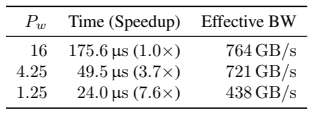
Table 2 .Micro-benchmark results for the product of a 1×8192 bf16 vector and 8192×8192 quantized matrix. The 4-bit format achieves near-optimal speedup. Peak memory bandwidth for the test GPU is864 GB/s. All standard errors are<0.2µs.
원문 · CC BY 4.0 · Sohir Maskey, Constantin Eichenberg, Johannes Messner, Douglas Orr · 1-Bit Wonder: Improving QAT Performance in the Low-Bit Regime through K-Means Quantization · 원문 그림 인용 · 원본 PDF 7쪽에서 그림 영역을 추출했습니다.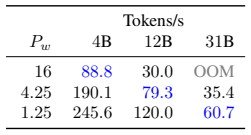
Table 3 .Token generation performance for the models of Sec- tion 3.2 (blue), for single-user autoregressive generation. These correspond to effective bandwidth of 620, 524, and 372 GB/s for 4B 16-bit, 12B 4-bit, and 31B 1-bit models respectively. The maximum error bar (±2standard errors) is<1%of the mean.
원문 · CC BY 4.0 · Sohir Maskey, Constantin Eichenberg, Johannes Messner, Douglas Orr · 1-Bit Wonder: Improving QAT Performance in the Low-Bit Regime through K-Means Quantization · 원문 그림 인용 · 원본 PDF 8쪽에서 그림 영역을 추출했습니다.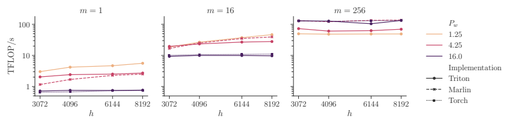
Figure 8 .A micro-benchmark of kernel performance for square matrix multiplication, swept over batch size m, hidden size h and bit-width. The maximum error bar (±2standard errors) is approximately±1%of the mean, so error bars are not visible at this scale.
원문 · CC BY 4.0 · Sohir Maskey, Constantin Eichenberg, Johannes Messner, Douglas Orr · 1-Bit Wonder: Improving QAT Performance in the Low-Bit Regime through K-Means Quantization · 원문 그림 인용 · 원본 PDF 22쪽에서 그림 영역을 추출했습니다.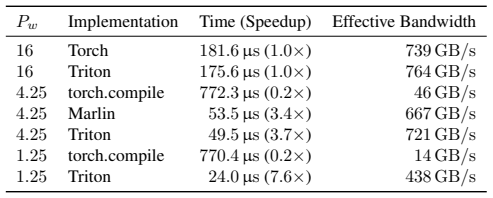
Table 6 .A micro-benchmark of different kernel implementations, for m= 1 and h= 8192. The theoretical maximum speedup for 4-bit and 1-bit kernels is 3.8× and 12.8× respectively. Standard errors are <0.2µs except for the torch.compile implementation (<0.6µs ).
원문 · CC BY 4.0 · Sohir Maskey, Constantin Eichenberg, Johannes Messner, Douglas Orr · 1-Bit Wonder: Improving QAT Performance in the Low-Bit Regime through K-Means Quantization · 원문 그림 인용 · 원본 PDF 22쪽에서 그림 영역을 추출했습니다.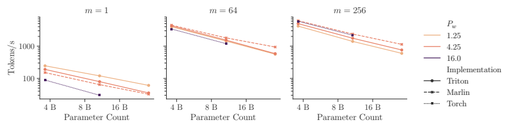
Figure 9 .Autoregressive decoding speed for different model size, batch size and bit-width. Larger batches are beneficial to token/s, since they amortize the cost of transferring the model parameters, but this has greater impact on the bf16 baseline than on compact formats. The maximum error bar (±2standard errors) is<0.5%of the mean.
원문 · CC BY 4.0 · Sohir Maskey, Constantin Eichenberg, Johannes Messner, Douglas Orr · 1-Bit Wonder: Improving QAT Performance in the Low-Bit Regime through K-Means Quantization · 원문 그림 인용 · 원본 PDF 23쪽에서 그림 영역을 추출했습니다.한계와 적용 범위
이 연구의 주요 한계는 평가와 탐색의 범위에 있습니다. pre-training 로그 확률 지표는 하위 생성형 과제 성능을 정확히 예측하지 못하며, 실제로 12B 4-bit 모델이 pre-training 지표에서는 31B 1-bit 모델과 같거나 나았지만 생성형 평가에서는 31B 모델이 대부분 앞섰습니다. 속도 측정은 현재 하드웨어와 작은 batch size에 한정되며, 대형 batch와 prefill이 많은 환경에서는 별도 dequantize 단계가 더 효율적일 수 있다고 저자들은 설명합니다. 스케일링 실험 비용 때문에 형식 공간과 학습률 같은 설계 선택을 폭넓게 탐색하지 못했습니다. 따라서 이 결과는 본 논문이 검토한 형식, 모델 규모, 하드웨어 설정 안에서 읽어야 합니다.
논문 정보
- 저자
- Sohir Maskey, Constantin Eichenberg, Johannes Messner, Douglas Orr
- 학회·저널
- arXiv · 프리프린트
- 최초 공개일
- 2026년 2월 17일
- 등록일
- 2026년 10월 29일
- 수정일
- 2026년 2월 17일
- 버전
- v1
- arXiv
- 2602.15563
- 분류
- cs.LG
- 원문 이용 조건
- CC BY 4.0
- 제공 범위
- 논문 정보, 해설, 허용된 원문 그림
AI 해설은 논문 원문과 별개의 설명이며 오류가 있을 수 있습니다. 원문과 그림은 각 출처의 이용 조건과 따로 표시된 권리를 따릅니다.
초록
Quantization-aware training (QAT) is an effective method to drastically reduce the memory footprint of LLMs while keeping performance degradation at an acceptable level. However, the optimal choice of quantization format and bit-width presents a challenge in practice. The full design space of quantization is not fully explored in the context of QAT, and the precise trade-off between quantization and downstream performance is poorly understood, as comparisons often rely solely on perplexity-based evaluations. In this work, we address these shortcomings with an empirical study of QAT in the low-bit regime. We show that k-means based weight quantization outperforms integer formats and can be implemented efficiently on standard hardware. Furthermore, we find that, under a fixed inference memory budget, the best performance on generative downstream tasks is achieved with $1$-bit quantized weights.
원문 인용
Sohir Maskey, Constantin Eichenberg, Johannes Messner, Douglas Orr (2026). 1-Bit Wonder: Improving QAT Performance in the Low-Bit Regime through K-Means Quantization. arXiv:2602.15563v1. https://arxiv.org/abs/2602.15563v1
BibTeX
@misc{maskey2026wonder,
  title = {{1-Bit Wonder: Improving QAT Performance in the Low-Bit Regime through K-Means Quantization}},
  author = {Sohir Maskey and Constantin Eichenberg and Johannes Messner and Douglas Orr},
  year = {2026},
  eprint = {2602.15563},
  archivePrefix = {arXiv},
  url = {https://arxiv.org/abs/2602.15563v1}
}