논문 해설
Tackling Length Inflation Without Trade-offs: Group Relative Reward Rescaling for Reinforcement Learning
트레이드오프 없이 길이 팽창 해결하기: 강화학습을 위한 그룹 상대 보상 재조정
- 연구 문제 RL로 학습된 LLM이 보상을 얻기 위해 길어지는 length inflation을, 성능 손실 없이 일반적으로 줄이는 방법을 다룹니다.
- 연구 방법 GR3는 가산형 길이 패널티 대신 보상에 그룹 평균 길이 기반 스케일링 인자를 곱하고, 패널티 계수를 이점 보존 기준으로 보정합니다.
- 주요 결과 수학 추론에서 GR3는 토큰을 줄이면서 AIME24 정확도를 높였고, RLHF에서는 Arena-Hard-Auto 점수를 높이며 응답 길이를 거의 유지했다고 보고됩니다.
length inflation과 기존 보상 설계의 한계
강화학습으로 학습된 LLM은 보상을 높이기 위해 불필요하게 긴 응답이나 비효율적인 추론을 생성하는 경향이 있으며, 논문은 이를 length inflation이라고 부릅니다. RLHF에서는 보상 모델의 편향을 이용한 reward hacking으로, RLVR에서는 정답 가능성을 조금 높이려는 과도한 추론으로 나타납니다. 기존의 가산형 길이 패널티는 보상 R에 λ·S를 더하는 방식이어서, 길이 항이 과제 성공과 무관하게 최적화의 지름길이 될 수 있습니다. 성공한 응답에만 패널티를 주는 게이팅 방법은 이진 보상에는 적합하지만 연속 보상이 쓰이는 RLHF로 자연스럽게 확장되지 않습니다. 따라서 논문은 일반적이면서도 성능을 해치지 않는 길이 제어가 가능한지를 질문합니다.
곱셈형 보상 재조정과 그룹 상대 길이 스케일링
GR3는 보상을 R̂ = R · 1/(1 + α·ℓ(i)/ℓ̄) 형태로 재조정합니다. 여기서 ℓ(i)는 i번째 응답의 길이이고 ℓ̄는 같은 그룹 안의 평균 길이이며, 스케일링 인자 S(i)는 (0,1) 범위의 값을 가집니다. 이 식은 가산 항 대신 보상에 곱해지므로 길이 제어의 강도가 R에 연동됩니다. 논문은 ∂R̂/∂S = R이라는 점을 들어 과제 성공이 높을수록 길이 신호가 강해지는 구조를 설명합니다. 또한 길이를 절대 임계값이 아니라 그룹 평균으로 나누기 때문에 문제의 난이도에 따라 길이 예산이 온폴리시 통계로 조정됩니다. 재조정된 보상은 표준 GRPO의 그룹 정규화 이점 계산과 PPO형 클리핑 목적 함수에 그대로 입력됩니다.
이점 인식 보정과 패널티 계수 α의 선택
논문은 패널티가 지나치면 고품질 응답의 이점이 음수가 되어 학습 신호가 뒤집힐 수 있다고 봅니다. 모든 최고 보상 응답이 양의 이점을 갖도록 요구하는 엄격한 조건은 최고 보상 응답이 많은 고밀도 상황에서 실현되기 어렵다고 원문은 분석합니다. 그래서 논문은 최고 보상 R_max를 가진 대표적인 평균 길이 응답이 음수가 되지 않도록 하는 평균 기준 조건을 사용합니다. 이 조건은 학습 중 모든 업데이트에서 강제되는 하드 제약이 아니며, 학습 초기의 짧은 보정 단계에서 후보 α마다 제약 만족률(CSR)을 측정하고 CSR이 높게 유지되는 가장 큰 α를 고르는 절차로 쓰입니다. 원문에서 CSR 기준은 대략 99.9% 이상으로 설명되며, 수학 설정에서 선택된 계수는 0.33입니다.
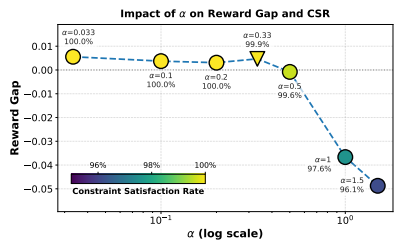
Figure 4 . Sensitivity of α: reward gap relative to the standard GRPO baseline versus α (log scale). Marker color indicates the average CSR measured during actual training, while the triangle marker denotes the value ofα selected during the calibration phase.
원문 · CC BY 4.0 · Zichao Li, Jie Lou, Fangchen Dong, Zhiyuan Fan, Mengjie Ren, Hongyu Lin, Xianpei Han, Debing Zhang, Le Sun, Yaojie Lu, Xing Yu · Tackling Length Inflation Without Trade-offs: Group Relative Reward Rescaling for Reinforcement Learning · 원문 그림 인용 · 원본 PDF 6쪽에서 그림 영역을 추출했습니다.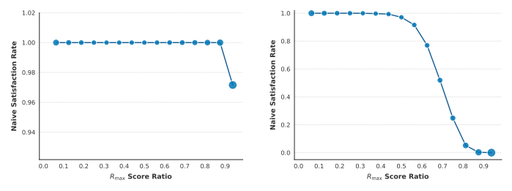
Figure 6 . Effect of reward density on the strict advantage-preservation objective. As reward density increases, the strict constraint satisfaction rate decreases, even for a small penalty coefficientα= 0.05, and more noticeably for a larger penaltyα= 5.0.
원문 · CC BY 4.0 · Zichao Li, Jie Lou, Fangchen Dong, Zhiyuan Fan, Mengjie Ren, Hongyu Lin, Xianpei Han, Debing Zhang, Le Sun, Yaojie Lu, Xing Yu · Tackling Length Inflation Without Trade-offs: Group Relative Reward Rescaling for Reinforcement Learning · 원문 그림 인용 · 원본 PDF 16쪽에서 그림 영역을 추출했습니다.RLVR 수학 추론에서의 길이와 정확도
RLVR 실험은 DeepSeek-R1-Distill-7B를 기반으로 하며 DeepScaleR 데이터셋으로 학습합니다. 평가는 AIME24, AIME25, AMC23, MATH500에서 Avg@32 등의 지표로 수행됩니다. AIME24에서 GR3는 평균 길이를 13,213에서 7,923 토큰으로 줄이면서 Avg@32를 52.4에서 60.1로 높였고, GRPO는 57.1에 머물렀습니다. 길이 지향 기준선들은 대체로 토큰을 줄였지만 정확도가 떨어지거나 AIME25에서 초기 모델 성능(39.4)을 넘지 못했습니다. 저자들은 이 결과를 GR3가 단순한 절단이 아니라 더 효율적인 추론 궤적을 만든다는 근거로 해석합니다.
코드 생성 실험에서도 토큰 수는 줄고 점수는 비슷하거나 개선되는 경향이 보고됩니다.
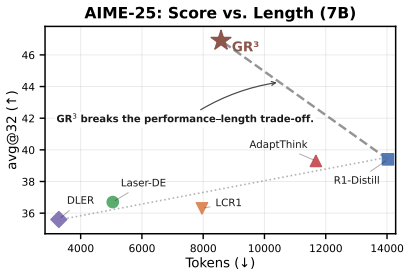
Figure 1 . Comparison of GR3 with open-source efficient reasoning models, all trained on DeepSeek-R1-Distill-7B.GR 3 pioneers a new paradigm that sustains stable performance gains under RL while simultaneously mitigating the length inflation issue.
원문 · CC BY 4.0 · Zichao Li, Jie Lou, Fangchen Dong, Zhiyuan Fan, Mengjie Ren, Hongyu Lin, Xianpei Han, Debing Zhang, Le Sun, Yaojie Lu, Xing Yu · Tackling Length Inflation Without Trade-offs: Group Relative Reward Rescaling for Reinforcement Learning · 원문 그림 인용 · 원본 PDF 1쪽에서 그림 영역을 추출했습니다.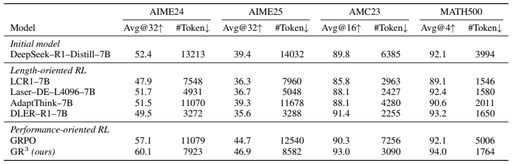
Table 3 .Mathematical reasoning performance for 7B models. Length-oriented methods reduce tokens but may sacrifice accuracy, while GR 3 consistently achieves comparable accuracy with significantly fewer tokens, establishing a markedly better Pareto frontier.
원문 · CC BY 4.0 · Zichao Li, Jie Lou, Fangchen Dong, Zhiyuan Fan, Mengjie Ren, Hongyu Lin, Xianpei Han, Debing Zhang, Le Sun, Yaojie Lu, Xing Yu · Tackling Length Inflation Without Trade-offs: Group Relative Reward Rescaling for Reinforcement Learning · 원문 그림 인용 · 원본 PDF 7쪽에서 그림 영역을 추출했습니다.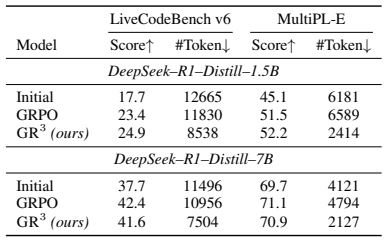
Table 4 . Performance on code generation tasks.GR 3 achieves competitive scores with fewer tokens across model sizes.
원문 · CC BY 4.0 · Zichao Li, Jie Lou, Fangchen Dong, Zhiyuan Fan, Mengjie Ren, Hongyu Lin, Xianpei Han, Debing Zhang, Le Sun, Yaojie Lu, Xing Yu · Tackling Length Inflation Without Trade-offs: Group Relative Reward Rescaling for Reinforcement Learning · 원문 그림 인용 · 원본 PDF 7쪽에서 그림 영역을 추출했습니다.RLHF 대화 평가와 길이 편향
RLHF 실험은 비추론형 Qwen3-8B를 기반으로 하며, 보상 모델로 Skywork-Reward-V2-Llama-3.1-8B를 사용합니다. 표준 GRPO는 Arena-Hard-Auto에서 평균 응답 길이가 1,171에서 2,343 토큰으로 늘어나 보상 해킹과 length inflation이 나타납니다. GR3는 같은 설정에서 점수를 77.2에서 92.8로 높이면서 토큰 비용을 1,171에서 1,178로 거의 바꾸지 않았습니다. 학습 동역학에서 GR3는 처음에 응답을 늘린 뒤 성능이 안정되면 줄이는 증가 후 감소 패턴을 보였다고 설명됩니다. 이 결과는 Qwen3-8B 설정에서의 관찰이며 다른 대화 모델로 바로 확대되지는 않습니다.
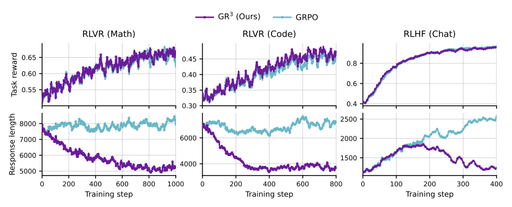
Figure 2 .Training dynamics of GR 3, which retains GRPO’s reward gains without loss while significantly reducing average tokens. The base models used for the two settings are DeepSeek-R1-Distill-1.5B and Qwen3-8B (without thinking mode), respectively.
원문 · CC BY 4.0 · Zichao Li, Jie Lou, Fangchen Dong, Zhiyuan Fan, Mengjie Ren, Hongyu Lin, Xianpei Han, Debing Zhang, Le Sun, Yaojie Lu, Xing Yu · Tackling Length Inflation Without Trade-offs: Group Relative Reward Rescaling for Reinforcement Learning · 원문 그림 인용 · 원본 PDF 2쪽에서 그림 영역을 추출했습니다.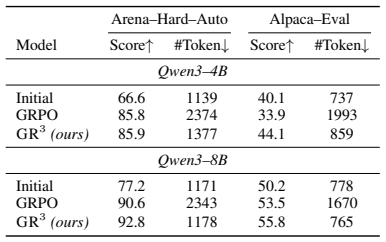
Table 5 . Performance on chat tasks. GRPO improves performance but incurs substantial length bias, whileGR 3 achieves stronger alignment gains while preserving the length of the initial policy.
원문 · CC BY 4.0 · Zichao Li, Jie Lou, Fangchen Dong, Zhiyuan Fan, Mengjie Ren, Hongyu Lin, Xianpei Han, Debing Zhang, Le Sun, Yaojie Lu, Xing Yu · Tackling Length Inflation Without Trade-offs: Group Relative Reward Rescaling for Reinforcement Learning · 원문 그림 인용 · 원본 PDF 7쪽에서 그림 영역을 추출했습니다.additive shaping 비교와 α 민감도
Figure 3 분석은 additive shaping이 λ를 0.01, 0.1, 1.0으로 바꾸어도 빠른 길이 감소가 지배하여 과제 보상을 낮춘다는 점을 보여 줍니다. 반면 곱셈형 방식은 학습 중 안정적인 보상 향상을 유지한다고 보고됩니다. 또한 α 민감도 분석에서 α가 크면 응답이 짧아지지만 성능 이득은 제한되고, α가 작아질수록 길이는 늘고 성능은 먼저 개선된 뒤 정체합니다. 원문은 선택된 α=0.33이 길이 감소와 성능 유지 사이의 전이 구간에 있다고 설명합니다. 이 분석도 해당 설정과 실험 범위 안에서 읽어야 합니다.
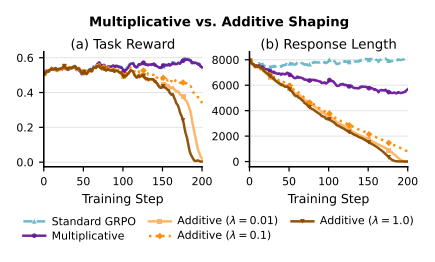
Figure 3 . Additive length regularization consistently degrades task reward across different choices of λ, whereas the multiplicative scheme maintains stable reward improvement throughout training.
원문 · CC BY 4.0 · Zichao Li, Jie Lou, Fangchen Dong, Zhiyuan Fan, Mengjie Ren, Hongyu Lin, Xianpei Han, Debing Zhang, Le Sun, Yaojie Lu, Xing Yu · Tackling Length Inflation Without Trade-offs: Group Relative Reward Rescaling for Reinforcement Learning · 원문 그림 인용 · 원본 PDF 4쪽에서 그림 영역을 추출했습니다.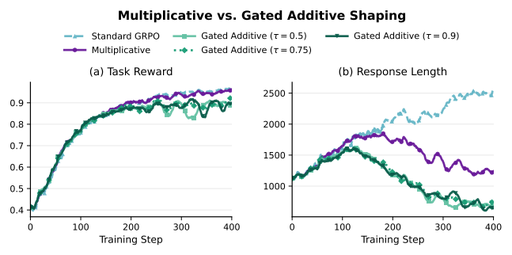
Figure 5 . Comparison of multiplicative and gated additive shaping during RLHF training. Multiplicative shaping matches standard GRPO in task reward while achieving controlled length reduction. In contrast, gated additive variants with different reward thresholds underperform and produce overly short responses, reflecting optimization instability introduced by hard gating.
원문 · CC BY 4.0 · Zichao Li, Jie Lou, Fangchen Dong, Zhiyuan Fan, Mengjie Ren, Hongyu Lin, Xianpei Han, Debing Zhang, Le Sun, Yaojie Lu, Xing Yu · Tackling Length Inflation Without Trade-offs: Group Relative Reward Rescaling for Reinforcement Learning · 원문 그림 인용 · 원본 PDF 13쪽에서 그림 영역을 추출했습니다.적용 범위와 한계
GR3는 길이를 줄이면서 성능을 지키는 것을 목표로 하지만, 원문은 α를 지나치게 크게 잡으면 길이 제어가 성능 향상보다 압축에 치우칠 수 있다고 설명합니다. 안전이 중요한 영역에서는 과도한 길이 억제가 검증에 필요한 추론 흔적을 잘라낼 수 있다는 주의도 제시됩니다. 설정표에서 GR3의 α는 수학과 코드에서 0.33이고 채팅 설정에서는 0.00133으로 달라, 설정별 계수 조건을 함께 읽어야 합니다. 또한 이점 보정 기준은 온폴리시 샘플링의 확률성 때문에 모든 업데이트에서 보장되지 않습니다.
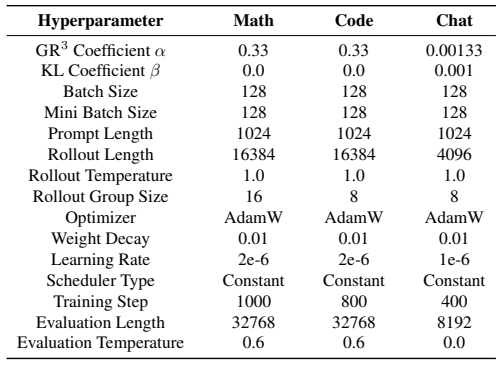
Table 7 .Hyper-parameters used in our experiments.
원문 · CC BY 4.0 · Zichao Li, Jie Lou, Fangchen Dong, Zhiyuan Fan, Mengjie Ren, Hongyu Lin, Xianpei Han, Debing Zhang, Le Sun, Yaojie Lu, Xing Yu · Tackling Length Inflation Without Trade-offs: Group Relative Reward Rescaling for Reinforcement Learning · 원문 그림 인용 · 원본 PDF 17쪽에서 그림 영역을 추출했습니다.논문 정보
- 저자
- Zichao Li, Jie Lou, Fangchen Dong, Zhiyuan Fan, Mengjie Ren, Hongyu Lin, Xianpei Han, Debing Zhang, Le Sun, Yaojie Lu, Xing Yu
- 학회·저널
- arXiv · 프리프린트
- 최초 공개일
- 2026년 3월 11일
- 등록일
- 2026년 10월 29일
- 수정일
- 2026년 3월 11일
- 버전
- v1
- arXiv
- 2603.10535
- 분류
- cs.LG · cs.CL
- 원문 이용 조건
- CC BY 4.0
- 제공 범위
- 논문 정보, 해설, 허용된 원문 그림
AI 해설은 논문 원문과 별개의 설명이며 오류가 있을 수 있습니다. 원문과 그림은 각 출처의 이용 조건과 따로 표시된 권리를 따릅니다.
초록
Reinforcement learning significantly enhances LLM capabilities but suffers from a critical issue: length inflation, where models adopt verbosity or inefficient reasoning to maximize rewards. Prior approaches struggle to address this challenge in a general and lossless manner, primarily because additive penalties introduce a compensatory effect that creates optimization shortcuts, while heuristic gating strategies lack generality beyond binary feedback. To bridge this gap, we present Group Relative Reward Rescaling (GR$^3$), which reframes length control as a multiplicative rescaling paradigm, effectively establishing a generalized, continuous, and reward-dependent gating mechanism. To further ensure lossless optimization, we incorporate group-relative regularization and advantage-aware calibration, which dynamically adapt length budgets to instance difficulty and preserve the advantage signal of high-quality trajectories. Empirically, across both RLHF and RLVR settings, GR$^3$~maintains training dynamics and downstream performance comparable to standard GRPO while significantly mitigating length inflation, outperforming state-of-the-art length-regularized baselines.
원문 인용
Zichao Li, Jie Lou, Fangchen Dong, Zhiyuan Fan, Mengjie Ren, Hongyu Lin, Xianpei Han, Debing Zhang, Le Sun, Yaojie Lu, Xing Yu (2026). Tackling Length Inflation Without Trade-offs: Group Relative Reward Rescaling for Reinforcement Learning. arXiv:2603.10535v1. https://arxiv.org/abs/2603.10535v1
BibTeX
@misc{li2026tackling,
  title = {{Tackling Length Inflation Without Trade-offs: Group Relative Reward Rescaling for Reinforcement Learning}},
  author = {Zichao Li and Jie Lou and Fangchen Dong and Zhiyuan Fan and Mengjie Ren and Hongyu Lin and Xianpei Han and Debing Zhang and Le Sun and Yaojie Lu and Xing Yu},
  year = {2026},
  eprint = {2603.10535},
  archivePrefix = {arXiv},
  url = {https://arxiv.org/abs/2603.10535v1}
}