논문 해설
PRISM: Demystifying Retention and Interaction in Mid-Training
PRISM: 중간 학습에서의 유지와 상호작용 비밀 풀기
- 연구 문제 대규모 언어 모델의 mid-training은 데이터 구성, 적용 시점, RL과의 상호작용에 대한 체계적 지침이 부족합니다.
- 연구 방법 PRISM은 7개 기본 모델에 약 27B 토큰의 도메인 mid-training을 적용하고, 이후 GRPO 기반 RL을 이어 붙여 성능, 장문맥, 가중치와 표현 변화를 비교합니다.
- 주요 결과 PRISM mid-training은 수학과 코드 점수를 높이며, PRISM→RL 파이프라인은 여섯 벤치마크 매크로 평균을 12 미만에서 29에서 42 사이로 끌어올립니다. 과학 데이터는 mid-training 단계에서 넣을 때 RL의 GPQA-Diamond 향상에 기여합니다.
mid-training 설계의 불명확성
대규모 언어 모델의 학습 파이프라인에는 pre-training과 fine-tuning·RL 사이에 고품질 도메인 데이터로 추론 능력을 부여하는 mid-training 단계가 추가되고 있습니다. 그러나 어떤 데이터를 쓸지, 언제 적용할지, RL과 어떻게 상호작용하는지, 아키텍처에 걸쳐 일반화되는지에 대한 체계적 지침이 부족합니다. PRISM은 이 질문을 7개 기본 모델, 4개 계열, 밀집 Transformer와 attention-Mamba 하이브리드, 3B에서 24B 규모에서 통제된 실험으로 다룹니다.
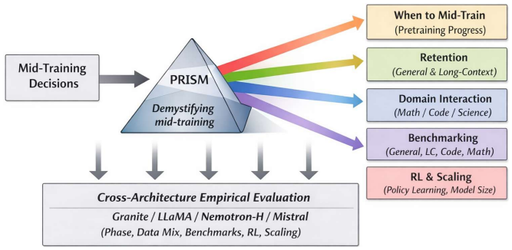
Figure 1 PRISM overview.Mid-training decisions are decomposed into their principal design axes, including retention of general and long-context abilities, domain interaction (math, code, science), benchmark selection, reinforcement learning compatibility, and scaling behavior.PRISMenables holistic evaluation of mid-training choices across model families at scale.
원문 · CC BY 4.0 · Bharat Runwal, Ashish Agrawal, Anurag Roy, Rameswar Panda · PRISM: Demystifying Retention and Interaction in Mid-Training · 원문 그림 인용 · 원본 PDF 2쪽에서 그림 영역을 추출했습니다.PRISM의 mid-training과 RL 파이프라인
PRISM은 mid-training 데이터로 약 27B 토큰을 사용하며, 일반 웹 데이터 DCLM-EDU와 수학·코드·과학 추론 데이터, 채팅 데이터를 함께 씁니다. 학습 단계의 후속으로는 GRPO 기반 RL을 적용합니다. RL 보상은 정답 여부와 사고 형식을 함께 반영하며, 학습 중에는 절단형 중요도 샘플링 비율을 사용합니다. RL 프롬프트는 mid-training 체크포인트 기준으로 난이도를 걸러 구성합니다.
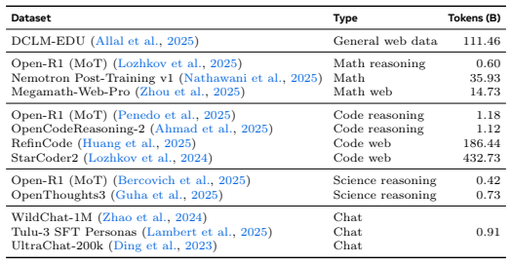
Table 1 Datasets used in mid-training mixtures.Token counts are reported in billions (Granite 3.3, 8B).
원문 · CC BY 4.0 · Bharat Runwal, Ashish Agrawal, Anurag Roy, Rameswar Panda · PRISM: Demystifying Retention and Interaction in Mid-Training · 원문 그림 인용 · 원본 PDF 4쪽에서 그림 영역을 추출했습니다.데이터 구성과 mid-training의 효과
Granite-3.3 (8B) 기본 모델에 Math-only, Math+Code, Math+Code+Science 혼합을 같은 약 27B 토큰 예산과 8192 문맥으로 적용했습니다. 원문은 Math+Code+Science에서 과학 점수(GPQA-Diamond)가 높아지고 코드 평균이 유지된다고 보고합니다. 일반 리더보드는 대체로 기준선 근처를 유지하지만 HellaSwag 등 개별 과제에서 약 5점의 회귀가 나타났습니다. 이 결과는 Granite-3.3 (8B) 한 모델의 설정에서 얻은 것입니다.
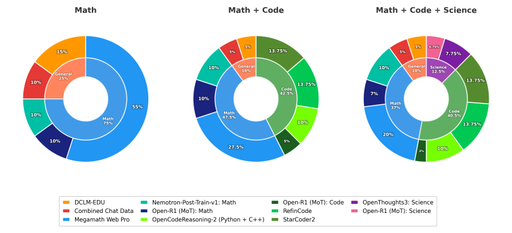
Figure 2 Mid-training data mixture configurations and per-source sampling percentages.The outer ring shows individual data sources; the inner ring groups them by domain category.
원문 · CC BY 4.0 · Bharat Runwal, Ashish Agrawal, Anurag Roy, Rameswar Panda · PRISM: Demystifying Retention and Interaction in Mid-Training · 원문 그림 인용 · 원본 PDF 5쪽에서 그림 영역을 추출했습니다.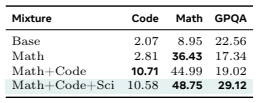
Table 5 Domain-specific resultsfor Granite-3.3 (8B). Code/Math are averages; full results in Appendix Table 19.
원문 · CC BY 4.0 · Bharat Runwal, Ashish Agrawal, Anurag Roy, Rameswar Panda · PRISM: Demystifying Retention and Interaction in Mid-Training · 원문 그림 인용 · 원본 PDF 7쪽에서 그림 영역을 추출했습니다.mid-training 시점과 장문맥 복원
Granite-4 Micro (3B)에서는 같은 혼합 레시피를 Phase 3 후, Phase 4 후, 장문맥 확장 후 세 시점에 적용했습니다. 장문맥 확장 후 적용한 경우 AIME24, MATH500, GPQA-Diamond가 가장 높았습니다. 저자들은 이 결과가 단일 모델에 기반한 예비 결과이며, 기본 모델의 절대 성능 차이와 시점 효과가 섞일 수 있다고 해석합니다. 장문맥 복원은 짧은 문맥 mid-training으로 RULER@128k가 59.09에서 6.46으로 떨어진 뒤, 1k 스텝의 장문맥 학습 또는 15% 기본 모델과 85% mid-training 모델의 선형 병합으로 42.16 또는 37.75까지 회복되는 절차입니다.
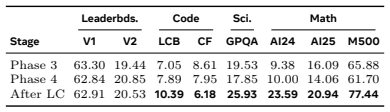
Table 3 Effect of when mid-training is appliedon Granite-4 Micro (3B). Phase 3/4 = intermediate/late pretraining; After LC = after long-context extension.
원문 · CC BY 4.0 · Bharat Runwal, Ashish Agrawal, Anurag Roy, Rameswar Panda · PRISM: Demystifying Retention and Interaction in Mid-Training · 원문 그림 인용 · 원본 PDF 6쪽에서 그림 영역을 추출했습니다.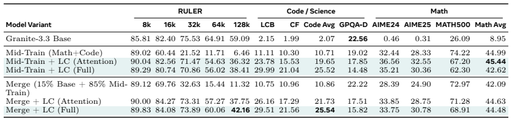
Table 7 Restoring long-context capability after mid-training for Granite-3.3 (8B).RULER is evaluated from 8k to 128k input lengths. Downstream performance includes Code (LiveCodeBench, Codeforces), Science (GPQA-Diamond), and Math (AIME24, AIME25, MATH500).
원문 · CC BY 4.0 · Bharat Runwal, Ashish Agrawal, Anurag Roy, Rameswar Panda · PRISM: Demystifying Retention and Interaction in Mid-Training · 원문 그림 인용 · 원본 PDF 9쪽에서 그림 영역을 추출했습니다.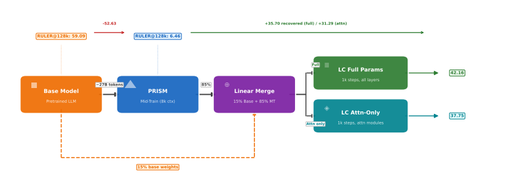
Figure 3 Long-context restoration pipeline.After PRISM mid-training degrades RULER@128k from 59.09 to 6.46, a linear merge (15% base + 85% mid-trained) followed by long-context extension recovers performance to 42.16 (full params) or 37.75 (attention-only).
원문 · CC BY 4.0 · Bharat Runwal, Ashish Agrawal, Anurag Roy, Rameswar Panda · PRISM: Demystifying Retention and Interaction in Mid-Training · 원문 그림 인용 · 원본 PDF 10쪽에서 그림 영역을 추출했습니다.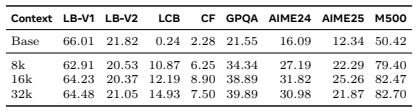
Table 8 Mid-training context length ablationon Granite-4 Micro (3B) with Math+Code+Science mix. V1/V2 = Leaderboard V1/V2.
원문 · CC BY 4.0 · Bharat Runwal, Ashish Agrawal, Anurag Roy, Rameswar Panda · PRISM: Demystifying Retention and Interaction in Mid-Training · 원문 그림 인용 · 원본 PDF 10쪽에서 그림 영역을 추출했습니다.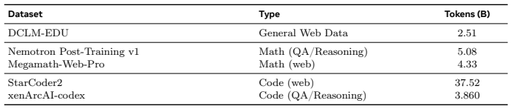
Table 18 Datasets used in the long-context extension phase.Token counts in billions (Granite 3.3, 8B).
원문 · CC BY 4.0 · Bharat Runwal, Ashish Agrawal, Anurag Roy, Rameswar Panda · PRISM: Demystifying Retention and Interaction in Mid-Training · 원문 그림 인용 · 원본 PDF 36쪽에서 그림 영역을 추출했습니다.PRISM 이후 RL의 효과와 기본 모델 대비 차이
PRISM mid-training 체크포인트에 unbalanced MCS 혼합으로 RL을 적용하면 여섯 벤치마크의 매크로 평균이 12 미만에서 29에서 42 사이로 올라갑니다. 같은 RL을 mid-training 없이 기본 모델에 직접 적용하면 AIME24와 AIME25가 대부분 0 근처에 머뭅니다. 과학 데이터를 mid-training에 넣으면 RL 과정에서 GPQA-Diamond 향상폭이 커지며, RL 데이터 혼합을 바꾸는 효과는 대체로 2점 미만입니다.
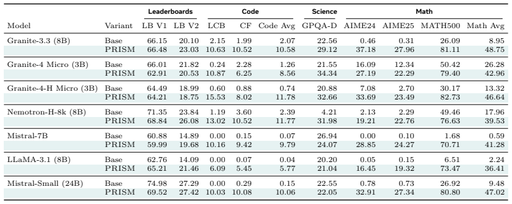
Table 6 Base versus PRISM (Math+Code+Science) mid-training results across model families.Code Avg is the mean of LiveCodeBench (LCB) and Codeforces (CF). Math Avg is the mean of AIME24, AIME25, and MATH500. All values are reported to two decimal places.
원문 · CC BY 4.0 · Bharat Runwal, Ashish Agrawal, Anurag Roy, Rameswar Panda · PRISM: Demystifying Retention and Interaction in Mid-Training · 원문 그림 인용 · 원본 PDF 8쪽에서 그림 영역을 추출했습니다.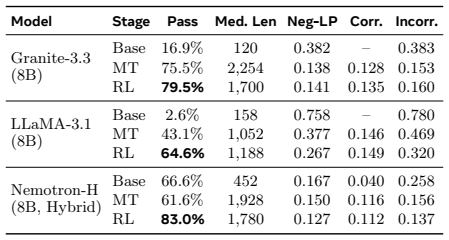
Table 15 Correctness, response length, and prediction confidence across pipeline stageson 200 held-out MATH500 problems (8 samples/prompt, 7680 max generation tokens, step-by-step reasoning prompt). Pass = mean pass rate across 8 samples per prompt (%). Med. Len = median response length (tokens). Neg-LP = mean negative log-probability. Corr./Incorr. = mean neg-LP for correct/incorrect responses; – indicates too few correct samples. ThePRISM→RL pipeline consistently achieves the highest pass rates across all three model families.
원문 · CC BY 4.0 · Bharat Runwal, Ashish Agrawal, Anurag Roy, Rameswar Panda · PRISM: Demystifying Retention and Interaction in Mid-Training · 원문 그림 인용 · 원본 PDF 24쪽에서 그림 영역을 추출했습니다.가중치 변화와 표현 기하
정규화 L2 divergence는 변화 뒤 가중치와 이전 가중치의 차이 노름을 이전 가중치의 L2 노름으로 나눈 값입니다. Granite-3.3에서 mid-training은 약 0.175 수준의 변화를 만들며, RL은 약 0.0003 수준으로 훨씬 작게 바꾸고 95% 가까운 파라미터를 1% 기준 안에 둡니다. 선형 CKA로 본 표현 기하에서는 RL 전후 MT 대비 값이 0.998 이상으로 유지됩니다. 이 분석은 Granite-3.3 (8B), Nemotron-H (8B), LLaMA-3.1 (8B)의 범위에서 보고됩니다.
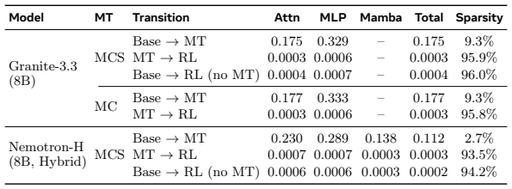
Table 12 Weight divergence summary across models and architectures.Normalized L2 =∥wnew −w old∥2/∥wold∥2. Nemotron- H reports all three component types (Attention, MLP, Mamba). Sparsity = fraction of parameters with<1% relative change. The dense/sparse asymmetry is consistent across all component types and architectures.
원문 · CC BY 4.0 · Bharat Runwal, Ashish Agrawal, Anurag Roy, Rameswar Panda · PRISM: Demystifying Retention and Interaction in Mid-Training · 원문 그림 인용 · 원본 PDF 19쪽에서 그림 영역을 추출했습니다.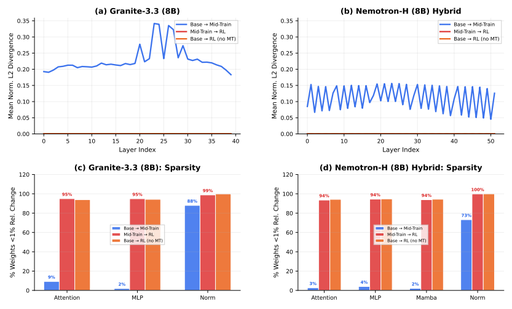
Figure 11 Mid-training densely restructures the network; RL makes sparse, surgical refinements.Top row: layer-wise normalized L2 divergence for Granite-3.3 (8B, left) and Nemotron-H (8B, right). Mid-training (blue) changes weights 370–580× more than RL (red, orange), broadly across all layers with some layer-wise variation. For Nemotron-H, the repeating pattern reflects its hybrid architecture where Mamba-2, self-attention and FFN are separate sequential layers with independent residual connections (NVIDIA et al., 2025). Bottom row: update sparsity by component type. Mid-training modifies >90% of all parameters (attention, MLP, and Mamba alike), while RL leaves>93% unchanged.
원문 · CC BY 4.0 · Bharat Runwal, Ashish Agrawal, Anurag Roy, Rameswar Panda · PRISM: Demystifying Retention and Interaction in Mid-Training · 원문 그림 인용 · 원본 PDF 20쪽에서 그림 영역을 추출했습니다.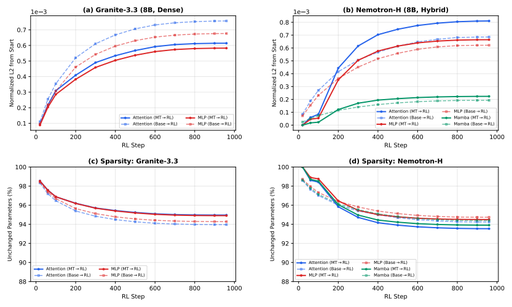
Figure 16 RL optimization is front-loaded and starting-point-invariant.Top row: cumulative L2 divergence from the initial checkpoint over RL steps for Granite-3.3 (left) and Nemotron-H (right). Solid lines: MT→RL; dashed lines: Base→RL. Most weight change occurs in the first∼200–400 steps, then plateaus. MT→RL and Base→RL produce nearly identical divergence profiles, confirming that RL’s weight footprint is independent of the starting point. Bottom row: sparsity evolution showing the fraction of parameters within 1% of their initial values. The active parameter set grows progressively from∼1.5% at step 20 to∼5–6% by step 960, with all component types following the same trajectory.
원문 · CC BY 4.0 · Bharat Runwal, Ashish Agrawal, Anurag Roy, Rameswar Panda · PRISM: Demystifying Retention and Interaction in Mid-Training · 원문 그림 인용 · 원본 PDF 26쪽에서 그림 영역을 추출했습니다.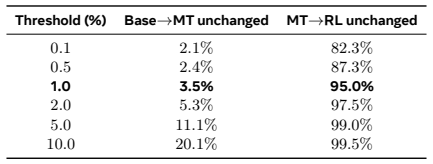
Table 22 Per-element sparsity at different relative change thresholds (Granite-3.3, 8B).The dense/sparse asymmetry between mid-training and RL is robust across all tested thresholds. Bold row shows the 1% threshold used in the main text.
원문 · CC BY 4.0 · Bharat Runwal, Ashish Agrawal, Anurag Roy, Rameswar Panda · PRISM: Demystifying Retention and Interaction in Mid-Training · 원문 그림 인용 · 원본 PDF 41쪽에서 그림 영역을 추출했습니다.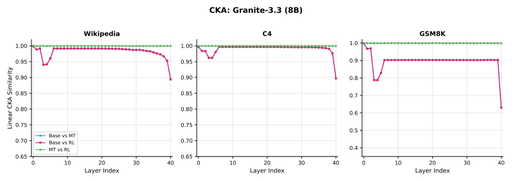
Figure 27 CKA across input distributions: Granite-3.3 (8B).MT vs. RL (green) remains ≈1.0 on all three inputs. Base vs. MT divergence is input-dependent: strongest on GSM8K math prompts (min 0.55), weakest on C4 general text (min 0.94).
원문 · CC BY 4.0 · Bharat Runwal, Ashish Agrawal, Anurag Roy, Rameswar Panda · PRISM: Demystifying Retention and Interaction in Mid-Training · 원문 그림 인용 · 원본 PDF 46쪽에서 그림 영역을 추출했습니다.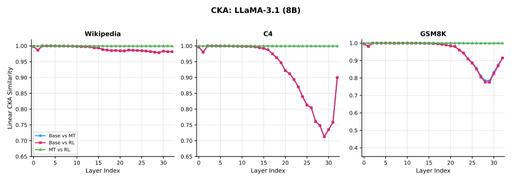
Figure 28 CKA across input distributions: LLaMA-3.1 (8B).Same pattern as Granite-3.3: MT vs. RL ≈1.0 everywhere, confirming the finding generalizes across dense Transformer families.
원문 · CC BY 4.0 · Bharat Runwal, Ashish Agrawal, Anurag Roy, Rameswar Panda · PRISM: Demystifying Retention and Interaction in Mid-Training · 원문 그림 인용 · 원본 PDF 47쪽에서 그림 영역을 추출했습니다.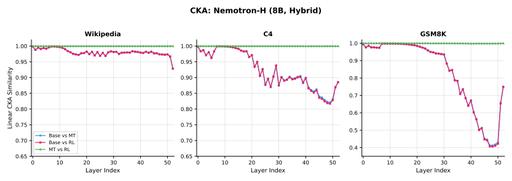
Figure 29 CKA across input distributions: Nemotron-H (8B, Hybrid).MT vs. RL >0.998 on all three inputs, consistent with all other models. Base vs. MT divergence is most pronounced on GSM8K math prompts (min≈0.41), reflecting mid-training’s targeted restructuring of reasoning-relevant representations.
원문 · CC BY 4.0 · Bharat Runwal, Ashish Agrawal, Anurag Roy, Rameswar Panda · PRISM: Demystifying Retention and Interaction in Mid-Training · 원문 그림 인용 · 원본 PDF 47쪽에서 그림 영역을 추출했습니다.적용 범위와 남은 질문
이 연구는 모든 모델과 데이터에서 일반화된다고 단정하지 않습니다. mid-training 시점 결과는 단일 모델의 예비 결과이며, 장문맥 확장과 시점의 효과가 교란될 수 있습니다. RL 데이터는 Granite-3.3-8B mid-training 체크포인트를 기준으로 걸러 다른 모델에도 같은 혼합으로 적용되었습니다. 70B 이상 규모와 다국어·도구 사용 같은 추가 도메인은 원문이 남긴 향후 과제입니다.
논문 정보
- 저자
- Bharat Runwal, Ashish Agrawal, Anurag Roy, Rameswar Panda
- 학회·저널
- arXiv · 프리프린트
- 최초 공개일
- 2026년 3월 17일
- 등록일
- 2026년 10월 29일
- 수정일
- 2026년 3월 24일
- 버전
- v3
- arXiv
- 2603.17074
- 분류
- cs.LG
- 원문 이용 조건
- CC BY 4.0
- 제공 범위
- 논문 정보, 해설, 허용된 원문 그림
AI 해설은 논문 원문과 별개의 설명이며 오류가 있을 수 있습니다. 원문과 그림은 각 출처의 이용 조건과 따로 표시된 권리를 따릅니다.
초록
We present PRISM, a comprehensive empirical study of mid-training design choices for large language models. Through controlled experiments across seven base models spanning four families (Granite, LLaMA, Mistral, Nemotron-H), two architecture types (dense Transformer and attention-Mamba hybrid), and scales from 3B to 24B parameters, we show that mid-training on approximately 27B high-quality tokens yields consistent gains of +15 to +40 points on math, +5 to +12 points on code, and +6 to +13 points on science benchmarks while preserving general performance. The full PRISM to RL pipeline improves macro-average across six reasoning benchmarks from under 12 to 29-42 (a 3-4x improvement), whereas RL applied directly to most of the base models remains substantially less effective, with AIME scores near zero. Data composition matters most at mid-training, not RL: including science data during mid-training unlocks +17 to +28 point GPQA-Diamond gains during RL, while changing the RL mix produces less than 2 point differences. Mechanistically, mid-training densely restructures over 90% of model weights, while RL makes sparse, front-loaded refinements to approximately 5% of parameters. Representation analysis (CKA) confirms that RL consistently preserves mid-training's representational geometry (over 0.998 CKA) across architectures. Crucially, RL applies identical weight changes regardless of starting point, yet only succeeds on mid-trained models, consistent with mid-training placing the model in a configuration from which RL can effectively improve performance. Our results demonstrate that retention-aware mid-training is highly effective for reliable reasoning enhancement and provide practical guidance for designing robust mid-training pipelines.
원문 인용
Bharat Runwal, Ashish Agrawal, Anurag Roy, Rameswar Panda (2026). PRISM: Demystifying Retention and Interaction in Mid-Training. arXiv:2603.17074v3. https://arxiv.org/abs/2603.17074v3
BibTeX
@misc{runwal2026prism,
  title = {{PRISM: Demystifying Retention and Interaction in Mid-Training}},
  author = {Bharat Runwal and Ashish Agrawal and Anurag Roy and Rameswar Panda},
  year = {2026},
  eprint = {2603.17074},
  archivePrefix = {arXiv},
  url = {https://arxiv.org/abs/2603.17074v3}
}