논문 해설
Preference learning made easy: Everything should be understood through win rate
선호 학습을 쉽게: 모든 것은 승률을 통해 이해해야 한다
- 연구 문제 선호 학습은 생성 모델을 선호 비교 데이터에 맞추는 과제이지만, 평가와 목적 함수를 잇는 개념적 기반이 부족합니다.
- 연구 방법 선호 쌍의 샘플링 분포에서 출발해 두 일관성 조건을 만족하는 평가가 win rate 형태뿐임을 보이고, 이를 기준으로 WRO와 비WRO 방법을 분석합니다.
- 주요 결과 RLHF와 WRO-KL 변형은 이론적 이점을 가지지만 실험에서 최적화 성공이 성능을 좌우하는 것으로 보고됩니다. DPO와 SFT는 win rate-correspondence나 consistency를 충족하지 않습니다.
선호 학습의 평가 기준 문제
선호 학습은 생성 모델을 쌍별 선호 비교 데이터에 맞추는 과제이지만, 분류나 밀도 추정처럼 공유된 개념적 기반이 아직 정리되지 않았습니다. 이 논문은 평가 지표와 학습 목적을 선호 쌍의 샘플링 분포에서 출발해 하나의 틀로 묶으려 합니다. 먼저 생성 모델을 평가하는 함수가 선호와 질의 분포의 빈도를 모두 존중해야 한다는 조건을 세우고, 그 조건을 만족하는 평가가 win rate 형태뿐임을 보입니다. 이 결과는 이후의 방법 비교에서 win rate를 기준선으로 삼는 근거가 됩니다.
선호 쌍 분포와 h-win rate
논문은 입력 x, 두 후보 응답 y0와 y1, 선호 라벨 ℓ로 이루어진 샘플링 분포를 정의합니다. 평가 함수는 생성 모델, 질의-선호 환경, 앵커 분포를 받아 스칼라를 내며, 선호 일관성과 빈도 일관성이라는 두 조건을 만족해야 합니다. 명제 3.3은 이 조건을 만족하는 평가가 앵커 분포에 대한 기대 승률 형태 E[h · p(ℓ = 1 | x, y0, y)]와 같다고 말합니다. 여기서 h는 엄격히 증가하는 함수이며, h가 항등함수이면 일반 win rate가 됩니다.
WRO 목적과 두 가지 이점
WRO 목적은 명제 3.3의 h-win rate를 생성 모델 πθ에 대해 직접 최대화하는 목적으로 정의됩니다. 이 계열에는 RLHF와 역방향 KL로 정규화된 WRO-KL이 포함되며, 선호 분류기가 Bradley-Terry 가정을 따르고 h가 logit일 때 RLHF가 WRO-KL의 한 사례로 설명됩니다. 논문은 WRO 목적이 win rate-correspondence(목적 개선이 h-win rate 개선으로 이어짐)와 win rate-consistency(목적의 최적해가 h-win rate를 최대화함)를 가진다고 보입니다. 정규화된 경우에는 두 성질이 수정된 형태로만 성립합니다.

Table 2 : Summary of the win-rate centric framework introduced in this work. (*) means that the given insight can be attributed to multiple works. Works which generalize DPO and propose alternative direct alignment algorithms: Azar et al. (2023); Huang et al. (2024); Tang et al. (2024); Han et al. (2024). Works that generalize SFT on the preferred sample to more samples include Dong et al. (2023); Gulcehre et al. (2023). †RLHF and NLHF typically include a regularization term and satisfy regularized win rate-correspondence and consistency. Without regularization, win rate-correspondence and consistency are satisfied. ‡DPO only satisfies regularized win rate-consistency (β must be greater than zero for a meaningful objective) and was constructed specifically with this goal in mind.
원문 · CC BY 4.0 · Lily H. Zhang, Rajesh Ranganath · Preference learning made easy: Everything should be understood through win rate · 원문 그림 인용 · 원본 PDF 12쪽에서 그림 영역을 추출했습니다.DPO와 SFT가 놓치는 성질
DPO는 RLHF와 같은 목표 분포를 가지지만 목적 함수가 달라 win rate-correspondence를 충족하지 않습니다. 원문은 그 이유로 오프라인 데이터가 빈도 일관성을 깨뜨리는 점과, 온라인으로 바꿔도 선호 확률의 로그 손실이 h-win rate가 되지 않는다는 점을 듭니다. SFT는 선호 샘플에 최대우도를 적용하며, 목표 분포가 평균 선호 확률로 기울어진 분포입니다. 이 경우 win rate 향상은 초기 모델의 평균 선호 확률 분산에 의해 결정되며, 세 개 이상의 응답 지지 집합이 있을 때 win rate는 최대화되지 않습니다.
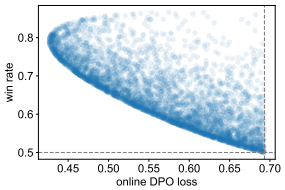
Figure 1 : Plot of win rate vs. DPO loss for differentpθ(y | x) for a given choice of anchor and preference classifier (see Appendix F.2 for details). Any pair of points that would form a line segment with a positive slope form a setting of θ, θ′ such that win rate correspondence does not hold. Grey lines denote the win rate and DPO loss at initialization. See Appendix F.2 for additional discussion and examples.
원문 · CC BY 4.0 · Lily H. Zhang, Rajesh Ranganath · Preference learning made easy: Everything should be understood through win rate · 원문 그림 인용 · 원본 PDF 6쪽에서 그림 영역을 추출했습니다.이론적 이점과 실제 최적화 성능
실험은 Pythia-2.8b 기반 초기 모델과 OASST, HH 데이터셋을 사용합니다. 판정 모델을 오라클로 두고 win rate를 평가하며, 100개 테스트 프롬프트에서 RLHF, DPO, SFT를 비교합니다. 결과에서 RLHF는 기대보다 크게 낮은 win rate를 보였고, 오라클 선호 분류기를 쓴 WRO 변형도 더 나은 성능을 내지 못했습니다. WRO-KL 변형들에서는 학습 손실이 테스트 win rate와 Spearman 상관을 보이며(p-value 8.27e-5), 선호 분류기 추정이나 h, β의 선택보다 최적화 성공이 더 중요한 요인이라고 저자들은 해석합니다.
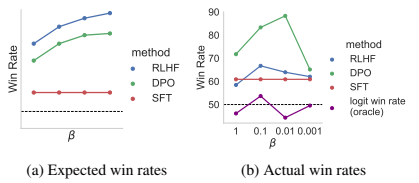
Figure 2 : Expected versus observed win rates of RLHF, DPO, and SFT over the original model for OASST. RLHF notably underperforms relative to expectations. Moreover, substituting the learned reward model for the oracle pref- erence classifier (logit win rate (oracle)) does not improve performance, suggesting other factors are more important.
원문 · CC BY 4.0 · Lily H. Zhang, Rajesh Ranganath · Preference learning made easy: Everything should be understood through win rate · 원문 그림 인용 · 원본 PDF 7쪽에서 그림 영역을 추출했습니다.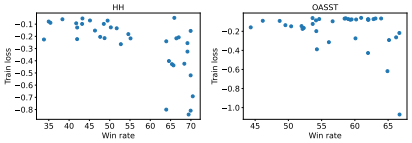
Figure 3 : Train loss vs. test win rate across all settings tested in Table 1.
원문 · CC BY 4.0 · Lily H. Zhang, Rajesh Ranganath · Preference learning made easy: Everything should be understood through win rate · 원문 그림 인용 · 원본 PDF 8쪽에서 그림 영역을 추출했습니다.판정 모델과 적용 범위
실험의 선호 신호는 오라클 판정 모델에서 나오며, 이 판정 모델의 정확도는 완벽하지 않습니다. OASST에서 판정 모델의 정확도는 80.47, HH에서는 85.16으로 보고됩니다. 또한 실험은 Pythia-2.8b 한 모델과 두 데이터셋에 한정되며, 결과는 이 설정에서 얻은 것입니다. 논문은 최적화 성공이 중요하다고 해석하지만, 다른 모델 규모나 과제에서 같은 관계가 성립하는지는 이 원문만으로 확인되지 않습니다.
논문 정보
- 저자
- Lily H. Zhang, Rajesh Ranganath
- 학회·저널
- arXiv · 프리프린트
- 최초 공개일
- 2025년 2월 14일
- 등록일
- 2026년 10월 31일
- 수정일
- 2025년 7월 26일
- 버전
- v2
- arXiv
- 2502.10505
- 분류
- cs.LG · cs.CL · stat.ML
- 원문 이용 조건
- CC BY 4.0
- 제공 범위
- 논문 정보, 해설, 허용된 원문 그림
AI 해설은 논문 원문과 별개의 설명이며 오류가 있을 수 있습니다. 원문과 그림은 각 출처의 이용 조건과 따로 표시된 권리를 따릅니다.
초록
Preference learning, or the task of aligning generative models to preference comparison data, has yet to reach the conceptual maturity of classification, density estimation, etc. To close this gap, this work presents a framework to understand preference learning starting from the sampling distribution of pairwise preference data. First, we prove that the only evaluation of a generative model that respects both preferences and prevalences in the data distribution is a form of win rate, justifying win rate as the focal point to understand preference learning. We then analyze preference learning methods as win rate optimization (WRO) or non-WRO. We present novel instances of WRO beyond existing examples (RLHF, NLHF) and identify two key theoretical benefits of all such methods. We prove that common non-WRO methods like DPO and SFT on preferred samples lack these properties and suggest ways to mitigate such theoretical limitations. We also show that WRO underperforms in practice due optimization difficulties and that optimization success predicts performance better than choices which affect the objective's solution. Our analysis highlights best practices for existing methods and provides recommendations for future research, guided by the principle that one should either align non-WRO methods more closely with WRO or improve the optimization of WRO objectives.
원문 인용
Lily H. Zhang, Rajesh Ranganath (2025). Preference learning made easy: Everything should be understood through win rate. arXiv:2502.10505v2. https://arxiv.org/abs/2502.10505v2
BibTeX
@misc{zhang2025preference,
  title = {{Preference learning made easy: Everything should be understood through win rate}},
  author = {Lily H. Zhang and Rajesh Ranganath},
  year = {2025},
  eprint = {2502.10505},
  archivePrefix = {arXiv},
  url = {https://arxiv.org/abs/2502.10505v2}
}