논문 해설
What Matters for Cross-Modal Alignment
교차 모달 정렬에서 중요한 요소
- 연구 문제 쌍 데이터 없이 고정된 이미지와 텍스트 인코더를 정렬하는 방법은 자연 이미지에서는 되지만 의료 영상에서는 실패합니다.
- 연구 방법 공유 부분공간의 분산 비율과 부호를 분석하고, 소수의 쌍으로 능선 회귀 매핑과 보고서 분류기를 학습합니다.
- 주요 결과 CT-RATE에서 200쌍의 LightAlign은 CT-CLIP보다 높은 0.754 AUROC를 기록했습니다.
zero-pair 정렬이 실패하는 이유
이 논문은 쌍으로 된 데이터 없이 고정된 이미지 인코더와 텍스트 모델을 맞추는 zero-pair 정렬이 자연 이미지에서만 성공하는지 묻습니다. 저자들은 COCO에서는 FOSCTTM 0.012로 정렬이 되지만, CT 데이터에서는 56개 인코더-텍스트 조합이 모두 무작위 수준(0.440–0.536)에 머문다고 보고합니다. 원인을 찾기 위해 두 모달리티가 함께 변하는 공유 부분공간의 이미지 분산 비율 η를 핵심 변수로 둡니다. 의료 영상에서는 η가 CT에서 0.5–10.5%, 흉부 X선에서 2–3.5%로 작습니다.
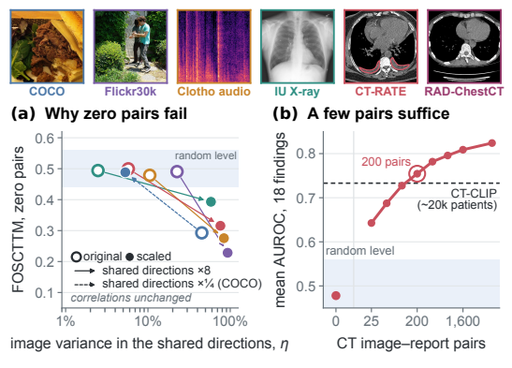
Figure 1 . A large variance share is necessary for zero-pair alignment, and 200 pairs outperform an end-to-end model. Top: one held-out example per dataset, framed in its marker color (CT: one axial slice).(a)Each marker is one dataset (open: before, filled: after scaling the shared directions eight-fold at unchanged canonical correlations); horizontal: mean fraction η of image variance in the shared directions; vertical: FOSCTTM, lower is better (shaded: random level). Scaling the shared directions aligns all four failing datasets (solid arrows, after sign correction; each combination in Fig. 3); shrinking them on COCO to a quarter breaks the alignment (dashed arrow).(b)Mean AUROC over 18 findings on the 3,002 test scans vs. pair count (red curve; ring: 200 pairs, both encoders frozen); dashed line: CT-CLIP, trained end to end on the image–report pairs of about 20,000 patients without finding labels.
원문 · CC BY 4.0 · Yipeng Sun, Jiajun Wang, Siyuan Mei, Yan Xia, Siming Bayer, Vincent Christlein, Andreas Maier · What Matters for Cross-Modal Alignment · 원문 그림 인용 · 원본 PDF 2쪽에서 그림 영역을 추출했습니다.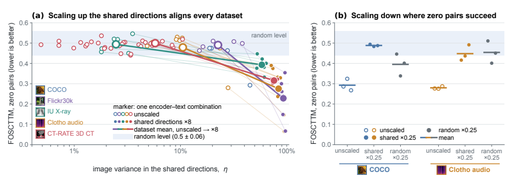
Figure 3 . Without paired data, the zero-pair method finds the shared subspace only when it holds a large share of the variance.(a)Horizontal: share η of image variance in the shared directions (log scale). Vertical: FOSCTTM at zero pairs. Color: dataset. Each encoder–text combination (three-seed mean): open: original; filled: shared directions scaled eight-fold at unchanged canonical correlations (sign correction: oracle signs on Flickr30k, Clotho, IU X-ray; GW sign selection on CT). Large markers: dataset means. Band: random level (0.44–0.56).(b)Where zero pairs work, shrinking the shared directions to a quarter breaks alignment on COCO (DINOv2 mean × MPNet; Clotho: AST × MPNet); shrinking random directions of equal variance (gray) breaks COCO less (FOSCTTM 0.395 vs. 0.488) and Clotho about as much (0.454 vs. 0.448). Dots: single seeds; lines: three-seed mean.
원문 · CC BY 4.0 · Yipeng Sun, Jiajun Wang, Siyuan Mei, Yan Xia, Siming Bayer, Vincent Christlein, Andreas Maier · What Matters for Cross-Modal Alignment · 원문 그림 인용 · 원본 PDF 7쪽에서 그림 영역을 추출했습니다.위치 파악과 부호 결정
정렬은 두 단계로 나눠 볼 수 있습니다. 먼저 주성분으로 투영한 뒤 공유 방향의 위치를 찾고, 다음으로 각 방향의 부호를 정합니다. 저자들은 이미지 특징이 비대칭(skewed)이라 세 번째 모멘트가 부호에 따라 바뀌며, 거울상 매핑은 Gromov–Wasserstein 손실이 더 높다고 설명합니다. 이 손실로 부호 패턴을 골라 쌍 없이 거울상 매핑을 교정합니다. 쌍의 수를 고르는 단계에서는 200쌍 파일럿과 탐지 임계값 n⋆ = d(1+1/r)을 사용합니다. 최종 방법인 LightAlign은 고정된 두 인코더 사이에서 능선 회귀로 이미지를 텍스트 공간에 매핑하고, 보고서 텍스트만으로 학습한 로지스틱 분류기가 소견을 예측합니다.
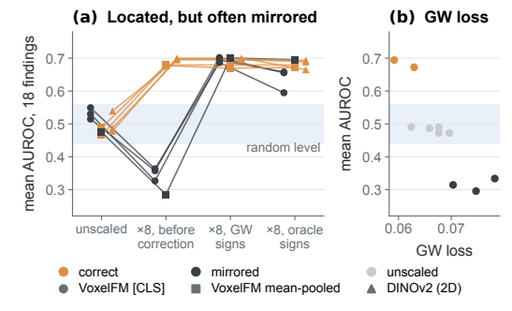
Figure 4 . A located subspace is often mirrored, and the GW loss distinguishes the mirror without paired data.(a)Mean AUROC over 18 findings per seed on CT for three encoder–text combinations (circle: V oxelFM [CLS] token, block 11,× Qwen3.5-9B; square: V oxelFM mean-pooled patch tokens × Qwen3.5-4B; triangle: DINOv2 on 2D slices × Qwen3.5-4B): original features, shared directions scaled eight-fold before sign correction, and signs chosen by the GW loss (Eq. (2)) or by oracle signs. Each line is one seed, colored by the orientation of its map before sign correction (orange: correct; black: mirrored). Band: random level.(b)GW loss against mean AUROC (V oxelFM patch×Qwen3.5-4B, five seeds). Gray: original; orange: correct; black: mirrored.
원문 · CC BY 4.0 · Yipeng Sun, Jiajun Wang, Siyuan Mei, Yan Xia, Siming Bayer, Vincent Christlein, Andreas Maier · What Matters for Cross-Modal Alignment · 원문 그림 인용 · 원본 PDF 8쪽에서 그림 영역을 추출했습니다.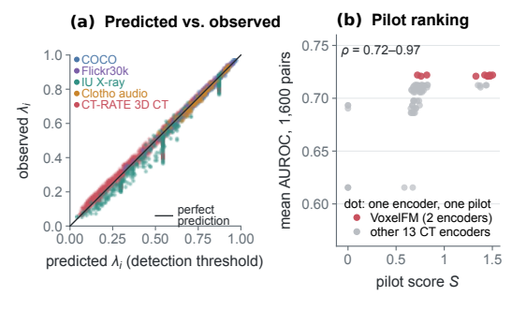
Figure 5 . The random-matrix detection threshold predicts how many pairs localization requires, and a 200-pair pilot ranks the encoders. (a)Top three squared sample canonical correlations λi of every setting, predicted by Eqs. (3)–(4) against observed (CT-RATE: 2,550 settings); line: perfect prediction; color: dataset.(b)A 200-pair pilot score (Qwen3.5-4B middle layer, d= 64 ) ranks 15 CT encoders by AUROC at 1,600 pairs. Horizontal: pilot score S, the summed estimated strengths of the detected shared directions. Each dot: one encoder in one of five independent 200-pair pilots; red: the two V oxelFM encoders; light gray: the other 13.ρ: Spearman rank correlation per pilot, 0.72–0.97.
원문 · CC BY 4.0 · Yipeng Sun, Jiajun Wang, Siyuan Mei, Yan Xia, Siming Bayer, Vincent Christlein, Andreas Maier · What Matters for Cross-Modal Alignment · 원문 그림 인용 · 원본 PDF 9쪽에서 그림 영역을 추출했습니다.CT와 흉부 X선에서의 결과
CT-RATE에서 200쌍으로 학습한 LightAlign은 CT-CLIP보다 높은 평균 AUROC(0.754 대 0.733)를 기록했습니다. 이 비교는 CT-CLIP이 약 20,000명의 환자에서 종단간으로 학습된 모델이라는 조건에서 이루어졌습니다. CheXpert에서는 약 5%의 쌍으로 0.862 평균 AUROC를 달성했다고 보고합니다. 공유 방향의 분산을 8배로 키우면 CT 세 조합의 FOSCTTM이 0.50에서 0.32로 낮아졌습니다. 같은 설정에서 GW 부호 선택은 CT 거울상 매핑 4개 시드를 모두 교정하며 평균 AUROC를 0.35에서 0.69로 높였습니다.
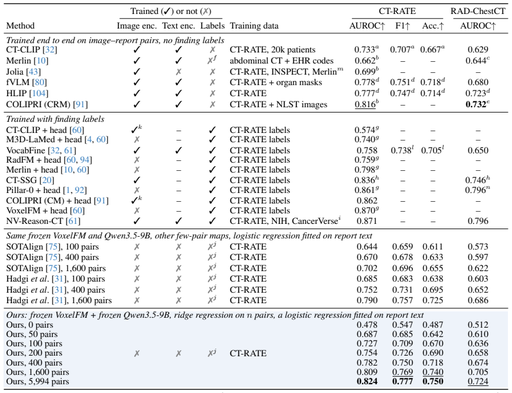
Table 1 . Multi-abnormality classification on 3D chest CT. CT-RATE: test set, i.e., the official validation set (3,002 scans, 18 findings), mean AUROC, weighted F1, and accuracy at the receiver operating characteristic (ROC) corner threshold of CT-CLIP [32]. RAD-ChestCT: OOD hospital, 3,630 volumes, 16 findings; ours applies the CT-RATE map and classifier unchanged. Labels: finding-label supervision; –: no text encoder, not reported, or not evaluated. Published models: numbers from the cited papers; SOTAlign and Hadgiet al.: fitted by us. Ours: frozen V oxelFM block 11 + Qwen3.5-9B middle layer, selected on validation patients; ridge regression onn pairs, report classifier, five seeds; 0 pairs uses the Wasserstein Procrustes method [76]. COLIPRI (CRM): contrastive + report generation + masked autoencoder; (CM): without report generation. NLST: National Lung Screening Trial. V ocabFine: CT-CLIP fine-tuned on 18 labels. Other few-pair maps: Table S2.Bold: best without image labels; underline : second best.
원문 · CC BY 4.0 · Yipeng Sun, Jiajun Wang, Siyuan Mei, Yan Xia, Siming Bayer, Vincent Christlein, Andreas Maier · What Matters for Cross-Modal Alignment · 원문 그림 인용 · 원본 PDF 4쪽에서 그림 영역을 추출했습니다.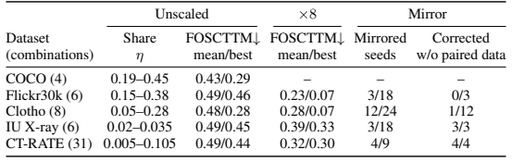
Table 2 . Scaling the shared directions aligns all four failing datasets. Combinations: encoder–text combinations of Fig. 3a, three seeds each. Share η: fraction of image variance in the shared directions (range). FOSCTTM: dataset mean / best combination. ×8: shared directions scaled eight-fold at fixed correlations, signs corrected (oracle signs from paired test correlations; GW sign selection on CT). CT-RATE×8 and mirror columns: the three combinations of Fig. 4a (nine seeds). Mirrored seeds: maps on scaled features whose FOSCTTM improves by more than 0.1 under the best of the 210 sign patterns on paired validation data, as mirrored / all seeds. Corrected without paired data: mirrored seeds where GW sign selection (Eq. (2); variants: Table S25) recovers over half of that improvement. –: not applicable.
원문 · CC BY 4.0 · Yipeng Sun, Jiajun Wang, Siyuan Mei, Yan Xia, Siming Bayer, Vincent Christlein, Andreas Maier · What Matters for Cross-Modal Alignment · 원문 그림 인용 · 원본 PDF 7쪽에서 그림 영역을 추출했습니다.적용 범위와 설정 의존성
결과는 쌍의 수와 평가 조건에 따라 달라집니다. RAD-ChestCT 평가는 CT-RATE에서 학습한 매핑과 분류기를 변경 없이 적용한 것이며, 설정표 전체의 승인은 이 원문만으로는 확인되지 않습니다. 또한 Qwen3.5-4B 대신 110M 텍스트 임베딩 모델이 여러 데이터셋에서 더 나은 결과를 보였다는 관찰은 이 연구의 설정 범위 안에서 보고된 것입니다.
논문 정보
- 저자
- Yipeng Sun, Jiajun Wang, Siyuan Mei, Yan Xia, Siming Bayer, Vincent Christlein, Andreas Maier
- 학회·저널
- arXiv · 프리프린트
- 최초 공개일
- 2026년 11월 15일
- 등록일
- 2026년 11월 17일
- 수정일
- 2026년 11월 15일
- 버전
- v1
- arXiv
- 2611.20000
- 분류
- cs.CV · cs.AI
- 원문 이용 조건
- CC BY 4.0
- 제공 범위
- 논문 정보, 해설, 허용된 원문 그림
AI 해설은 논문 원문과 별개의 설명이며 오류가 있을 수 있습니다. 원문과 그림은 각 출처의 이용 조건과 따로 표시된 권리를 따릅니다.
초록
The Platonic Representation Hypothesis posits that models trained on different modalities converge toward a shared representation. Related work aligns frozen image and text encoders on natural images without paired data. We test zero-pair alignment on five datasets across four modalities: natural images, environmental audio, chest radiographs, and 3D computed tomography (CT). It succeeds only on COCO and fails on the other four. We analyze the failures and find that alignment must first locate the subspace where the modalities co-vary and then orient the mapping within it. Consistent with previous studies, medical imaging is the hardest case: its shared subspace carries the smallest fraction of the variance. When this fraction is small, alignment needs image-text pairs, and random-matrix theory predicts how many pairs are needed. These findings motivate LightAlign: a few pairs let a ridge regression between two frozen encoders locate and orient the mapping simultaneously, and a classifier fitted only on report text then predicts findings from the mapped images. On 3D CT, LightAlign surpasses models trained end to end on image-report pairs without finding-level labels: with only 200 pairs, LightAlign outperforms CT-CLIP on CT-RATE (0.754 vs. 0.733 AUROC), and with only 100 CT-RATE pairs, it does so on RAD-ChestCT, an out-of-distribution dataset from a different hospital. On CheXpert, it reaches 0.862 mean AUROC with only about 5% as many pairs as models trained on MIMIC-CXR.
원문 인용
Yipeng Sun, Jiajun Wang, Siyuan Mei, Yan Xia, Siming Bayer, Vincent Christlein, Andreas Maier (2026). What Matters for Cross-Modal Alignment. arXiv:2611.20000v1. https://arxiv.org/abs/2611.20000v1
BibTeX
@misc{sun2026what,
  title = {{What Matters for Cross-Modal Alignment}},
  author = {Yipeng Sun and Jiajun Wang and Siyuan Mei and Yan Xia and Siming Bayer and Vincent Christlein and Andreas Maier},
  year = {2026},
  eprint = {2611.20000},
  archivePrefix = {arXiv},
  url = {https://arxiv.org/abs/2611.20000v1}
}