논문 해설
Dynamic Sparse Training of Diagonally Sparse Networks
대각 희소 네트워크의 동적 희소 학습
- 연구 문제 비구조적 희소성은 정확도를 잘 유지하지만 GPU에서 속도 향상으로 잘 이어지지 않고, 구조적 희소성은 하드웨어 친화적이지만 높은 희소성에서 성능이 떨어집니다.
- 연구 방법 DynaDiag는 대각선 희소성 패턴을 학습 중 TopK 기반으로 선택하고, 선택된 대각선 행렬을 BCSR 형식으로 변환해 순전파와 역전파를 가속합니다.
- 주요 결과 ImageNet-1K의 ViT-L/16에서 90% 희소성 기준 77.74% 정확도를 보고하며, ViT-B/16 90% 희소성에서 추론 최대 3.1배, 학습 1.59배 속도 향상을 보고합니다.
구조적 희소성과 실행 속도의 간극
비구조적 희소성은 높은 희소성에서도 정확도를 잘 유지하지만, 임의 위치에 0이 흩어져 있어 현대 GPU에서 실제 속도 향상으로 잘 이어지지 않습니다. 반대로 구조적 희소성은 하드웨어에 친화적이지만 높은 희소성에서 성능이 크게 떨어지는 경향이 있습니다. 기존 구조적 방법들은 역전파를 밀집 상태로 수행하거나 전치 과정에서 하드웨어 친화적 패턴이 깨지는 문제를 가집니다. 이 논문은 학습 중 희소성 패턴을 유지하면서 정확도와 GPU 실행 속도를 함께 확보할 수 있는지를 질문합니다.
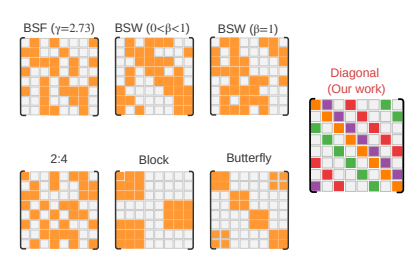
Figure 2 : Overview of different sparsity patterns from the literature used in sparse training methods. Bipartite Scale- Free (BSF) and behavior of Bipartite Small-World (BSW) networks with varying β is explained in Apdx. I
원문 · CC BY 4.0 · Tyagi, Abhishek, Iyer, Arjun, Renninger, William H, Kanan, Christopher, Zhu, Yuhao · Dynamic Sparse Training of Diagonally Sparse Networks · 원문 그림 인용 · 원본 PDF 3쪽에서 그림 영역을 추출했습니다.대각선 희소성과 TopK 기반 선택
DynaDiag는 가중치 행렬 W를 순열 행렬 Pj와 대각 행렬 diag(Vj)의 곱으로 표현하고, 선택된 K개 대각선을 합하여 희소 가중치를 구성합니다. 각 대각선의 중요도는 학습 가능한 벡터 α로 표현되며, 소프트맥스 기반 TopK 함수가 상위 K개 대각선을 고릅니다. 온도 T는 코사인 방식으로 조절되어 학습 초기에 더 많은 대각선을 탐색하게 합니다. 선택된 대각선 행렬은 BCSR 형식으로 변환되어 순전파와 역전파에서 GPU 희소 연산에 사용됩니다.
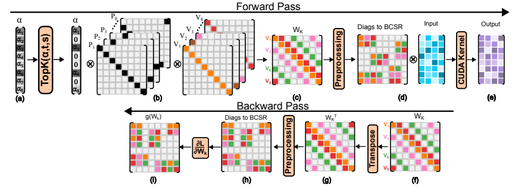
Figure 3 : Training with DynaDiag and diagonal sparsity. TopK induces sparsity in α (a), which leads to selecting a subset of diagonals for the forward pass (b) and (c). Matrices with diagonals are converted to BCSR format to accelerate sparse matrix-matrix multiplication (d) and (e). Backward pass is accelerated by converting the diagonal sparse weight matrix to BCSR format (g). Sparse gradients are calculated using our custom CUDA kernels (h) and (i).
원문 · CC BY 4.0 · Tyagi, Abhishek, Iyer, Arjun, Renninger, William H, Kanan, Christopher, Zhu, Yuhao · Dynamic Sparse Training of Diagonally Sparse Networks · 원문 그림 인용 · 원본 PDF 4쪽에서 그림 영역을 추출했습니다.
Table 8 : DynaDiag performance with and without BCSR conversion with a 90% sparse ViT-B/16 on ImageNet-1K.
원문 · CC BY 4.0 · Tyagi, Abhishek, Iyer, Arjun, Renninger, William H, Kanan, Christopher, Zhu, Yuhao · Dynamic Sparse Training of Diagonally Sparse Networks · 원문 그림 인용 · 원본 PDF 19쪽에서 그림 영역을 추출했습니다.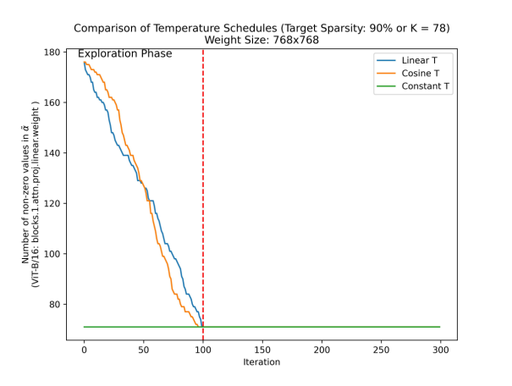
Figure 8 : Comparing the three different temperature schedules which affect the amount of non-zeros present at a training step.
원문 · CC BY 4.0 · Tyagi, Abhishek, Iyer, Arjun, Renninger, William H, Kanan, Christopher, Zhu, Yuhao · Dynamic Sparse Training of Diagonally Sparse Networks · 원문 그림 인용 · 원본 PDF 22쪽에서 그림 영역을 추출했습니다.
Table 15 : Impact of different scheduling methods on ViT-B/16 performance on ImageNet-1K
원문 · CC BY 4.0 · Tyagi, Abhishek, Iyer, Arjun, Renninger, William H, Kanan, Christopher, Zhu, Yuhao · Dynamic Sparse Training of Diagonally Sparse Networks · 원문 그림 인용 · 원본 PDF 23쪽에서 그림 영역을 추출했습니다.이미지와 언어 과제의 비교 결과
ImageNet-1K에서 ViT-L/16은 90% 희소성에서 DynaDiag가 77.74%의 Top-1 정확도를 보이며, 원문은 다음으로 좋은 구조적 방법인 SRigL보다 2.28% 높다고 보고합니다. GPT-2 Small의 WikiText-103 실험에서는 90% 희소성에서 DynaDiag가 다음으로 좋은 DST 방법보다 perplexity가 6.22점 낮고, RigL 기준선과는 2.57점 차이라고 보고합니다. 이 결과들은 각각 해당 모델과 과제, 희소성 조건에서 얻은 값입니다.
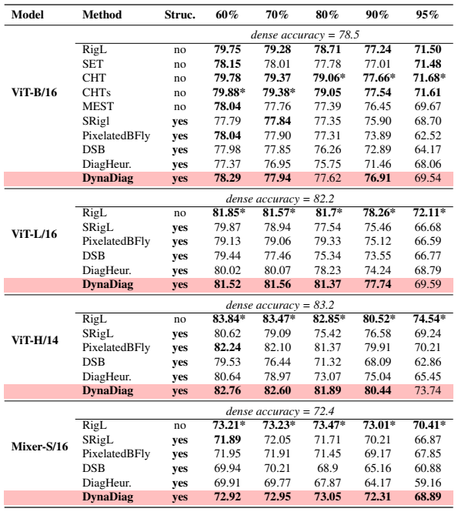
Table 1 : Top-1 accuracy of DynaDiag alongside baseline methods at varying sparsities. We bold results that are not significantly different (based on paired asymptotic McNemar tests (α = 0.05)) from the best-performing method (marked with a *) in each column. Among all structured sparse training methods, DynaDiag achieves the highest accuracy on the ImageNet-1K dataset.
원문 · CC BY 4.0 · Tyagi, Abhishek, Iyer, Arjun, Renninger, William H, Kanan, Christopher, Zhu, Yuhao · Dynamic Sparse Training of Diagonally Sparse Networks · 원문 그림 인용 · 원본 PDF 6쪽에서 그림 영역을 추출했습니다.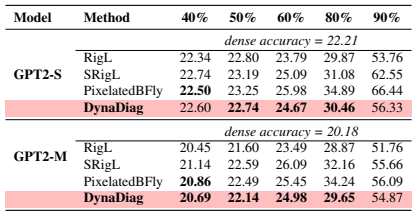
Table 2 : Perplexity of DynaDiag and baselines. We bold results that are not significantly different from RigL based on paired asymptotic McNemar tests (α = 0.05). Among all the baselines, DynaDiag achieves the lower PPL (lower, the better) on the WikiText-103 dataset.
원문 · CC BY 4.0 · Tyagi, Abhishek, Iyer, Arjun, Renninger, William H, Kanan, Christopher, Zhu, Yuhao · Dynamic Sparse Training of Diagonally Sparse Networks · 원문 그림 인용 · 원본 PDF 7쪽에서 그림 영역을 추출했습니다.GPU 추론과 학습 시간 측정
ViT-Base의 선형 계층에서 DynaDiag는 90% 희소성에서 추론 최대 3.1배, 학습 1.59배의 wall-clock 속도 향상을 보고합니다. 60% 희소성에서는 추론 1.37배, 학습 0.98배로 학습 이득이 거의 없습니다. 이 측정은 저자가 구현한 PyTorch 계층과 커스텀 커널을 사용한 결과이며, 저자는 CUDA 커널 최적화를 적용하지 않은 점이 추가 개선 여지라고 밝힙니다.
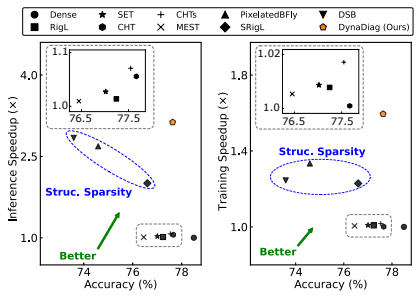
Figure 1 : Comparing the inference (left) and training speedups (right) (calculated using wall-clock time) of sparse training methods and the Top-1 classification accuracy (x-axis) for a ViT-Base model at 90% sparsity running ImageNet-1K. DynaDiag, being closest to the top right cor- ner, demonstrates superior accuracy and speedup compared to structured and unstructured sparse training approaches.
원문 · CC BY 4.0 · Tyagi, Abhishek, Iyer, Arjun, Renninger, William H, Kanan, Christopher, Zhu, Yuhao · Dynamic Sparse Training of Diagonally Sparse Networks · 원문 그림 인용 · 원본 PDF 1쪽에서 그림 영역을 추출했습니다.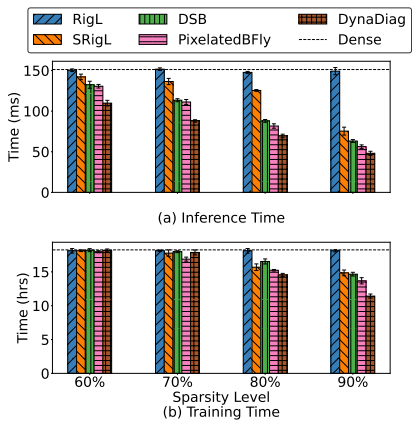
Figure 4 : Inference and training time of a ViT-Base at dif- ferent sparsity levels trained with DynaDiag and baselines. When controlling for an equivalent number of non-zero pa- rameters, our specialized diagonal-sparse kernel achieves faster execution on GPUs than standard sparse kernels.
원문 · CC BY 4.0 · Tyagi, Abhishek, Iyer, Arjun, Renninger, William H, Kanan, Christopher, Zhu, Yuhao · Dynamic Sparse Training of Diagonally Sparse Networks · 원문 그림 인용 · 원본 PDF 7쪽에서 그림 영역을 추출했습니다.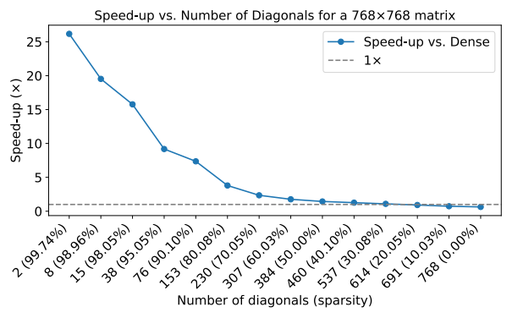
Figure 7 : Speedup obtained using our custom CUDA implementation while doing matrix-matrix multiplication with matrices having the diagonal sparsity pattern.
원문 · CC BY 4.0 · Tyagi, Abhishek, Iyer, Arjun, Renninger, William H, Kanan, Christopher, Zhu, Yuhao · Dynamic Sparse Training of Diagonally Sparse Networks · 원문 그림 인용 · 원본 PDF 19쪽에서 그림 영역을 추출했습니다.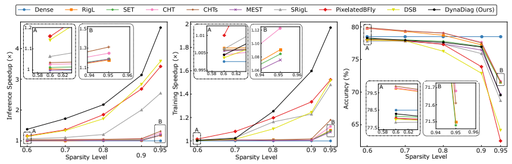
Figure 9 : Comparing the inference speedup (left), training speedup (center), and Top-1 accuracy (right) of sparse training methods for ViT-B/16 model at varying levels of sparsity running ImageNet-1K. DynaDiag achieves the highest training and inference speedup while demonstrating superior accuracy to other structured sparsity patterns.
원문 · CC BY 4.0 · Tyagi, Abhishek, Iyer, Arjun, Renninger, William H, Kanan, Christopher, Zhu, Yuhao · Dynamic Sparse Training of Diagonally Sparse Networks · 원문 그림 인용 · 원본 PDF 23쪽에서 그림 영역을 추출했습니다.적용 범위와 한계
저자들은 CNN에서는 채널마다 다른 대각선 패턴을 탐색하는 오버헤드 때문에 확장성에 문제가 있다고 밝힙니다. 극단적 희소성에서 DynaDiag가 RigL보다 높은 성능을 보이는 결과도 있으나, 이는 ViT-Base와 MLP-Mixer 등 보고된 설정에 한정됩니다. 따라서 이 결과를 모든 구조와 과제로 일반화하기는 어렵습니다.
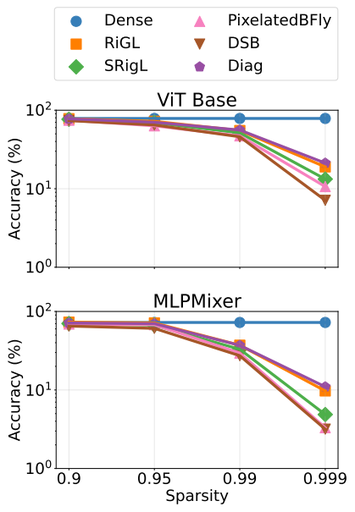
Figure 6 : Performance of DynaDiag compared to other base- lines at extreme sparsities for a ViT-Base and MLPMixer models on ImageNet-1K. DynaDiag outperforms other base- lines, including RigL, at extreme sparsities.
원문 · CC BY 4.0 · Tyagi, Abhishek, Iyer, Arjun, Renninger, William H, Kanan, Christopher, Zhu, Yuhao · Dynamic Sparse Training of Diagonally Sparse Networks · 원문 그림 인용 · 원본 PDF 8쪽에서 그림 영역을 추출했습니다.논문 정보
- 저자
- Tyagi, Abhishek, Iyer, Arjun, Renninger, William H, Kanan, Christopher, Zhu, Yuhao
- 학회·저널
- arXiv · 프리프린트
- 최초 공개일
- 2025년 6월 13일
- 등록일
- 2026년 10월 29일
- 수정일
- 2025년 6월 13일
- 버전
- v1
- arXiv
- 2506.11449
- 원문 이용 조건
- CC BY 4.0
- 제공 범위
- 논문 정보, 해설, 허용된 원문 그림
AI 해설은 논문 원문과 별개의 설명이며 오류가 있을 수 있습니다. 원문과 그림은 각 출처의 이용 조건과 따로 표시된 권리를 따릅니다.
초록
Recent advances in Dynamic Sparse Training (DST) have pushed the frontier of sparse neural network training in structured and unstructured contexts, matching dense-model performance while drastically reducing parameter counts to facilitate model scaling. However, unstructured sparsity often fails to translate into practical speedups on modern hardware. To address this shortcoming, we propose DynaDiag, a novel structured sparse-to-sparse DST method that performs at par with unstructured sparsity. DynaDiag enforces a diagonal sparsity pattern throughout training and preserves sparse computation in forward and backward passes. We further leverage the diagonal structure to accelerate computation via a custom CUDA kernel, rendering the method hardware-friendly. Empirical evaluations on diverse neural architectures demonstrate that our method maintains accuracy on par with unstructured counterparts while benefiting from tangible computational gains. Notably, with 90% sparse linear layers in ViTs, we observe up to a 3.13x speedup in online inference without sacrificing model performance and a 1.59x speedup in training on a GPU compared to equivalent unstructured layers. Our source code is available at https://github.com/horizon-research/DynaDiag/.
원문 인용
Tyagi, Abhishek, Iyer, Arjun, Renninger, William H, Kanan, Christopher, Zhu, Yuhao (2025). Dynamic Sparse Training of Diagonally Sparse Networks. arXiv:2506.11449v1. https://arxiv.org/abs/2506.11449v1
BibTeX
@misc{abhishek2025dynamic,
  title = {{Dynamic Sparse Training of Diagonally Sparse Networks}},
  author = {Tyagi, Abhishek and Iyer, Arjun and Renninger, William H and Kanan, Christopher and Zhu, Yuhao},
  year = {2025},
  eprint = {2506.11449},
  archivePrefix = {arXiv},
  url = {https://arxiv.org/abs/2506.11449v1}
}