논문 해설
BEND 2.0: Benchmarking the Capabilities Needed to Design DNA
BEND 2.0: DNA 설계에 필요한 역량을 벤치마킹하기
- 연구 문제 유전체 기반 모델이 DNA 변이 효과를 예측하고 이를 원하는 반응의 DNA 설계에 쓸 수 있는지 평가합니다.
- 연구 방법 Prior, Function, Context, Interaction, Design의 다섯 능력을 나눠 보고, 동결된 임베딩 위의 선형 판독기와 모델의 원래 출력을 따로 비교합니다.
- 주요 결과 스플라이싱 효과와 데이터셋 간 전이에서 판독기 성능이 확인되지만, 평균 효과의 정확도가 세포 간 차이나 돌연변이 상호작용의 정확도를 보장하지는 않습니다.
유전체 모델 평가에 필요한 질문
유전체 기반 모델은 DNA 서열과 편집을 제안하는 데 점점 더 많이 쓰이지만, 설계에 필요한 능력은 기존 벤치마크에서 충분히 측정되지 않습니다. 전체 예측 정확도만으로는 모델이 설계 목적에 쓸 수 있는지 알기 어렵습니다. 예를 들어 서열 기반 점수는 진화적으로 제약된 위치를 찾더라도 특정 세포에서의 발현 효과를 예측하지 못할 수 있습니다. 개별 돌연변이를 잘 맞히는 것도 돌연변이 사이의 상호작용이나 다른 유전 배경의 효과를 보장하지 않습니다. BEND 2.0은 이런 차이를 드러내기 위해 예측 능력과 설계 능력을 나눠 평가하는 벤치마크로 제시됩니다.
다섯 가지 능력과 평가 방식
BEND 2.0은 Prior, Function, Context, Interaction, Design의 다섯 능력으로 과제를 구성합니다. Prior는 마스킹된 염기 x_i를 주변 DNA 맥락에서 예측하는 확률 p를 재며, 음의 로그 확률인 -log2 p로 bits per base를 보고합니다. 값이 낮을수록 좋습니다. Function은 참조 서열 x와 편집 δ에 대해 실험 측정치의 변화 Δy를 예측하는 문제입니다. Context는 여러 세포나 조직에서 측정한 값 y_c를 맥락 전체의 평균과 맥락별 편차 κ_c로 나눕니다. Interaction은 두 돌연변이의 결합 효과 Δy_{1+2}에서 각 효과의 합을 뺀 비가산 부분 I_{1,2}를 따로 점수화합니다.
Design은 목표 반응 y_target에 가장 가까운 후보 a*를 손실 ℓ이 최소가 되도록 고르는 문제입니다. 대부분의 예측에는 동결된 모델 임베딩 위에서 적합한 선형 헤드가 쓰입니다. 돌연변이 효과는 변이와 기준 임베딩의 차이에 가중치 w를 곱해 추정하고, 모델의 원래 출력 헤드 결과와 따로 보고합니다. 상관계수는 유전자나 조절 서열 단위에서 계산한 뒤 그룹 평균으로 합쳐 한 유전자가 결과를 지배하지 않게 합니다.
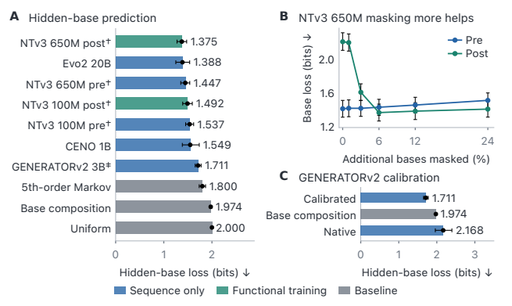
Figure 1 :Sequence-prior performance depends on the representation extraction.A: masked loss on 512 windows. NTv3 uses fixed 12% additional masking (†), averaging losses over two draws. GENERATORv2 uses temperature calibration fitted on separate data ( ‡). B: additional masking substantially improves post-trained NTv3 sequence loss. C: calibration improves GENERATORv2’s predicted probabilities without changing base-prediction accuracy. Whiskers show 95% block- bootstrap intervals. Colors denote model/baseline category.
원문 · CC BY 4.0 · Andreas Bjerregaard, Rachael DeVries, Dionysia Danai Brilli, Panagiotis Antoniadis, Yan Li, Anders Krogh, Wouter Boomsma, Ole Winther, Frederikke Isa Marin · BEND 2.0: Benchmarking the Capabilities Needed to Design DNA · 원문 그림 인용 · 원본 PDF 4쪽에서 그림 영역을 추출했습니다.스플라이싱 효과 예측과 데이터셋 간 전이
스플라이싱 과제에서는 OpenSplice 데이터의 466개 유전자에 걸친 590,104개 돌연변이를 사용합니다. 보류된 유전자에서 AlphaGenome의 임베딩 기반 선형 헤드는 macro-gene Spearman 0.650을 기록했습니다. 같은 모델의 원래 출력은 0.621이었고, NTv3 650M post의 선형 헤드는 0.564였습니다. 전문 모델인 SpliceAI는 0.674로 이 foundation model 판독기보다 높았습니다. 전이 검증에서는 OpenSplice로 학습한 판독기를 COMPASS의 4,618개 돌연변이 88개 유전자에 적용했습니다. 이 유전자들은 OpenSplice 학습 집합에서 제외되었고, COMPASS 라벨은 적합이나 모델 선택에 쓰이지 않았습니다.
AlphaGenome과 NTv3 650M post는 여러 세포주에 대해 평균한 돌연변이 효과에서 여전히 유의미한 예측 정확도를 유지했습니다.
세포 맥락과 상호작용 예측의 차이
Siraj 데이터에서 AlphaGenome은 128개 조절 요소에 대해 평균 효과 상관 0.532를 보였습니다. 같은 데이터의 HepG2와 K562 차이를 예측하는 상관은 0.398로 낮았습니다. 이 모델은 Siraj 측정치에 맞추지 않고 기존 예측 트랙을 사용했습니다. NTv3 650M post의 선형 판독기는 각각 0.492와 0.256을 보였으므로 두 모델 모두 평균을 차이보다 더 정확히 맞혔습니다. 유전 배경 상호작용은 68,026개 쌍 돌연변이에서 평가되었고, AlphaGenome의 상호작용 상관은 0.260이었습니다. COMPASS의 이중 돌연변이에서 NTv3 650M post는 상관 0.500을 보였지만, 두 단일 효과를 뺀 상호작용 상관은 0.046에 그쳤습니다.
예측된 상호작용을 제거해도 이중 돌연변이 상관은 0.500에서 0.493으로만 변했습니다. 따라서 결합 효과를 정확히 맞히는 모델이라도 돌연변이 사이의 상호작용을 많이 회복한다고 결론내릴 수는 없습니다.
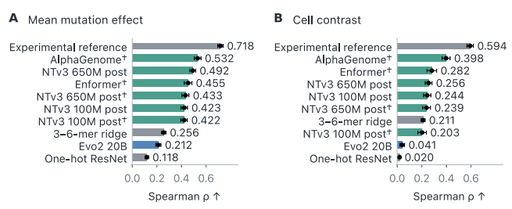
Figure 3 :Predicting cell-specific effects.A/B: mean mutation effect and HepG2–K562 difference across 128 Siraj regulatory elements. Experimental references compare groups of repeat measure- ments (127 elements); they are not ceilings. † marks native outputs; unmarked NTv3 entries use fitted readouts. Whiskers show available 95% element-bootstrap intervals.
원문 · CC BY 4.0 · Andreas Bjerregaard, Rachael DeVries, Dionysia Danai Brilli, Panagiotis Antoniadis, Yan Li, Anders Krogh, Wouter Boomsma, Ole Winther, Frederikke Isa Marin · BEND 2.0: Benchmarking the Capabilities Needed to Design DNA · 원문 그림 인용 · 원본 PDF 6쪽에서 그림 영역을 추출했습니다.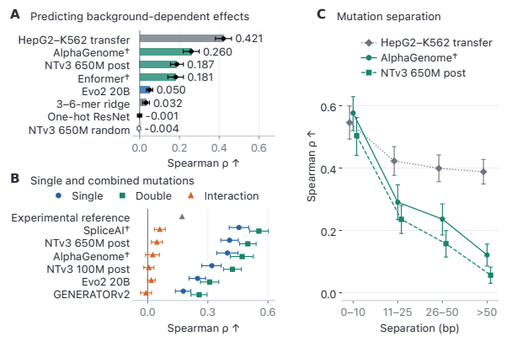
Figure 4 :Accurate combined effects can conceal weak interaction prediction.A: difference in mutation effects between two backgrounds differing at one base. B: single, double and non-additive mutation effects in 110 COMPASS genes. C: Interaction prediction by distance between mutations. HepG2–K562 transfer compares measured interactions across cells (A/C). The experimental reference compares repeat measurements of interactions (B). Neither is a ceiling. † marks native outputs, and whiskers show 95% bootstrap intervals over regulatory elements (A/C) or genes (B).
원문 · CC BY 4.0 · Andreas Bjerregaard, Rachael DeVries, Dionysia Danai Brilli, Panagiotis Antoniadis, Yan Li, Anders Krogh, Wouter Boomsma, Ole Winther, Frederikke Isa Marin · BEND 2.0: Benchmarking the Capabilities Needed to Design DNA · 원문 그림 인용 · 원본 PDF 7쪽에서 그림 영역을 추출했습니다.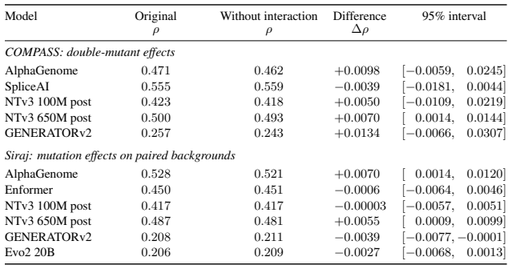
Table 4 :Effect prediction with and without interactions.Overall effect accuracy changes little when predicted interactions are removed. Spearman correlations are averaged across genes for COMPASS and regulatory elements for Siraj. Positive differences indicate better accuracy with interactions included; brackets show 95% confidence intervals adjusted for multiple comparisons.
원문 · CC BY 4.0 · Andreas Bjerregaard, Rachael DeVries, Dionysia Danai Brilli, Panagiotis Antoniadis, Yan Li, Anders Krogh, Wouter Boomsma, Ole Winther, Frederikke Isa Marin · BEND 2.0: Benchmarking the Capabilities Needed to Design DNA · 원문 그림 인용 · 원본 PDF 24쪽에서 그림 영역을 추출했습니다.설계 과제에서의 성능
설계 과제는 측정된 실험 라이브러리 안에서 모델이 고른 후보의 실제 결과를 확인합니다. 목표 반응 매칭에서는 331개 목표와 110개 요소를 사용했고, AlphaGenome 첫 선택의 평균 백분위 순위는 24.3이었습니다. NTv3 650M post는 30.0이었고 균일 선택은 50이었습니다. 상위 10개 후보 중 목표 반응과 측정 오차 안에서 맞는 편집이 하나 이상 있는 비율은 AlphaGenome에서 62%, NTv3에서 59%, 균일 선택에서 38%였습니다. 세포 선택성 과제에서는 목표 세포의 효과에서 다른 세포의 절댓값 효과를 빼는 utility를 사용했습니다. 보정된 native AlphaGenome은 λ=1에서 0.384를 얻었고, NTv3 650M post는 0.287이었습니다.
AlphaGenome의 고정 임베딩에 적합한 선형 판독기는 0.515였습니다. 여러 세포 활성 프로그램 과제에서는 AlphaGenome의 평균 utility가 −0.222였고 Enformer는 −0.228이었습니다. 이 결과는 모델 선택이 무작위보다 개선되는 경우가 있어도 평균 활성 조건을 항상 만족하지는 않는다는 점을 보여줍니다.
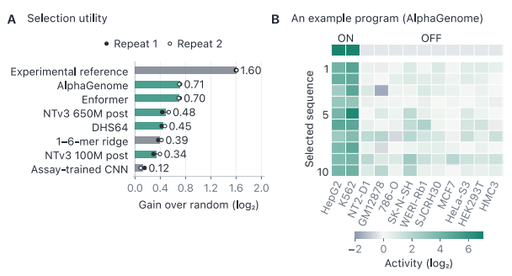
Figure 6 :Selecting DNA with activity in desired cells and little activity elsewhere.Models choose ten enhancers for each of sixteen requested expression patterns. A: gain in utility over random selection among sequences originally designed for the same ON/OFF pattern, averaged across patterns. Utility rewards the weakest ON-cell activity and penalizes the strongest OFF-cell activity above the negative-control level. Dots show the two repeat measurements. The experimental reference selects sequences using one measurement and evaluates them using the other, then swaps them. B: example across cell types, showing ten enhancers chosen by AlphaGenome having selective activity in HepG2 and K562.
원문 · CC BY 4.0 · Andreas Bjerregaard, Rachael DeVries, Dionysia Danai Brilli, Panagiotis Antoniadis, Yan Li, Anders Krogh, Wouter Boomsma, Ole Winther, Frederikke Isa Marin · BEND 2.0: Benchmarking the Capabilities Needed to Design DNA · 원문 그림 인용 · 원본 PDF 9쪽에서 그림 영역을 추출했습니다.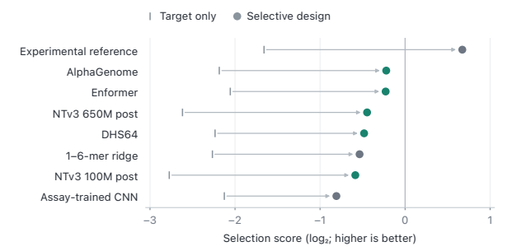
Figure 15 :Considering unwanted activity improves sequence selection.Arrows run from selection based only on the weakest ON-cell prediction (ticks) to selection that also penalizes the strongest OFF-cell prediction (dots). Both are scored using Equation 6, averaged over ten sequences, sixteen expression patterns and both RNA measurements. The experimental reference selects using one measurement and evaluates using the other.
원문 · CC BY 4.0 · Andreas Bjerregaard, Rachael DeVries, Dionysia Danai Brilli, Panagiotis Antoniadis, Yan Li, Anders Krogh, Wouter Boomsma, Ole Winther, Frederikke Isa Marin · BEND 2.0: Benchmarking the Capabilities Needed to Design DNA · 원문 그림 인용 · 원본 PDF 27쪽에서 그림 영역을 추출했습니다.적용 범위와 남은 한계
저자들은 실험 참조가 단순할 수 있다고 밝힙니다. 예를 들어 한 세포형에서 다른 세포형으로 효과를 옮기는 기준은 대표적인 강한 비교가 아닙니다. 선형 헤드는 모델의 임베딩 크기에 의존할 수 있고, 입력 문맥 길이가 다른 모델의 과제 성능에 영향을 줄 수 있습니다. 서열 사전 확률도 기능 효과를 직접 포착하는 것은 아닙니다. Evo2와 CENO는 측정 기준 염기의 55.2%와 62.4%를 복원했지만, 대립 유전자 점수는 리포터 효과와 0.045와 0.029의 상관만 보였습니다. 따라서 염기 복원 성능을 기능 예측 능력으로 바로 해석하기는 어렵습니다.
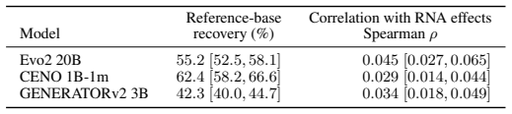
Table 3 :Base recovery and correlation with RNA effects.Brackets show 95% confidence intervals from resampling regulatory elements.
원문 · CC BY 4.0 · Andreas Bjerregaard, Rachael DeVries, Dionysia Danai Brilli, Panagiotis Antoniadis, Yan Li, Anders Krogh, Wouter Boomsma, Ole Winther, Frederikke Isa Marin · BEND 2.0: Benchmarking the Capabilities Needed to Design DNA · 원문 그림 인용 · 원본 PDF 19쪽에서 그림 영역을 추출했습니다.논문 정보
- 저자
- Andreas Bjerregaard, Rachael DeVries, Dionysia Danai Brilli, Panagiotis Antoniadis, Yan Li, Anders Krogh, Wouter Boomsma, Ole Winther, Frederikke Isa Marin
- 학회·저널
- arXiv · 프리프린트
- 최초 공개일
- 2026년 11월 2일
- 등록일
- 2026년 11월 5일
- 수정일
- 2026년 11월 2일
- 버전
- v1
- arXiv
- 2611.03806
- 분류
- q-bio.GN · cs.LG · q-bio.QM
- 원문 이용 조건
- CC BY 4.0
- 제공 범위
- 논문 정보, 해설, 허용된 원문 그림
AI 해설은 논문 원문과 별개의 설명이며 오류가 있을 수 있습니다. 원문과 그림은 각 출처의 이용 조건과 따로 표시된 권리를 따릅니다.
초록
Genomic foundation models are increasingly used to propose DNA sequences and edits. But successful design requires capabilities that current benchmarks do not measure. Here we introduce BEND 2.0 (BENchmark for DNA language models), which tests how well models predict the effects of DNA changes and whether these predictions can guide sequence design. Across eight tasks built on five experimental datasets, we find that model choice and how representations are accessed both affect performance. Linear readouts fitted to frozen representations can match or exceed models' native outputs, and functional post-training substantially improves the models' capabilities. Linear readouts transfer well across experimental assays and genes, suggesting that models capture functional patterns beyond the data used to fit individual predictors. At the same time, strong prediction of average effects can conceal weaker prediction of context-specific effects, and accurate prediction of combined mutation effects does not imply accurate prediction of their interactions. In design tasks, model predictions can reduce the number of candidates needed to find a desired response, but still leave substantial room for better design choices, particularly for context-specific and multi-cell objectives. Our benchmark reveals that genomic models now display signs of general utility but have yet to saturate on performance in even simple tasks.
원문 인용
Andreas Bjerregaard, Rachael DeVries, Dionysia Danai Brilli, Panagiotis Antoniadis, Yan Li, Anders Krogh, Wouter Boomsma, Ole Winther, Frederikke Isa Marin (2026). BEND 2.0: Benchmarking the Capabilities Needed to Design DNA. arXiv:2611.03806v1. https://arxiv.org/abs/2611.03806v1
BibTeX
@misc{bjerregaard2026bend,
  title = {{BEND 2.0: Benchmarking the Capabilities Needed to Design DNA}},
  author = {Andreas Bjerregaard and Rachael DeVries and Dionysia Danai Brilli and Panagiotis Antoniadis and Yan Li and Anders Krogh and Wouter Boomsma and Ole Winther and Frederikke Isa Marin},
  year = {2026},
  eprint = {2611.03806},
  archivePrefix = {arXiv},
  url = {https://arxiv.org/abs/2611.03806v1}
}