논문 해설
Adaptive Shells for Efficient Neural Radiance Field Rendering
효율적인 신경 방사장 렌더링을 위한 적응형 셸
- 연구 문제 NeRF는 광선마다 많은 샘플을 요구해 고해상도 실시간 렌더링이 어렵습니다.
- 연구 방법 공간 가변 커널 크기로 NeuS를 일반화하고, 학습된 SDF에서 추출한 얇은 셸 안에서만 샘플을 배치합니다.
- 주요 결과 Shelly에서 Ours는 PSNR 36.02로 Instant NGP의 33.22보다 높고 샘플 수는 2.07로 보고됩니다.
NeRF 렌더링의 샘플 비용 문제
NeRF는 장면의 부피 밀도와 시점 의존 색을 신경망으로 표현하고, 광선을 따라 많은 샘플을 누적하는 부피 렌더링으로 영상을 만듭니다. 이 방식은 고해상도 영상을 실시간으로 합성하기 어렵게 만드는 높은 샘플 비용을 갖습니다. 반면 많은 장면은 대부분 단일 샘플로 정확히 렌더링할 수 있는 불투명한 표면으로 이루어져 있습니다. 본 논문은 이 불균형을 이용해 표면에서는 적은 샘플을, 머리카락이나 풀처럼 흐린 영역에서는 더 많은 샘플을 배치하는 방법을 다룹니다. 따라서 질문은 샘플 수를 줄이면서도 렌더링 품질을 유지하거나 높일 수 있는지, 그리고 이를 위해 어떤 명시적 구조가 필요한지입니다.
공간 가변 커널과 적응형 셸
기존 NeuS 공식화는 SDF f와 하나의 전역 커널 크기 s로 밀도를 계산합니다. 본 방법은 커널 크기를 위치 x의 함수로 바꾸어 네트워크가 (c, f, s) = NN(x, d)를 출력하게 합니다. 작은 s는 날카로운 표면을, 큰 s는 흐린 부피를 뜻하며, 이 값은 색 영상 감독만으로 학습됩니다. 이후 학습된 f와 s에서 팽창과 침식 level set 흐름을 적용해 외부 경계 M+와 내부 경계 M−의 두 메시를 추출합니다. 이 두 메시가 이루는 얇은 셸은 커널이 크면 두꺼워지고 작으면 얇아집니다. 원문은 흐름 속도가 밀도 σ에 따라 정해지며 Eikonal 정규화가 SDF를 거리 함수에 가깝게 유도한다고 설명합니다.
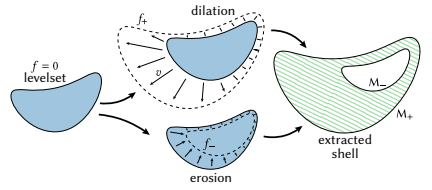
Fig. 4 . After fitting an initial SDF and spatially varying kernel, we apply level set flows to extract an adaptive shell via dilation and erosion. For illustrative purposes, the adaptive shell is enlarged; in practice it very tightly encloses sharp surfaces.
원문 · CC BY 4.0 · Zian Wang, Tianchang Shen, Merlin Nimier-David, Nicholas Sharp, Jun Gao, Alexander Keller, Sanja Fidler, Thomas Müller, Zan Gojcic · Adaptive Shells for Efficient Neural Radiance Field Rendering · 원문 그림 인용 · 원본 PDF 4쪽에서 그림 영역을 추출했습니다.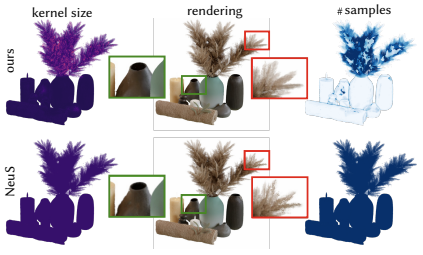
Fig. 7 . The original NeuS [Wang et al. 2021] formulation uses a single global kernel size𝑠. On complex scenes with varying content, the global𝑠 value converges to an average which is too small for volumetric parts , and too large for sharp surfaces . Instead, our locally varying kernel size adapts to the scene, in-turn allowing us to reduce the number of samples to a single sample for sharp surfaces and up to 32 samples for the fern (top right). NeuS uses a constant 384 samples per pixel (bottom right).
원문 · CC BY 4.0 · Zian Wang, Tianchang Shen, Merlin Nimier-David, Nicholas Sharp, Jun Gao, Alexander Keller, Sanja Fidler, Thomas Müller, Zan Gojcic · Adaptive Shells for Efficient Neural Radiance Field Rendering · 원문 그림 인용 · 원본 PDF 6쪽에서 그림 영역을 추출했습니다.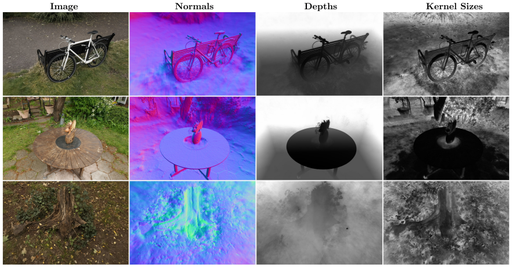
Fig. 1 . Qualitative visualization of geometry and kernel size on MipNeRF360 data set. The kernel size is re-scaled to between 0 and 1. Our method automatically converges to a large kernel size for fuzzy regions such as grass and a small kernel size for sharp surfaces.
원문 · CC BY 4.0 · Zian Wang, Tianchang Shen, Merlin Nimier-David, Nicholas Sharp, Jun Gao, Alexander Keller, Sanja Fidler, Thomas Müller, Zan Gojcic · Adaptive Shells for Efficient Neural Radiance Field Rendering · 원문 그림 인용 · 원본 PDF 18쪽에서 그림 영역을 추출했습니다.좁은 대역 렌더링과 fine-tuning
추론 단계에서는 광선을 외부 메시 M+와 내부 메시 M−에 교차시켜 셸 안의 구간을 얻습니다. 각 구간의 폭 w에 대해 샘플 수는 ceil(max(w−w_s, 0)/δ_s)+1로 계산되며 최대 N_max로 제한됩니다. 폭이 w_s보다 작은 구간은 중심의 단일 샘플로 처리됩니다. 광선이 내부 메시에 닿으면 이후 샘플은 처리하지 않습니다. 이 과정은 표면에서는 사실상 하드웨어 광선 추적과 한 번의 네트워크 평가로 끝나고, 흐린 영역에서는 필요한 곳에서만 촘촘히 샘플링합니다. 학습은 두 단계로 나뉩니다. 첫 단계는 전체 부피 렌더링으로 색 손실, Eikonal, 커널 평활화, 법선 손실을 최적화하고, 둘째 단계는 셸 안에서 색 손실만으로 미세 조정합니다.
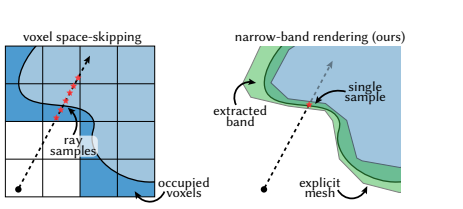
Fig. 2 . One state-of-the-art approach to accelerate volumetric rendering is to skip empty voxels, however this still requires multiple samples within occupied voxels (left). Our approach extracts a narrow band mesh, for which a single sample at the midpoint is a very good approximation of the surface (right).
원문 · CC BY 4.0 · Zian Wang, Tianchang Shen, Merlin Nimier-David, Nicholas Sharp, Jun Gao, Alexander Keller, Sanja Fidler, Thomas Müller, Zan Gojcic · Adaptive Shells for Efficient Neural Radiance Field Rendering · 원문 그림 인용 · 원본 PDF 2쪽에서 그림 영역을 추출했습니다.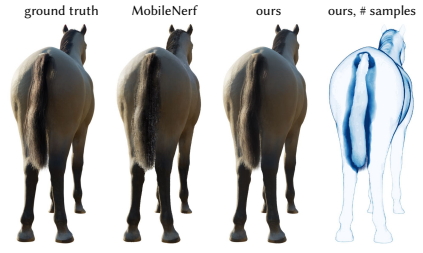
Fig. 6 . Pure surface-based representations struggle to represent fuzzy sur- faces such as the tail. On the other hand, our method adapts the narrow shell to the local complexity of the scene, using a single sample for the sharp skin surface and up to 16 samples for the tail.
원문 · CC BY 4.0 · Zian Wang, Tianchang Shen, Merlin Nimier-David, Nicholas Sharp, Jun Gao, Alexander Keller, Sanja Fidler, Thomas Müller, Zan Gojcic · Adaptive Shells for Efficient Neural Radiance Field Rendering · 원문 그림 인용 · 원본 PDF 6쪽에서 그림 영역을 추출했습니다.Shelly와 DTU에서의 품질과 효율
Shelly 데이터셋은 저자들이 도입한 객체 수준 합성 장면 여섯 개로, 머리카락·털·잎 같은 흐린 표면을 포함합니다. 이 데이터셋에서 Ours는 PSNR 36.02, SSIM 0.954, LPIPS 0.079를 보고하며, Instant NGP는 PSNR 33.22, SSIM 0.922, LPIPS 0.125를 보고합니다. 표 1에서 Shelly의 샘플 수는 Ours 2.07, Instant NGP 2.89로 보고됩니다. DTU는 로봇 팔 카메라로 촬영한 탁상 장면 15개이며, 제공된 객체 마스크 안에서만 평가합니다. DTU에서 Ours의 PSNR은 33.37이고 Ours (full ray)는 33.51로, 원문은 한 방향 카메라 분포가 이 차이의 원인일 것으로 가정합니다.
이 결과는 해당 데이터셋과 설정에서 얻은 관찰입니다.
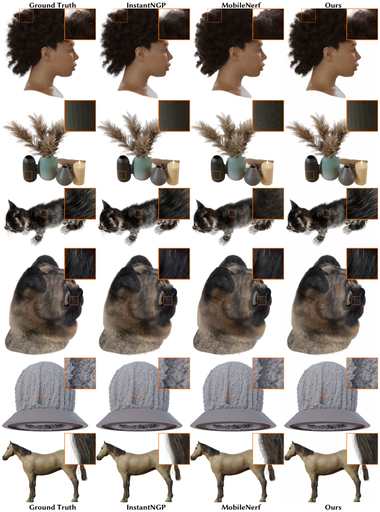
Fig. 8 . A gallery of results on the test-views of our Shelly data set.
원문 · CC BY 4.0 · Zian Wang, Tianchang Shen, Merlin Nimier-David, Nicholas Sharp, Jun Gao, Alexander Keller, Sanja Fidler, Thomas Müller, Zan Gojcic · Adaptive Shells for Efficient Neural Radiance Field Rendering · 원문 그림 인용 · 원본 PDF 8쪽에서 그림 영역을 추출했습니다.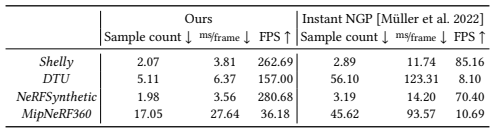
Table 1 . Performance comparisons on all four data sets, measured at 1080p without GUI overhead using an RTX 4090 GPU. Our adaptive sample placement and mesh-based empty-space skipping technique allows us to outperform Instant NGP without compromising visual fidelity. Note that Instant NGP’s performance on the DTU data set was hindered by a large number of background samples, and is therefore not necessarily indicative of a real use case: the user may specify a tighter scene bounding box to focus the samples on the main scene contents.
원문 · CC BY 4.0 · Zian Wang, Tianchang Shen, Merlin Nimier-David, Nicholas Sharp, Jun Gao, Alexander Keller, Sanja Fidler, Thomas Müller, Zan Gojcic · Adaptive Shells for Efficient Neural Radiance Field Rendering · 원문 그림 인용 · 원본 PDF 9쪽에서 그림 영역을 추출했습니다.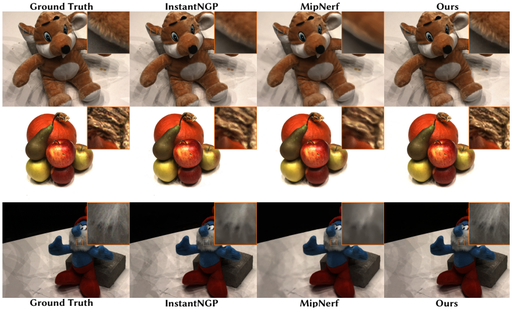
Fig. 9 . A gallery of results on the DTU data set.
원문 · CC BY 4.0 · Zian Wang, Tianchang Shen, Merlin Nimier-David, Nicholas Sharp, Jun Gao, Alexander Keller, Sanja Fidler, Thomas Müller, Zan Gojcic · Adaptive Shells for Efficient Neural Radiance Field Rendering · 원문 그림 인용 · 원본 PDF 10쪽에서 그림 영역을 추출했습니다.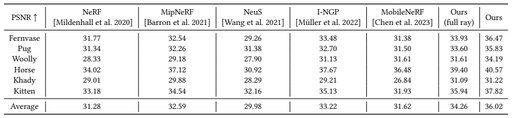
Table 1 . Per-scene quantitative PSNR comparison on Shelly data set.
원문 · CC BY 4.0 · Zian Wang, Tianchang Shen, Merlin Nimier-David, Nicholas Sharp, Jun Gao, Alexander Keller, Sanja Fidler, Thomas Müller, Zan Gojcic · Adaptive Shells for Efficient Neural Radiance Field Rendering · 원문 그림 인용 · 원본 PDF 17쪽에서 그림 영역을 추출했습니다.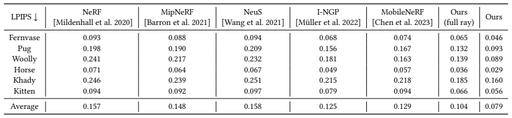
Table 2 . Per-scene quantitative LPIPS comparison on Shelly data set.
원문 · CC BY 4.0 · Zian Wang, Tianchang Shen, Merlin Nimier-David, Nicholas Sharp, Jun Gao, Alexander Keller, Sanja Fidler, Thomas Müller, Zan Gojcic · Adaptive Shells for Efficient Neural Radiance Field Rendering · 원문 그림 인용 · 원본 PDF 17쪽에서 그림 영역을 추출했습니다.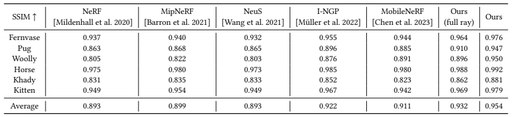
Table 3 . Per-scene quantitative SSIM comparison on Shelly dataset.
원문 · CC BY 4.0 · Zian Wang, Tianchang Shen, Merlin Nimier-David, Nicholas Sharp, Jun Gao, Alexander Keller, Sanja Fidler, Thomas Müller, Zan Gojcic · Adaptive Shells for Efficient Neural Radiance Field Rendering · 원문 그림 인용 · 원본 PDF 17쪽에서 그림 영역을 추출했습니다.
Table 4 . Per-scene sample count of our method on Shelly data set.
원문 · CC BY 4.0 · Zian Wang, Tianchang Shen, Merlin Nimier-David, Nicholas Sharp, Jun Gao, Alexander Keller, Sanja Fidler, Thomas Müller, Zan Gojcic · Adaptive Shells for Efficient Neural Radiance Field Rendering · 원문 그림 인용 · 원본 PDF 17쪽에서 그림 영역을 추출했습니다.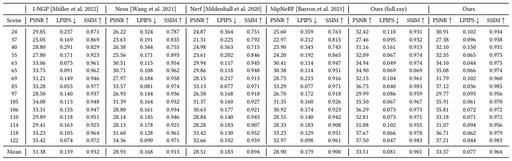
Table 5 . Per-scene quantitative results on DTU data set. We report the PSNR, LPIPS and SSIM results for each scene and compare them with baselines.
원문 · CC BY 4.0 · Zian Wang, Tianchang Shen, Merlin Nimier-David, Nicholas Sharp, Jun Gao, Alexander Keller, Sanja Fidler, Thomas Müller, Zan Gojcic · Adaptive Shells for Efficient Neural Radiance Field Rendering · 원문 그림 인용 · 원본 PDF 17쪽에서 그림 영역을 추출했습니다.
Table 6 . Per-scene sample count of our method on DTU data set.
원문 · CC BY 4.0 · Zian Wang, Tianchang Shen, Merlin Nimier-David, Nicholas Sharp, Jun Gao, Alexander Keller, Sanja Fidler, Thomas Müller, Zan Gojcic · Adaptive Shells for Efficient Neural Radiance Field Rendering · 원문 그림 인용 · 원본 PDF 18쪽에서 그림 영역을 추출했습니다.커널 크기 절제와 샘플 수 변화
절제 실험은 Shelly 데이터셋에서 SV 커널을 제외한 full ray 변형과 포함한 full ray 변형을 비교합니다. SV 커널을 제외한 변형은 PSNR 32.99, 포함한 변형은 PSNR 34.26으로 보고되며, 두 변형 모두 샘플 수 384를 사용합니다. 고정 SDF 임계값으로 대역을 추출한 변형은 공간 가변 커널이 없는 적응형 셸과 구분해 비교됩니다. 이 비교는 공간 가변 커널이 학습 중 로컬 복잡도에 맞춰 셸 폭을 조정하는 역할을 지지한다는 점을 보여 줍니다. 또한 학습 정규화를 끝까지 유지한 변형보다 셸 추출 뒤 정규화를 끈 최종 설정의 PSNR이 높습니다.
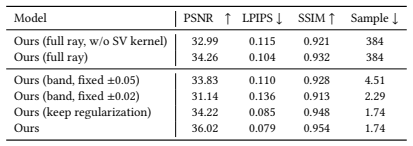
Table 4 . Ablating our method on the Shelly data set. SV Kernel denotes the spatially varying kernel as introduced in Section 3.2. Band, fixed denotes the shell is not adaptive but extracted for a given SDF threshold.
원문 · CC BY 4.0 · Zian Wang, Tianchang Shen, Merlin Nimier-David, Nicholas Sharp, Jun Gao, Alexander Keller, Sanja Fidler, Thomas Müller, Zan Gojcic · Adaptive Shells for Efficient Neural Radiance Field Rendering · 원문 그림 인용 · 원본 PDF 10쪽에서 그림 영역을 추출했습니다.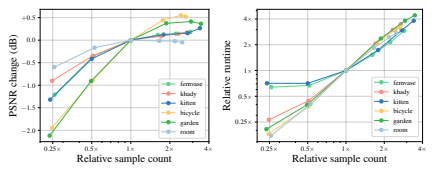
Fig. 11 . Ablating the effect of sample count on image quality and runtime performance. We vary the sample count, and plot the PSNR change (left) and relative runtime performance (right) compared to the default hyper- parameters denoted as “1× sample count”. We experiment with six scenes from the Shelly (fernvase, khady, kitten) and MipNeRF360 (bicycle, garden, room) data sets.
원문 · CC BY 4.0 · Zian Wang, Tianchang Shen, Merlin Nimier-David, Nicholas Sharp, Jun Gao, Alexander Keller, Sanja Fidler, Thomas Müller, Zan Gojcic · Adaptive Shells for Efficient Neural Radiance Field Rendering · 원문 그림 인용 · 원본 PDF 12쪽에서 그림 영역을 추출했습니다.적용 범위와 한계
MipNeRF360 실험에서 원문은 샘플 수를 I-NGP 대비 세 배 줄이고 평균 프레임률을 다섯 배 높이면서 비슷한 렌더링 품질을 보고합니다. 다만 이 장면들은 배경에 크게 의존하며, 본 접근법은 배경 처리에 특화되어 있지 않습니다. 또한 추출된 셸이 어떤 기하 영역을 빠뜨리면 fine-tuning 과정에서 그 영역을 복구할 수 없어 재구성에서 항상 사라진다고 원문은 밝힙니다. 원문은 이를 해결하기 위해 셸과 재구성을 번갈아 조정하는 반복 절차를 향후 과제로 제시합니다.
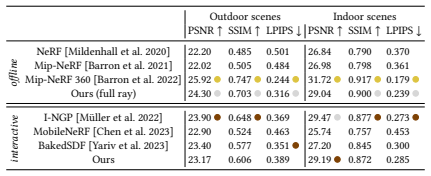
Table 3 . Quantitative results on the MipNeRF360 data set. We report the PSNR, LPIPS and SSIM results for each object and compare them to baselines. Our method achieves a performance comparable to the baselines while being significantly faster during inference (see Table 1). In our comparison, we exclude the two scenes with license issues: Flowers, Treehill.
원문 · CC BY 4.0 · Zian Wang, Tianchang Shen, Merlin Nimier-David, Nicholas Sharp, Jun Gao, Alexander Keller, Sanja Fidler, Thomas Müller, Zan Gojcic · Adaptive Shells for Efficient Neural Radiance Field Rendering · 원문 그림 인용 · 원본 PDF 10쪽에서 그림 영역을 추출했습니다.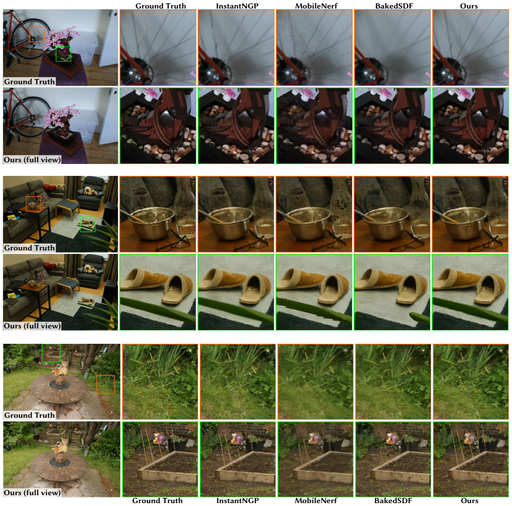
Fig. 10 . A gallery of results on the test-views of the MipNerf360 data set.
원문 · CC BY 4.0 · Zian Wang, Tianchang Shen, Merlin Nimier-David, Nicholas Sharp, Jun Gao, Alexander Keller, Sanja Fidler, Thomas Müller, Zan Gojcic · Adaptive Shells for Efficient Neural Radiance Field Rendering · 원문 그림 인용 · 원본 PDF 11쪽에서 그림 영역을 추출했습니다.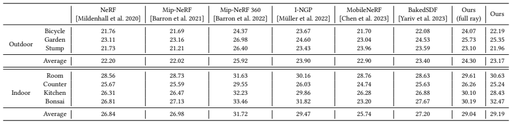
Table 8 . Per-scene quantitative PSNR comparison on MipNeRF360 data set.
원문 · CC BY 4.0 · Zian Wang, Tianchang Shen, Merlin Nimier-David, Nicholas Sharp, Jun Gao, Alexander Keller, Sanja Fidler, Thomas Müller, Zan Gojcic · Adaptive Shells for Efficient Neural Radiance Field Rendering · 원문 그림 인용 · 원본 PDF 18쪽에서 그림 영역을 추출했습니다.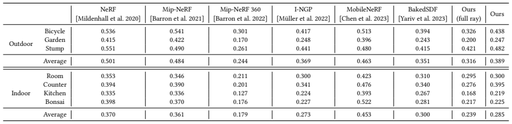
Table 9 . Per-scene quantitative LPIPS comparison on MipNeRF360 data set.
원문 · CC BY 4.0 · Zian Wang, Tianchang Shen, Merlin Nimier-David, Nicholas Sharp, Jun Gao, Alexander Keller, Sanja Fidler, Thomas Müller, Zan Gojcic · Adaptive Shells for Efficient Neural Radiance Field Rendering · 원문 그림 인용 · 원본 PDF 19쪽에서 그림 영역을 추출했습니다.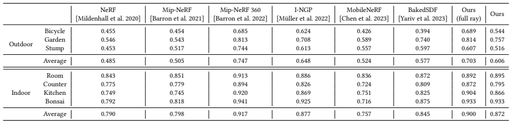
Table 10 . Per-scene quantitative SSIM comparison on MipNeRF360 data set.
원문 · CC BY 4.0 · Zian Wang, Tianchang Shen, Merlin Nimier-David, Nicholas Sharp, Jun Gao, Alexander Keller, Sanja Fidler, Thomas Müller, Zan Gojcic · Adaptive Shells for Efficient Neural Radiance Field Rendering · 원문 그림 인용 · 원본 PDF 19쪽에서 그림 영역을 추출했습니다.
Table 11 . Per-scene sample count of our method on MipNeRF360 data set.
원문 · CC BY 4.0 · Zian Wang, Tianchang Shen, Merlin Nimier-David, Nicholas Sharp, Jun Gao, Alexander Keller, Sanja Fidler, Thomas Müller, Zan Gojcic · Adaptive Shells for Efficient Neural Radiance Field Rendering · 원문 그림 인용 · 원본 PDF 19쪽에서 그림 영역을 추출했습니다.논문 정보
- 저자
- Zian Wang, Tianchang Shen, Merlin Nimier-David, Nicholas Sharp, Jun Gao, Alexander Keller, Sanja Fidler, Thomas Müller, Zan Gojcic
- 학회·저널
- arXiv · 프리프린트
- 최초 공개일
- 2023년 11월 16일
- 등록일
- 2026년 11월 5일
- 수정일
- 2023년 11월 16일
- 버전
- v1
- arXiv
- 2311.10091
- 분류
- cs.CV · cs.GR
- 원문 이용 조건
- CC BY 4.0
- 제공 범위
- 논문 정보, 해설, 허용된 원문 그림
AI 해설은 논문 원문과 별개의 설명이며 오류가 있을 수 있습니다. 원문과 그림은 각 출처의 이용 조건과 따로 표시된 권리를 따릅니다.
초록
Neural radiance fields achieve unprecedented quality for novel view synthesis, but their volumetric formulation remains expensive, requiring a huge number of samples to render high-resolution images. Volumetric encodings are essential to represent fuzzy geometry such as foliage and hair, and they are well-suited for stochastic optimization. Yet, many scenes ultimately consist largely of solid surfaces which can be accurately rendered by a single sample per pixel. Based on this insight, we propose a neural radiance formulation that smoothly transitions between volumetric- and surface-based rendering, greatly accelerating rendering speed and even improving visual fidelity. Our method constructs an explicit mesh envelope which spatially bounds a neural volumetric representation. In solid regions, the envelope nearly converges to a surface and can often be rendered with a single sample. To this end, we generalize the NeuS formulation with a learned spatially-varying kernel size which encodes the spread of the density, fitting a wide kernel to volume-like regions and a tight kernel to surface-like regions. We then extract an explicit mesh of a narrow band around the surface, with width determined by the kernel size, and fine-tune the radiance field within this band. At inference time, we cast rays against the mesh and evaluate the radiance field only within the enclosed region, greatly reducing the number of samples required. Experiments show that our approach enables efficient rendering at very high fidelity. We also demonstrate that the extracted envelope enables downstream applications such as animation and simulation.
원문 인용
Zian Wang, Tianchang Shen, Merlin Nimier-David, Nicholas Sharp, Jun Gao, Alexander Keller, Sanja Fidler, Thomas Müller, Zan Gojcic (2023). Adaptive Shells for Efficient Neural Radiance Field Rendering. arXiv:2311.10091v1. https://arxiv.org/abs/2311.10091v1
BibTeX
@misc{wang2023adaptive,
  title = {{Adaptive Shells for Efficient Neural Radiance Field Rendering}},
  author = {Zian Wang and Tianchang Shen and Merlin Nimier-David and Nicholas Sharp and Jun Gao and Alexander Keller and Sanja Fidler and Thomas Müller and Zan Gojcic},
  year = {2023},
  eprint = {2311.10091},
  archivePrefix = {arXiv},
  url = {https://arxiv.org/abs/2311.10091v1}
}