논문 해설
Radiance Fields for Robotic Teleoperation
로봇 원격 조작을 위한 Radiance Fields
- 연구 문제 기존 원격 조작 시각화는 직접 카메라 영상의 높은 충실도와 재구성 기반 방식의 조작성 사이에서 한쪽을 택해야 하는 한계가 있습니다.
- 연구 방법 이 논문은 ROS의 다중 카메라 데이터로 NeRF 또는 3DGS 방법을 온라인 학습하는 Radiance Field Node와 RViz 및 VR 시각화 도구를 제안합니다.
- 주요 결과 세 데이터셋의 사진 품질 비교에서 Static Arm은 3DGS, Mobile Base는 NeRF가 가장 높은 점수를 보였고, 1024x1024 렌더링에서 3DGS는 NeRF보다 훨씬 빠른 151FPS를 기록했습니다.
원격 조작 시각화의 어려움
원격 조작에서 작업자는 로봇 주변 환경을 충분히 파악할 수 있어야 합니다. 직접 카메라 영상은 충실도가 높지만 시점을 자유롭게 바꾸기 어렵고, 재구성 기반 방식은 조작은 쉽지만 기하와 질감을 정확히 담지 못하는 경우가 많습니다. 특히 볼륨형이나 반사형 환경에서는 메쉬 기반 재구성이 이 문제를 더 분명하게 드러냅니다. 이 논문은 이러한 기존 재구성-시각화 구성요소를 온라인 Radiance Field로 대체하는 것을 다룹니다. 여기서 Radiance Field는 NeRF와 3DGS를 포함합니다.
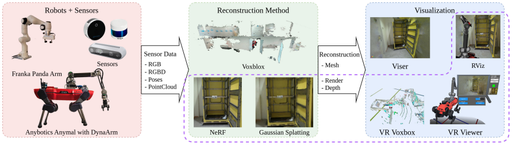
Fig. 2 . General teleoperation visualization pipeline divided into three sections: Robots, Reconstruction Methods, Visualization. Sensor and pose data flows from various robotic components (red) into the reconstruction method (green) to create a scene representation that is shown to the user in the visualizer (blue). Support for Radiance Field reconstructions such as Neural Radiance Fields (NeRFs) and Gaussian Splatting, as well as RViz and VR visualizers for these methods, are presented in this work. For baseline comparisons, a V oxblox mesh viewer was also ported to VR. These contributions are highlighted with a purple dashed line.
원문 · CC BY 4.0 · Maximum Wilder-Smith, Vaishakh Patil, Marco Hutter · Radiance Fields for Robotic Teleoperation · 원문 그림 인용 · 원본 PDF 2쪽에서 그림 영역을 추출했습니다.온라인 Radiance Field 노드의 구성
제안 파이프라인은 ROS로 들어오는 다중 카메라의 이미지, 내부 파라미터, 포즈를 Radiance Field Node가 구독하는 구조입니다. 이 노드는 NerfStudio의 방법을 사용할 수 있도록 구성되며, 3DGS 방법으로는 Splatfacto를 사용합니다. 노드는 초기 배치를 모은 뒤 온라인 학습 모드로 전환하여 새 이미지를 계속 받아 학습합니다. 이미지는 흐림과 포즈 차이 기준으로 걸러지고, 해상도가 다른 카메라의 이미지는 가장 큰 카메라 기준으로 맞춘 뒤 학습 시 다시 줄입니다. 렌더 요청은 ActionServer로 받으며, 요청에는 시점 포즈가 포함되고 응답으로 렌더링 이미지와 추정 장면 깊이가 반환됩니다.
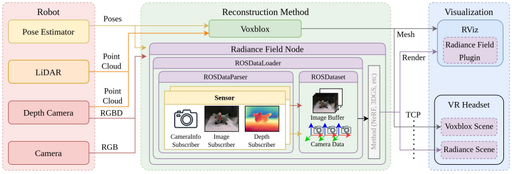
Fig. 3 . Component diagram showing the connections between the robotic systems (red and orange), the reconstruction methods (green), and the visualizers (blue). Data flows from the robotic systems into reconstruction method nodes where it is either merged into rendered views for Radiance Fields or a mesh for V oxblox. The Radiance Field Node is comprised of a custom DataLoader, DataParser, and Dataset, and uses a collection of Sensor objects to manage the ROS subscribers. The DataLoader and Dataset send data to any standard method during training, only returning images and cameras that have been updated. This data is then displayed directly in RViz or transmitted over TCP to a VR headset.
원문 · CC BY 4.0 · Maximum Wilder-Smith, Vaishakh Patil, Marco Hutter · Radiance Fields for Robotic Teleoperation · 원문 그림 인용 · 원본 PDF 3쪽에서 그림 영역을 추출했습니다.RViz 플러그인과 VR 시각화
RViz 플러그인은 RViz 카메라 역할을 하며, 카메라가 움직일 때마다 렌더 요청을 보내는 동적 모드와 움직이는 프레임을 기준으로 렌더 스트림을 보내는 연속 모드를 제공합니다. 동적 모드에서는 빠른 반응을 위해 렌더를 최종 해상도의 10%, 50%, 그다음 전체 해상도 순서로 보냅니다. 반환된 깊이는 RViz의 OpenGL 깊이로 변환되어 로봇이나 점군 같은 RViz 요소를 Radiance Field 앞뒤로 가리는 데 사용됩니다. 또한 축 정렬 경계 상자는 광선 적분을 제한해 배경이나 벽을 잘라낼 수 있습니다. VR 쪽에서는 Meta Quest 3에서 Unity 장면을 실행하고, 2.5D 핸드헬드 시차 뷰어와 360도 구형 렌더를 제공합니다.
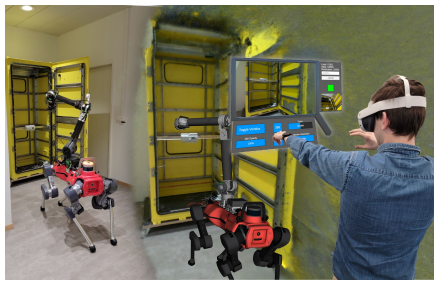
Fig. 1 . Teleoperator controlling a robot using a VR interface from inside a reconstructed Radiance Field. Reconstructions are created online from any robot based on its sensor configuration. Neural Radiance Field or Gaussian Splatting renders can be displayed in an immersive 360 ◦ render or on a handheld viewer. These renders are displayed alongside the robot and its sensor data, such as camera feeds and LiDAR.
원문 · CC BY 4.0 · Maximum Wilder-Smith, Vaishakh Patil, Marco Hutter · Radiance Fields for Robotic Teleoperation · 원문 그림 인용 · 원본 PDF 1쪽에서 그림 영역을 추출했습니다.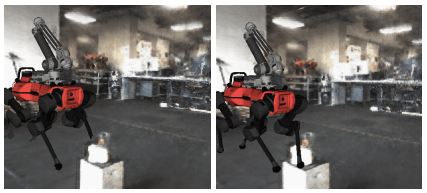
Fig. 4 . Sample of the RViz plugin occluding the robot based on scene depth (left) and having the robot rendered on top (right).
원문 · CC BY 4.0 · Maximum Wilder-Smith, Vaishakh Patil, Marco Hutter · Radiance Fields for Robotic Teleoperation · 원문 그림 인용 · 원본 PDF 4쪽에서 그림 영역을 추출했습니다.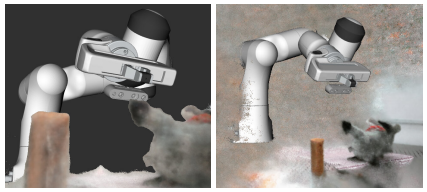
Fig. 5 . An axis-aligned bounding box can be used to crop the background (left) or remove walls (right) allowing for novel views and clearer operation.
원문 · CC BY 4.0 · Maximum Wilder-Smith, Vaishakh Patil, Marco Hutter · Radiance Fields for Robotic Teleoperation · 원문 그림 인용 · 원본 PDF 5쪽에서 그림 영역을 추출했습니다.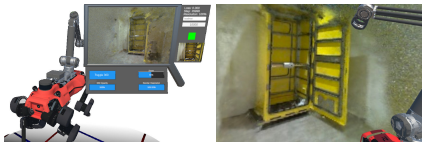
Fig. 7 . Radiance Field VR scene with 2.5D handheld parallax viewer (left) and fully immersive 360 ◦ (right).
원문 · CC BY 4.0 · Maximum Wilder-Smith, Vaishakh Patil, Marco Hutter · Radiance Fields for Robotic Teleoperation · 원문 그림 인용 · 원본 PDF 5쪽에서 그림 영역을 추출했습니다.세 가지 로봇 구성의 사진 품질 비교
사진 품질 실험은 고정 팔, 이동 기지, 이동 팔의 세 데이터셋에서 V oxblox, NeRF, 3DGS를 비교합니다. NeRF는 Nerfacto, 3DGS는 Splatfacto를 사용하며 세 배포 구성은 같은 파라미터로 학습되었습니다. 평가 지표는 PSNR, SSIM, LPIPS입니다. Static Arm에서는 3DGS가 PSNR 34.12, SSIM 0.9288, LPIPS 0.2298로 NeRF의 18.07, 0.5309, 0.4917보다 높았습니다. Mobile Base에서는 NeRF가 PSNR 25.55, SSIM 0.8718, LPIPS 0.1988로 세 방법 가운데 가장 높았습니다. 이 결과는 해당 데이터셋과 설정에서 얻은 것이며, 다른 로봇이나 장면으로 일반화된 결과가 아닙니다.
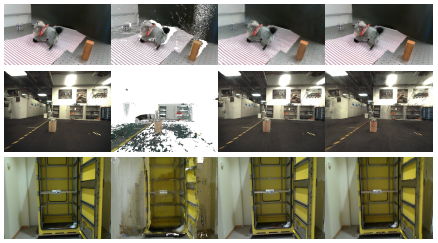
Fig. 8 . Comparisons of the static arm (left), mobile base (middle), and mobile arm (right). The top row shows the ground truth images, the second row shows the V oxblox reconstructions, the third row shows the NeRF reconstruction and the bottom row shows the 3DGS reconstruction. NeRF produced the highest quality results for both the mobile datasets, while 3DGS created a near-perfect image for the static arm dataset.
원문 · CC BY 4.0 · Maximum Wilder-Smith, Vaishakh Patil, Marco Hutter · Radiance Fields for Robotic Teleoperation · 원문 그림 인용 · 원본 PDF 6쪽에서 그림 영역을 추출했습니다.렌더 속도와 학습 시간 비교
온라인 조작에는 재구성과 렌더링 속도도 중요합니다. RTX 4090에서 측정한 결과, V oxblox는 배치 통합에 1.2초가 걸렸고 NeRF와 3DGS의 학습 반복 시간은 각각 35.644ms와 34.651ms였습니다. 이 비교에서 Radiance Field 방법은 V oxblox의 최종 PSNR 16.94dB에 맞출 때까지 학습되었으며, NeRF는 7.027초, 3DGS는 6.996초가 걸렸습니다. 1024x1024 이미지 렌더링에서는 NeRF가 1020.13ms(0.98FPS), 3DGS가 6.63ms(151FPS)였습니다. 원문은 이 학습 시간 차이를 거의 20배 빠른 결과로 보고합니다. 다만 이는 PSNR 16.94dB 도달 시간 비교이며 최종 품질이 같은 조건의 시간은 아닙니다.
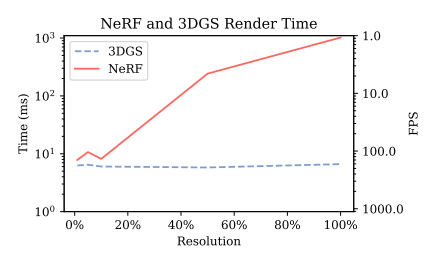
Fig. 9 . Render times for NeRF and 3DGS for a 1024x1024 image at different resolution percentages, showing an exponential increase in render time for NeRFs with a nearly constant time for 3DGS. The data is displayed at log scale due to the rapid increase in NeRF render times.
원문 · CC BY 4.0 · Maximum Wilder-Smith, Vaishakh Patil, Marco Hutter · Radiance Fields for Robotic Teleoperation · 원문 그림 인용 · 원본 PDF 7쪽에서 그림 영역을 추출했습니다.사용자 연구와 적용 범위
사용자 연구는 20명의 참가자가 Mobile Arm 데이터셋을 평가한 결과입니다. 이 데이터셋은 PSNR 등 사진 지표에서 가장 높은 품질을 보였기 때문에 선택되었습니다. 비교 대상은 RViz의 V oxblox와 NeRF, 그리고 VR의 V oxblox와 NeRF입니다. 저자들은 VR이 같은 데이터를 보여 주더라도 깊이 인지와 머리 장착 광학이 품질 인식을 높인다고 해석합니다. 사용성은 VR 시스템이 RViz보다 선호되었으며, 위치 인식과 이동 과제에서는 메쉬가, 조작 과제에서는 NeRF가 더 선호되었습니다. 이 결과는 사용자 연구의 특정 참가자와 데이터셋에 한정됩니다.
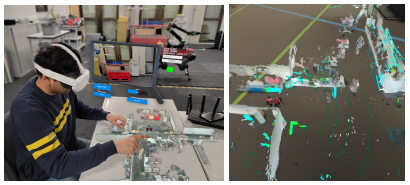
Fig. 6 . Teleoperator using VR system with V oxblox mesh on the table and Radiance Field Viewer on the left (left) and live LiDAR data overlayed on the mesh reconstruction.
원문 · CC BY 4.0 · Maximum Wilder-Smith, Vaishakh Patil, Marco Hutter · Radiance Fields for Robotic Teleoperation · 원문 그림 인용 · 원본 PDF 5쪽에서 그림 영역을 추출했습니다.한계와 결론의 범위
이 논문의 주요 결과는 세 데이터셋과 특정 로봇 구성, 지정된 평가 지표, 20명의 사용자 연구에 기반합니다. 3DGS는 장면 충실도에서 복잡한 반사와 날카로운 경계에 대해 NeRF보다 약하다고 원문은 서술합니다. Mobile Base에서는 NeRF가 포즈 최적화를 통해 잡음을 줄였지만, 이 결과를 모든 이동 로봇에 적용할 수 있다는 근거는 아닙니다. 또한 3DGS와 NeRF 사이의 시간 비교는 PSNR 16.94dB 도달 조건에서의 결과이며, 다른 품질 수준이나 다른 하드웨어에서의 결과는 제공된 근거에 포함되지 않습니다.
논문 정보
- 저자
- Maximum Wilder-Smith, Vaishakh Patil, Marco Hutter
- 학회·저널
- arXiv · 프리프린트
- 최초 공개일
- 2024년 7월 29일
- 등록일
- 2026년 11월 4일
- 수정일
- 2025년 5월 16일
- 버전
- v2
- arXiv
- 2407.20194
- 분류
- cs.RO
- 원문 이용 조건
- CC BY 4.0
- 제공 범위
- 논문 정보, 해설, 허용된 원문 그림
AI 해설은 논문 원문과 별개의 설명이며 오류가 있을 수 있습니다. 원문과 그림은 각 출처의 이용 조건과 따로 표시된 권리를 따릅니다.
초록
Radiance field methods such as Neural Radiance Fields (NeRFs) or 3D Gaussian Splatting (3DGS), have revolutionized graphics and novel view synthesis. Their ability to synthesize new viewpoints with photo-realistic quality, as well as capture complex volumetric and specular scenes, makes them an ideal visualization for robotic teleoperation setups. Direct camera teleoperation provides high-fidelity operation at the cost of maneuverability, while reconstruction-based approaches offer controllable scenes with lower fidelity. With this in mind, we propose replacing the traditional reconstruction-visualization components of the robotic teleoperation pipeline with online Radiance Fields, offering highly maneuverable scenes with photorealistic quality. As such, there are three main contributions to state of the art: (1) online training of Radiance Fields using live data from multiple cameras, (2) support for a variety of radiance methods including NeRF and 3DGS, (3) visualization suite for these methods including a virtual reality scene. To enable seamless integration with existing setups, these components were tested with multiple robots in multiple configurations and were displayed using traditional tools as well as the VR headset. The results across methods and robots were compared quantitatively to a baseline of mesh reconstruction, and a user study was conducted to compare the different visualization methods. For videos and code, check out https://rffr.leggedrobotics.com/works/teleoperation/.
원문 인용
Maximum Wilder-Smith, Vaishakh Patil, Marco Hutter (2024). Radiance Fields for Robotic Teleoperation. arXiv:2407.20194v2. https://arxiv.org/abs/2407.20194v2
BibTeX
@misc{wildersmith2024radiance,
  title = {{Radiance Fields for Robotic Teleoperation}},
  author = {Maximum Wilder-Smith and Vaishakh Patil and Marco Hutter},
  year = {2024},
  eprint = {2407.20194},
  archivePrefix = {arXiv},
  url = {https://arxiv.org/abs/2407.20194v2}
}