논문 해설
Social Coordination and Altruism in Autonomous Driving
자율주행에서의 사회적 조정과 이타주의
- 연구 문제 혼합 자율주행 교통에서 자율주행 차량은 인간 운전 차량과 명시적으로 조정하기 어렵고, 기존 인간 행동 모델의 충실도도 불확실합니다.
- 연구 방법 AV에 SVO 기반 분산 보상을 주어 이타성을 학습시키고, 반순차 다중 에이전트 Q 학습으로 고속도로 합류 정책을 도출합니다.
- 주요 결과 HV+SC 설정은 공감과 협력이 없는 설정보다 병합 실패와 충돌을 줄이고 이동 거리를 늘린다고 보고됩니다. 단일 SC 에이전트만 있는 HV+1SC 설정은 다중 에이전트 협조보다 크게 나쁩니다.
혼합 자율주행 교통의 협조 문제
자율주행 차량(AV)은 인간 운전 차량(HV)과 함께 도로를 쓰는 환경에서 서로 명시적으로 조정하기 어렵습니다. 기존 사회적 주행 연구는 인간 운전자의 행동을 학습되거나 손으로 작성된 모델로 예측하는 경우가 많습니다. 그러나 이 논문은 혼합 자율주행 환경에서 인간 운전자가 AV 주변에서 다르게 행동할 수 있으므로 이런 모델의 충실도가 의문스럽다고 지적합니다.
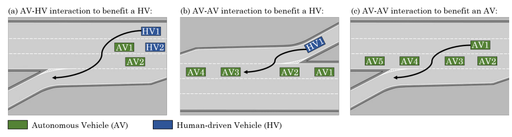
Fig. 1 : (a) A V-HV interaction to benefit another HV: Altruistic agents have the opportunity to form alliances and guide the behavior of HVs in order to improve the traffic flow and avoid hazardous situations. A V1 & A V2 can build a formation to slow down HV2 and open up a pathway for HV1, enabling it to trust the A Vs, change lanes, and navigate towards the exit ramp. (b) A V-A V interaction to benefit another HV: HV1 is intended to merge into the highway. Egoistic A Vs ignore the merging vehicle and do not open up space for it which can potentially lead to hazardous scenarios, whereas if they show sympathy for the merging HV , they can compromise on their own interest in order to create a safe path for HV1 to merge into the highway. (c) A V-A V interaction to benefit another A V:A V1 attempts to exit the highway. If A V2-A V5 act egoistically, A V1 might miss the exit and not be able to follow its planned mission. However, if A V2-A V5 take into account the interest of A V1 and act altruistically, they can open up space in the platoon, by A V2 & A V3 decelerating and A V4 & A V5 accelerating, to enable a safe exit for A V1.
원문 · CC BY 4.0 · Behrad Toghi, Rodolfo Valiente, Dorsa Sadigh, Ramtin Pedarsani, Yaser P. Fallah · Social Coordination and Altruism in Autonomous Driving · 원문 그림 인용 · 원본 PDF 2쪽에서 그림 영역을 추출했습니다.이 연구는 AV를 개별 에이전트가 아니라 다중 에이전트 집단으로 보고, 사회적 가치 지향(SVO)으로 표현한 이타성을 AV의 보상 구조에 넣습니다. 연구 범위는 고속도로 합류 상황이며, 병합 차량이 인간 운전 차량이거나 자율주행 차량일 수 있습니다. 목표는 이타적 AV가 안전과 병합 성공률을 높이는지 확인하는 것입니다.
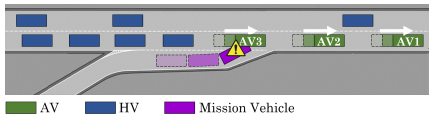
Fig. 3 : Case study: a mission vehicle that can be human-driven or autonomous attempts to merge into the mixed group of A Vs and HVs.
원문 · CC BY 4.0 · Behrad Toghi, Rodolfo Valiente, Dorsa Sadigh, Ramtin Pedarsani, Yaser P. Fallah · Social Coordination and Altruism in Autonomous Driving · 원문 그림 인용 · 원본 PDF 4쪽에서 그림 영역을 추출했습니다.SVO 기반 분산 보상 구조
이 논문은 각 에이전트의 총 효용을 자신의 보상 r_i와 다른 차량 보상의 가중합으로 정의합니다. SVO 각도 φ는 자기 보상과 타인 보상 사이의 가중을 정하며, 식 (12)에서는 협력(cooperation)과 공감(sympathy)을 θ 비율로 분리합니다. θ는 협력과 공감의 비율을 정하는 각도입니다.
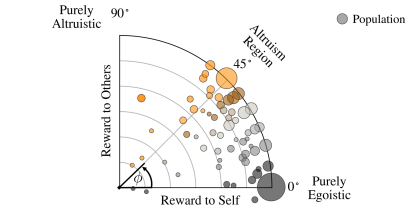
Fig. 2 : SVO angular phase φ quantifies an agent’s level of altruism. Figure is based on the empirical data collected from humans by Garapin et al. [35]. Diameter of the circles show the size of the human population that hold the corresponding SVO.
원문 · CC BY 4.0 · Behrad Toghi, Rodolfo Valiente, Dorsa Sadigh, Ramtin Pedarsani, Yaser P. Fallah · Social Coordination and Altruism in Autonomous Driving · 원문 그림 인용 · 원본 PDF 4쪽에서 그림 영역을 추출했습니다.보상은 자신의 주행 성능 항, AV 사이의 협력 항, 인간 운전 차량에 대한 공감 항으로 나뉩니다. 협력 항은 에이전트가 관측 행렬로 얻는 정보만 사용하며 다른 에이전트의 행동을 명시적으로 알 필요가 없습니다. 공감 항은 인간 차량의 효용을 거리에 따라 가중하여 계산합니다. 병합 차량의 임무 보상은 병합에 성공했을 때만 주어집니다.
반내 순차 다중 에이전트 학습
정책 학습에는 심층 Q 네트워크 계열의 방법을 사용하며, 경험 재현 버퍼로 학습 샘플의 시간 상관을 줄입니다. 다중 에이전트 환경에서는 다른 에이전트가 동시에 정책을 바꾸면 전이 확률이 변하는 비정상성 문제가 생깁니다. 이 논문은 이를 완화하기 위해 반순차(semi-sequential) 학습 알고리즘을 제안합니다.
알고리즘은 시뮬레이션 에피소드를 버퍼에 채운 뒤, 한 에이전트를 학습하는 동안 다른 에이전트의 가중치를 고정합니다. 갱신된 가중치는 다른 에이전트에 배포됩니다. 샘플은 병합 지점과의 공간 거리에 비례하는 확률로 뽑히며, 저자들은 이것이 마지막 보상에 기반한 우선순위 방법보다 낫다고 보고합니다.
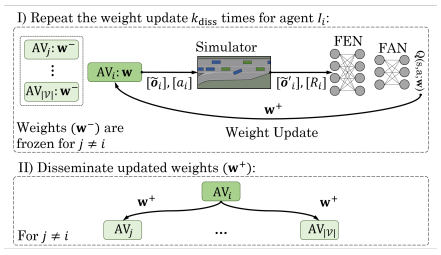
Fig. 4 : Multi-agent training and policy dissemination process.
원문 · CC BY 4.0 · Behrad Toghi, Rodolfo Valiente, Dorsa Sadigh, Ramtin Pedarsani, Yaser P. Fallah · Social Coordination and Altruism in Autonomous Driving · 원문 그림 인용 · 원본 PDF 8쪽에서 그림 영역을 추출했습니다.설정별 합류 결과와 단일 SC 절제
실험은 자율주행 에이전트가 이기적인 설정(HV+E), 협력만 있는 설정(HV+C), 공감과 협력을 함께 가진 설정(HV+SC)을 비교합니다. 병합 차량은 인간 운전 차량으로 두었으며, 이 설정에서 공감 요소가 없는 경우 병합이 대부분의 에피소드에서 실패했다고 보고됩니다.
절제 실험에서는 Guide AV 한 대만 공감과 협력을 가지는 HV+1SC와 모든 자율주행 차량이 공감과 협력을 가지는 HV+SC를 비교합니다. 원문 표에서 HV+1SC는 실패 병합 74.4%, 충돌 74.5%, 평균 이동 거리 268.5m이고, HV+SC는 실패 병합 12.2%, 충돌 12.8%, 평균 이동 거리 334.4m입니다. 이 결과는 해당 고속도로 합류 시나리오와 저자가 설정한 조건에서 얻은 것입니다.
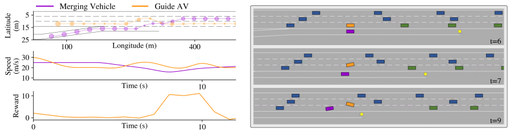
Fig. 7 : An example of A Vs (green) and HVs ( blue) in HV+SC setting. Successful merging requires all the A Vs to work together and none of them can achieve this goal alone. We focus on the “Guide A V” that makes the most significant impact and show how it learns to take sequences of actions to not only enable the mission vehicle to merge (by decelerating and performing a lane change to left), but also manages to make the minimal compromise on its individual utility (by another lane change to right and cruising with optimal speed). Diameter of the circles on the trajectory plot shows vehicles’ speed.
원문 · CC BY 4.0 · Behrad Toghi, Rodolfo Valiente, Dorsa Sadigh, Ramtin Pedarsani, Yaser P. Fallah · Social Coordination and Altruism in Autonomous Driving · 원문 그림 인용 · 원본 PDF 10쪽에서 그림 영역을 추출했습니다.최적 SVO 각도 탐색
저자들은 φ를 0(완전 이기적)에서 π/2(완전 이타적) 사이에서 바꾸며 충돌 에피소드 비율 f_C와 실패 병합 비율 f_MF를 측정했습니다. 최적 각도 φ*는 ξ f_C(φ) + (1−ξ) f_MF(φ)를 최소화하는 값으로 정의되며, 이 연구에서는 ξ = 0.5로 두었습니다. 이 정의에서 두 비율은 같은 가중으로 결합됩니다.
결과로 보고된 바에 따르면 두 극단 중 어느 쪽도 최적이 아니며, 이기심과 타인에 대한 배려 사이의 중간 지점이 가장 나은 결과를 냅니다. 이 결론은 특정 학습 설정과 시뮬레이션 조건에서 얻은 것입니다.
적용 범위와 남은 질문
저자들은 인간 운전자 모델을 보수적이고 제한된 형태로 사용했다고 밝힙니다. 따라서 다른 인간 행동 모델에서의 성능은 아직 확인되지 않았으며, 이는 향후 연구 과제로 남아 있습니다. 또한 통신의 불완전성과 패킷 손실이 협조에 미치는 영향은 이 논문에서 더 복잡한 통신 모델로 다루지 않았습니다.
각 AV는 다른 에이전트의 행동 정보를 알지 못하고 명시적으로 조정하지 않는다고 가정합니다. 이 가정 아래에서 협조가 보상 신호로만 생겨난다는 결과가 얻어졌으므로, 명시적 조정이 가능한 환경에 대한 결론으로 확장할 수 없습니다.
논문 정보
- 저자
- Behrad Toghi, Rodolfo Valiente, Dorsa Sadigh, Ramtin Pedarsani, Yaser P. Fallah
- 학회·저널
- arXiv · 프리프린트
- 최초 공개일
- 2021년 7월 1일
- 등록일
- 2026년 11월 6일
- 수정일
- 2022년 4월 4일
- 버전
- v4
- arXiv
- 2107.00200
- 분류
- cs.RO
- 원문 이용 조건
- CC BY 4.0
- 제공 범위
- 논문 정보, 해설, 허용된 원문 그림
AI 해설은 논문 원문과 별개의 설명이며 오류가 있을 수 있습니다. 원문과 그림은 각 출처의 이용 조건과 따로 표시된 권리를 따릅니다.
초록
Despite the advances in the autonomous driving domain, autonomous vehicles (AVs) are still inefficient and limited in terms of cooperating with each other or coordinating with vehicles operated by humans. A group of autonomous and human-driven vehicles (HVs) which work together to optimize an altruistic social utility -- as opposed to the egoistic individual utility -- can co-exist seamlessly and assure safety and efficiency on the road. Achieving this mission without explicit coordination among agents is challenging, mainly due to the difficulty of predicting the behavior of humans with heterogeneous preferences in mixed-autonomy environments. Formally, we model an AV's maneuver planning in mixed-autonomy traffic as a partially-observable stochastic game and attempt to derive optimal policies that lead to socially-desirable outcomes using a multi-agent reinforcement learning framework. We introduce a quantitative representation of the AVs' social preferences and design a distributed reward structure that induces altruism into their decision making process. Our altruistic AVs are able to form alliances, guide the traffic, and affect the behavior of the HVs to handle competitive driving scenarios. As a case study, we compare egoistic AVs to our altruistic autonomous agents in a highway merging setting and demonstrate the emerging behaviors that lead to a noticeable improvement in the number of successful merges as well as the overall traffic flow and safety.
원문 인용
Behrad Toghi, Rodolfo Valiente, Dorsa Sadigh, Ramtin Pedarsani, Yaser P. Fallah (2021). Social Coordination and Altruism in Autonomous Driving. arXiv:2107.00200v4. https://arxiv.org/abs/2107.00200v4
BibTeX
@misc{toghi2021social,
  title = {{Social Coordination and Altruism in Autonomous Driving}},
  author = {Behrad Toghi and Rodolfo Valiente and Dorsa Sadigh and Ramtin Pedarsani and Yaser P. Fallah},
  year = {2021},
  eprint = {2107.00200},
  archivePrefix = {arXiv},
  url = {https://arxiv.org/abs/2107.00200v4}
}