논문 해설
UniLatent: Cross-Embodiment Transfer via Latent Observation Alignment
UniLatent: 잠재 관측 정렬을 통한 교차 embodiment 전이
- 연구 문제 로봇 데이터는 특정 임바디먼트에 묶여 있어 형태와 외관이 다른 로봇으로 재사용하기 어렵습니다. 이 논문은 이 시각 격차를 픽셀 번역 없이 잠재 공간에서 줄이는 방법을 다룹니다.
- 연구 방법 시뮬레이션에서 같은 TCP 자세의 원본·대상 로봇 쌍을 렌더링하고, DINOv2 기반 원본 인코더를 고정된 대상 인코더 특징에 정렬합니다. 이후 정렬된 잠재 표현으로 학습한 정책을 대상 로봇에 바로 배포합니다.
- 주요 결과 시뮬레이션 평균 대상 성공률은 픽셀 번역 기준선 RoVi-Aug*의 44.5%에서 UniLatent의 76.0%로 보고되었습니다. 실제 xArm에서 Franka로의 10개 시연 fine-tuning에서는 27/30 성공을 보고했습니다.
로봇 데이터의 임바디먼트 격차 문제
로봇 데이터셋은 수집 비용이 크고 특정 임바디먼트에 묶여 있어, 형태·외관·기구학이 다른 로봇 사이에서 시연을 재사용하기 어렵습니다. 특히 제3자 시점 카메라에서는 로봇이 영상의 큰 부분을 차지하므로, 팔이나 그리퍼를 바꾸면 외관뿐 아니라 자기 가림, 접촉 기하, 과제 관련 물체의 가시성까지 달라집니다. 이를 임바디먼트 유발 시각 격차라고 부르며, 이 격차 때문에 시각 기반 정책은 새 로봇에서 성능이 떨어집니다.
기존 연구는 원본 시연 프레임을 마스킹, 인페인팅, 확산 생성으로 대상 시각 영역에 맞게 편집합니다. 그러나 픽셀 공간 번역은 분할 오류와 로봇 기하 왜곡을 만들 수 있고, 합성 영역과 실제 대상 관찰의 차이 때문에 정책이 번역 아티팩트에 과적합될 수 있습니다. 이 논문은 이 문제를 픽셀이 아니라 잠재 공간에서 줄이는 것을 목표로 합니다.
쌍 렌더링과 잠재 공간 정렬
UniLatent는 시뮬레이션에서 원본과 대상 로봇이 같은 TCP 자세에 도달하도록 역기구학을 풀고, 같은 카메라와 무작위화된 장면에서 두 로봇을 렌더링하여 쌍 관찰을 만듭니다. TCP는 두 손가락 끝의 중점으로 정의되어, 그리퍼 길이가 다른 로봇 사이에서도 조작 지점을 맞춥니다.
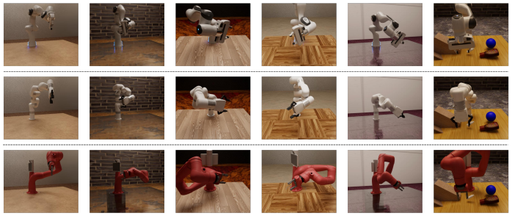
Figure 3 : Paired image generation.Examples of simulation-rendered paired observations for three robots (top to bottom): Franka, xArm, and Sawyer. For each sampled end-effector pose, we render the robots under randomized backgrounds, lighting, and scene variations while preserving action-level correspondence between paired frames.
원문 · CC BY 4.0 · Yufei Ding, Yi Du, Weiduo Yuan, Hao Jiang, Dylan Goetting, Lawrence Yunliang Chen, Daniel Seita, Yue Wang · UniLatent: Cross-Embodiment Transfer via Latent Observation Alignment · 원문 그림 인용 · 원본 PDF 4쪽에서 그림 영역을 추출했습니다.원본 인코더 E_S는 DINOv2로 초기화되고, 대상 인코더 E_T는 고정됩니다. 학습은 E_S만 갱신하며, 같은 자세의 원본 특징이 E_T의 특징을 따라가도록 MSE 회귀를 수행합니다. 이 방식은 대상 인코더가 배포 표현을 정의하도록 하여, 실행 시 대상 관찰을 같은 고정 인코더로 바로 인코딩할 수 있게 합니다.

Figure 7 : t-SNE of latent embeddings during alignment.Each point denotes a latent embedding of a ren- dered image; colors indicate robot embodiments, and marker shapes indicate paired rendered samples. Across training (1→6), embeddings from different robots become more aligned in the latent space.
원문 · CC BY 4.0 · Yufei Ding, Yi Du, Weiduo Yuan, Hao Jiang, Dylan Goetting, Lawrence Yunliang Chen, Daniel Seita, Yue Wang · UniLatent: Cross-Embodiment Transfer via Latent Observation Alignment · 원문 그림 인용 · 원본 PDF 9쪽에서 그림 영역을 추출했습니다.이후 정렬된 E_S로 원본 시연을 인코딩하여 조건부 흐름 매칭 정책을 학습합니다. 배포 시에는 대상 관찰을 E_T로 인코딩한 뒤 같은 정책을 실행하므로 테스트 시 이미지 합성이 필요 없습니다.
시뮬레이션 제로샷 전이 결과
시뮬레이션에서는 Franka를 원본으로 두고 xArm7과 Sawyer로 제로샷 전이를 평가했습니다. 과제는 Close Box Lid, Stack Cup into Bowl, Kick Football이며 각 설정은 100회 롤아웃으로 측정되었습니다. 비교군은 직접 정책 전이, 정렬 없는 공유 DINOv2, 픽셀 번역 기준선 RoVi-Aug*입니다.
직접 정책 전이는 Franka에서 80–97%의 동일 로봇 성공률을 보였지만 xArm과 Sawyer 대상에서는 0–5%였습니다. 정렬 없는 DINOv2는 일부 xArm 설정을 개선했으나 Sawyer에서 최대 16%에 그쳤습니다. 저자들이 보고한 평균 대상 성공률은 RoVi-Aug*가 44.5%, UniLatent가 76.0%입니다. Stack Cup into Bowl에서는 xArm 15%에서 65%, Sawyer 5%에서 51%로 올랐다고 보고됩니다.
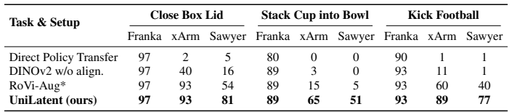
Table 1 : Zero-shot transfer results in simulation.Policies are trained on Franka demonstrations and evalu- ated on Franka (in-domain) and zero-shot on xArm and Sawyer. We compare direct policy transfer, a shared frozen DINOv2 encoder without alignment, RoVi-Aug* (our adaptation of RoVi-Aug), and the full UniLatent pipeline. Entries report success rates (%) over 100 rollouts.
원문 · CC BY 4.0 · Yufei Ding, Yi Du, Weiduo Yuan, Hao Jiang, Dylan Goetting, Lawrence Yunliang Chen, Daniel Seita, Yue Wang · UniLatent: Cross-Embodiment Transfer via Latent Observation Alignment · 원문 그림 인용 · 원본 PDF 6쪽에서 그림 영역을 추출했습니다.실제 로봇 few-shot 전이 결과
실제 실험은 xArm을 원본, Franka를 대상으로 하며 Close Drawer, Close Box Lid, Wipe Table 세 과제에서 Franka 대상 시연 10개를 사용했습니다. 정렬 인코더는 시뮬레이션 쌍 렌더링 약 100k개로만 학습되었고, 실제 로봇 데이터로는 정렬하지 않았습니다. 대상 전용 학습, RoVi-Aug pre-training 후 fine-tuning, UniLatent pre-training 후 fine-tuning이 비교되었습니다.
저자들이 보고한 총 성공 수는 UniLatent 27/30, RoVi-Aug pre-training 23/30, 대상 전용 학습 11/30입니다. 과제별로는 Close Drawer가 9/10에서 10/10, Wipe Table이 5/10에서 8/10으로 높아졌고 Close Box Lid는 9/10으로 같았습니다. 실제 로봇 결과는 한 가지 물리 설정과 10회 롤아웃의 범위에서 읽어야 합니다.
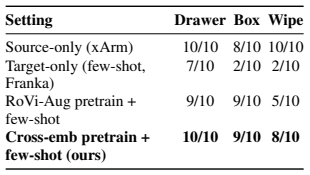
Table 2 : Few-shot real-world transfer. Source-onlyis an in-domain xArm reference. Rows 2–4 are evaluated on Franka and use the sameM T = 10Franka demonstrations.Cross- emb pretrain + few-shot (ours)is UniLatent.
원문 · CC BY 4.0 · Yufei Ding, Yi Du, Weiduo Yuan, Hao Jiang, Dylan Goetting, Lawrence Yunliang Chen, Daniel Seita, Yue Wang · UniLatent: Cross-Embodiment Transfer via Latent Observation Alignment · 원문 그림 인용 · 원본 PDF 7쪽에서 그림 영역을 추출했습니다.다중 원본과 시점·배경 확장
다중 원본 실험에서는 Franka와 Sawyer 원본 인코더를 같은 xArm 대상 인코더에 정렬하고 두 원본의 시연을 함께 학습했습니다. 원본별 100개 시연은 단독으로 63–64%였지만, 두 원본을 합친 설정은 91%였습니다. 시점 이동 실험에서는 v1 특징을 v2에 정렬했을 때 일치 시점 정책 62%에서 교차 시점 정렬 89%로 개선되었다고 보고됩니다. 배경 실험은 Close Box Lid의 시뮬레이션 배경 이동에 한정됩니다.

Table 3 : Additional transfer analyses onClose Box Lid(success, %).(a) Multi-source transfer to xArm from Sawyer, Franka, or both source robots; demo counts denote total source demonstrations, and all sources align to the same frozen target encoderE T . (b) Cross-view paired rendering improves deployment on the shifted view v2. (c) Success under matched backgrounds and under source-background randomization, averaged over five held-out simulated scenes.
원문 · CC BY 4.0 · Yufei Ding, Yi Du, Weiduo Yuan, Hao Jiang, Dylan Goetting, Lawrence Yunliang Chen, Daniel Seita, Yue Wang · UniLatent: Cross-Embodiment Transfer via Latent Observation Alignment · 원문 그림 인용 · 원본 PDF 8쪽에서 그림 영역을 추출했습니다.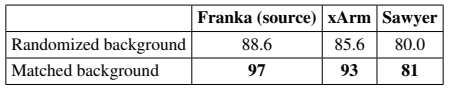
Table 8 : Background generalization via image randomization.Success rates (%) on the simulated Close Box Lid task, with Franka as the source robot and xArm and Sawyer as transfer targets. The first row trains with randomized source backgrounds and tests in 5 unseen scenes; the second uses matched train–test backgrounds.
원문 · CC BY 4.0 · Yufei Ding, Yi Du, Weiduo Yuan, Hao Jiang, Dylan Goetting, Lawrence Yunliang Chen, Daniel Seita, Yue Wang · UniLatent: Cross-Embodiment Transfer via Latent Observation Alignment · 원문 그림 인용 · 원본 PDF 32쪽에서 그림 영역을 추출했습니다.적용 범위와 남은 한계
저자들은 UniLatent가 7자유도 단일 팔과 평행 턱 그리퍼, 공유 엔드 이펙터 행동 인터페이스에 맞춰져 있다고 명시합니다. 덱스터스 손, 휴머노이드, 모바일 조작기처럼 형태가 크게 다른 로봇이나 공구 특이 접촉에는 추가 모델링이 필요하다고 봅니다. 또한 Open X-Embodiment 같은 외부 원본 데이터셋 적용은 아직 입증되지 않았습니다.
배경 이동 평가는 하나의 시뮬레이션 과제에 한정되며, 실제 로봇 실험은 단일 물리 설정입니다. 따라서 실제 세계의 혼잡, 조명, 방해물 변화에 대한 강건성은 확인되지 않았습니다.
논문 정보
- 저자
- Yufei Ding, Yi Du, Weiduo Yuan, Hao Jiang, Dylan Goetting, Lawrence Yunliang Chen, Daniel Seita, Yue Wang
- 학회·저널
- arXiv · 프리프린트
- 최초 공개일
- 2026년 11월 6일
- 등록일
- 2026년 11월 10일
- 수정일
- 2026년 11월 6일
- 버전
- v1
- arXiv
- 2611.10061
- 분류
- cs.RO · cs.CV
- 원문 이용 조건
- CC BY 4.0
- 제공 범위
- 논문 정보, 해설, 허용된 원문 그림
AI 해설은 논문 원문과 별개의 설명이며 오류가 있을 수 있습니다. 원문과 그림은 각 출처의 이용 조건과 따로 표시된 권리를 따릅니다.
초록
Robot datasets are costly to collect and are usually tied to a specific embodiment, making it difficult to reuse demonstrations across robots with different geometry, appearance, and kinematics. We introduce UniLatent, a cross-embodiment transfer framework that reduces the embodiment-induced observation gap in a shared latent space. UniLatent renders paired source-target robot observations in simulation and aligns a source visual encoder to a frozen target encoder. A policy trained on encoded source demonstrations can then run directly on target observations, with no pixel-level image translation. Across three simulation tasks and two target robot arms, UniLatent reaches up to 93% zero-shot success, exceeding the strongest pixel-translation baseline by over 30 points on average. In real-world xArm-to-Franka transfer, fine-tuning with only 10 target demonstrations per task yields 27/30 successful rollouts. Code, videos and data are available at https://selina2023.github.io/unilatent/.
원문 인용
Yufei Ding, Yi Du, Weiduo Yuan, Hao Jiang, Dylan Goetting, Lawrence Yunliang Chen, Daniel Seita, Yue Wang (2026). UniLatent: Cross-Embodiment Transfer via Latent Observation Alignment. arXiv:2611.10061v1. https://arxiv.org/abs/2611.10061v1
BibTeX
@misc{ding2026unilatent,
  title = {{UniLatent: Cross-Embodiment Transfer via Latent Observation Alignment}},
  author = {Yufei Ding and Yi Du and Weiduo Yuan and Hao Jiang and Dylan Goetting and Lawrence Yunliang Chen and Daniel Seita and Yue Wang},
  year = {2026},
  eprint = {2611.10061},
  archivePrefix = {arXiv},
  url = {https://arxiv.org/abs/2611.10061v1}
}