논문 해설
VAMOS: A Hierarchical Vision-Language-Action Model for Capability-Modulated and Steerable Navigation
VAMOS: 능력 조절 및 조향 가능한 내비게이션을 위한 계층형 비전-언어-행동 모델
- 연구 문제 여러 로봇의 이질적인 데이터를 한 정책으로 합칠 때 로봇별 물리 능력 차이가 학습과 배포를 어렵게 만듭니다.
- 연구 방법 VAMOS는 픽셀 공간에서 2D 경로를 예측하는 고수준 VLM 계획기와 로봇별 시뮬레이션 학습 affordance 함수를 결합하여 후보 경로를 재순위화합니다.
- 주요 결과 실제 실내외 6개 코스에서 VAMOS는 평균 성공률 90%를 보였고, Hound에서 affordance 모듈을 쓰면 성공률이 60%에서 90%로 올랐습니다.
로봇 내비게이션에서 데이터 이질성이 생기는 이유
이 논문이 다루는 문제는 여러 로봇의 데이터를 합쳐 하나의 일반적인 내비게이션 정책을 학습할 때 생기는 이질성입니다. 같은 목표 지점이라도 사족보행 로봇은 계단을 오를 수 있지만 바퀴 로봇은 그렇지 못합니다. 따라서 데이터를 많이 모을수록 한 로봇이 실제로 수행할 수 없는 행동까지 함께 학습하게 되는 문제가 생깁니다.
기존 접근은 두 방향으로 나뉩니다. 모듈형 내비게이션 스택은 특정 로봇과 제한된 환경에 맞게 많이 튜닝되어 있어 새 로봇으로 옮기려면 학습 요소의 재학습과 전체 스택의 재조정이 필요합니다. 엔드투엔드 학습은 데이터셋마다 행동 공간이 달라 이질적인 데이터를 한꺼번에 다루기 어렵습니다.
VAMOS는 이 긴장을 계층 구조로 풉니다. 고수준 VLM 계획기는 여러 데이터에서 목표 방향과 장애물 회피 같은 일반적인 내비게이션 의미를 배우고, 로봇별 affordance 모델은 그 계획이 해당 로봇의 물리적 능력에 맞는지를 평가합니다. 이 글은 이 분리가 실제로 어떻게 구현되는지, 그리고 어떤 실험으로 뒷받침되는지를 따라갑니다.
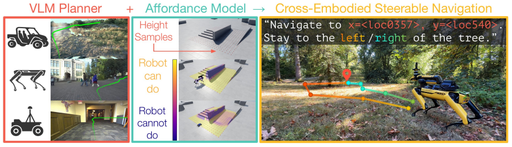
Fig. 1 :We presentVAMOS, a general-purpose hierarchical VLA for navigation. Our key idea is to decouple semantic planning from embodiment grounding. We achieve this by training a high-level VLM planner with diverse, heterogeneous real-world data that proposes trajectory candidates as 2D paths, which are then re-ranked by an embodiment-specific affordance model trained cheaply and safely in simulation. This yields robust, cross-embodied and steerable open-world navigation controllers.
원문 · CC BY 4.0 · Mateo Guaman Castro, Sidharth Rajagopal, Daniel Gorbatov, Matt Schmittle, Rohan Baijal, Octi Zhang, Rosario Scalise, Sidharth Talia, Emma Romig, Celso de Melo, Byron Boots, Abhishek Gupta · VAMOS: A Hierarchical Vision-Language-Action Model for Capability-Modulated and Steerable Navigation · 원문 그림 인용 · 원본 PDF 1쪽에서 그림 영역을 추출했습니다.픽셀 공간 2D 경로를 예측하는 고수준 VLM 계획기
고수준 계획기는 단안 RGB 이미지와 텍스트로 인코딩된 목표 좌표를 입력으로 받아, 이미지 픽셀 공간의 2D 경로를 출력하는 VLM입니다. 목표 좌표는 1024개의 위치 토큰을 사용하여 「Navigate to x=<locXXXX>, y=<locYYYY>」 형태의 문자열로 바뀝니다. 2D 경로는 로봇이 향후 시간 단계에서 이동할 위치를 이미지 평면에 투영한 점들의 순서열입니다. 이 표현을 쓰면 서로 다른 로봇 데이터의 행동 공간 차이가 픽셀 점 예측이라는 공통 인터페이스로 묶입니다.
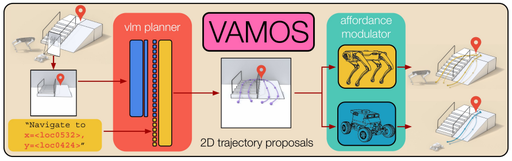
Fig. 2 :The high-level planner is a VLM trained to take an image and a goal coordinate (encoded as text) as input, optionally appending natural language preferences, and to output a set of candidate paths in pixel space. These paths are encoded as strings of location token pairs, then decoded and projected from 2D pixel space to the 3D ground plane. Finally, a capability-aware affordance function evaluates and re-ranks the 3D candidate paths to determine which path the robot should execute in the real world based on low-level policy capabilities.
원문 · CC BY 4.0 · Mateo Guaman Castro, Sidharth Rajagopal, Daniel Gorbatov, Matt Schmittle, Rohan Baijal, Octi Zhang, Rosario Scalise, Sidharth Talia, Emma Romig, Celso de Melo, Byron Boots, Abhishek Gupta · VAMOS: A Hierarchical Vision-Language-Action Model for Capability-Modulated and Steerable Navigation · 원문 그림 인용 · 원본 PDF 2쪽에서 그림 영역을 추출했습니다.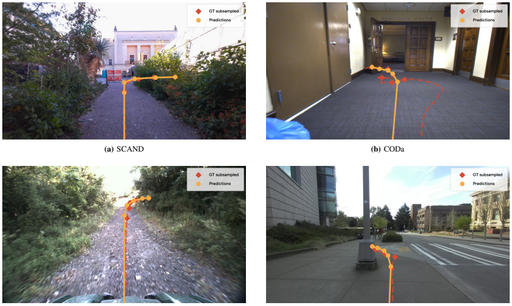
Fig. 12 : Examples of high-level trajectory predictor.The high-level navigator consistently gets to the goal, is good at following paths, going around obstacles, and taking turns behind occlusions such as walls, people, poles, etc.
원문 · CC BY 4.0 · Mateo Guaman Castro, Sidharth Rajagopal, Daniel Gorbatov, Matt Schmittle, Rohan Baijal, Octi Zhang, Rosario Scalise, Sidharth Talia, Emma Romig, Celso de Melo, Byron Boots, Abhishek Gupta · VAMOS: A Hierarchical Vision-Language-Action Model for Capability-Modulated and Steerable Navigation · 원문 그림 인용 · 원본 PDF 13쪽에서 그림 영역을 추출했습니다.학습 데이터는 odometry가 있는 4개 데이터셋, 3개 embodiment에서 모아 총 29.8시간 분량으로 구성됩니다. 각 궤적은 hindsight 방식으로 미래 시점의 로봇 자세를 카메라 내외부 행렬로 이미지에 투영하여 라벨링합니다. 저자들은 짧은 궤적과 긴 궤적을 50% 비율로 샘플링하고, 곡률 기준으로 데이터를 걸러 중복된 직진 위주 데이터를 줄였습니다.
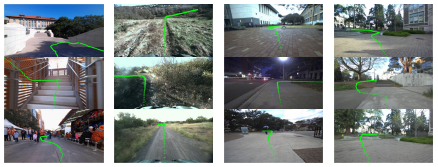
Fig. 3 :We fine-tune a VLM with navigation-specific, real-world datasets, with heterogeneous embodiments and capabilities, to ob- tain a general-puropse high-level planner. We use a filtered data mix from SCAND [26], TartanDrive 2 [27], CODa [28], and a small, 0.3 hour in-domain dataset collected on Spot.
원문 · CC BY 4.0 · Mateo Guaman Castro, Sidharth Rajagopal, Daniel Gorbatov, Matt Schmittle, Rohan Baijal, Octi Zhang, Rosario Scalise, Sidharth Talia, Emma Romig, Celso de Melo, Byron Boots, Abhishek Gupta · VAMOS: A Hierarchical Vision-Language-Action Model for Capability-Modulated and Steerable Navigation · 원문 그림 인용 · 원본 PDF 4쪽에서 그림 영역을 추출했습니다.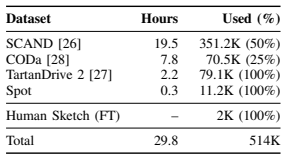
원문 그림 TABLE VI: Dataset mix used for training high-level navigation. All datasets include odometry annotations. Human sketch annota- tions enable few-shot adaptation (Section IV-C).
원문 · CC BY 4.0 · Mateo Guaman Castro, Sidharth Rajagopal, Daniel Gorbatov, Matt Schmittle, Rohan Baijal, Octi Zhang, Rosario Scalise, Sidharth Talia, Emma Romig, Celso de Melo, Byron Boots, Abhishek Gupta · VAMOS: A Hierarchical Vision-Language-Action Model for Capability-Modulated and Steerable Navigation · 원문 그림 인용 · 원본 PDF 10쪽에서 그림 영역을 추출했습니다.모델은 PaliGemma 2 3B를 224px 해상도에서 지도 미세조정한 것입니다. 이때 LoRA를 사용하며, 저자들은 전체 파라미터 fine-tuning과 LoRA가 비슷한 성능을 보였다고 보고합니다. 학습 설정은 이 고수준 VLM fine-tuning에 해당하며, 시뮬레이션에서 학습하는 affordance 함수와는 구분됩니다. 자연어 선호는 데이터의 10%에 VLM 주석을 붙여 학습시켰습니다.
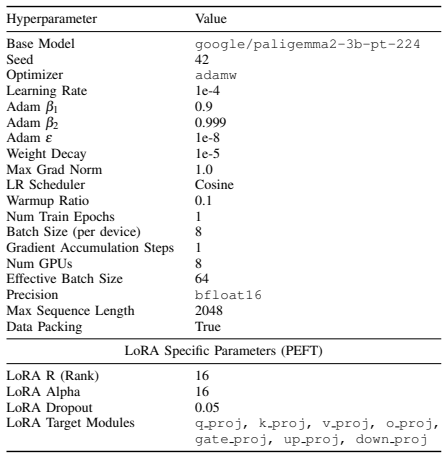
원문 그림 TABLE V:Key Training Hyperparameters
원문 · CC BY 4.0 · Mateo Guaman Castro, Sidharth Rajagopal, Daniel Gorbatov, Matt Schmittle, Rohan Baijal, Octi Zhang, Rosario Scalise, Sidharth Talia, Emma Romig, Celso de Melo, Byron Boots, Abhishek Gupta · VAMOS: A Hierarchical Vision-Language-Action Model for Capability-Modulated and Steerable Navigation · 원문 그림 인용 · 원본 PDF 10쪽에서 그림 영역을 추출했습니다.시뮬레이션에서 학습한 affordance 함수와 경로 재순위화
affordance 함수는 국소 elevation map \(M\), 질의 위치 \((x,y)\), 방향 \(a\)를 입력받아 정책이 그 방향으로 해당 지점을 통과할 확률을 0과 1 사이 점수로 예측합니다. 방향은 0도부터 315도까지 45도 간격의 8개 값입니다. 이 함수는 로봇별 저수준 정책을 시뮬레이션에서 실행하여 얻은 성공과 실패 라벨로 학습되며, 손실은 binary cross-entropy입니다. 이렇게 하면 지형 통과 가능성에 대한 정보를 실제 로봇에서 위험한 시도 없이 모을 수 있습니다.
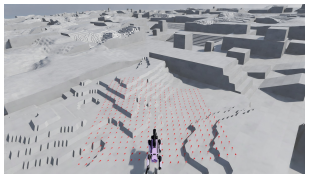
Fig. 14 :We generate terrains in simulation to train the affordance function using a combination of procedurally generated stairs- and ramp-like terrains with different parameterizations.
원문 · CC BY 4.0 · Mateo Guaman Castro, Sidharth Rajagopal, Daniel Gorbatov, Matt Schmittle, Rohan Baijal, Octi Zhang, Rosario Scalise, Sidharth Talia, Emma Romig, Celso de Melo, Byron Boots, Abhishek Gupta · VAMOS: A Hierarchical Vision-Language-Action Model for Capability-Modulated and Steerable Navigation · 원문 그림 인용 · 원본 PDF 14쪽에서 그림 영역을 추출했습니다.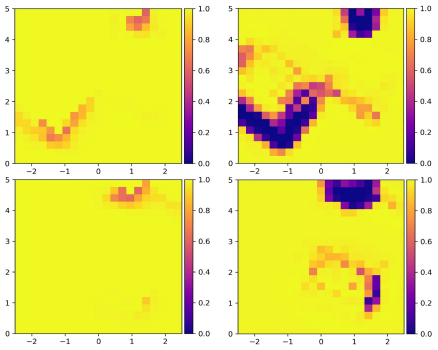
Fig. 15 :Computing the affordance function as a classification task rather than a regression on returns, as is common in reinforcement learning, yields more discriminative affordance scores. Here, we show two examples from two different scenes, where each row represents a scene.
원문 · CC BY 4.0 · Mateo Guaman Castro, Sidharth Rajagopal, Daniel Gorbatov, Matt Schmittle, Rohan Baijal, Octi Zhang, Rosario Scalise, Sidharth Talia, Emma Romig, Celso de Melo, Byron Boots, Abhishek Gupta · VAMOS: A Hierarchical Vision-Language-Action Model for Capability-Modulated and Steerable Navigation · 원문 그림 인용 · 원본 PDF 14쪽에서 그림 영역을 추출했습니다.배포 시에는 VLM이 생성한 픽셀 경로를 지면 위의 3D 점열로 투영합니다. 각 후보 경로의 점에서 affordance를 계산한 뒤, 한 점이라도 막히면 경로가 막힌다는 원칙에 따라 누적 affordance를 최솟값으로 정의합니다. 즉 \(F_c(p_i^w)=\min_t F_\pi(M,x_t,y_t,a_t)_i\)입니다. 가장 높은 누적 점수의 경로를 greedy하게 고르거나, 소프트맥스 샘플링으로 약간의 확률성을 주어 선택할 수 있습니다.
이 절차에서 VLM은 후보를 만들고 affordance 모듈은 그 후보를 실행 가능성으로 걸러냅니다. 로봇 종류를 바꿀 때는 계획기를 그대로 두고 affordance 모듈과 저수준 컨트롤러만 교체합니다.
실내와 실외 실제 로봇 실험의 성공률 비교
첫 검증은 Boston Dynamics Spot과 UW Hound를 사용한 실제 내비게이션 실험입니다. 대상은 Hallway, Atrium, Lab, Campus, Forest, Down Ramp의 6개 코스이며, 각 로봇과 환경 쌍에서 5회 시도한 성공률을 주요 지표로 씁니다. 목표는 3D 전역 좌표로 주어지고, 약 10m 간격으로 중간 웨이포인트를 생성합니다.

Fig. 4 :We run real-world navigation experiments indoors and outdoors in unseen scenes with challenging terrain, lighting, and vegetation. Our results show that VAMOSoutperforms state-of-the-art navigation foundation models and model-based baselines.
원문 · CC BY 4.0 · Mateo Guaman Castro, Sidharth Rajagopal, Daniel Gorbatov, Matt Schmittle, Rohan Baijal, Octi Zhang, Rosario Scalise, Sidharth Talia, Emma Romig, Celso de Melo, Byron Boots, Abhishek Gupta · VAMOS: A Hierarchical Vision-Language-Action Model for Capability-Modulated and Steerable Navigation · 원문 그림 인용 · 원본 PDF 5쪽에서 그림 영역을 추출했습니다.Table I에서 VAMOS의 평균 성공률은 90%입니다. 같은 표의 모듈형 스택은 53%, ViPlanner는 67%, NoMaD는 27%, NaVILA는 10%입니다. VAMOS는 Hallway, Atrium, Lab, Campus, Forest, Down Ramp에서 각각 100%, 80%, 100%, 80%, 100%, 80%를 기록했습니다. 실내에서는 모듈형 스택과 ViPlanner와 비슷한 수준이었고, Lab 코스에서는 모든 기준선보다 높았습니다. 실외에서는 NoMaD와 NaVILA가 직선 주행 위주로 움직이며 실패했고, ViPlanner는 Lab과 Down Ramp처럼 장기 계획이 필요한 장애물에서 실패했다고 저자들이 설명합니다.

원문 그림 TABLE I:VAMOSoutperforms model-based (above the horizontal line) and end-to-end generalist navigation baselines (below the line) across a wide variety of conditions. Success Rate (SR) is computed over 5 trials for each robot-environment pair. Notably, we show that prior navigation generalists struggle to match the performance of a traditional modular stack, while VAMOSoutperforms all baselines.
원문 · CC BY 4.0 · Mateo Guaman Castro, Sidharth Rajagopal, Daniel Gorbatov, Matt Schmittle, Rohan Baijal, Octi Zhang, Rosario Scalise, Sidharth Talia, Emma Romig, Celso de Melo, Byron Boots, Abhishek Gupta · VAMOS: A Hierarchical Vision-Language-Action Model for Capability-Modulated and Steerable Navigation · 원문 그림 인용 · 원본 PDF 5쪽에서 그림 영역을 추출했습니다.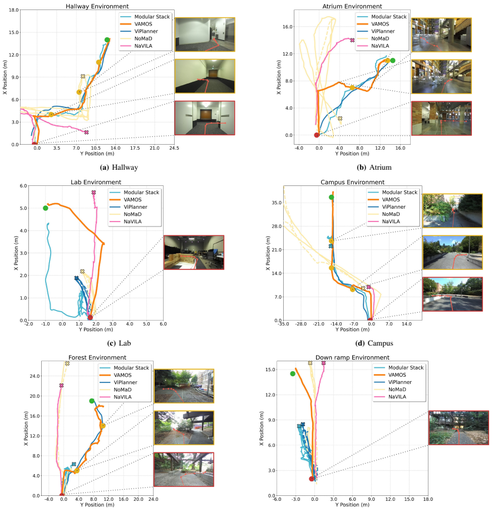
Fig. 11 :We show a top-down map for all navigation courses of the paths taken by different methods to navigate from the start of the course (red circle) to the goal (green circle), through each waypoint (yellow circles). VAMOSis capable of long-horizon, precise navigation. To the right, we visualize the paths predicted and selected by VAMOSwhen replanning after reaching a waypoint. Dotted lines correspond to taking the robot back to the last previously-completed waypoint after interventions, and X’s correspond to the positions where baselines failed or timed-out.
원문 · CC BY 4.0 · Mateo Guaman Castro, Sidharth Rajagopal, Daniel Gorbatov, Matt Schmittle, Rohan Baijal, Octi Zhang, Rosario Scalise, Sidharth Talia, Emma Romig, Celso de Melo, Byron Boots, Abhishek Gupta · VAMOS: A Hierarchical Vision-Language-Action Model for Capability-Modulated and Steerable Navigation · 원문 그림 인용 · 원본 PDF 12쪽에서 그림 영역을 추출했습니다.이 결과는 5회 시도로 측정한 성공률이며, 특정 로봇과 특정 코스 구성에서 얻은 값입니다. 기준선 값들은 표에 보고된 실험에서 나온 결과이므로, 다른 환경이나 다른 기준선 설정으로 일반화하지는 않습니다.
같은 계획기와 다른 affordance 모듈로 얻은 교차 embodiment 결과
교차 embodiment 실험은 같은 고수준 계획기를 Spot과 Hound에 사용하고 affordance 모듈만 교체하는 설정입니다. 테스트 환경은 계단과 경사로가 나란히 있고 위쪽 바닥으로 이어지는 구조이며, 각 로봇은 10회 실행했습니다. 이 실험에서 Hound는 계단을 오르지 못하고 경사로만 이용할 수 있다는 점이 핵심 조건입니다.
Table II에서 Spot은 affordance 모듈을 쓰지 않을 때와 쓸 때 모두 100%였습니다. Hound는 modulation이 없을 때 60%였고, 있을 때 90%로 올라갔습니다. 그 사이 경로 선택도 바뀌었는데, 모듈이 없을 때는 Hound의 계단 선택이 4/10이었지만 모듈이 있을 때는 1/10으로 줄었습니다. Table III에서 ViPlanner는 Spot에서 100%, Hound에서 0%였고 VAMOS는 두 로봇에서 각각 100%와 90%였습니다.
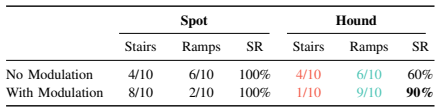
원문 그림 TABLE II:Affordance modulation maintains Spot’s perfect per- formance and improves Hound’s overall success rate from 60% to 90%, enabling cross-embodied navigation. Counts show per-terrain path choices (teal = success, red = failure) over 10 runs.
원문 · CC BY 4.0 · Mateo Guaman Castro, Sidharth Rajagopal, Daniel Gorbatov, Matt Schmittle, Rohan Baijal, Octi Zhang, Rosario Scalise, Sidharth Talia, Emma Romig, Celso de Melo, Byron Boots, Abhishek Gupta · VAMOS: A Hierarchical Vision-Language-Action Model for Capability-Modulated and Steerable Navigation · 원문 그림 인용 · 원본 PDF 6쪽에서 그림 영역을 추출했습니다.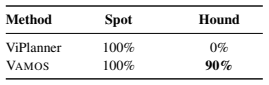
원문 그림 TABLE III:VAMOSoutperforms the best navigation baseline in cross-embodiment tasks, selecting ramps vs. stairs aligned with robot capabilities via its affordance model (N=10).
원문 · CC BY 4.0 · Mateo Guaman Castro, Sidharth Rajagopal, Daniel Gorbatov, Matt Schmittle, Rohan Baijal, Octi Zhang, Rosario Scalise, Sidharth Talia, Emma Romig, Celso de Melo, Byron Boots, Abhishek Gupta · VAMOS: A Hierarchical Vision-Language-Action Model for Capability-Modulated and Steerable Navigation · 원문 그림 인용 · 원본 PDF 6쪽에서 그림 영역을 추출했습니다.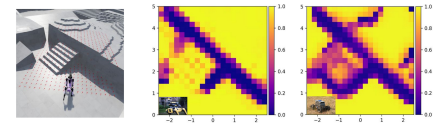
Fig. 10 :The affordance function indicates that the Spot robot can ascend stairs, but the wheeled Hound cannot (yellow signifies high- affordance score). Both robots cannot traverse tall obstacles (e.g., the wall has a low-affordance score).
원문 · CC BY 4.0 · Mateo Guaman Castro, Sidharth Rajagopal, Daniel Gorbatov, Matt Schmittle, Rohan Baijal, Octi Zhang, Rosario Scalise, Sidharth Talia, Emma Romig, Celso de Melo, Byron Boots, Abhishek Gupta · VAMOS: A Hierarchical Vision-Language-Action Model for Capability-Modulated and Steerable Navigation · 원문 그림 인용 · 원본 PDF 8쪽에서 그림 영역을 추출했습니다.이 결과는 같은 계획기에 affordance 재순위화를 더한 조건에서의 비교입니다. ViPlanner와의 비교는 같은 실험 과제의 표를 근거로 한 것이며, 그 밖의 과제나 로봇으로 확장한 결과는 아닙니다.
자연어 선호와 풀링 데이터의 오프라인 비교
자연어 조향 실험에서는 목표 좌표 문자열 뒤에 선호를 덧붙여 경로를 바꿀 수 있는지 봅니다. 저자들은 왼쪽이나 오른쪽 방향, 계단이나 경사로, 잔디 화분 같은 지형 선택을 정성적으로 보여 줍니다. 정량 평가는 ChatGPT 5를 판정자로 쓴 VLM-as-a-judge 방식으로, 계단과 경사로 선택 지시에서 20개 중 20개의 선호 일치를 보고합니다. 이 점수는 VLM 판정에 의존하므로 사람의 판정이나 다른 판정자의 결과로 확장하지 않습니다.
데이터 구성의 효과는 오프라인 평가로 따로 봅니다. 풀링 데이터로 학습한 고수준 모델은 Figure 3의 개별 데이터셋 각각으로 학습한 전문 모델과 비교했습니다. 검증 세트 전체에서 평균 L2 예측 오차를 비교한 결과, 풀링 모델이 개별 데이터셋 모델보다 나은 것으로 보고됩니다. 이 비교는 평균 L2 오차라는 오프라인 지표이며, 실제 로봇 성공률의 향상으로 바로 옮겨 해석하지 않습니다.
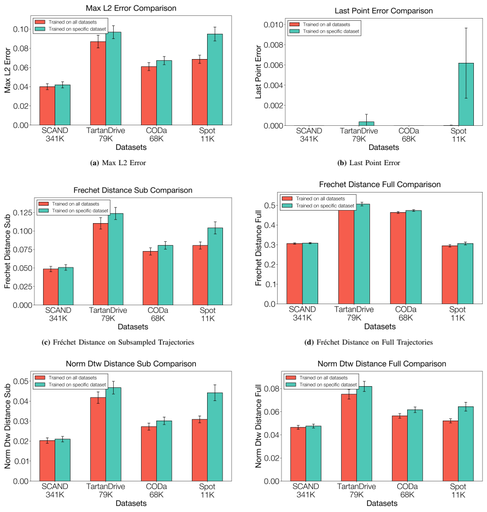
Fig. 16 :Offline metrics comparing high-level generalist vs robot-specific navigators. In all metrics, we benefit from training on the pooled data compared to robot-specific datasets.
원문 · CC BY 4.0 · Mateo Guaman Castro, Sidharth Rajagopal, Daniel Gorbatov, Matt Schmittle, Rohan Baijal, Octi Zhang, Rosario Scalise, Sidharth Talia, Emma Romig, Celso de Melo, Byron Boots, Abhishek Gupta · VAMOS: A Hierarchical Vision-Language-Action Model for Capability-Modulated and Steerable Navigation · 원문 그림 인용 · 원본 PDF 16쪽에서 그림 영역을 추출했습니다.단일 로봇에서 affordance 모듈이 VLM 오류를 보정하는 결과
단일 로봇 실험은 affordance 모듈이 같은 embodiment 안에서도 VLM의 오류를 고칠 수 있는지 확인합니다. OOD 장애물 설정에서 10회 실행한 결과, modulation이 없을 때의 성공률은 20.0%이고 있을 때는 60.0%입니다. 저자들은 이 차이를 VLM이 장애물을 통과하는 경로를 예측했을 때 affordance 점수가 그 경로를 걸러낸 결과로 해석합니다.
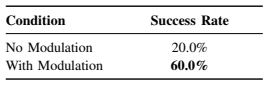
원문 그림 TABLE IV:Affordance modulation reduces high-level VLM pre- diction errors in cases where the VLM predicts paths that violate the robot’s capabilities or physics. Success rate is over 10 runs.
원문 · CC BY 4.0 · Mateo Guaman Castro, Sidharth Rajagopal, Daniel Gorbatov, Matt Schmittle, Rohan Baijal, Octi Zhang, Rosario Scalise, Sidharth Talia, Emma Romig, Celso de Melo, Byron Boots, Abhishek Gupta · VAMOS: A Hierarchical Vision-Language-Action Model for Capability-Modulated and Steerable Navigation · 원문 그림 인용 · 원본 PDF 7쪽에서 그림 영역을 추출했습니다.이 결과의 적용 범위는 이 실험의 장애물 설정과 10회 실행입니다. 장애물 회피 개선을 모든 장애물이나 모든 환경에서의 보장으로 읽으면 안 됩니다.
남은 실패 양상과 실험 해석의 한계
저자들은 고수준 VLM이 정적인 학습 데이터에 의존하기 때문에 가까이 있는 사람처럼 움직이는 동적 장애물을 잘 포착하지 못한다고 설명합니다. 또한 회전 뒤에서 경로를 과도하게 또는 덜 돌리는 overshoot과 undershoot이 일부 나타납니다. 저자들은 궤적을 균일하게 샘플링하면서 중요한 지점이 잘려 나갈 수 있다고 보고, Ramer-Douglas-Peucker 방식의 대안은 성능을 떨어뜨렸다고 보고합니다.
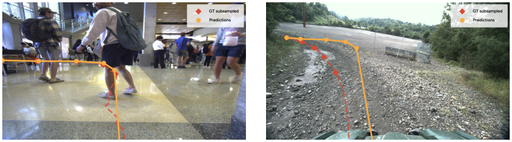
Fig. 13 : Examples of failure modes.The high-level navigator sometimes struggles with dynamic obstacles, as in the training data dynamic obstacles usually move out of the way and their motion is not captured in the training data. It also sometimes overshoots or undershoots turns.
원문 · CC BY 4.0 · Mateo Guaman Castro, Sidharth Rajagopal, Daniel Gorbatov, Matt Schmittle, Rohan Baijal, Octi Zhang, Rosario Scalise, Sidharth Talia, Emma Romig, Celso de Melo, Byron Boots, Abhishek Gupta · VAMOS: A Hierarchical Vision-Language-Action Model for Capability-Modulated and Steerable Navigation · 원문 그림 인용 · 원본 PDF 13쪽에서 그림 영역을 추출했습니다.데이터 구성에서도 한계가 드러납니다. CoTracker로 추정한 3.7시간의 실내 보행 데이터는 노이즈와 직진 위주 경로를 만들어 성능을 낮췄고, iPhone 기반 81K 데이터도 궤적을 과도하게 구불거리게 만들어 정량 지표를 해쳤다고 보고됩니다.
시뮬레이션 측면에서 Spot의 내장 정책 대신 Isaac Lab에서 학습한 perceptive RL 정책을 대리 정책으로 썼습니다. 저자들은 이 정책이 모든 지형 능력을 가진 기동 정책의 좋은 대리물이라고 설명하지만, 실제 내장 정책과 동일하다고 보지는 않습니다. 실제 성공률은 로봇과 환경마다 5회 또는 10회 실행에 기반하므로 통계적 신뢰 구간을 제공하지 않습니다.
논문 정보
- 저자
- Mateo Guaman Castro, Sidharth Rajagopal, Daniel Gorbatov, Matt Schmittle, Rohan Baijal, Octi Zhang, Rosario Scalise, Sidharth Talia, Emma Romig, Celso de Melo, Byron Boots, Abhishek Gupta
- 학회·저널
- arXiv · 프리프린트
- 최초 공개일
- 2025년 10월 23일
- 등록일
- 2026년 11월 6일
- 수정일
- 2025년 10월 23일
- 버전
- v1
- arXiv
- 2510.20818
- 분류
- cs.RO · cs.AI · cs.LG
- 원문 이용 조건
- CC BY 4.0
- 제공 범위
- 논문 정보, 해설, 허용된 원문 그림
AI 해설은 논문 원문과 별개의 설명이며 오류가 있을 수 있습니다. 원문과 그림은 각 출처의 이용 조건과 따로 표시된 권리를 따릅니다.
초록
A fundamental challenge in robot navigation lies in learning policies that generalize across diverse environments while conforming to the unique physical constraints and capabilities of a specific embodiment (e.g., quadrupeds can walk up stairs, but rovers cannot). We propose VAMOS, a hierarchical VLA that decouples semantic planning from embodiment grounding: a generalist planner learns from diverse, open-world data, while a specialist affordance model learns the robot's physical constraints and capabilities in safe, low-cost simulation. We enabled this separation by carefully designing an interface that lets a high-level planner propose candidate paths directly in image space that the affordance model then evaluates and re-ranks. Our real-world experiments show that VAMOS achieves higher success rates in both indoor and complex outdoor navigation than state-of-the-art model-based and end-to-end learning methods. We also show that our hierarchical design enables cross-embodied navigation across legged and wheeled robots and is easily steerable using natural language. Real-world ablations confirm that the specialist model is key to embodiment grounding, enabling a single high-level planner to be deployed across physically distinct wheeled and legged robots. Finally, this model significantly enhances single-robot reliability, achieving 3X higher success rates by rejecting physically infeasible plans. Website: https://vamos-vla.github.io/
원문 인용
Mateo Guaman Castro, Sidharth Rajagopal, Daniel Gorbatov, Matt Schmittle, Rohan Baijal, Octi Zhang, Rosario Scalise, Sidharth Talia, Emma Romig, Celso de Melo, Byron Boots, Abhishek Gupta (2025). VAMOS: A Hierarchical Vision-Language-Action Model for Capability-Modulated and Steerable Navigation. arXiv:2510.20818v1. https://arxiv.org/abs/2510.20818v1
BibTeX
@misc{castro2025vamos,
  title = {{VAMOS: A Hierarchical Vision-Language-Action Model for Capability-Modulated and Steerable Navigation}},
  author = {Mateo Guaman Castro and Sidharth Rajagopal and Daniel Gorbatov and Matt Schmittle and Rohan Baijal and Octi Zhang and Rosario Scalise and Sidharth Talia and Emma Romig and Celso de Melo and Byron Boots and Abhishek Gupta},
  year = {2025},
  eprint = {2510.20818},
  archivePrefix = {arXiv},
  url = {https://arxiv.org/abs/2510.20818v1}
}