논문 해설
Fast and Low-Cost Genomic Foundation Models via Outlier Removal
이상치 제거를 통한 빠르고 저비용인 유전체 파운데이션 모델
- 연구 문제 유전체 기반 모델은 크고 계산 비용이 높아 자원이 제한된 환경에서 fine-tuning과 양자화가 어렵고, 원래 모델의 아웃라이어가 이를 방해합니다.
- 연구 방법 기존 어텐션 층을 Softmax1 기반 아웃라이어 제거 층으로 바꾸어 GERM을 만들고, 처음부터 재학습하지 않는 GERM-T 절충 전략을 함께 제시합니다.
- 주요 결과 GERM은 SmoothQuant 기반 W8A8에서 평균 성능 감소를 4.82%로 보고하며, 저랭크 적응과 사후 양자화에서 DNABERT-2보다 나은 결과를 보입니다. GERM-T는 낮은 비용의 절충안이지만 4비트 설정에서는 성능 저하가 뚜렷합니다.
자원이 제한된 환경에서 유전체 모델을 쓰기 어려운 이유
유전체 기반 모델은 다양한 유전체 과제에서 높은 성능을 보이지만, 모델 크기와 계산 비용이 커서 휴대폰, 엣지 장치, 일반 생명과학 연구실의 장비에서 사용하기 어렵습니다. 특히 새로운 과제에 맞추려고 fine-tuning을 하거나 모델을 양자화해 추론 비용을 줄이려 할 때, 원래 모델에 존재하는 아웃라이어 값이 저랭크 적응과 사후 양자화의 성능을 크게 떨어뜨립니다. 이 논문은 이러한 문제를 DNABERT-2 기반 모델의 어텐션 구조에서 다룹니다.
아웃라이어 제거 어텐션으로의 변경
GERM은 DNABERT-2의 기존 소프트맥스 어텐션 층을 아웃라이어 제거 층으로 대체합니다. 이 층은 Softmax1 함수를 사용하며, 이 함수는 기존 소프트맥스의 분모에 1을 더한 형태로 정의됩니다. 저자들은 이 변경이 pre-training과 fine-tuning 과정에서 아웃라이어를 줄이도록 설계되었다고 설명합니다. 위치 정보는 ALiBi 선형 편향으로 처리하고, DNA 서열은 SentencePiece와 BPE로 토큰화하며 어휘 크기는 4096으로 설정합니다.
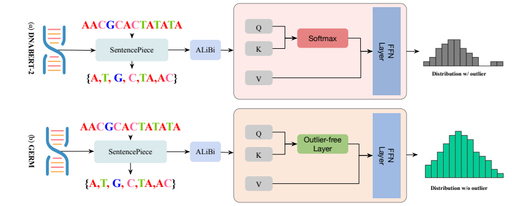
Figure 1 : Structural Comparison of DNABERT-2 and GERM Models. This diagram illustrates the differences in processing pipelines between DNABERT-2 andGERM. Both DNABERT-2 and GERM use the SciencePiece tokenizer with BPE for tokenization. Following that, both models employ ALiBi for positional encoding in the embedding layer. However, as shown in (a), DNABERT-2’s transformer architecture outputs the outliers. We propose replacing the vanilla Softmaxwith an outlier-free layer. In (b), the output of the attention mechanism removes outliers from the original output.
원문 · CC BY 4.0 · Haozheng Luo, Chenghao Qiu, Maojiang Su, Zhihan Zhou, Zoe Mehta, Guo Ye, Jerry Yao-Chieh Hu, Han Liu · Fast and Low-Cost Genomic Foundation Models via Outlier Removal · 원문 그림 인용 · 원본 PDF 2쪽에서 그림 영역을 추출했습니다.처음부터 재학습하지 않는 GERM-T
GERM-T는 처음부터 다시 학습하는 비용을 줄이기 위한 절충형 전략입니다. DNABERT-2 구조로 초기 학습한 체크포인트에서 시작해, 아웃라이어 제거 구조로 작은 단계의 지속 학습을 이어 갑니다. 논문의 대표 설정은 40K 지속 학습 단계이며, 이 모델은 완전한 재학습보다 효과가 작을 수 있다고 저자들이 밝힙니다.
저랭크 적응 실험의 비교 구조
저랭크 적응 실험은 DNABERT-2, GERM, GERM-T를 Full fine-tuning, LoRA, QLoRA, LoftQ 설정에서 비교합니다. QLoRA와 LoftQ는 4비트 양자화를 사용합니다. 원문은 LoRA rank 128과 alpha 256을 본문에 쓰고, 부록의 하이퍼파라미터 설명에는 rank 8과 alpha 16이 나타나므로 두 설정을 구분해서 읽어야 합니다. 평가 지표는 MCC이며 평균 성능 감소와 아웃라이어 지표를 함께 보고합니다.
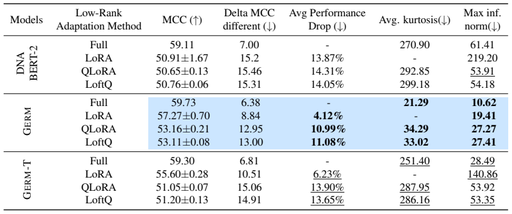
Table 2 : Comparing GERM and GERM -T with DNABERT-2 in a Low-Rank Adaptation Setting. We perform experiments on GERM with baseline models across three Low-Rank Adaptation methods (LoRA, QLoRA, LoftQ). The evaluation metrics include the Matthews Correlation Coefficient (MCC), the Delta MCC performance difference relative to the official DNABERT-2 checkpoint, the average kurtosis, and the maximum infinity norm ∥x∥∞ for outlier values. Additionally, we measure the average performance drop after low-rank adaptation to evaluate the efficiency of GERM in this setting. The best results are highlighted in bold, while the second-best results are underlined. In most configurations, GERM demonstrates superior fine-tuning performance compared to DNABERT-2. The GERM demonstrates an average performance improvement of 37.98% compared to the DNABERT-2 model.
원문 · CC BY 4.0 · Haozheng Luo, Chenghao Qiu, Maojiang Su, Zhihan Zhou, Zoe Mehta, Guo Ye, Jerry Yao-Chieh Hu, Han Liu · Fast and Low-Cost Genomic Foundation Models via Outlier Removal · 원문 그림 인용 · 원본 PDF 6쪽에서 그림 영역을 추출했습니다.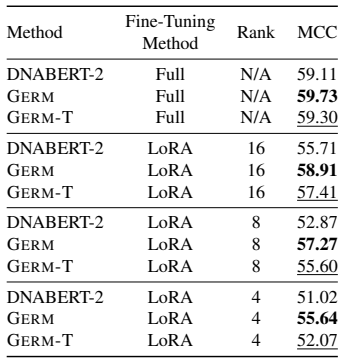
Table 7 : Comparison of Different Ranks Using LoRA. We conduct experiments to evaluate how different ranks affect the performance of LoRA. The evaluation metric used is Matthews Correlation Coefficient (MCC). We measure the average performance decline following low-rank adaptation, with best results highlighted in bold.
원문 · CC BY 4.0 · Haozheng Luo, Chenghao Qiu, Maojiang Su, Zhihan Zhou, Zoe Mehta, Guo Ye, Jerry Yao-Chieh Hu, Han Liu · Fast and Low-Cost Genomic Foundation Models via Outlier Removal · 원문 그림 인용 · 원본 PDF 19쪽에서 그림 영역을 추출했습니다.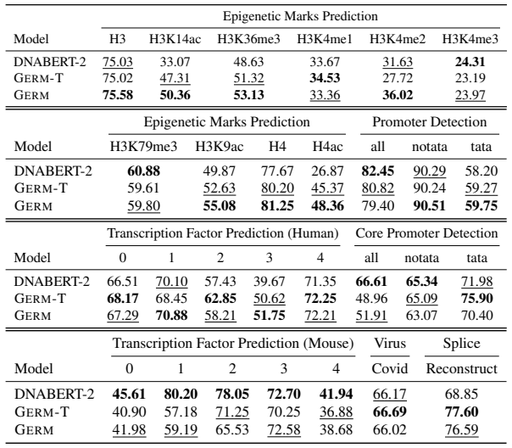
Table 8 : Performance Comparison of Full Fine-tuning with DNABERT-2. This table shows the performance of all models on the full fine-tuning task.
원문 · CC BY 4.0 · Haozheng Luo, Chenghao Qiu, Maojiang Su, Zhihan Zhou, Zoe Mehta, Guo Ye, Jerry Yao-Chieh Hu, Han Liu · Fast and Low-Cost Genomic Foundation Models via Outlier Removal · 원문 그림 인용 · 원본 PDF 20쪽에서 그림 영역을 추출했습니다.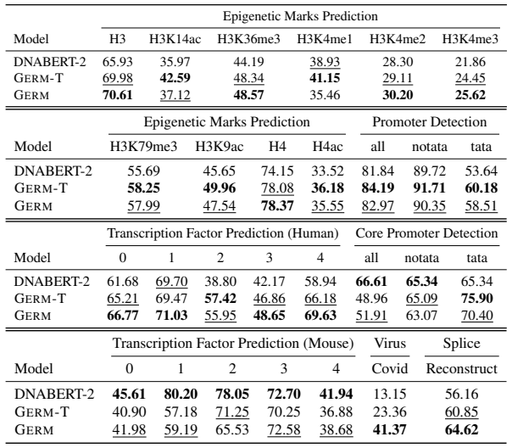
Table 9 : Performance Comparison of LoRA with DNABERT-2.This table shows the performance of all models on the low-rank adaptation (LoRA) task.
원문 · CC BY 4.0 · Haozheng Luo, Chenghao Qiu, Maojiang Su, Zhihan Zhou, Zoe Mehta, Guo Ye, Jerry Yao-Chieh Hu, Han Liu · Fast and Low-Cost Genomic Foundation Models via Outlier Removal · 원문 그림 인용 · 원본 PDF 21쪽에서 그림 영역을 추출했습니다.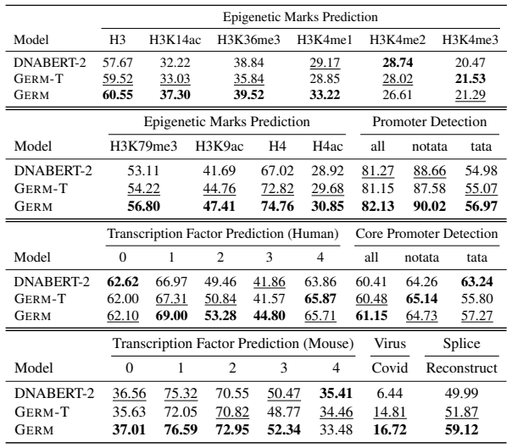
Table 10 : Performance Comparison of QLoRA with DNABERT-2.This table shows the performance of all models on the QLoRa task.
원문 · CC BY 4.0 · Haozheng Luo, Chenghao Qiu, Maojiang Su, Zhihan Zhou, Zoe Mehta, Guo Ye, Jerry Yao-Chieh Hu, Han Liu · Fast and Low-Cost Genomic Foundation Models via Outlier Removal · 원문 그림 인용 · 원본 PDF 22쪽에서 그림 영역을 추출했습니다.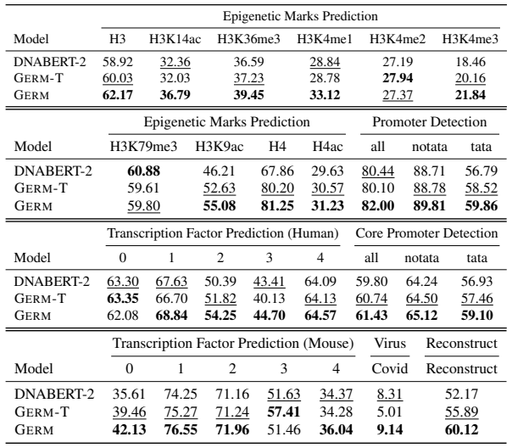
Table 11 : Performance Comparison of LoftQ with DNABERT-2. This table shows the performance of all models on the LoftQ task.
원문 · CC BY 4.0 · Haozheng Luo, Chenghao Qiu, Maojiang Su, Zhihan Zhou, Zoe Mehta, Guo Ye, Jerry Yao-Chieh Hu, Han Liu · Fast and Low-Cost Genomic Foundation Models via Outlier Removal · 원문 그림 인용 · 원본 PDF 23쪽에서 그림 영역을 추출했습니다.사후 양자화 결과와 적용 범위
사후 양자화 실험에서 GERM은 SmoothQuant 기반 W8A8 설정에서 평균 성능 감소를 4.82%로 보고합니다. 같은 실험에서 GERM-T는 8비트와 6비트 수준에서 작은 성능 하락을 보이지만, 4비트 W4A4에서는 GERM보다 큰 아웃라이어 때문에 뚜렷한 성능 저하가 나타납니다. 아웃라이어 지표로는 27개 데이터셋 평균에서 GERM의 평균 첨도가 약 92.14%, 최대 무한대 노름이 약 82.77% 줄었다고 보고됩니다.
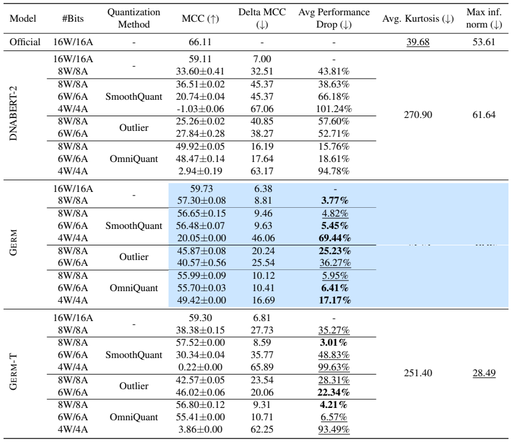
Table 1 : Comparing GERM and GERM -T with DNABERT-2 in a Post-Training Quantisation (PTQ) setting. We perform experiments on GERM with baseline models using four quantization methods (Traditional W8A8, SmoothQuant, Outlier Suppression, OmniQuant) across three quantization configurations (Weight-8bit-Activation-8bit (W8A8), Weight-6bit-Activation-6bit (W6A6), and Weight-4bit-Activation-4bit (W4A4)). The evaluation metrics include the Matthews Correlation Coefficient (MCC), the difference in MCC (Delta MCC) compared to the official DNABERT-2 checkpoint, theaverage kurtosis, and the maximum infinity norm ∥x∥∞ for outlier values at FP16. The best results are highlighted in bold, while the second-best results are underlined. In most configurations, GERM demonstrates superior fine-tuning performance compared to DNABERT-2.
원문 · CC BY 4.0 · Haozheng Luo, Chenghao Qiu, Maojiang Su, Zhihan Zhou, Zoe Mehta, Guo Ye, Jerry Yao-Chieh Hu, Han Liu · Fast and Low-Cost Genomic Foundation Models via Outlier Removal · 원문 그림 인용 · 원본 PDF 5쪽에서 그림 영역을 추출했습니다.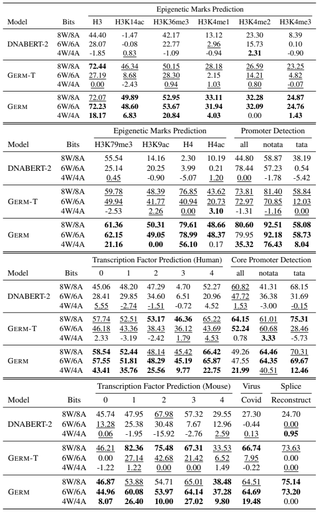
Table 13 : Performance Comparison of SmoothQuant with DNABERT-2.This table shows the performance of all models on the SmoothQuant.
원문 · CC BY 4.0 · Haozheng Luo, Chenghao Qiu, Maojiang Su, Zhihan Zhou, Zoe Mehta, Guo Ye, Jerry Yao-Chieh Hu, Han Liu · Fast and Low-Cost Genomic Foundation Models via Outlier Removal · 원문 그림 인용 · 원본 PDF 25쪽에서 그림 영역을 추출했습니다.지속 학습 단계와 자원 비용
지속 학습 단계 실험은 20K, 40K, 100K 단계를 비교하며, 전체 학습은 200K 단계입니다. 8비트 양자화에서는 Out100k와 GERM-T가 GERM보다 나은 성능 하락을 보인다고 원문은 보고합니다. 저자들은 40K 단계가 양자화와 저랭크 적응의 균형에서 적합하다고 해석합니다. 자원 제약 실험에서는 단일 RTX 2080 Ti GPU에서 DNABERT를 약 5분 만에 미세 조정할 수 있다고 보고하며, 에폭당 학습 시간과 양자화 지연이 DNABERT-2보다 짧다고 밝힙니다.
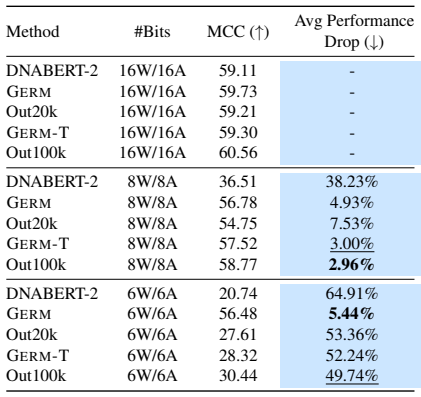
Table 3 : Quantization Robustness Performance Comparison with Different Continual Learning Steps. We evaluate the quan- tization robustness of different models, using SmoothQuant at 16-bit, 8-bit, and 6-bit quantization levels. The evaluation metric is the Matthews Correlation Coefficient (MCC) with the average per- formance drop following quantization also noted. The best results are highlighted in bold, and the second-best results are underlined.
원문 · CC BY 4.0 · Haozheng Luo, Chenghao Qiu, Maojiang Su, Zhihan Zhou, Zoe Mehta, Guo Ye, Jerry Yao-Chieh Hu, Han Liu · Fast and Low-Cost Genomic Foundation Models via Outlier Removal · 원문 그림 인용 · 원본 PDF 7쪽에서 그림 영역을 추출했습니다.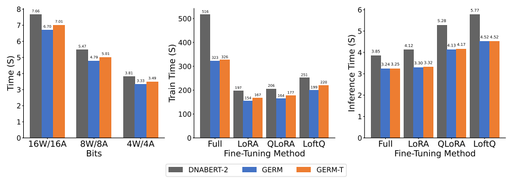
Figure 2 : Comparison of Performance in Resource-Constrained Computing Environments. Comparison of three models on the quantization and fine-tuning task. All models were trained on the same computing infrastructure (Nvidia GeForce RTX 2080 TI 11GB) for fair comparison. The training time represents the average time per epoch, with OmniQuant used as quantization example in this figure.
원문 · CC BY 4.0 · Haozheng Luo, Chenghao Qiu, Maojiang Su, Zhihan Zhou, Zoe Mehta, Guo Ye, Jerry Yao-Chieh Hu, Han Liu · Fast and Low-Cost Genomic Foundation Models via Outlier Removal · 원문 그림 인용 · 원본 PDF 8쪽에서 그림 영역을 추출했습니다.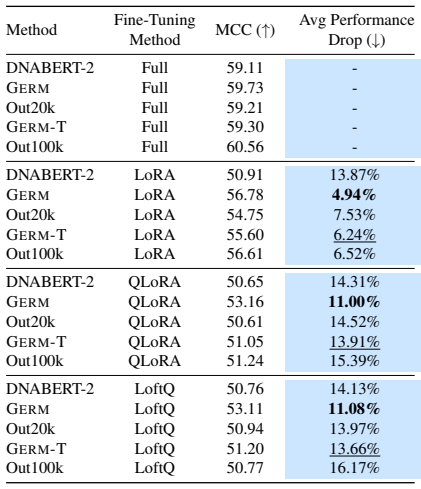
Table 4 : Low-Rank Adaptation Performance Comparison with Different Continual Learning Steps. We evaluate the low- rank adaptation performance (LoRA, QLoRA, LoftQ) for various models with different continual learning steps. The evaluation metric is the Matthews Correlation Coefficient (MCC), and the average performance drop after adaptation is also shown. The best results are highlighted in bold, and the second-best results are underlined.
원문 · CC BY 4.0 · Haozheng Luo, Chenghao Qiu, Maojiang Su, Zhihan Zhou, Zoe Mehta, Guo Ye, Jerry Yao-Chieh Hu, Han Liu · Fast and Low-Cost Genomic Foundation Models via Outlier Removal · 원문 그림 인용 · 원본 PDF 9쪽에서 그림 영역을 추출했습니다.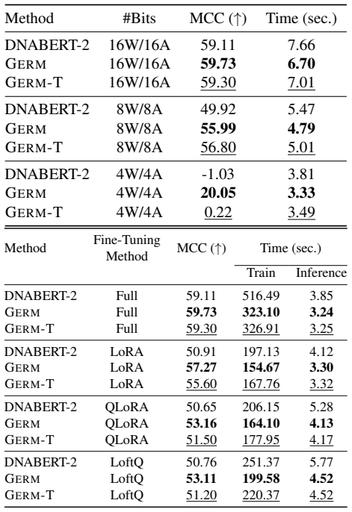
Table 16 : Comparison of Performance in Resource-Constrained Computing Environments. Comparison of three models on the quantization and fine-tuning task.
원문 · CC BY 4.0 · Haozheng Luo, Chenghao Qiu, Maojiang Su, Zhihan Zhou, Zoe Mehta, Guo Ye, Jerry Yao-Chieh Hu, Han Liu · Fast and Low-Cost Genomic Foundation Models via Outlier Removal · 원문 그림 인용 · 원본 PDF 28쪽에서 그림 영역을 추출했습니다.한계와 적용 범위
GERM-T는 4비트 양자화와 QLoRA, LoftQ 같은 저랭크 적응에서 큰 성능 저하를 보이며, 아웃라이어를 완전히 제거하지 못한다고 저자들이 밝힙니다. 이 결과는 DNABERT-2 기반 27개 데이터셋과 특정 실험 설정에서 얻은 것입니다. 논문은 처음부터 재학습 없이 아웃라이어를 제거하는 방법을 향후 과제로 남겨 둡니다.
논문 정보
- 저자
- Haozheng Luo, Chenghao Qiu, Maojiang Su, Zhihan Zhou, Zoe Mehta, Guo Ye, Jerry Yao-Chieh Hu, Han Liu
- 학회·저널
- arXiv · 프리프린트
- 최초 공개일
- 2025년 5월 1일
- 등록일
- 2026년 10월 29일
- 수정일
- 2025년 5월 2일
- 버전
- v2
- arXiv
- 2505.00598
- 분류
- cs.LG · cs.AI
- 원문 이용 조건
- CC BY 4.0
- 제공 범위
- 논문 정보, 해설, 허용된 원문 그림
AI 해설은 논문 원문과 별개의 설명이며 오류가 있을 수 있습니다. 원문과 그림은 각 출처의 이용 조건과 따로 표시된 권리를 따릅니다.
초록
To address the challenge of scarce computational resources in genomic modeling, we introduce GERM, a genomic foundation model with strong compression performance and fast adaptability. GERM improves upon models like DNABERT-2 by eliminating outliers that hinder low-rank adaptation and post-training quantization, enhancing both efficiency and robustness. We replace the vanilla attention layer with an outlier-free mechanism inspired by associative memory models. By removing outliers during both pre-training and fine-tuning, this approach accelerates adaptation, reduces computational costs, and enhances quantization robustness within acceptable loss margins. Additionally, we propose GERM-T, a strategy that employs small-step continual learning within the outlier-free framework, leveraging original checkpoints to avoid retraining from scratch. Empirically, GERM improves fine-tuning performance by 37.98% and quantization by 64.34% over the baseline model. It also reduces average kurtosis by 92.14% and maximum infinity norm by 82.77%. Compared to leading methods, GERM consistently delivers superior performance, offering a practical solution for genomic modeling in resource-constrained settings. Code is available at https://github.com/MAGICS-LAB/GERM.
원문 인용
Haozheng Luo, Chenghao Qiu, Maojiang Su, Zhihan Zhou, Zoe Mehta, Guo Ye, Jerry Yao-Chieh Hu, Han Liu (2025). Fast and Low-Cost Genomic Foundation Models via Outlier Removal. arXiv:2505.00598v2. https://arxiv.org/abs/2505.00598v2
BibTeX
@misc{luo2025fast,
  title = {{Fast and Low-Cost Genomic Foundation Models via Outlier Removal}},
  author = {Haozheng Luo and Chenghao Qiu and Maojiang Su and Zhihan Zhou and Zoe Mehta and Guo Ye and Jerry Yao-Chieh Hu and Han Liu},
  year = {2025},
  eprint = {2505.00598},
  archivePrefix = {arXiv},
  url = {https://arxiv.org/abs/2505.00598v2}
}