논문 해설
Joint Modeling of Conditional Mean and Variability in Multilevel Functional Data: Application to Postprandial Glucose Trajectories in the AEGIS Study
다수준 함수형 데이터에서 조건부 평균과 변동성의 결합 모델링: AEGIS 연구의 식후 혈당 궤적에 대한 적용
- 연구 문제 다층 함수형 자료에서 평균뿐 아니라 시간에 따라 변하는 조건부 변동성을 함께 모형화하는 방법이 부족합니다.
- 연구 방법 공변량과 참가자 무작위 함수가 평균과 로그 잔차 표준편차에 함께 작용하는 기능적 혼합효과 위치-척도 모형을 세 단계로 추정합니다.
- 주요 결과 AEGIS 자료에서 탄수화물, 식사 유형, 식전 혈당이 평균과 변동성에 시간 의존적 연관성을 보였고, 개인 R2 중앙값은 0.477에서 참가자 효과 포함 시 0.548이었습니다.
연구 문제와 기존 접근의 한계
다층 함수형 자료에서는 기존 다층 함수형 회귀가 주로 조건부 평균을 모형화해 왔고, 조건부 변동성은 상대적으로 적게 다뤄졌습니다. 연속혈당측정처럼 고빈도로 기록되는 생체 신호에서는 평균 궤적이 같더라도 시간에 따라 변하는 변동성이 다를 수 있습니다. 이 논문은 이 공백을 메우기 위해 조건부 평균과 조건부 분산을 참가자별 무작위 함수와 함께 동시에 모형화하는 방법을 다룹니다. 스칼라 반복 측정용 혼합효과 위치-척도 모형은 이미 있지만, 함수형 궤적의 구조를 직접 다루지 못한다는 점이 출발점입니다.
기능적 혼합효과 위치-척도 모형과 세 단계 추정
모형은 관측 궤적 Yij(t)를 공변량 기반 평균 Xij⊤β(t)와 참가자 무작위 효과 ui(t)의 합으로 두고, 잔차 표준편차를 exp{Xij⊤γ(t)+vi(t)}로 둡니다. 따라서 공변량과 참가자 효과가 평균과 로그 잔차 표준편차에 함께 작용합니다. 추정은 먼저 평균 모형을 점수별 REML 혼합모형으로 적합합니다. 다음으로 평균 예측에 쓰이지 않은 교차적합 잔차의 제곱을 로그 연결 Gamma 회귀로 모형화하여 초기 척도 계수를 얻습니다. 그러나 교차적합 잔차에는 참가자 평균의 예측 오차 분산 ψij(t)가 포함되므로, 이 성분을 제거하는 조건부 재적합을 세 번 수행해 공변량 기울기를 보정합니다. 보정된 기울기에 대해서는 별도의 레벨 적합으로 참가자 평균 잔차 분산 ¯q(x,t)의 수준을 추정합니다.
추정 대상: 참가자 평균 잔차 분산
이 논문의 핵심 추정 대상은 공변량 프로파일 x에서의 기준 평균 m(x,t)=x⊤β(t)와 참가자 평균 잔차 분산 ¯q(x,t)입니다. ¯q(x,t)는 같은 공변량을 가진 참가자들에 대해 평균한 제곱 잔차 분산으로, 참가자 평균 궤적 주변의 궤적 내 변동을 나타냅니다. 원문은 총 조건부 분산이 참가자 간 분산과 이 잔차 분산의 합으로 분해된다고 정리합니다. 척도 모형의 절편은 참가자 효과의 평균 항에 따라 달라지므로, 저자들은 전체 변동 수준을 절편이 아니라 ¯q(x,·)로 보고합니다.
참가자 부트스트랩과 검증 범위
불확실성은 참가자를 복원추출하는 부트스트랩으로 계산합니다. 각 반복에서 평균 적합, 교차적합, Gamma 벌점 선택, S번의 재적합, 레벨 적합까지 모든 단계를 다시 수행하므로 이 단계들이 더하는 변동성이 부트스트랩 분포에 포함됩니다. 점별 구간과 동시 신뢰대역을 함께 보고하며, 동시 대역은 한 곡선 안의 전체 시간 범위에 대한 보정입니다. 사례 분석의 계수 곡선 검정은 Benjamini–Hochberg 절차로 조정되며, 결과는 500회 부트스트랩 반복을 기준으로 합니다.
AEGIS 자료와 분석 설정
AEGIS 연구에서 363명의 참가자와 5,237건의 식사가 분석되었습니다. 각 식사에 대해 식후 180분 동안 5분 간격의 혈당 궤적이 쓰였고, 연령, BMI, HbA1c, 성별, 칼로리, 탄수화물, 식사 유형, 식전 혈당이 공변량으로 포함되었습니다. 식사 유형에 따라 탄수화물 효과가 다르게 나타나도록 탄수화물과 식사 유형의 상호작용 항이 들어갔습니다. 평균 기저는 8개, 척도 기저는 6개를 사용했고, 식사 단위 교차적합은 15개 폴드, 조건부 재적합은 3회로 설정되었습니다.
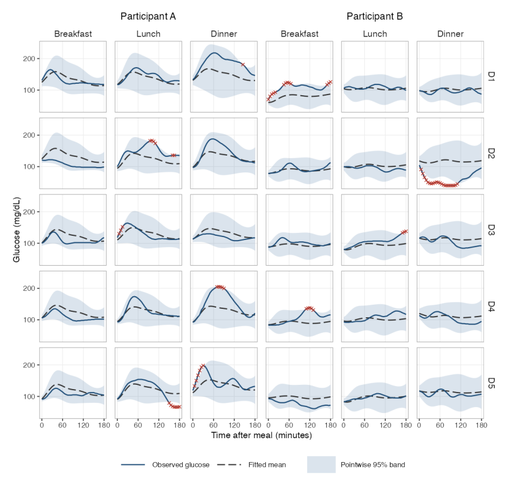
Figure 1 :Postprandial glucose trajectories of two AEGIS participants after breakfast, lunch and dinner on five study days (D1–D5), on a five-minute grid from the start of each meal. Solid lines are the observed glucose and dashed lines the participant’s fitted mean for that meal. Shading is an approximate pointwise 95% prediction band with asymptotic approximation, the fitted mean±1.96 times the fitted residual standard deviation; crosses mark observations outside it.
원문 · CC BY 4.0 · Yang Xiao, Francisco Gude, Marcos Matabuena · Joint Modeling of Conditional Mean and Variability in Multilevel Functional Data: Application to Postprandial Glucose Trajectories in the AEGIS Study · 원문 그림 인용 · 원본 PDF 3쪽에서 그림 영역을 추출했습니다.공변량 연관성과 개인 R2
탄수화물은 세 식사 모두에서 평균 혈당과 잔차 표준편차를 높이는 방향으로 나타났습니다. 식사 유형 간 차이는 주로 저녁과 관련된 대비에서 100분 이후에 나타났습니다. 식전 혈당은 평균과 관련이 있었고, HbA1c는 평균에서는 170~180분에서만 BH 보정 후 유의했으며 잔차 표준편차와의 연관은 보정 후 유의하지 않았습니다. 참가자별 개인 R2는 기준 평균에서 중앙값 0.477, 참가자 평균 효과를 포함하면 0.548이었고, 이 지표는 실제 예측 성능 지표가 아니라고 원문이 밝힙니다.
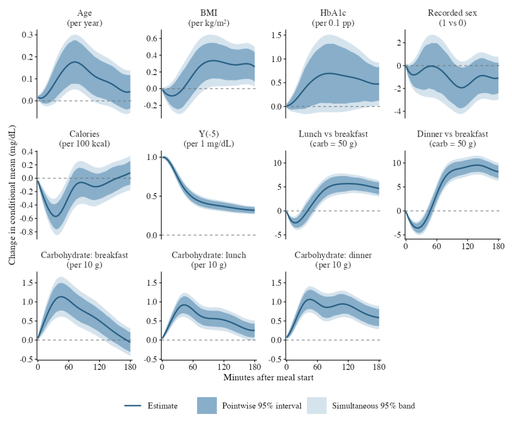
Figure 2 :Mean-glucose associations over postmeal time and meal type. Panels show 11 conditional-mean coefficient effects in mg/dL, with covariate increments in the labels. Dark shading shows pointwise nominal 95% intervals and light shading simultaneous bands from 500 participant-bootstrap refits. Meal contrasts compare lunch and dinner with breakfast at 50 g carbohydrate; female (sex coded 0) is the recorded-sex reference. Calories and carbohydrate adjust for each other. The three carbohydrate panels share a vertical scale, as do the two meal-contrast panels.
원문 · CC BY 4.0 · Yang Xiao, Francisco Gude, Marcos Matabuena · Joint Modeling of Conditional Mean and Variability in Multilevel Functional Data: Application to Postprandial Glucose Trajectories in the AEGIS Study · 원문 그림 인용 · 원본 PDF 12쪽에서 그림 영역을 추출했습니다.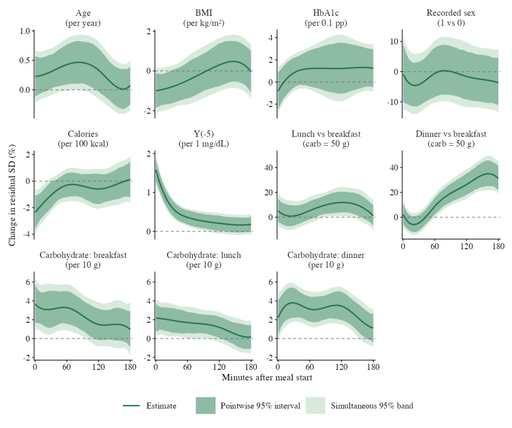
Figure 3 :Residual-SD associations over postmeal time. Effects are displayed as 100 {exp(daγa(t))−1} percent change in residual SD, with increments da in the panel labels; effects and band limits are calculated on the log-SD scale before transformation. Dark and light shading show pointwise nominal 95% intervals and simultaneous bands from 500 participant-bootstrap refits. Meal contrasts use breakfast at 50 g carbohydrate, and female (sex coded 0) is the recorded-sex reference. The three carbohydrate panels share a vertical scale, as do the two meal contrasts; each simultaneous band covers one coefficient curve.
원문 · CC BY 4.0 · Yang Xiao, Francisco Gude, Marcos Matabuena · Joint Modeling of Conditional Mean and Variability in Multilevel Functional Data: Application to Postprandial Glucose Trajectories in the AEGIS Study · 원문 그림 인용 · 원본 PDF 13쪽에서 그림 영역을 추출했습니다.해석 조건과 한계
해석은 참가자 효과가 공변량과 관측 궤적 수로부터 독립이라는 조건 C3에 의존합니다. 식전 혈당은 참가자 효과와 연관될 수 있어 이 조건이 제한적일 수 있으며, 그 경우 연관성 일부가 참가자 간 차이를 반영할 수 있습니다. 잔차 변동은 생리적 변동 외에도 센서 오차, 식사 구성 미기록, 탄수화물 섭취 부정확성 등 여러 원인을 포함할 수 있습니다. 신뢰대역도 평활화나 투영 편향을 보정하지 않습니다.
논문 정보
- 저자
- Yang Xiao, Francisco Gude, Marcos Matabuena
- 학회·저널
- arXiv · 프리프린트
- 최초 공개일
- 2026년 11월 5일
- 등록일
- 2026년 11월 6일
- 수정일
- 2026년 11월 5일
- 버전
- v1
- arXiv
- 2611.07937
- 분류
- stat.ML · cs.LG · stat.AP · stat.ME
- 원문 이용 조건
- CC BY 4.0
- 제공 범위
- 논문 정보, 해설, 허용된 원문 그림
AI 해설은 논문 원문과 별개의 설명이며 오류가 있을 수 있습니다. 원문과 그림은 각 출처의 이용 조건과 따로 표시된 권리를 따릅니다.
초록
Functional data analysis provides a framework for studying time-varying associations between covariates and high-frequency biological signals. In digital health, participants often contribute repeated functional trajectories, yet existing multilevel regression methods largely focus on the conditional mean, overlooking variability and its role in biological heterogeneity. We propose a heteroskedastic functional mixed-effects regression framework that jointly models the conditional mean and variance of repeated trajectories, with participant-specific random effects in both components. We also develop a participant-level bootstrap to quantify uncertainty in estimated functional parameters. We apply the method to postprandial glucose trajectories from the AEGIS study. Premeal glucose, carbohydrate intake, and meal type show distinct time-dependent associations with glucose variability, whereas HbA1c is more strongly associated with the conditional mean than with variability. Substantial between-participant differences in residual variability remain even after accounting for observed covariates. These findings show that modeling conditional variability alongside the mean provides insights into glucose regulation and individual heterogeneity that mean-focused analyses may miss. More broadly, the proposed framework enables joint characterization of average responses, variability, and participant-specific heterogeneity in repeated biological signals.
원문 인용
Yang Xiao, Francisco Gude, Marcos Matabuena (2026). Joint Modeling of Conditional Mean and Variability in Multilevel Functional Data: Application to Postprandial Glucose Trajectories in the AEGIS Study. arXiv:2611.07937v1. https://arxiv.org/abs/2611.07937v1
BibTeX
@misc{xiao2026joint,
  title = {{Joint Modeling of Conditional Mean and Variability in Multilevel Functional Data: Application to Postprandial Glucose Trajectories in the AEGIS Study}},
  author = {Yang Xiao and Francisco Gude and Marcos Matabuena},
  year = {2026},
  eprint = {2611.07937},
  archivePrefix = {arXiv},
  url = {https://arxiv.org/abs/2611.07937v1}
}