논문 해설
Confounder-Free Continual Learning via Recursive Feature Normalization
재귀적 특징 정규화를 통한 교란 변수 없는 지속 학습
- 연구 문제 연속 학습에서 시간에 따라 변하는 교란변수의 영향을 중간 특징에서 제거하는 문제입니다.
- 연구 방법 재귀 최소제곱으로 교란변수 회귀 상태를 예시 단위로 갱신하고 잔차 특징을 전달하는 R-MDN 계층을 제안합니다.
- 주요 결과 합성 연속 학습과 의료 영상 실험에서 R-MDN은 교란 상관과 이전 단계 성능 지표에서 비교 기준보다 낮은 값을 보고합니다.
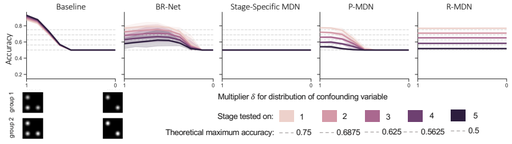
Figure 3 . Effects of the presence of the confounder for task generalization. After training the different methods on data with confounders, we evaluate them on test data with varying intensities of the confounder, from 1 (completely present) to 0 (completely absent). R-MDN does not get influenced by the change in confounder distribution during inference as it maintains its prediction accuracy (i.e., the lines are straight). This shows that it does not “cheat” by looking at the confounder and instead learns task-relevant features.
원문 · CC BY 4.0 · Yash Shah, Camila Gonzalez, Mohammad H. Abbasi, Qingyu Zhao, Kilian M. Pohl, Ehsan Adeli · Confounder-Free Continual Learning via Recursive Feature Normalization · 원문 그림 인용 · 원본 PDF 5쪽에서 그림 영역을 추출했습니다.연속 학습에서 교란변수 문제
연속 학습에서는 데이터가 시간에 따라 순차적으로 도착하며, 단계마다 교란변수의 분포가 달라질 수 있습니다. 교란변수는 입력과 목표에 함께 영향을 주어 허위 상관을 만들고 모델의 예측을 편향시킵니다. 기존의 MDN은 학습 전에 전체 데이터에 대한 배치 수준 통계와 공분산 정보를 계산해야 하므로, 데이터가 순차적으로 들어오는 상황과 비전 트랜스포머처럼 예시 단위로 병렬 계산하는 구조에 적용하기 어렵습니다. 이 논문은 이러한 제약 아래에서 중간 특징 표현에서 교란변수의 영향을 제거하는 방법을 다룹니다.
재귀 최소제곱 기반 R-MDN 계층
R-MDN은 중간 특징 z를 교란변수 행렬 X로 회귀하고, 설명되는 성분을 뺀 잔차 r을 다음 계층으로 전달하는 정규화 계층입니다. 기존 OLS 해 β = R(N)^{-1}Q(N)에서 출발하여, 새 예시가 들어올 때마다 Sherman-Morrison 랭크-1 갱신으로 역행렬을 효율적으로 갱신합니다. 이때 Q(N)은 특징이 학습 중 바뀌기 때문에 다시 계산하지 않고 추정값으로 취급합니다. 역공분산 행렬은 ϵI로 초기화하며, 미니배치에서는 Sherman-Morrison-Woodbury 형태를 사용합니다. 학습 안정화를 위해 P(N+B)에 정규화항 λI를 더합니다.
합성 연속 학습 실험
합성 데이터셋에서는 5단계의 데이터가 순차적으로 도착하며, 교란변수 분포, 주효과 분포, 두 분포가 함께 바뀌는 세 가지 설정을 비교합니다. 평가에는 ACCd, BWTd, FWTd를 사용하며, 세 지표는 이론적 최대 정확도와의 차이로 정의되어 값이 작을수록 좋습니다. 데이터셋 1에서 R-MDN은 ACCd 0.02 ± 0.01, BWTd 0.15 ± 0.14, FWTd 0.02 ± 0.01을 보고합니다. ViT 백본을 사용한 데이터셋 3 실험에서는 R-MDN의 ACCd가 0.061 ± 0.013으로 ViT Baseline의 0.110 ± 0.027보다 낮습니다.
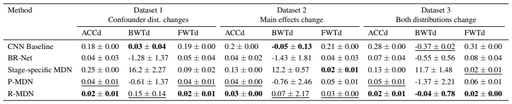
Table 1 . Quantifying metrics for the synthetic dataset in continual learning. ACCd, BWTd (×10−2), and FWTd mean and standard deviation for different methods and datasets. A total of 5 runs were performed with different model initialization seeds. We compare against prior works—BR-Net (Adeli et al., 2020a), MDN (Lu et al., 2021), and P-MDN (Vento et al., 2022). MDN, a CNN was trained separately on each training stage and then evaluated against all stages. Best results in bold, second-to-best, underlined.
원문 · CC BY 4.0 · Yash Shah, Camila Gonzalez, Mohammad H. Abbasi, Qingyu Zhao, Kilian M. Pohl, Ehsan Adeli · Confounder-Free Continual Learning via Recursive Feature Normalization · 원문 그림 인용 · 원본 PDF 5쪽에서 그림 영역을 추출했습니다.
Table 2 . Training a 2D vision transformer on synthetic continual data. The setup is the same as in Section 4.1. We use dataset 3—where the distributions of both the confounder and main effects change. Results are averaged over 5 runs of random model initialization seeds.
원문 · CC BY 4.0 · Yash Shah, Camila Gonzalez, Mohammad H. Abbasi, Qingyu Zhao, Kilian M. Pohl, Ehsan Adeli · Confounder-Free Continual Learning via Recursive Feature Normalization · 원문 그림 인용 · 원본 PDF 6쪽에서 그림 영역을 추출했습니다.의료 영상 실험과 비교 범위
HAM10000 피부 병변 분류에서는 나이를 교란변수로 두고 다섯 단계로 나눈 데이터를 사용합니다. ADNI 진단 분류에서는 3D ViT를 사용하며 AD, MCI, CN 집단별 dcor2를 비교합니다. R-MDN(C)의 dcor2 (AD)는 0.09 ± 0.07이고 ViT Baseline은 0.25 ± 0.22입니다. ABCD 정적 학습 실험은 PDS를 교란변수로 두고 이진 성별 분류를 수행합니다. 이 실험에서 CNN Baseline의 정확도는 86.86 ± 0.354이고 R-MDN은 85.08 ± 0.591입니다. 여아의 dcor2는 0.0218 ± 0.0029에서 0.0090 ± 0.0027로 낮아집니다.
이 결과는 각 데이터셋과 백본에서 얻은 것이며, 다른 의료 자료나 다른 모델로 일반화되었다는 근거는 아닙니다.
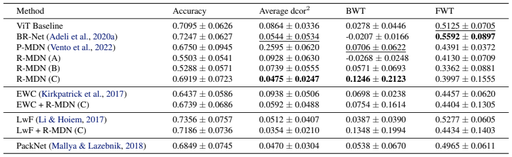
Table 4 . HAM10K skin lesion classification results for continual learning. Results shown as the mean and standard deviation over test sets of different stages of training for the model after being trained on the last training stage. Best and second-to-best results shown in bold and underlined respectively. Our metrics of interest are dcor2, BWT, and FWT. A higher accuracy in our case does not equate to a better model as it might be “cheating” by looking at the confounder for prediction.
원문 · CC BY 4.0 · Yash Shah, Camila Gonzalez, Mohammad H. Abbasi, Qingyu Zhao, Kilian M. Pohl, Ehsan Adeli · Confounder-Free Continual Learning via Recursive Feature Normalization · 원문 그림 인용 · 원본 PDF 7쪽에서 그림 영역을 추출했습니다.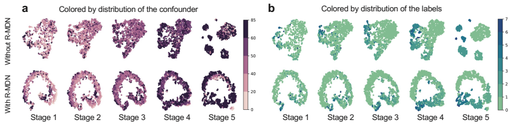
Figure 4 . Visualizing learned features for HAM10K skin lesion classification. t-SNE representation of the learned features after training a model with and without R-MDN on all stages of continual learning. Without R-MDN, the model drives fine-grained separation of feature clusters based on category labels, especially for stage 5, which roughly overlap with confounder distributions for that training stage. By looking at the confounder for fine-grained discrimination, the baseline fails to generalize to previous data. R-MDN, on the other hand, does not seem to be using confounder information to drive fine-grained feature separation, leading to better backward transfer.
원문 · CC BY 4.0 · Yash Shah, Camila Gonzalez, Mohammad H. Abbasi, Qingyu Zhao, Kilian M. Pohl, Ehsan Adeli · Confounder-Free Continual Learning via Recursive Feature Normalization · 원문 그림 인용 · 원본 PDF 7쪽에서 그림 영역을 추출했습니다.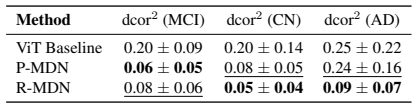
Table 5 . ADNI diagnostic classification for continual learning. Average squared distance correlation after training on the last training stage for different groups across different methods (Baseline ViT, P-MDN (Vento et al., 2022), and R-MDN). Note that we do not train BR-Net as adversarial training does not scale well to more than one confounder (Zhao et al., 2020).
원문 · CC BY 4.0 · Yash Shah, Camila Gonzalez, Mohammad H. Abbasi, Qingyu Zhao, Kilian M. Pohl, Ehsan Adeli · Confounder-Free Continual Learning via Recursive Feature Normalization · 원문 그림 인용 · 원본 PDF 8쪽에서 그림 영역을 추출했습니다.
Table 6 . ABCD sex classification results for static learning. Accuracy, true positive (TPR) and negative rates (TNR), difference between TPR and TNR, and squared distance correlation for both boys and girls for different methods. Results are shown as the mean and standard deviation over 5 folds of 5-fold cross-validation, with data split by subject and site ID. Our metrics of interest are (TPR - TNR) and dcor2. A higher accuracy in our case does not equate to a better model as it might be “cheating” by looking at the confounder for prediction.
원문 · CC BY 4.0 · Yash Shah, Camila Gonzalez, Mohammad H. Abbasi, Qingyu Zhao, Kilian M. Pohl, Ehsan Adeli · Confounder-Free Continual Learning via Recursive Feature Normalization · 원문 그림 인용 · 원본 PDF 9쪽에서 그림 영역을 추출했습니다.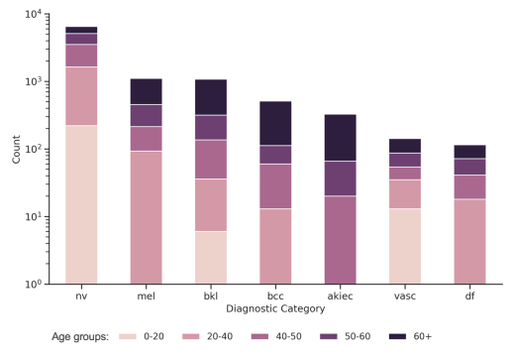
Figure 10 . Distribution of dermatoscopic images across different diagnostic categories for various age brackets in the HAM10000 dataset.
원문 · CC BY 4.0 · Yash Shah, Camila Gonzalez, Mohammad H. Abbasi, Qingyu Zhao, Kilian M. Pohl, Ehsan Adeli · Confounder-Free Continual Learning via Recursive Feature Normalization · 원문 그림 인용 · 원본 PDF 19쪽에서 그림 영역을 추출했습니다.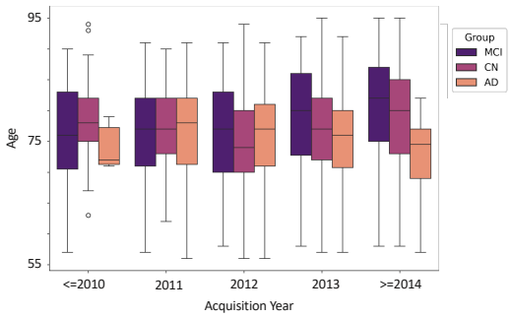
Figure 11 . Distribution of age across different participant groups in the ADNI dataset.
원문 · CC BY 4.0 · Yash Shah, Camila Gonzalez, Mohammad H. Abbasi, Qingyu Zhao, Kilian M. Pohl, Ehsan Adeli · Confounder-Free Continual Learning via Recursive Feature Normalization · 원문 그림 인용 · 원본 PDF 20쪽에서 그림 영역을 추출했습니다.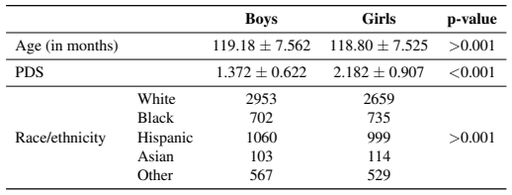
Table 10 . Variable distributions across boys and girls in the ABCD study . Mean and standard deviation for age and pubertal development scale (PDS), and the number of subjects of each race in the study across boys and girls. PDS is an integer between 1-5. Differences are significant across boys and girls for PDS (measured using a two-sample t-test) but not age or race. Girls have a higher PDS than boys in the study. All values are for the first visit of each subject.
원문 · CC BY 4.0 · Yash Shah, Camila Gonzalez, Mohammad H. Abbasi, Qingyu Zhao, Kilian M. Pohl, Ehsan Adeli · Confounder-Free Continual Learning via Recursive Feature Normalization · 원문 그림 인용 · 원본 PDF 21쪽에서 그림 영역을 추출했습니다.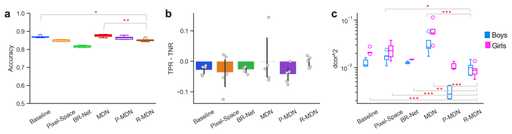
Figure 13 . Visualizing different metrics for the ABCD dataset. a. Accuracy, b. difference between True Positive Rate (TPR) and True Negative Rate (TNR), and c. dcor2 between learned features and PDS for boys and girls for different methods. Results shown over 5 folds of 5-fold cross validation, with data split by subject and site ID. Statistically significant differences between R-MDN and other methods are measured first using Kruskal-Wallis and then a post-hoc Conover’s test with Bonferroni adjustment.
원문 · CC BY 4.0 · Yash Shah, Camila Gonzalez, Mohammad H. Abbasi, Qingyu Zhao, Kilian M. Pohl, Ehsan Adeli · Confounder-Free Continual Learning via Recursive Feature Normalization · 원문 그림 인용 · 원본 PDF 25쪽에서 그림 영역을 추출했습니다.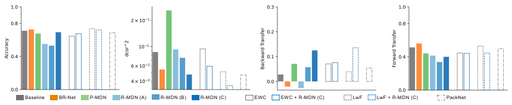
Figure 14 . Visualizing different metrics for HAM10K skin lesion classification. Accuracy, squared distance correlation, backward transfer, and forward transfer for different methods. Results are shown after training each model on the final training stage.
원문 · CC BY 4.0 · Yash Shah, Camila Gonzalez, Mohammad H. Abbasi, Qingyu Zhao, Kilian M. Pohl, Ehsan Adeli · Confounder-Free Continual Learning via Recursive Feature Normalization · 원문 그림 인용 · 원본 PDF 25쪽에서 그림 영역을 추출했습니다.한계와 향후 범위
P-MDN은 벌점 계수 γ를 조정하기 어렵고, proxy 목적함수 최적화가 실행 간 높은 분산을 보인다고 원문에 보고됩니다. R-MDN의 유도는 RLS 추정량이 데이터 수가 무한대로 갈 때 OLS 추정량과 일치한다는 선행 이론에 기대며, 이 논문은 초기화가 수렴을 빠르게 하는 것을 합성 데이터로 보여줍니다. 실험의 대부분은 의료 영상에 있으며, 비디오나 오디오 같은 다른 영역에 대한 적용은 향후 과제로 제시됩니다.
논문 정보
- 저자
- Yash Shah, Camila Gonzalez, Mohammad H. Abbasi, Qingyu Zhao, Kilian M. Pohl, Ehsan Adeli
- 학회·저널
- arXiv · 프리프린트
- 최초 공개일
- 2025년 7월 11일
- 등록일
- 2026년 10월 30일
- 수정일
- 2025년 8월 6일
- 버전
- v2
- arXiv
- 2507.09031
- 분류
- cs.LG · cs.CV
- 원문 이용 조건
- CC BY 4.0
- 제공 범위
- 논문 정보, 해설, 허용된 원문 그림
AI 해설은 논문 원문과 별개의 설명이며 오류가 있을 수 있습니다. 원문과 그림은 각 출처의 이용 조건과 따로 표시된 권리를 따릅니다.
초록
Confounders are extraneous variables that affect both the input and the target, resulting in spurious correlations and biased predictions. There are recent advances in dealing with or removing confounders in traditional models, such as metadata normalization (MDN), where the distribution of the learned features is adjusted based on the study confounders. However, in the context of continual learning, where a model learns continuously from new data over time without forgetting, learning feature representations that are invariant to confounders remains a significant challenge. To remove their influence from intermediate feature representations, we introduce the Recursive MDN (R-MDN) layer, which can be integrated into any deep learning architecture, including vision transformers, and at any model stage. R-MDN performs statistical regression via the recursive least squares algorithm to maintain and continually update an internal model state with respect to changing distributions of data and confounding variables. Our experiments demonstrate that R-MDN promotes equitable predictions across population groups, both within static learning and across different stages of continual learning, by reducing catastrophic forgetting caused by confounder effects changing over time.
원문 인용
Yash Shah, Camila Gonzalez, Mohammad H. Abbasi, Qingyu Zhao, Kilian M. Pohl, Ehsan Adeli (2025). Confounder-Free Continual Learning via Recursive Feature Normalization. arXiv:2507.09031v2. https://arxiv.org/abs/2507.09031v2
BibTeX
@misc{shah2025confounder,
  title = {{Confounder-Free Continual Learning via Recursive Feature Normalization}},
  author = {Yash Shah and Camila Gonzalez and Mohammad H. Abbasi and Qingyu Zhao and Kilian M. Pohl and Ehsan Adeli},
  year = {2025},
  eprint = {2507.09031},
  archivePrefix = {arXiv},
  url = {https://arxiv.org/abs/2507.09031v2}
}