논문 해설
D&A: Decoupling Description and Assessment Enables VLMs as Zero-Shot Robotic Reward Models
D&A: 설명과 평가의 분리로 VLM을 제로샷 로봇 보상 모델로 활용하기
- 연구 문제 VLM을 프롬프트만으로 로봇 영상의 진행도 보상 모델로 쓰면 실패 궤적에도 진행이 있다고 판단하는 확인 편향이 나타납니다.
- 연구 방법 D&A는 지시를 보지 않는 Describer가 영상을 텍스트로 설명하고, Assessor가 생성한 성공 기준에 설명을 대조해 시점별 보상을 계산하는 제로샷 방법입니다.
- 주요 결과 Gemini 3 Flash 기반 D&A는 D&A-Bench에서 Kendall τα 0.67을 기록해 post-training 기준선보다 높은 순위 일치도를 보입니다.
제로샷 보상 추정의 확인 편향 문제
VLM을 로봇 영상의 진행도 보상 모델로 바로 쓰면, 실패한 실행에서도 진행이 있었다고 판단하는 확인 편향이 나타납니다. 저자들은 이를 그림 1과 2의 사례로 보이며, 프롬프트만 바꾼 Naive VLM이 실패 궤적에 높은 보상을 주는 현상을 문제로 삼습니다. 기존 제로샷 방법인 GVL은 섞인 프레임의 순위를 매기고, TOPReward는 'True' 토큰의 로짓을 읽어 진행도를 얻습니다. 이 방식들도 성공 쪽으로 치우친다고 저자들은 보고합니다.
post-training 보상 모델인 RoboReward와 Robometer, SOLE-R1은 로봇 데이터를 새로 모아 모델마다 다시 학습해야 합니다. 이 논문은 fine-tuning 없이 프롬프트만으로 동작하는 방법이 이 두 문제를 함께 줄일 수 있는지 묻습니다.
Describer와 Assessor로 나눈 보상 계산
D&A는 보상 함수 R(o1:T, l)을 Describer D와 Assessor A의 합성으로 바꿉니다. Describer는 영상 o1:T만 보고 작업 지시 l 없이 궤적의 텍스트 설명 d1:T를 만듭니다. 지시를 보지 않게 하여 과제 가정이 설명에 섞이는 것을 막으려는 설계입니다. 실제 구현은 entity extractor가 과제 관련 및 무관 장면 개체를 나열하고, 그 개체에 접지된 describer가 궤적을 서술하는 두 단계입니다.
Assessor는 지시 l과 설명 d1:T를 받아 관찰 가능한 세계 상태로 기술된 성공 기준 c를 먼저 만듭니다. 그다음 각 시점의 설명을 c에 대조하여 r1:T ∈ [0,1]을 산출합니다. 이 두 작업은 한 번의 Assessor 호출 안에서 시스템 프롬프트로 수행됩니다. 실제 입력은 프레임을 H개로 줄인 뒤 보간해 T 길이로 되돌리는 방식입니다.
보상 외 언어 피드백 생성
Assessor에는 피드백 생성기 F가 추가됩니다. F는 지시 l과 설명 d1:T로부터 실패 분석과 교정 지시를 담은 텍스트 f를 출력합니다. 스칼라 보상만으로는 실패의 이유를 알기 어렵다는 점을 보완하려는 것입니다. 이 구성요소는 보상 산출과 병행되는 확장으로 설명되며, 뒤의 Code-as-Policies 실험에서 피드백이 사용됩니다.
온라인·오프라인 강화학습에서의 사용
온라인 RL에서는 D&A의 절대 진행 점수가 밀집 환경 보상으로 쓰입니다. 이 실험은 동결된 기반 정책의 잠재 공간에서 노이즈를 학습하는 DSRL로 구현되며, π0 정책을 DROID에서 미세조정한 모델에 적용됩니다. 과제 'put the fruit in the bowl'에서 기저 정책의 성공률은 10%이고, D&A 보상을 쓴 학습 뒤 성공률은 약 90분의 벽시계 시간 안에 100%에 도달한다고 보고됩니다.

Fig. 4 : Real-world RL Results. D&A improves real-world online (left) and offline reinforcement learning (middle, right) while other zero-shot and post-trained models struggle. Left: in the online setting, TOPReward fails to distinguish between success and failure, predicting high reward for both picking up the ice cream cone and the banana. Middle, right:Behavior cloning on suboptimal data hurts performance, while offline RL with D&A leads to a higher success rate and faster completion time. TOPReward and Robometer lack generalization and assign similar reward to optimal and suboptimal action chunks.
원문 · CC BY 4.0 · Marius Memmel, Shawn Yin, Urvi Rutia, Angad Wadhwa, Eldon Li, Gavin Angeloff, Ankit Goyal, Jesse Zhang, Dieter Fox, Fabio Ramos, Anqi Li, Abhishek Gupta · D&A: Decoupling Description and Assessment Enables VLMs as Zero-Shot Robotic Reward Models · 원문 그림 인용 · 원본 PDF 4쪽에서 그림 영역을 추출했습니다.오프라인 RL에서는 진행 점수를 잠재 함수로 보고 단계별 잠재 기반 보상의 차이를 만듭니다. 이 차이로 Monte Carlo 반환과 데이터셋 전체 평균을 기준선으로 한 이점을 계산합니다. 이 이점을 CFGRL 또는 RECAP 형태의 조건화에 사용합니다. 이 결과는 특정 로봇 과제와 모델 설정에서 얻은 것입니다.
궤적 순위 벤치마크의 결과
D&A-Bench에서 Gemini 3 Flash 기반 D&A는 Kendall τα 0.67을 기록합니다. 같은 벤치마크에서 post-training 모델인 Robometer는 0.56, RoboReward는 0.43입니다. 제로샷 TOPReward는 0.24, GVL은 0.27입니다. 같은 기반 모델의 Naive VLM 대비 D&A의 향상은 +0.23입니다.
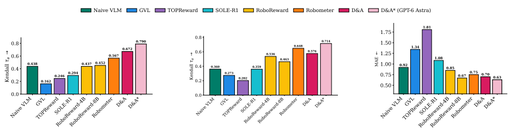
Fig. 5 :Results onD&A-Bench,RBM-EVAL-OOD[16], andRoboRewardBenchmark[15].D&A(Gemini 3 Flash) emerges as the strongest zero-shot method, outperforming (SOLE-R1) and matching the performance (Robometer/ RoboReward) of post-trained models. Scaling up the base model,D&A ∗ (GPT-6 Astra), tops every benchmark.
원문 · CC BY 4.0 · Marius Memmel, Shawn Yin, Urvi Rutia, Angad Wadhwa, Eldon Li, Gavin Angeloff, Ankit Goyal, Jesse Zhang, Dieter Fox, Fabio Ramos, Anqi Li, Abhishek Gupta · D&A: Decoupling Description and Assessment Enables VLMs as Zero-Shot Robotic Reward Models · 원문 그림 인용 · 원본 PDF 5쪽에서 그림 영역을 추출했습니다.이 결과는 D&A-Bench의 장면·언어 일반화에 대한 결과입니다. 저자들은 Naive VLM이 이 벤치마크에서 비교적 강한 기준선이었다고 설명합니다. 이 점수들은 각 비교군의 원문 보고 또는 저자 측정으로 구분해서 읽어야 합니다.
설계 요소의 절제 결과
RBM-EVAL-OOD에서 Gemini 3.7 Flash를 쓴 절제 실험은 성공 기준, 설명과 평가의 분리, 접지의 유무를 조합합니다. 명시적 성공 기준을 Naive VLM에 추가하면 Kendall τα가 +0.18 향상됩니다. 장면 개체에 접지한 설명을 쓰면 Naive VLM 대비 +0.26 향상됩니다.
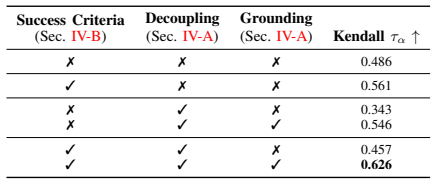
원문 그림 TABLE I:Ablations onRBM-EVAL-OOD.
원문 · CC BY 4.0 · Marius Memmel, Shawn Yin, Urvi Rutia, Angad Wadhwa, Eldon Li, Gavin Angeloff, Ankit Goyal, Jesse Zhang, Dieter Fox, Fabio Ramos, Anqi Li, Abhishek Gupta · D&A: Decoupling Description and Assessment Enables VLMs as Zero-Shot Robotic Reward Models · 원문 그림 인용 · 원본 PDF 8쪽에서 그림 영역을 추출했습니다.설명과 평가를 분리한 구성만 결합하면 해당 표에서 0.343으로 낮아집니다. 저자들은 이를 작업 관련 객체가 설명에서 빠지거나 식별되지 않기 때문으로 해석합니다. 따라서 분리 구조는 접지와 함께 쓸 때 효과를 내는 것으로 읽어야 합니다.
영상과 지시의 불일치 판별
영상-지시 혼동 행렬 평가에서 미확인 과제 영상과 미확인 지시의 모든 조합을 사용합니다. 보고 값은 열 정규화된 대각 평균입니다. 원문에 따르면 D&A는 불일치 쌍에 0 진행도를 주고 일치 쌍에 높은 보상을 줍니다. 저자들은 이 결과를 시각 상태가 비슷한 쌍에서의 판별 능력으로 해석합니다.
기반 VLM 규모에 따른 변화
규모 확장 실험에서 비용을 모델 능력의 대리 변수로 사용합니다. 기반 모델의 능력이 커질수록 D&A의 RBM-EVAL-OOD 순위 일치도도 함께 올라갑니다. GVL도 모델과 함께 나아지지만 기울기가 낮습니다. TOPReward와 RoboReward는 모델 능력과 성능이 역상관하는 경향을 보입니다.
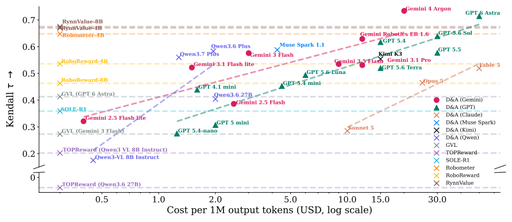
Fig. 8 :D&A scales with model capability across four open- and closed-source model families.GVLscales much worse thanD&A, whileTOPRewardandRoboRewardshow an inverse correlation between performance and model capability.
원문 · CC BY 4.0 · Marius Memmel, Shawn Yin, Urvi Rutia, Angad Wadhwa, Eldon Li, Gavin Angeloff, Ankit Goyal, Jesse Zhang, Dieter Fox, Fabio Ramos, Anqi Li, Abhishek Gupta · D&A: Decoupling Description and Assessment Enables VLMs as Zero-Shot Robotic Reward Models · 원문 그림 인용 · 원본 PDF 6쪽에서 그림 영역을 추출했습니다.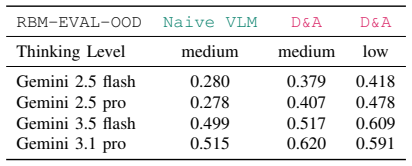
원문 그림 TABLE V:Backbone and compute(Kendallτ↑)
원문 · CC BY 4.0 · Marius Memmel, Shawn Yin, Urvi Rutia, Angad Wadhwa, Eldon Li, Gavin Angeloff, Ankit Goyal, Jesse Zhang, Dieter Fox, Fabio Ramos, Anqi Li, Abhishek Gupta · D&A: Decoupling Description and Assessment Enables VLMs as Zero-Shot Robotic Reward Models · 원문 그림 인용 · 원본 PDF 12쪽에서 그림 영역을 추출했습니다.Gemini 4 Argon의 RBM-EVAL-OOD 결과에서는 D&A 0.724와 Naive VLM 0.734가 나타나 D&A가 뒤처지거나 동등합니다. 저자들은 이 모델이 해당 데이터로 학습되었을 가능성을 가설로 제시합니다. 이는 실측으로 확인된 사실이 아니라 저자의 가설입니다.
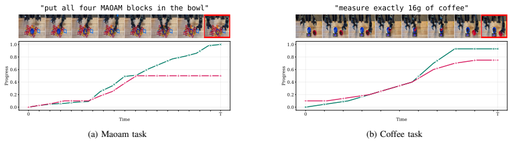
Fig. 13 :D&A qualitative gains on Gemini 4 Argon
원문 · CC BY 4.0 · Marius Memmel, Shawn Yin, Urvi Rutia, Angad Wadhwa, Eldon Li, Gavin Angeloff, Ankit Goyal, Jesse Zhang, Dieter Fox, Fabio Ramos, Anqi Li, Abhishek Gupta · D&A: Decoupling Description and Assessment Enables VLMs as Zero-Shot Robotic Reward Models · 원문 그림 인용 · 원본 PDF 12쪽에서 그림 영역을 추출했습니다.코드 기반 정책 개선에서의 피드백
Code-as-Policies 실험은 LIBERO goal suite의 500개 초기 조건에서 진행됩니다. 각 조건은 25회 시도되며 계획기는 gemini-3.7-flash를 사용합니다. 이력 없이 시도하면 11.4%, 이전 코드와 이진 성공 이력을 쓰면 40.6%입니다. D&A의 언어 피드백을 추가하면 51.4%이며, 이력 기준선 대비 p=0.00076입니다.
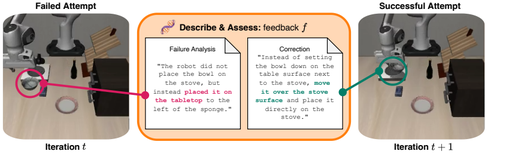
Fig. 10 :CaP with rich feedback.Example of iterative improvement withD&Afeedback in LIBERO.
원문 · CC BY 4.0 · Marius Memmel, Shawn Yin, Urvi Rutia, Angad Wadhwa, Eldon Li, Gavin Angeloff, Ankit Goyal, Jesse Zhang, Dieter Fox, Fabio Ramos, Anqi Li, Abhishek Gupta · D&A: Decoupling Description and Assessment Enables VLMs as Zero-Shot Robotic Reward Models · 원문 그림 인용 · 원본 PDF 8쪽에서 그림 영역을 추출했습니다.이 결과는 언어 피드백이 스칼라 신호보다 정책 개선에 효과적인지 보이는 실험입니다. 평가기는 같은 D&A 구성을 쓰고, 피드백은 시도 사이의 누적 정보로 쓰입니다.
한계와 적용 범위
저자들은 D&A가 고성능 기반 모델의 높은 추론 지연, 토큰 비용, 제한된 문맥 창을 상속한다고 밝힙니다. 폐쇄형 API 접근은 확률성과 세밀한 제어의 한계를 만듭니다. 또한 생성 보상은 자연어 설명의 세분성에 제한되므로, 정밀한 공간 관계나 절대 기하 거리처럼 말로 표현하기 어려운 연속 보상에는 적합성이 낮을 수 있습니다.
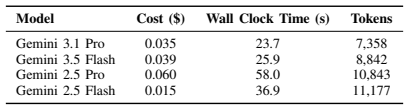
원문 그림 TABLE VI: Average compute, latency, and financial cost per trajectory evaluated across 567 trajectories onRBM-EVAL-OOD.
원문 · CC BY 4.0 · Marius Memmel, Shawn Yin, Urvi Rutia, Angad Wadhwa, Eldon Li, Gavin Angeloff, Ankit Goyal, Jesse Zhang, Dieter Fox, Fabio Ramos, Anqi Li, Abhishek Gupta · D&A: Decoupling Description and Assessment Enables VLMs as Zero-Shot Robotic Reward Models · 원문 그림 인용 · 원본 PDF 12쪽에서 그림 영역을 추출했습니다.이 연구의 실험은 D&A-Bench, RBM-EVAL-OOD, RoboRewardBenchmark와 특정 실제 로봇 과제에 한정됩니다. 다른 로봇 플랫폼이나 과제 전체에 대한 보장은 원문 근거로 확인되지 않습니다.
논문 정보
- 저자
- Marius Memmel, Shawn Yin, Urvi Rutia, Angad Wadhwa, Eldon Li, Gavin Angeloff, Ankit Goyal, Jesse Zhang, Dieter Fox, Fabio Ramos, Anqi Li, Abhishek Gupta
- 학회·저널
- arXiv · 프리프린트
- 최초 공개일
- 2026년 11월 2일
- 등록일
- 2026년 11월 4일
- 수정일
- 2026년 11월 2일
- 버전
- v1
- arXiv
- 2611.03622
- 분류
- cs.RO · cs.AI · cs.CL · cs.LG · eess.SY
- 원문 이용 조건
- CC BY 4.0
- 제공 범위
- 논문 정보, 해설, 허용된 원문 그림
AI 해설은 논문 원문과 별개의 설명이며 오류가 있을 수 있습니다. 원문과 그림은 각 출처의 이용 조건과 따로 표시된 권리를 따릅니다.
초록
Vision-Language Models (VLMs) hold promise for zero-shot video task-progress estimation in robot learning, yet existing frameworks frequently suffer from confirmation bias, hallucinating progress in failed executions due to implicit success assumptions or relative temporal ranking designs. Naive prompting of frontier models collapses into a binary success detector that fails to capture nuanced, non-linear progress and failures. While post-training approaches can mitigate this through explicit training, they demand expensive real-world robotics data and require computationally intensive post-training for every individual base model. To resolve these limitations, we introduce D&A (Describe & Assess): our approach decouples progress estimation into an objective, task-grounded textual description of scene dynamics followed by an assessment phase using explicit rubrics. By compelling the VLM to synthesize an explicit, text-based definition of absolute success before scoring, the framework anchors evaluations to an external, global criterion rather than the video's internal timeline. Empirical results demonstrate that our method calibrates zero-shot estimates and mitigates confirmation bias, providing fine-grained, partial progress metrics that accurately penalize failed executions while correctly interpolating successful runs. Being purely prompt-based, D&A generalizes across tasks, embodiments, and benchmarks---matching or surpassing post-trained reward models---and its reward estimates enable efficient downstream reinforcement learning.
원문 인용
Marius Memmel, Shawn Yin, Urvi Rutia, Angad Wadhwa, Eldon Li, Gavin Angeloff, Ankit Goyal, Jesse Zhang, Dieter Fox, Fabio Ramos, Anqi Li, Abhishek Gupta (2026). D&A: Decoupling Description and Assessment Enables VLMs as Zero-Shot Robotic Reward Models. arXiv:2611.03622v1. https://arxiv.org/abs/2611.03622v1
BibTeX
@misc{memmel2026decoupling,
  title = {{D&A: Decoupling Description and Assessment Enables VLMs as Zero-Shot Robotic Reward Models}},
  author = {Marius Memmel and Shawn Yin and Urvi Rutia and Angad Wadhwa and Eldon Li and Gavin Angeloff and Ankit Goyal and Jesse Zhang and Dieter Fox and Fabio Ramos and Anqi Li and Abhishek Gupta},
  year = {2026},
  eprint = {2611.03622},
  archivePrefix = {arXiv},
  url = {https://arxiv.org/abs/2611.03622v1}
}