논문 해설
A Comprehensive Empirical Study of Bias Mitigation Methods for Machine Learning Classifiers
머신러닝 분류기를 위한 편향 완화 방법에 대한 포괄적 실증 연구
- 연구 문제 여러 편향 완화 방법을 비교할 때 기존 연구는 ML 성능 지표와 방법 수가 제한적이어서, 실제 적용 상황에 맞는 방법 선택 근거가 부족합니다.
- 연구 방법 17개 편향 완화 방법을 8개 과제에서 11개 ML 성능 지표, 4개 공정성 지표, 20개 트레이드오프 측정으로 평가하며 Fairea 기준선으로 트레이드오프를 정량화합니다.
- 주요 결과 편향 완화 방법은 53%의 시나리오에서 ML 성능을 낮추고 46%에서 공정성을 개선하며, 25%에서는 둘을 모두 낮춥니다. 최선의 방법도 30%의 시나리오에서만 다른 방법을 앞섰습니다.
편향 완화 방법을 어떻게 비교해야 하는가
머신러닝 분류기는 채용, 형사 사법, 신용 위험 예측처럼 중요한 의사결정에 쓰이며, 보호 속성에 따라 집단을 다르게 대우하는 편향이 문제가 됩니다. 기존 연구는 편향을 줄이는 여러 방법을 제안했지만, 성능 측정 지표를 한두 개만 사용하거나 평가하는 방법의 수가 제한적이었습니다. 예를 들어 여러 연구가 정확도만 ML 성능 지표로 사용했으며, 불리한 클래스에 대한 정밀도는 대부분 고려되지 않았습니다.
이 논문은 이러한 공백을 메우기 위해 ML 커뮤니티와 SE 커뮤니티의 대표적인 편향 완화 방법 17개를 같은 조건에서 비교합니다. 평가는 11개 ML 성능 지표, 4개 공정성 지표, 그리고 20개 공정성-성능 트레이드오프 측정을 함께 사용합니다.
평가 설계와 편향 완화 방법
실험은 다섯 개 벤치마크 데이터셋을 여덟 개 편향 완화 과제로 나누어 수행합니다. 각 과제는 하나의 보호 속성을 기준으로 이진 분류 문제를 구성합니다. 이 연구는 17개 방법 중 ML 커뮤니티의 10개 방법을 AIF360 구현으로 사용하고, SE 커뮤니티의 Fairway와 Fair-SMOTE를 포함합니다.
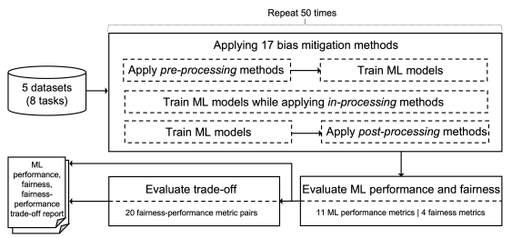
Fig. 1 . Overview of experimental design.
원문 · CC BY 4.0 · Zhenpeng Chen, Jie M. Zhang, Federica Sarro, Mark Harman · A Comprehensive Empirical Study of Bias Mitigation Methods for Machine Learning Classifiers · 원문 그림 인용 · 원본 PDF 5쪽에서 그림 영역을 추출했습니다.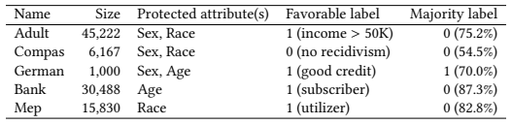
Table 1 . Benchmark datasets for bias mitigation.
원문 · CC BY 4.0 · Zhenpeng Chen, Jie M. Zhang, Federica Sarro, Mark Harman · A Comprehensive Empirical Study of Bias Mitigation Methods for Machine Learning Classifiers · 원문 그림 인용 · 원본 PDF 7쪽에서 그림 영역을 추출했습니다.전처리 방법인 Reweighting은 (group, label) 조합별로 학습 샘플에 다른 가중치를 부여하며, 원 논문은 이 방법이 특성이나 레이블을 수정하지 않는다고 설명합니다. Learning Fair Representation은 보호 속성 정보를 은닉하는 표현을 학습합니다. 인프로세싱 방법인 Prejudice Remover는 차별 인지 정규화 항을 학습 목적 함수에 추가하고, Adversarial Debiasing은 정확도를 높이면서 예측에 남은 보호 속성 정보를 줄이도록 학습합니다. 후처리 방법인 Reject Option Classification은 예측 불확실성이 높은 사례의 결과를 특권 그룹과 비특권 그룹에 다르게 배정합니다.
평가 지표는 Statistical Parity Difference(SPD), Average Odds Difference(AOD), Equal Opportunity Difference(EOD), Error Rate Difference(ERD)로 구성되며, 공정성 지표는 절댓값으로 사용하여 0일수록 공정함을 의미합니다.
Fairea 기준선을 통한 트레이드오프 검증
공정성과 ML 성능을 함께 보기 위해 이 연구는 Fairea를 사용합니다. Fairea는 원 모델을 점차 변이시켜 의사 모델을 만들고, 이를 연결하여 트레이드오프 기준선을 구성합니다. 각 기준선 점은 원 모델에서 일부 예측을 다수 클래스로 바꾸는 방식으로 얻어집니다.
기준선을 기준으로 편향 완화 결과는 win-win, good trade-off, poor trade-off, inverted trade-off, lose-lose 영역으로 나뉩니다. ERD는 Fairea의 가정을 만족하지 않아 기준선을 구성할 수 없으므로, 트레이드오프 분석은 SPD, AOD, EOD 세 지표와 다섯 ML 성능 지표로 구성된 15개 조합에서 수행됩니다.
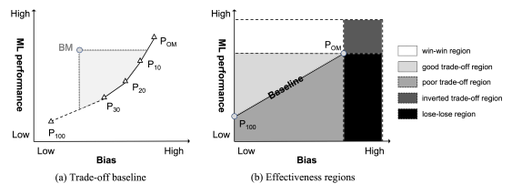
Fig. 2 . Illustration of Fairea [ 50]. (a) presents the fairness-performance trade-off baseline, where𝑃𝑂𝑀 repre- sents the original model, BM the model after bias mitigation, and𝑃10,...,𝑃 100 the points obtained by model behavior mutation. (b) presents the effectiveness regions of bias mitigation methods according to the changes in ML performance and bias.
원문 · CC BY 4.0 · Zhenpeng Chen, Jie M. Zhang, Federica Sarro, Mark Harman · A Comprehensive Empirical Study of Bias Mitigation Methods for Machine Learning Classifiers · 원문 그림 인용 · 원본 PDF 10쪽에서 그림 영역을 추출했습니다.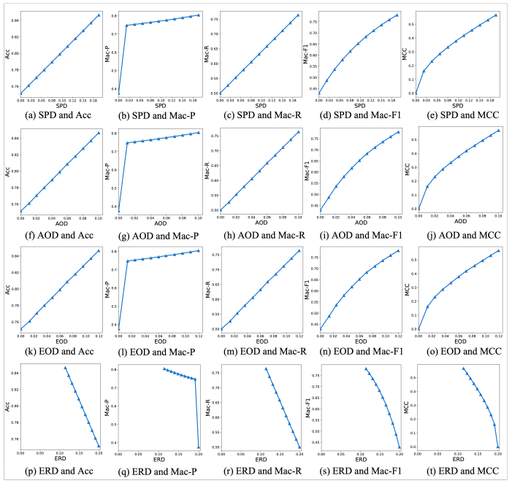
Fig. 7 . RQ3: Fairness-performance trade-off baselines for LR model in Adult-Sex task. ERD shows a different trade-off pattern from other fairness metrics in the baselines constructed by Fairea.
원문 · CC BY 4.0 · Zhenpeng Chen, Jie M. Zhang, Federica Sarro, Mark Harman · A Comprehensive Empirical Study of Bias Mitigation Methods for Machine Learning Classifiers · 원문 그림 인용 · 원본 PDF 20쪽에서 그림 영역을 추출했습니다.성능 저하, 공정성 개선, 트레이드오프 결과
ML 성능 측면에서 편향 완화 방법은 연구된 시나리오의 평균 53%에서 11개 ML 성능 지표 값을 유의하게 낮췄으며, 이 비율은 지표에 따라 42%에서 66% 사이였습니다. 공정성 측면에서는 4개 공정성 지표 기준 전체 시나리오의 46%에서 공정성이 유의하게 개선되었으며, 그 비율은 24%에서 59% 사이였습니다.
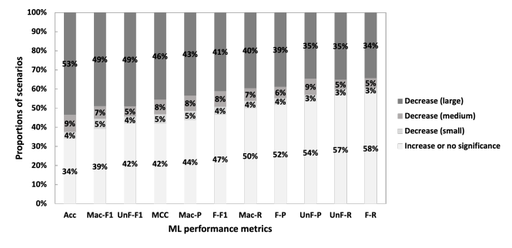
Fig. 3 . RQ1.1: Effects of bias mitigation methods on different ML performance metrics. After applying existing bias mitigation methods, the values of the 11 ML performance metrics significantly decrease in an average of 53% of applications.
원문 · CC BY 4.0 · Zhenpeng Chen, Jie M. Zhang, Federica Sarro, Mark Harman · A Comprehensive Empirical Study of Bias Mitigation Methods for Machine Learning Classifiers · 원문 그림 인용 · 원본 PDF 12쪽에서 그림 영역을 추출했습니다.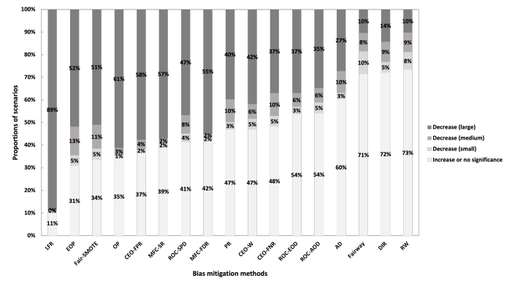
Fig. 4 . RQ1.2: Effect distribution of different bias mitigation methods in ML performance. We find that 6 out of 17 bias mitigation methods significantly decrease ML performance in less than 50% of scenarios.
원문 · CC BY 4.0 · Zhenpeng Chen, Jie M. Zhang, Federica Sarro, Mark Harman · A Comprehensive Empirical Study of Bias Mitigation Methods for Machine Learning Classifiers · 원문 그림 인용 · 원본 PDF 15쪽에서 그림 영역을 추출했습니다.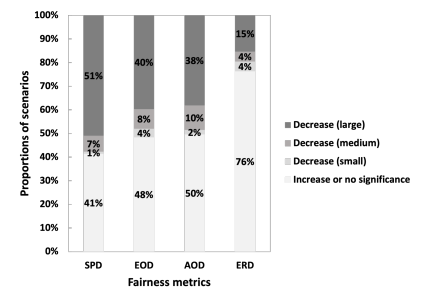
Fig. 5 . RQ2.1: Effects of bias mitigation methods on different fairness metrics. After applying existing bias mitigation methods, the values of the four fairness metrics significantly decrease (i.e., fairness is improved) in an average of 46% of applications.
원문 · CC BY 4.0 · Zhenpeng Chen, Jie M. Zhang, Federica Sarro, Mark Harman · A Comprehensive Empirical Study of Bias Mitigation Methods for Machine Learning Classifiers · 원문 그림 인용 · 원본 PDF 17쪽에서 그림 영역을 추출했습니다.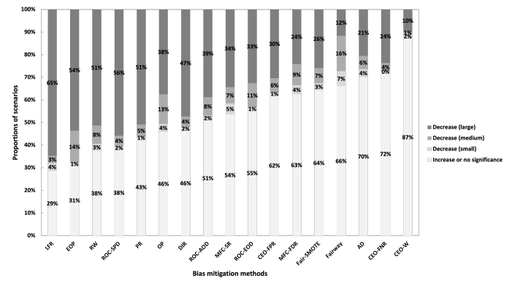
Fig. 6 . RQ2.2: Effect distribution of different bias mitigation methods in fairness. We observe that 7 out of 17 bias mitigation methods significantly reduce bias in more than 50% of scenarios.
원문 · CC BY 4.0 · Zhenpeng Chen, Jie M. Zhang, Federica Sarro, Mark Harman · A Comprehensive Empirical Study of Bias Mitigation Methods for Machine Learning Classifiers · 원문 그림 인용 · 원본 PDF 18쪽에서 그림 영역을 추출했습니다.트레이드오프 측면에서는 전체 시나리오의 25%가 lose-lose 영역에 속해 공정성과 ML 성능이 함께 낮아졌습니다. Reweighting은 win-win 또는 good trade-off를 77% 시나리오에서 보였으며, Fairway는 정량 평가에서 가장 많은 30%의 시나리오에서 최선의 결과를 보였습니다. 그러나 어떤 방법도 모든 시나리오에서 최선의 트레이드오프를 달성하지 못했습니다.
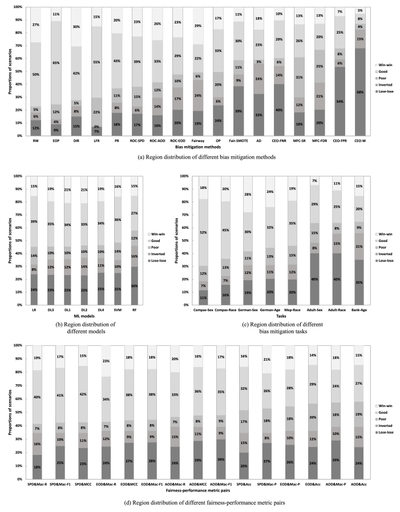
Fig. 8 . RQ3.1: Proportion of mitigation cases that fall into each mitigation region organized by (a) bias mitigation methods, (b) models, (c) bias mitigation tasks, and (d) fairness-performance metric pairs. We observe that a notable proportion (25%) of mitigation cases fall into a lose-lose trade-off region, and that the effectiveness of bias mitigation methods depends on models, tasks, the selection of protected attributes, and the set of metrics used to assess fairness and ML performance.
원문 · CC BY 4.0 · Zhenpeng Chen, Jie M. Zhang, Federica Sarro, Mark Harman · A Comprehensive Empirical Study of Bias Mitigation Methods for Machine Learning Classifiers · 원문 그림 인용 · 원본 PDF 22쪽에서 그림 영역을 추출했습니다.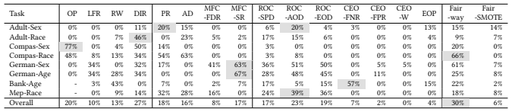
Table 6 . RQ3.2: Numbers of scenarios where each method achieves the best quantitative result, organized by different bias mitigation tasks. For each task, we highlight the bias mitigation method that achieves the best trade-off in the most scenarios in shading. Overall, none of the existing bias mitigation methods can achieve a better trade-off than other methods in all the scenarios, as even the best method that we find outperforms other methods in 30% of scenarios.
원문 · CC BY 4.0 · Zhenpeng Chen, Jie M. Zhang, Federica Sarro, Mark Harman · A Comprehensive Empirical Study of Bias Mitigation Methods for Machine Learning Classifiers · 원문 그림 인용 · 원본 PDF 24쪽에서 그림 영역을 추출했습니다.적용 범위와 한계
이 연구의 결과는 다섯 데이터셋, 여덟 편향 완화 과제, LR, SVM, RF와 네 개의 DNN 설정이라는 범위 안에서 얻은 것입니다. 보호 속성은 과제마다 하나씩 개별적으로 고려되었으며, 여러 보호 속성을 동시에 다루는 방법은 평가 대상에 포함되지 않았습니다.
또한 Fairea 기반 트레이드오프 분석은 ERD를 제외한 세 공정성 지표와 다섯 ML 성능 지표로 제한됩니다. 이 제한은 ERD에 대한 공정성 개선 결과가 없다는 뜻이 아니라, 해당 기준선 방법을 적용할 수 없다는 뜻입니다.
논문 정보
- 저자
- Zhenpeng Chen, Jie M. Zhang, Federica Sarro, Mark Harman
- 학회·저널
- arXiv · 프리프린트
- 최초 공개일
- 2022년 7월 7일
- 등록일
- 2026년 11월 6일
- 수정일
- 2023년 2월 10일
- 버전
- v3
- arXiv
- 2207.03277
- 분류
- cs.SE · cs.AI
- 원문 이용 조건
- CC BY 4.0
- 제공 범위
- 논문 정보, 해설, 허용된 원문 그림
AI 해설은 논문 원문과 별개의 설명이며 오류가 있을 수 있습니다. 원문과 그림은 각 출처의 이용 조건과 따로 표시된 권리를 따릅니다.
초록
Software bias is an increasingly important operational concern for software engineers. We present a large-scale, comprehensive empirical study of 17 representative bias mitigation methods for Machine Learning (ML) classifiers, evaluated with 11 ML performance metrics (e.g., accuracy), 4 fairness metrics, and 20 types of fairness-performance trade-off assessment, applied to 8 widely-adopted software decision tasks. The empirical coverage is much more comprehensive, covering the largest numbers of bias mitigation methods, evaluation metrics, and fairness-performance trade-off measures compared to previous work on this important software property. We find that (1) the bias mitigation methods significantly decrease ML performance in 53% of the studied scenarios (ranging between 42%~66% according to different ML performance metrics); (2) the bias mitigation methods significantly improve fairness measured by the 4 used metrics in 46% of all the scenarios (ranging between 24%~59% according to different fairness metrics); (3) the bias mitigation methods even lead to decrease in both fairness and ML performance in 25% of the scenarios; (4) the effectiveness of the bias mitigation methods depends on tasks, models, the choice of protected attributes, and the set of metrics used to assess fairness and ML performance; (5) there is no bias mitigation method that can achieve the best trade-off in all the scenarios. The best method that we find outperforms other methods in 30% of the scenarios. Researchers and practitioners need to choose the bias mitigation method best suited to their intended application scenario(s).
원문 인용
Zhenpeng Chen, Jie M. Zhang, Federica Sarro, Mark Harman (2022). A Comprehensive Empirical Study of Bias Mitigation Methods for Machine Learning Classifiers. arXiv:2207.03277v3. https://arxiv.org/abs/2207.03277v3
BibTeX
@misc{chen2022comprehensive,
  title = {{A Comprehensive Empirical Study of Bias Mitigation Methods for Machine Learning Classifiers}},
  author = {Zhenpeng Chen and Jie M. Zhang and Federica Sarro and Mark Harman},
  year = {2022},
  eprint = {2207.03277},
  archivePrefix = {arXiv},
  url = {https://arxiv.org/abs/2207.03277v3}
}