논문 해설
ACROSSVAM3.0: Resource-Bounded 4D Scene Construction and Adaptive Surface Association
ACROSSVAM3.0: 자원 제약 기반 4D 장면 구성과 적응형 표면 연관
- 연구 문제 서로 다른 가정을 가진 생성, 재구성, SLAM 구성요소를 단일 GPU 예산 안에서 일관된 버전화 4D 장면으로 묶는 문제를 다룹니다.
- 연구 방법 텍스트·이미지·관측 비디오를 입력 경로별로 처리하고, 불변 로컬 4D 윈도우를 Sim(3) 변환과 포즈 버전으로 묶으며, 교차 윈도우 연결에는 후보 격자와 질의별 디코딩을 쓰는 MHAC를 제안합니다.
- 주요 결과 개발 홀드아웃에서 B0 대비 AJ가 0.1394 향상되었고, 265개 RoboTAP 비디오에서는 평균 0.0610 향상과 215승 1무 49패가 관찰되었습니다. 엄격한 세 프레임 규칙은 TAP-Vid-DA VIS에서 기준선보다 낮았습니다.
여러 생성·재구성 모델을 하나의 4D 장면으로 묶는 문제
텍스트나 이미지로부터 영상을 생성하는 모델, 단안 RGB 영상에서 동적 기하를 복원하는 모델, 학습 기반 SLAM은 각각 다른 좌표계, 스케일, 전처리, 신뢰도 규약, 메모리 특성을 가집니다. 여기에 생성된 프레임은 실제 관측과 구분되어야 합니다. 따라서 이들을 하나로 묶으려면 좌표 변화를 일관되게 전파하고, 출처를 구분하며, 단일 GPU 예산 안에 머무르는 표현이 필요합니다. ACROSSVAM3.0은 이 조건을 만족하는 오프라인 시스템으로 제시되며, 척도는 미터가 아닌 상대 척도로 다룹니다.
세 입력 경로와 버전화된 장면 표현
텍스트와 RGB 참조 이미지 입력은 고정된 Wan2.2 TI2V-5B 모델이 17개의 RGB 프레임을 생성하는 경로로 들어가며, 생성 프레임은 관측으로 표시되지 않습니다. 관측 비디오는 최대 60프레임까지 디코딩되어 MASt3R-SLAM과 4RC 재구성 경로로 직접 들어갑니다. 4RC는 16프레임 윈도우와 4프레임 겹침으로 로컬 4D 기하와 궤적을 산출합니다. 각 로컬 윈도우는 불변 배열로 보존되고, Sim(3) 변환 A_k로 선언된 장면 좌표계에 옮겨집니다. 이때 회전 R_k에는 회전만 적용되고 카메라 중심에는 상사변환 전체가 적용되어 스케일이 직교 회전을 훼손하지 않습니다. 정렬 변환이 기준을 통과하면 카메라, 점, 궤적과 메타데이터가 포즈 버전 단위로 함께 갱신되며, 생성 RGB는 물리적 SLAM 맵 제약에 사용되지 않습니다.
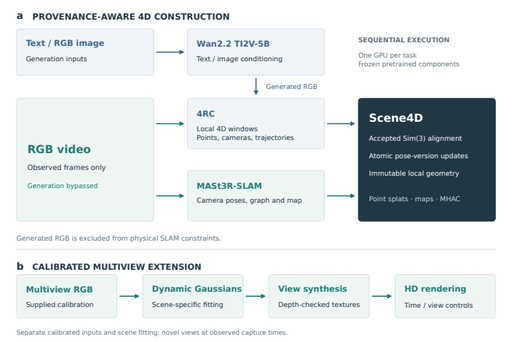
Figure 1 :System architecture and the separate calibrated rendering extension.(a) Text and image inputs pass through video generation, while observed RGB enters reconstruction and SLAM directly. Frozen components execute sequentially on one GPU. Immutable local 4D windows are aligned through accepted Sim(3) transforms, and pose-version updates keep cameras, points and trajectories consistent. Generated RGB never constrains the physical SLAM map. (b) The high- resolution extension instead requires synchronized multiview RGB and supplied calibration. It fits each capture independently and renders observed times from new camera views; it is separate from the monocular evaluation.
원문 · CC BY 4.0 · Wu, Nan, Hung, Hong Yee · ACROSSVAM3.0: Resource-Bounded 4D Scene Construction and Adaptive Surface Association · 원문 그림 인용 · 원본 PDF 2쪽에서 그림 영역을 추출했습니다.MHAC: 다중 후보 격자와 질의별 디코딩
교차 윈도우 표면 연결은 인접 윈도우의 대응 후보를 고르는 문제입니다. 초기 P4 규칙은 세 공유 프레임에서 단일 상호 최근접 이웃을 골랐습니다. MHAC는 이를 대신해 질의와 무관한 방향성 격자를 먼저 만듭니다. 각 후보 간선 e=(i,j)에 대해 네 겹침 프레임의 재투영 오차 평균·최댓값·산포, 가시 지지 비율, 정규화 색상 거리, 순방향·역방향 이웃 순위, 최근접과 차근접의 여유를 특징 벡터 f_e로 만들고, 고정 가중 점수 C_e=w^T(f_e ⊘ s)로 각 출발점에서 최대 세 개의 후보를 순위화합니다. 선택된 C02는 여덟 개의 고정 가중치, 평균 재투영 2픽셀, 최대 재투영 4픽셀, 정규화 색상 거리 0.15의 일반 한계를 사용하며 구제 간선을 두지 않습니다.
격자가 봉인된 뒤 각 질의는 누락 상태를 포함한 제한된 동적 계획법으로 디코딩되어 질의 간 정보가 섞이지 않습니다.
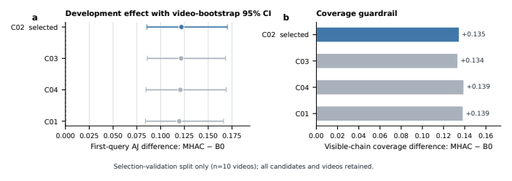
Figure 5 :P5 candidate selection on ten development videos.(a) Paired first-query AJ improvement over the position-only B0 baseline; error bars are 10,000-resample video-bootstrap 95% intervals. (b) visible-chain coverage improvement over B0. C02 was selected by the frozen lexicographic rule. These are development-selection results, not holdout or external-test evidence.
원문 · CC BY 4.0 · Wu, Nan, Hung, Hong Yee · ACROSSVAM3.0: Resource-Bounded 4D Scene Construction and Adaptive Surface Association · 원문 그림 인용 · 원본 PDF 11쪽에서 그림 영역을 추출했습니다.장거리 점 추적의 검증 설계와 분할 규율
장거리 투영 추적은 TAP-Vid 지표로 측정되며 256×256 해상도를 사용합니다. P4는 30개의 TAP-Vid-DA VIS 비디오를 사전에 고정된 프로토콜로 한 번 평가했고, 이후 이 데이터셋은 추가 튜닝이 금지되었습니다. P5는 RGB-Stacking 50개 비디오를 30/10/10으로 나누어 후보 설계, 선택 검증, 개발 홀드아웃에 사용했습니다. 최종 외부 평가는 265개 RoboTAP 비디오 전체이며, 모든 비디오가 분모에 남았습니다. 평가 지표 AJ는 Average Jaccard로, 위치 정확도와 가림 정확도와 함께 보고되었으며 신뢰구간은 10,000회 비디오 또는 장면 수준 백분위 부트스트랩으로 계산되었습니다.
부트스트랩 구간은 분석 계획이 테스트 출력 생성 뒤에 작성되었으므로 기술적 정보로만 해석됩니다.
P4 결과: 엄격한 세 프레임 규칙의 실패
P4에서 엄격한 세 프레임 규칙은 첫 질의 모드의 AJ가 13.21%였습니다. 같은 실험의 외형 인식 한 프레임 규칙은 13.26%, 위치 기반 기준선 B0는 14.63%였습니다. P4와 B1의 차이는 −0.050 퍼센트포인트이며 비디오 부트스트랩 95% 구간은 [−0.391,+0.275] 퍼센트포인트입니다. P4와 B0의 차이는 −1.423 포인트 [−2.280,−0.626]입니다. 질의 할당률은 변형 간에 비슷했지만 visible-chain coverage는 B0 28.53%에서 B1 22.11%, P4 21.47%로 떨어졌습니다. 저자들은 이를 조기 가지치기와 일치하는 진단으로 해석하며, 커버리지가 유일한 인과 경로라는 점은 입증되지 않았다고 밝힙니다.
이 결과는 TAP-Vid-DA VIS에서 엄격한 연쇄 규칙이 충분한 장거리 추적 경로가 아님을 보여 주지만, 다른 데이터셋이나 전체 설계 공간에 대한 결론은 아닙니다.
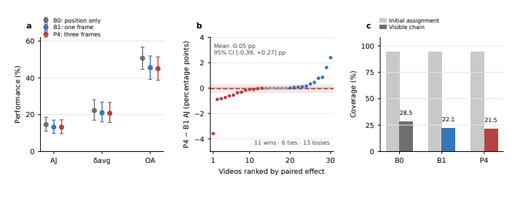
Figure 4 :The preregistered P4 external experiment rejects stricter matching as a sufficient route to long-range tracking.(a) First-query AJ across all 30 TAP-Vid-DA VIS videos. (b) Paired video-level differences for the prespecified comparisons. (c) Query assignment and visible-chain coverage, showing that equal initial assignment does not prevent later chain loss. Intervals resample videos 10,000 times.
원문 · CC BY 4.0 · Wu, Nan, Hung, Hong Yee · ACROSSVAM3.0: Resource-Bounded 4D Scene Construction and Adaptive Surface Association · 원문 그림 인용 · 원본 PDF 10쪽에서 그림 영역을 추출했습니다.P5 홀드아웃과 RoboTAP 외부 결과
선택 결과는 확증 증거로 쓰지 않았습니다. 고정된 10개 개발 홀드아웃에서 C02는 위치 기반 기준선 B0 대비 AJ를 0.1394 향상시켰으며 비디오 부트스트랩 95% 구간은 [0.1074,0.1689]이고 10개 비디오 모두 개선되었습니다. 265개 RoboTAP 비디오 전체에서 첫 질의 AJ 평균은 B0 0.1994에서 MHAC 0.2604로 증가했고, 쌍별 향상은 0.0610 [0.0510,0.0715]이었으며 215승 1무 49패였습니다. 49패는 효과가 이질적임을 보여 주므로, 이 결과는 이 프로토콜에서 B0 대비 외부 로봇 영상 추적 일반화를 지지하는 것이지 보편적 우위를 뜻하지 않습니다.
또한 MHAC는 후보 유지, 누락 상태, 가림 처리를 함께 바꾸므로 커버리지만이 원인이라고 분리할 수 없습니다.
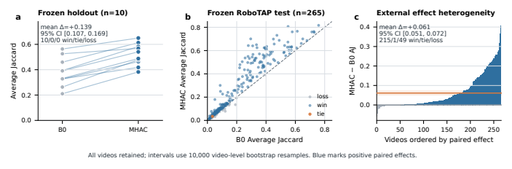
Figure 6 :Frozen confirmatory tests support a bounded external gain for MHAC.(a) Every development-holdout video improves over B0. (b) Paired RoboTAP AJ for all 265 videos; the dashed identity line separates wins and losses. (c) Sorted paired effects expose both the positive mean and the retained negative cases; the orange line and band show the mean and its 10,000-resample video-bootstrap 95% interval. No video was removed after evaluation.
원문 · CC BY 4.0 · Wu, Nan, Hung, Hong Yee · ACROSSVAM3.0: Resource-Bounded 4D Scene Construction and Adaptive Surface Association · 원문 그림 인용 · 원본 PDF 11쪽에서 그림 영역을 추출했습니다.실제 영상 장면의 재구성과 SLAM 결과
16개 짧은 실제 영상 장면은 모두 구조적으로 유효한 4RC 출력을 만들었고 그중 15개 장면에서 비어 있지 않은 SLAM 맵이 생성되었습니다. 포즈 평가 대상 12개 중 11개가 타임스탬프 연결 요건을 만족했으며, 이 중앙값 ATE RMSE는 0.0170 m, 95% 설명적 장면 부트스트랩 구간은 [0.0066,0.0428] m입니다. 중앙값 이동 RPE는 0.0109 m, 평균 회전 RPE는 0.718°입니다. 이 값들은 평가 기준에 따른 명목 단위일 뿐 전체 출력이 보장된 미터 척도임을 뜻하지 않습니다. 운동 순위의 ROC AUC 중앙값은 12개 장면에서 0.684 [0.596,0.769]이며, 균형 정확도는 0.593입니다.
다만 저장된 점수가 융합 점수뿐이었으므로 이 결과는 기하 기준에 대한 절대 판별력만 보여 주고 구성요소 점수보다 우월하다는 근거는 아닙니다.
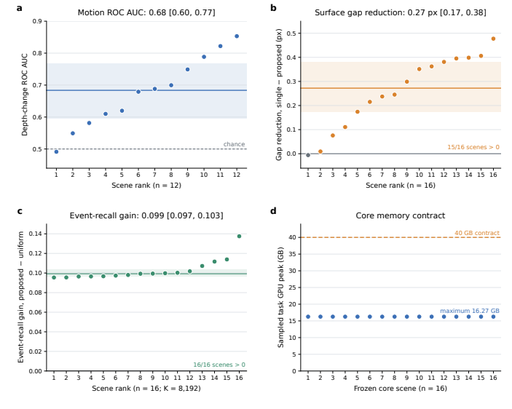
Figure 3 :Frozen real-video evaluation establishes a bounded resource and coordination result. (a) Motion-ranking ROC AUC across 12 reference-equipped scenes; the dashed line is chance. (b) Paired reduction in held-out overlapping-surface error for the three-frame geometry–colour rule relative to a one-frame rule. (c) Paired event-recall gain for motion-diversity sampling relative to uniform sampling at K= 8,192 . (d) Sampled task-process-tree GPU peak for the 16 4D reconstructions relative to the 40-GB contract. Points are independent scenes; coloured horizontal marks and bands show scene medians and descriptive 10,000-resample percentile intervals where applicable.
원문 · CC BY 4.0 · Wu, Nan, Hung, Hong Yee · ACROSSVAM3.0: Resource-Bounded 4D Scene Construction and Adaptive Surface Association · 원문 그림 인용 · 원본 PDF 9쪽에서 그림 영역을 추출했습니다.적용 범위와 남은 한계
입증된 범위는 고정된 짧은 장면 프로파일과 측정된 실행 경로입니다. 텍스트와 이미지 실행은 17프레임에 대해 확인되었으며, 121프레임 행동 품질 게이트는 통과하지 못했습니다. 포인트 스플랫은 고충실도 새 시점 렌더링을 입증하지 않으며, 투영 추적도 가림 이후 의미적 정체성을 입증하지 않습니다. 외부 비교는 프로토콜 안의 B0에 한정되고 전문 추적기와의 포괄적 비교는 없습니다. 메모리 측정은 50 ms 간격으로 샘플링되어 더 짧은 피크를 놓칠 수 있습니다. 보정 다시점 가우시안 확장은 별도의 시점 합성 시연이며 신발 변형 등 문제가 남아 있어 단안 평가의 공백을 메우지 않습니다.
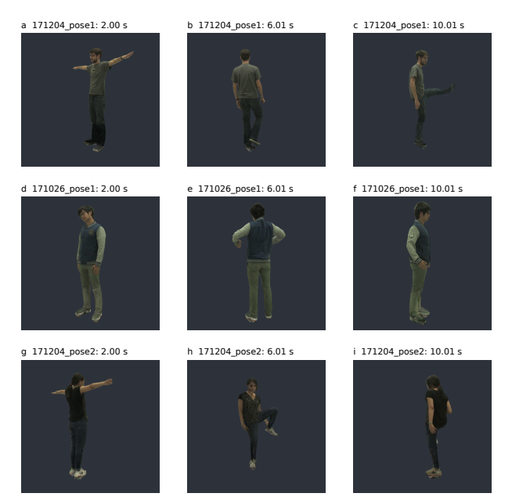
Figure 2 :Calibrated multiview reconstruction, separate from the monocular experiments.Rows show three separately fitted captures. Columns are frames 60, 180 and 300 of each 360-frame orbit video, at 2.002, 6.006 and 10.010 s; time and camera azimuth advance together. Panels use the same central crop of the native 1920×1080 frames, without additional colour adjustment or retouching. Training-view silhouette support reduces some detached splats, but shoe deformation and hand softness remain. Source recordings and calibration: CMU Panoptic Studio.
원문 · CC BY 4.0 · Wu, Nan, Hung, Hong Yee · ACROSSVAM3.0: Resource-Bounded 4D Scene Construction and Adaptive Surface Association · 원문 그림 인용 · 원본 PDF 7쪽에서 그림 영역을 추출했습니다.
Table 2 :Measured execution of the three input routes.One fresh final acceptance run per route, without generation or scene caches. Time is end-to-end wall time in seconds; GPU memory is the sampled task-process-tree peak in decimal GB. Pass denotes execution and exported-scene validation, not perceptual quality.
원문 · CC BY 4.0 · Wu, Nan, Hung, Hong Yee · ACROSSVAM3.0: Resource-Bounded 4D Scene Construction and Adaptive Surface Association · 원문 그림 인용 · 원본 PDF 8쪽에서 그림 영역을 추출했습니다.논문 정보
- 저자
- Wu, Nan, Hung, Hong Yee
- 학회·저널
- arXiv · 프리프린트
- 최초 공개일
- 2026년 11월 9일
- 등록일
- 2026년 11월 10일
- 수정일
- 2026년 11월 9일
- 버전
- v1
- arXiv
- 2611.11825
- 분류
- cs.AI
- 원문 이용 조건
- CC BY 4.0
- 제공 범위
- 논문 정보, 해설, 허용된 원문 그림
AI 해설은 논문 원문과 별개의 설명이며 오류가 있을 수 있습니다. 원문과 그림은 각 출처의 이용 조건과 따로 표시된 권리를 따릅니다.
초록
Combining video generation, dynamic reconstruction and monocular SLAM requires consistent coordinates, explicit handling of missing outputs and predictable memory use. We present AcrossVAM3.0, an offline system that converts text, images or monocular RGB video into a versioned point representation. Frozen components run sequentially on one GPU; map corrections update cameras, points and trajectories together. The coordination layer adds no neural parameters. Three fresh input-mode runs completed with a maximum sampled task-process-tree GPU footprint of 17.14 GB. In a frozen 16-scene video suite, every scene yielded a 4D reconstruction and 15 yielded a non-empty SLAM map. Strict cross-window matching reduced local surface error but lost long-range track coverage on TAP-Vid-DAVIS. We therefore developed multi-hypothesis adaptive surface chaining (MHAC), which retains several candidate matches and an explicit missing state. After selection on disjoint development data, MHAC improved Average Jaccard over a position-only baseline by 0.1394 on a frozen ten-video holdout (95% bootstrap interval [0.1074,0.1689]). Across 265 RoboTAP videos, the mean paired gain was 0.0610 ([0.0510,0.0715]), with 215 wins, one tie and 49 losses. These results support resource-bounded scene construction and an external tracking gain under the tested protocol. They do not establish metric scale, semantic identity or high-fidelity novel-view rendering.
원문 인용
Wu, Nan, Hung, Hong Yee (2026). ACROSSVAM3.0: Resource-Bounded 4D Scene Construction and Adaptive Surface Association. arXiv:2611.11825v1. https://arxiv.org/abs/2611.11825v1
BibTeX
@misc{nan2026acrossvam3,
  title = {{ACROSSVAM3.0: Resource-Bounded 4D Scene Construction and Adaptive Surface Association}},
  author = {Wu, Nan and Hung, Hong Yee},
  year = {2026},
  eprint = {2611.11825},
  archivePrefix = {arXiv},
  url = {https://arxiv.org/abs/2611.11825v1}
}