논문 해설
Neural Configuration-Space Barriers for Manipulation Planning and Control
조작 계획 및 제어를 위한 신경 구성 공간 장벽
- 연구 문제 고차원 조작기는 장애물이 많고 동적인 환경에서 충돌 검사 비용을 줄이면서도 실행 중 안전을 보장해야 합니다.
- 연구 방법 학습된 신경 CDF barrier를 bubble 기반 계획과 분포 강건 CBF 제어에 함께 사용합니다.
- 주요 결과 2-DoF 설정에서 Bubble-CDF는 충돌 검사 153.8±62.2회를 보고했고, PD + DR-CBF-QP는 동적 환경에서 0.992의 성공률을 보고했습니다.
고차원 manipulator 계획과 안전 제어의 어려움
고차원 로봇 조작기는 장애물이 많고 움직이는 환경에서 계획과 제어를 동시에 수행해야 합니다. 샘플링 기반 계획기는 고차원 공간을 잘 탐색하지만 충돌 검사 횟수가 많아 계산 병목이 되고, 실행 중 센서 잡음과 빠르게 바뀌는 장애물에는 계획만으로 안전을 보장하기 어렵습니다. 이 논문은 학습된 구성공간 거리 함수(CDF)를 계획과 제어의 공통 안전 표현으로 사용해 이 두 문제를 함께 다룹니다.
신경 CDF barrier의 구성
CDF는 workspace 점과 관절 구성 사이의 거리를 관절 공간의 최소 이동량으로 표현합니다. 환경 CDF는 장애물 점에 접촉하는 최소 관절 거리이며, 자기충돌 CDF는 자기충돌 구성 집합까지의 최소 관절 거리입니다. 이 두 값과 장애물 경계 근사 점 집합으로 CDF barrier h(q,t)를 정의하고, 실제에서는 점군 P(t)와 다층 퍼셉트론으로 근사한 ĥ(q,t;θ)를 사용합니다. 학습된 모델은 Eikonal 조건에 맞추어 거리와 기울기를 빠르게 질의하는 역할을 합니다.
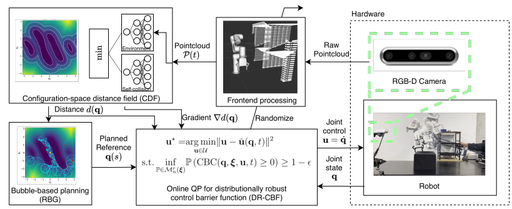
Fig. 2 :Overview: Two multi-layer perceptron networks, corresponding to the environment and robot self collisions, are trained to approximate the configuration-space distance function (CDF) of a robot manipulator. A sampling-based planner uses CDF values to form collision-free spheres (bubbles) organized in a Rapidly-exploring Bubble Graph (RBG). A controller imposes safety constraints via a distributionally-robust control barrier function obtained from the CDF and solves quadratic programs online to track the planned trajectory safely. The controller considers all distributions within a Wasserstein-1 ball of sampled environment and robot states obtained by randomizing the front-end CDF estimation model.
원문 · CC BY 4.0 · Kehan Long, Ki Myung Brian Lee, Nikola Raicevic, Niyas Attasseri, Melvin Leok, Nikolay Atanasov · Neural Configuration-Space Barriers for Manipulation Planning and Control · 원문 그림 인용 · 원본 PDF 2쪽에서 그림 영역을 추출했습니다.Bubble 기반 계획
계획 단계에서는 Rapidly-exploring Bubble Graph가 각 노드를 구성공간의 구형 bubble로 두고, bubble 반경을 r(q)=ĥ(q,t)−η로 정합니다. 새 bubble은 중심 간 거리가 두 반경의 합 이하이면 기존 bubble과 연결됩니다. 이렇게 하면 단일 구성마다 충돌을 검사하지 않고 batched CDF 질의로 안전 영역을 확보하므로 충돌 검사 횟수가 줄어듭니다. 이후 최단 경로를 고르고, Bezier 제어점을 각 bubble 안에 두는 convex QCQP로 매끄러운 궤적을 얻습니다.
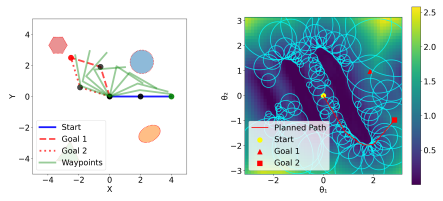
Fig. 1 :Illustration of sampling-based planning using configuration- space spheres to represent collision-free space for a planar 2-link robot arm. (a) The robot’s initial configuration (solid blue lines) and two potential goal configurations (dashed red). Four obstacles are present, represented as point-cloud data. Intermediate waypoints from the planned trajectory appear in light green. (b) The 2D configuration space (θ 1 vs.θ 2) of the 2-link robot, where the color map indicates the learned configuration-space distance function (CDF) value (darker regions denote proximity to collision). Cyan circles represent safe bubbles derived from the CDF, forming a graph of collision-free regions. A smooth, optimized trajectory (red) connects the start configuration (yellow circle) to the closest goal (red square).
원문 · CC BY 4.0 · Kehan Long, Ki Myung Brian Lee, Nikola Raicevic, Niyas Attasseri, Melvin Leok, Nikolay Atanasov · Neural Configuration-Space Barriers for Manipulation Planning and Control · 원문 그림 인용 · 원본 PDF 1쪽에서 그림 영역을 추출했습니다.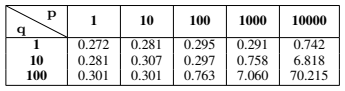
원문 그림 TABLE I:Inference time (ms) of Neural CDF barrier on xArm for varying batch sizes of configurations (q) and workspace points (p).
원문 · CC BY 4.0 · Kehan Long, Ki Myung Brian Lee, Nikola Raicevic, Niyas Attasseri, Melvin Leok, Nikolay Atanasov · Neural Configuration-Space Barriers for Manipulation Planning and Control · 원문 그림 인용 · 원본 PDF 8쪽에서 그림 영역을 추출했습니다.분포 강건 CBF 안전 제어
실행 단계에서는 governor가 진행 변수 s를 조절하고, PD 명목 제어기 ū가 기준 구성 γ(s)를 추적합니다. 안전 조건은 CBC로 정의되며, 신경 CDF 모델 오차와 점군 잡음을 반영하기 위해 Wasserstein-1 모호성 집합을 둔 DR-CBF-QP를 풉니다. 모델 불확실성의 샘플은 MC dropout으로 얻으며, 공식 (28)에 따라 N개의 샘플을 선택합니다. 이 QP는 명목 속도 ū에 가장 가까운 안전 속도 명령을 찾는 문제입니다.
2-DoF 평면 로봇 계획과 제어 검증
2-DoF 평면 로봇 실험은 500개 환경에서 네 개의 정적 장애물을 두고 계획기를 비교합니다. Bubble-CDF는 충돌 검사 횟수 153.8±62.2로 Lazy-RRT의 1759.2±299.3보다 적고, 계획 시간과 후처리 시간의 합도 가장 짧게 보고됩니다. 제어 실험에서는 정적 환경에서 PD + DR-CBF-QP가 1.0, 동적 환경에서 0.992의 성공률을 보고하며, 이때 추적 오차는 기준선보다 큽니다. 이 결과는 해당 2-DoF 설정에서 얻은 것입니다.
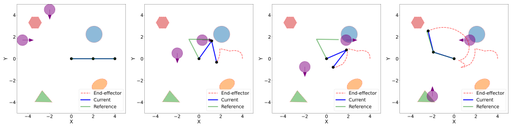
Fig. 3 :Snapshots of a 2-link arm navigating a dynamic environment with purple obstacles (velocity directions shown by arrows). The arm is tasked to follow the planned path in Fig. 1. The arm is shown in blue, and the trajectory of its end-effector is shown in red, and the local reference configuration goalγ(s)is shown in green.
원문 · CC BY 4.0 · Kehan Long, Ki Myung Brian Lee, Nikola Raicevic, Niyas Attasseri, Melvin Leok, Nikolay Atanasov · Neural Configuration-Space Barriers for Manipulation Planning and Control · 원문 그림 인용 · 원본 PDF 10쪽에서 그림 영역을 추출했습니다.
원문 그림 TABLE V:Control performance comparison on a 2-link arm.
원문 · CC BY 4.0 · Kehan Long, Ki Myung Brian Lee, Nikola Raicevic, Niyas Attasseri, Melvin Leok, Nikolay Atanasov · Neural Configuration-Space Barriers for Manipulation Planning and Control · 원문 그림 인용 · 원본 PDF 10쪽에서 그림 영역을 추출했습니다.6-DoF xArm 시뮬레이션과 실제 로봇 검증
6-DoF xArm 시뮬레이션에서는 50회 무작위 시행으로 계획 성능을 비교합니다. Bubble-CDF는 충돌 검사 278.5±80.7회를 보고합니다. 실제 xArm6 실험에서는 20회 무작위 시행을 수행하며, Bubble-CDF의 충돌 검사 횟수는 634.8±225.1회로 기준선보다 적게 보고됩니다. 실제 실험의 end-to-end 시간은 0.22±0.08 s입니다. 실제 로봇 결과는 정적 계획을 세운 뒤 동적 장애물에 반응하는 설정에서 얻은 것입니다.
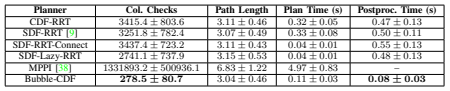
원문 그림 TABLE VI:Planning performance comparison on a 6-DoF xArm robot in PyBullet Simulation.
원문 · CC BY 4.0 · Kehan Long, Ki Myung Brian Lee, Nikola Raicevic, Niyas Attasseri, Melvin Leok, Nikolay Atanasov · Neural Configuration-Space Barriers for Manipulation Planning and Control · 원문 그림 인용 · 원본 PDF 10쪽에서 그림 영역을 추출했습니다.
Fig. 5 :Snapshots of safe control execution on a 6-DoF xArm robot in an environment with dynamic obstacles. (a) The control execution begins at the initial configuration. (b) A dynamic obstacle (blue) approaches the robot from the right. (c) The robot executes a defensive maneuver, moving upward to avoid the obstacle. (d) The robot successfully resumes tracking and reaches the goal configuration.
원문 · CC BY 4.0 · Kehan Long, Ki Myung Brian Lee, Nikola Raicevic, Niyas Attasseri, Melvin Leok, Nikolay Atanasov · Neural Configuration-Space Barriers for Manipulation Planning and Control · 원문 그림 인용 · 원본 PDF 11쪽에서 그림 영역을 추출했습니다.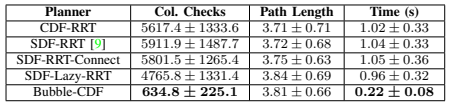
원문 그림 TABLE VIII:Planning performance comparison on a real 6-DoF xArm robot.
원문 · CC BY 4.0 · Kehan Long, Ki Myung Brian Lee, Nikola Raicevic, Niyas Attasseri, Melvin Leok, Nikolay Atanasov · Neural Configuration-Space Barriers for Manipulation Planning and Control · 원문 그림 인용 · 원본 PDF 11쪽에서 그림 영역을 추출했습니다.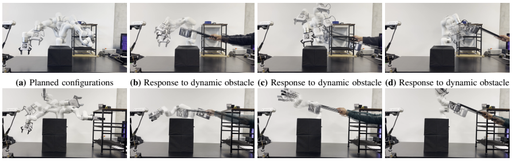
Fig. 6 :Bubble-CDF planner and DR-CBF control applied to two real-world setups for a 6-DoF xArm robot. The top row (a-d) represents Setup 1, with the robot navigating a cluttered environment featuring a combination of static and dynamic obstacles. Similarly, the bottom row (e-h) depicts Setup 2, showcasing the planner’s adaptability in a different obstacle layout. For both setups: (a, e) illustrate the bubble-CDF planned configuration in static environments, while (b-d, f-h) demonstrate the robot’s real-time adaptive responses to dynamic obstacles.
원문 · CC BY 4.0 · Kehan Long, Ki Myung Brian Lee, Nikola Raicevic, Niyas Attasseri, Melvin Leok, Nikolay Atanasov · Neural Configuration-Space Barriers for Manipulation Planning and Control · 원문 그림 인용 · 원본 PDF 12쪽에서 그림 영역을 추출했습니다.한계와 남은 질문
저자들은 DR-CBF-QP가 제어 한계나 불확실성 집합 때문에 실행 불가능해질 수 있으며, 명시적인 회복 전략은 향후 과제로 남긴다고 밝힙니다. 실험에서는 Wasserstein 반경과 샘플 수를 실행 불가능성이 나타나지 않도록 선택했다고 설명합니다. 따라서 이 결과는 논문이 검증한 설정의 범위 안에서 읽어야 합니다.
논문 정보
- 저자
- Kehan Long, Ki Myung Brian Lee, Nikola Raicevic, Niyas Attasseri, Melvin Leok, Nikolay Atanasov
- 학회·저널
- arXiv · 프리프린트
- 최초 공개일
- 2025년 3월 6일
- 등록일
- 2026년 11월 6일
- 수정일
- 2026년 5월 22일
- 버전
- v4
- arXiv
- 2503.04929
- 분류
- cs.RO · cs.LG · eess.SY
- 원문 이용 조건
- CC BY 4.0
- 제공 범위
- 논문 정보, 해설, 허용된 원문 그림
AI 해설은 논문 원문과 별개의 설명이며 오류가 있을 수 있습니다. 원문과 그림은 각 출처의 이용 조건과 따로 표시된 권리를 따릅니다.
초록
Planning and control for high-dimensional robot manipulators in cluttered dynamic environments require computational efficiency and robust safety guarantees. Inspired by recent advances in learning configuration-space distance functions (CDFs) as representations of robot bodies, we propose a unified approach for motion planning and control that formulates safety constraints as CDF barriers. A CDF barrier approximates the local free configuration space, substantially reducing the number of collision-checking operations during motion planning. However, learning a CDF barrier with a neural network and relying on online sensor observations introduces uncertainties that must be considered during control synthesis. To address this, we develop a distributionally robust CDF barrier formulation for control that accounts for modeling errors and sensor noise without assuming a known underlying distribution. Simulations and hardware experiments on a UFactory xArm6 manipulator show that our neural CDF barrier formulation enables efficient planning and robust safe control in cluttered and dynamic environments, relying only on onboard point-cloud observations.
원문 인용
Kehan Long, Ki Myung Brian Lee, Nikola Raicevic, Niyas Attasseri, Melvin Leok, Nikolay Atanasov (2025). Neural Configuration-Space Barriers for Manipulation Planning and Control. arXiv:2503.04929v4. https://arxiv.org/abs/2503.04929v4
BibTeX
@misc{long2025neural,
  title = {{Neural Configuration-Space Barriers for Manipulation Planning and Control}},
  author = {Kehan Long and Ki Myung Brian Lee and Nikola Raicevic and Niyas Attasseri and Melvin Leok and Nikolay Atanasov},
  year = {2025},
  eprint = {2503.04929},
  archivePrefix = {arXiv},
  url = {https://arxiv.org/abs/2503.04929v4}
}