논문 해설
Psychometric Predictive Power of Large Language Models
대규모 언어 모델의 심리측정적 예측력
- 연구 문제 지시 튜닝된 LLM은 기반 LLM보다 인간 독해 시간을 더 잘 모사하지 못하며, 프롬프팅과 메타언어 질의도 직접 확률 측정을 넘지 못했습니다.
- 연구 방법 여러 LLM에서 단어별 surprisal과 엔트로피를 계산하고, 독해 시간 회귀에서 PPP를 측정합니다. 이어서 프롬프트 조건부 확률과 메타언어 프롬프팅을 같은 기준으로 비교합니다.
- 주요 결과 같은 PPL에서 IT-LLM은 기반 LLM보다 낮은 PPP를 보였고, 프롬프트 조건부 설정 468개 중 448개도 기반 회귀선 아래에 있었습니다. 메타언어 프롬프팅의 순위 상관은 대부분 0 근처였습니다.
문제: 지시 튜닝이 독해 모사를 개선하는가
다음 단어의 확률은 독해 시간을 설명하는 강한 예측 변수로 알려져 있습니다. 최근에는 사람의 선호에 맞추어 튜닝한 지시 튜닝 LLM(IT-LLM)과 프롬프팅이 널리 쓰이지만, 이것이 인간의 문장 처리와 더 잘 맞는지는 명확하지 않습니다. 이 논문은 독해 시간에 대한 surprisal의 설명력을 Psychometric Predictive Power(PPP)로 측정하여, 지시 튜닝과 프롬프팅이 기반 LLM의 직접 확률 측정보다 나은 추정을 주는지 검증합니다.
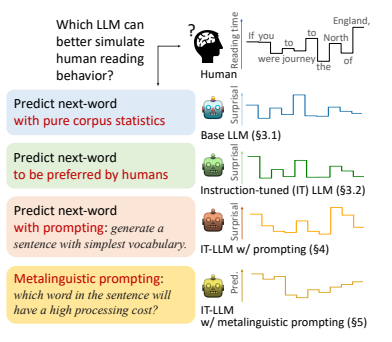
Figure 1 : Comparing the “reading behavior” of hu- mans and LLMs, i.e., reading time from humans is compared with surprisal from LLMs (§2.1). We in- vestigate which surprisal values estimated by: (i) base LLMs, (ii) instruction-tuned (IT) LLMs, (iii) IT-LLMs with prompting, or (iv) IT-LLMs with metalinguistic prompting can better simulate human reading time.
원문 · CC BY 4.0 · Tatsuki Kuribayashi, Yohei Oseki, Timothy Baldwin · Psychometric Predictive Power of Large Language Models · 원문 그림 인용 · 원본 PDF 1쪽에서 그림 영역을 추출했습니다.PPP는 독해 시간을 기준 요인에 더한 회귀 모델과 surprisal 요인을 추가한 회귀 모델의 토큰당 평균 로그우도 차이로 정의됩니다. 따라서 높은 PPP는 surprisal 요인이 독해 시간을 얼마나 잘 설명하는지를 뜻합니다.
surprisal과 엔트로피 기반 PPP 계산
각 모델 θ는 문장 내 문맥 w<t가 주어졌을 때 단어의 surprisal h를 −log2 pθ(w|w<t)로 계산합니다. 같은 문맥에서 기대 surprisal을 평균한 Shannon 엔트로피와, α = 0.5를 사용한 Rényi 엔트로피 H0.5도 함께 계산합니다. Shannon 엔트로피는 Rényi 엔트로피의 α = 1 특수 경우입니다.
회귀 모델에는 길이와 빈도 같은 기준 요인을 넣고, surprisal 또는 entropy 요인을 추가하여 두 모델을 비교합니다. 단어 경계는 독해 시간 코퍼스를 따르며, 여러 하위 토큰이 있으면 누적 surprisal을 사용합니다.
기반 LLM과 IT-LLM의 PPP 비교
먼저 기반 LLM에서 surprisal 이론의 기존 결과가 재현되는지 확인합니다. Dundee Corpus와 Natural Stories Corpus에서 PPP는 대부분 설정에서 양수로 나타나며, PPP와 PPL의 관계는 기반 LLM 회귀선에서 역상관을 보입니다. 이 결과는 기반 LLM에 대한 관찰이며, 두 데이터셋과 제시된 모델 범위 안에서 해석됩니다.
IT-LLM은 같은 PPL을 가진 기반 LLM 회귀선보다 아래에 위치합니다. 34개 IT-LLM×metric×corpus 설정 중 32개가 회귀선 아래에 있으며, 이 빈도는 이항 검정에서 우연보다 유의하게 많다고 보고됩니다. 저자들은 이를 지시 튜닝의 목적이 순수 언어 모델링과 달라졌기 때문으로 해석합니다.
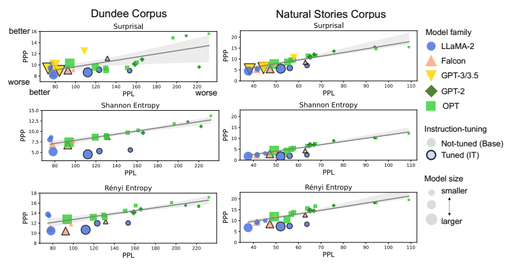
Figure 2 : The relationship between PPL and PPP (see exact scores in Table 1). Each point corresponds to each LLM, and those with a black edge line are IT-LLMs. The regression line is estimated by base LLMs, and the colored area presents a 95% confidence interval. IT-LLMs were relatively poor (below the line) at balancing PPL and PPP.
원문 · CC BY 4.0 · Tatsuki Kuribayashi, Yohei Oseki, Timothy Baldwin · Psychometric Predictive Power of Large Language Models · 원문 그림 인용 · 원본 PDF 4쪽에서 그림 영역을 추출했습니다.프롬프트 조건부 확률의 PPP
두 번째 실험은 프롬프트를 w<t 앞에 붙여 다음 단어 확률을 조건화합니다. 문법을 단순하게 쓰라는 Syn↓나 Task2 같은 프롬프트는 일부 설정에서 기준선보다 나은 PPP를 보입니다. 특히 엔트로피 측정에서 그 경향이 두드러집니다. 생성 문장 분석에서는 Syn↑·Lex↑ 등 지시가 의도한 문장 복잡도와 어휘 빈도 변화를 보였습니다.
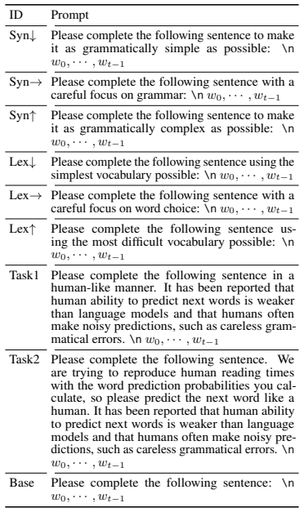
Table 2 : Our examined prompts. The IDs shown in the first column are also used in Tables 3 and 4.
원문 · CC BY 4.0 · Tatsuki Kuribayashi, Yohei Oseki, Timothy Baldwin · Psychometric Predictive Power of Large Language Models · 원문 그림 인용 · 원본 PDF 5쪽에서 그림 영역을 추출했습니다.그러나 468개 {prompt×model×metric×corpus} 설정 중 448개가 기반 LLM 회귀선 아래에 있었습니다. 따라서 이 프롬프트 조건부 모델들은 작은 기반 LLM, 예를 들어 GPT-2 small이 보인 최고 PPP를 넘지 못했습니다. 이 결과는 본문 실험의 설정 범위에서 확인된 것입니다.
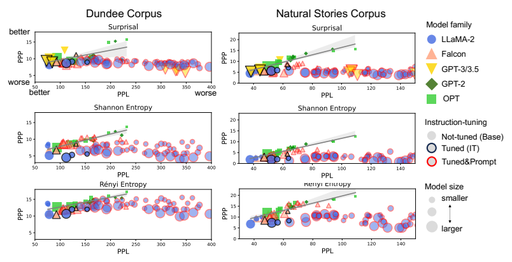
Figure 3 : The PPL and PPP of LLMs with prompting are plotted at the top of Figure 2. Each point corresponds to a given combination of LLM and prompt, and those with red-edged outlines are IT-LLMs with a particular prompt. The PPP–PPL regression line is estimated by base LLMs, and the colored area presents the 95% confidence interval. IT-LLMs with prompting are poorer than base LLMs at balancing PPL and PPP.
원문 · CC BY 4.0 · Tatsuki Kuribayashi, Yohei Oseki, Timothy Baldwin · Psychometric Predictive Power of Large Language Models · 원문 그림 인용 · 원본 PDF 8쪽에서 그림 영역을 추출했습니다.메타언어 프롬프팅과 직접 확률 측정
세 번째 실험은 모델에게 단어의 처리 비용 순위를 직접 묻는 메타언어 프롬프팅을 평가합니다. 3-shot 설정에서 세 번의 실행을 평균하고, 예측 순위와 실제 독해 시간 사이의 Spearman 순위 상관을 계산합니다. 측정 대상은 DC 100개 문장과 NS 50개 문장입니다.
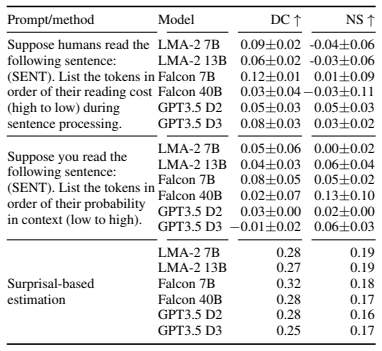
Table 5 : Average and standard deviation of rank corre- lation ρ between estimated cognitive load and reading time of words across three different runs. “LMA-2” de- notes the LLaMA-2 family.
원문 · CC BY 4.0 · Tatsuki Kuribayashi, Yohei Oseki, Timothy Baldwin · Psychometric Predictive Power of Large Language Models · 원문 그림 인용 · 원본 PDF 8쪽에서 그림 영역을 추출했습니다.메타언어 프롬프팅의 상관은 대부분 0 근처이며, surprisal 기반 상관보다 유의하게 낮습니다. 또한 확률 순위와 실제 surprisal의 상관도 대략 0.1에서 0.2 사이로 낮았습니다. 이 결과는 메타언어 응답이 직접 확률 측정을 대체하지 못한다는 증거로 읽힙니다.
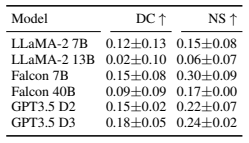
Table 6 : Rank correlation ρ between the word prob- ability (rank) estimated by the prompt and the actual surprisal values computed by the corresponding model.
원문 · CC BY 4.0 · Tatsuki Kuribayashi, Yohei Oseki, Timothy Baldwin · Psychometric Predictive Power of Large Language Models · 원문 그림 인용 · 원본 PDF 9쪽에서 그림 영역을 추출했습니다.적용 범위와 한계
저자들이 밝힌 주된 한계는 세 가지입니다. 첫째, 영어만 대상으로 했습니다. 둘째, 세 계열의 IT-LLM만 평가했습니다. 셋째, 프롬프트 종류가 제한적이었습니다. GPT-3.5 모델은 확률 출력이 제한되어 사용할 수 없는 시점이 있었으며, 지시 튜닝의 실제 RLHF 효과를 통제 실험으로 분리하지는 못했습니다.
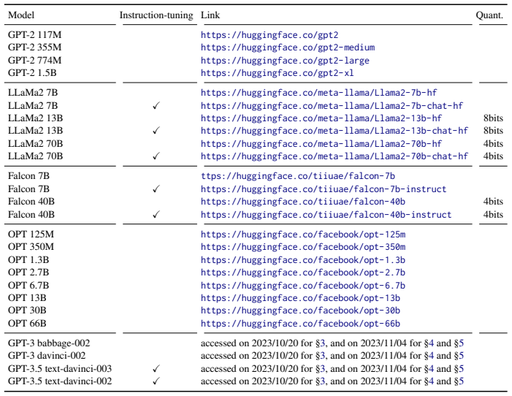
Table 7 : Information about the LLMs.
원문 · CC BY 4.0 · Tatsuki Kuribayashi, Yohei Oseki, Timothy Baldwin · Psychometric Predictive Power of Large Language Models · 원문 그림 인용 · 원본 PDF 15쪽에서 그림 영역을 추출했습니다.따라서 결과는 이 설정에서의 관찰로 읽어야 하며, 지시 튜닝 전반이나 모든 LLM에 대한 확정적 결론으로 확대할 수 없습니다.
논문 정보
- 저자
- Tatsuki Kuribayashi, Yohei Oseki, Timothy Baldwin
- 학회·저널
- arXiv · 프리프린트
- 최초 공개일
- 2023년 11월 13일
- 등록일
- 2026년 11월 5일
- 수정일
- 2024년 4월 15일
- 버전
- v3
- arXiv
- 2311.07484
- 분류
- cs.CL · cs.AI
- 원문 이용 조건
- CC BY 4.0
- 제공 범위
- 논문 정보, 해설, 허용된 원문 그림
AI 해설은 논문 원문과 별개의 설명이며 오류가 있을 수 있습니다. 원문과 그림은 각 출처의 이용 조건과 따로 표시된 권리를 따릅니다.
초록
Instruction tuning aligns the response of large language models (LLMs) with human preferences. Despite such efforts in human--LLM alignment, we find that instruction tuning does not always make LLMs human-like from a cognitive modeling perspective. More specifically, next-word probabilities estimated by instruction-tuned LLMs are often worse at simulating human reading behavior than those estimated by base LLMs. In addition, we explore prompting methodologies for simulating human reading behavior with LLMs. Our results show that prompts reflecting a particular linguistic hypothesis improve psychometric predictive power, but are still inferior to small base models. These findings highlight that recent advancements in LLMs, i.e., instruction tuning and prompting, do not offer better estimates than direct probability measurements from base LLMs in cognitive modeling. In other words, pure next-word probability remains a strong predictor for human reading behavior, even in the age of LLMs.
원문 인용
Tatsuki Kuribayashi, Yohei Oseki, Timothy Baldwin (2023). Psychometric Predictive Power of Large Language Models. arXiv:2311.07484v3. https://arxiv.org/abs/2311.07484v3
BibTeX
@misc{kuribayashi2023psychometric,
  title = {{Psychometric Predictive Power of Large Language Models}},
  author = {Tatsuki Kuribayashi and Yohei Oseki and Timothy Baldwin},
  year = {2023},
  eprint = {2311.07484},
  archivePrefix = {arXiv},
  url = {https://arxiv.org/abs/2311.07484v3}
}