논문 해설
Obstacle Avoidance using Dynamic Movement Primitives and Reinforcement Learning
동적 움직임 프리미티브와 강화학습을 이용한 장애물 회피
- 연구 문제 장애물 회피 궤적을 빠르게 얻으려면 대량의 데이터나 사람 시연이 필요한 기존 학습 방식이 부담이 됩니다.
- 연구 방법 단일 인공 시연을 DMP로 부호화하고 PI²로 장애물 구성별 궤적 데이터셋을 만든 뒤, 신경망이 작업 파라미터로부터 DMP 파라미터를 추론합니다.
- 주요 결과 3P-2D 모델은 시뮬레이션 무작위 장애물 구성 1000개에서 오프셋 적용 시 100% 회피 성공률을 보였고, pick-and-drop 비교에서 RRT-Connect 대비 짧은 궤적과 평활한 실행을 보였습니다.
문제 배경: 학습 기반 계획의 데이터 비용
로봇 매니퓰레이터의 장애물 회피 경로를 빠르게 얻으려면 샘플링 기반 계획기는 온라인 재표본추출 때문에 근최적 경로를 빨리 찾기 어렵습니다. 학습 기반 방법은 계산 부담을 오프라인 학습으로 옮기지만, 많은 학습 데이터나 사람 시연을 요구하는 경우가 많습니다. 움직임 프리미티브 기반 방법도 일반화 능력, 평활성, 최적성이 시연의 수와 품질에 의존하며 시연 수집 비용이 큽니다. 이 논문은 이 문제를 단일 인공 시연으로 줄이는 것을 목표로 합니다.
단일 시연에서 DMP 파라미터 추론까지
방법은 네 단계로 이루어집니다. 먼저 최소 저크 특성을 가진 선형 인공 시연을 DMP로 부호화합니다. DMP는 각 자유도를 스프링-댐퍼 시스템과 학습 가능한 강제항으로 모델링하며, 강제항은 Gaussian radial basis functions의 가중 합으로 근사됩니다. 다음으로 PI²는 DMP 파라미터 θ에 가우시안 노이즈를 주어 Q개의 정책을 만들고, 궤적 수준 비용 S에 따라 가중치를 계산해 가중 평균으로 θ를 갱신합니다. 이 반복으로 장애물 구성마다 충돌 없는 궤적의 데이터셋이 만들어지며, 신경망은 작업 파라미터를 입력받아 DMP 파라미터를 출력하도록 학습됩니다. 온라인 단계에서는 포인트 클라우드로 작업 파라미터를 도출한 뒤 학습된 신경망의 출력으로 DMP를 설정해 궤적을 생성합니다.
3P-2D 모델의 회피 성능
3P-2D 모델은 장애물 크기와 위치를 나타내는 세 개의 작업 파라미터를 입력으로 받습니다. 이 모델은 50회의 PI² 최적화 실행으로 5.1k개의 궤적을 만들고, 두 개의 은닉층(256, 512 노드)을 100 epoch 동안 학습합니다. 무작위로 생성한 작업 파라미터 1000개에서 평가했으며, 오프셋 o=0.02L를 모든 작업 파라미터에 적용하면 회피 성공률이 100%입니다. 이 결과는 3P-2D 모델과 이 시뮬레이션 평가 조건에서 얻은 것입니다.
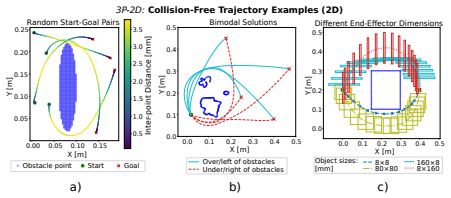
Fig. 3 . 2D avoidance example using the3P-2Dmodel with different obstacles (blue): a) near-optimal, smooth trajectories for random start and goal initialization, b) bi-modal solutions, c) considering four different obstacle dimensions.
원문 · CC BY 4.0 · Dominik Urbaniak, Alejandro Agostini, Pol Ramon, Jan Rosell, Raúl Suárez, Michael Suppa · Obstacle Avoidance using Dynamic Movement Primitives and Reinforcement Learning · 원문 그림 인용 · 원본 PDF 5쪽에서 그림 영역을 추출했습니다.pick-and-drop과 기준선 비교
pick-and-drop 실험에서는 1P-2D, 3P-2D, Linear 기준선, MoveIt의 RRT-Connect를 비교했습니다. 무작위 구성 50개에서 실행 시간, 계획 시간, 검출 시간, 궤적 길이를 측정했습니다. 3P-2D 모델은 짧은 궤적 길이와 평활한 실행을 함께 보였으며, 원문은 계획 및 실행 시간의 합이 Linear 방법보다 평균 16% 빠르다고 보고합니다. RRT-Connect는 모든 실행 가능 실행에서 해를 찾았지만 궤적 길이의 변동이 컸습니다. 1P-2D는 13회에서 해를 찾지 못해 RRT로 대체되었습니다.
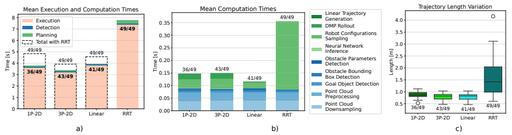
Fig. 5 . Comparison of our1P-2Dand3P-2Dmodels to two baselines:LinearandRRT. a) Computation time for detection and planning and execution time. b) Detailed contributions to computation time for detection and planning. c) Variations of the trajectory lengths.
원문 · CC BY 4.0 · Dominik Urbaniak, Alejandro Agostini, Pol Ramon, Jan Rosell, Raúl Suárez, Michael Suppa · Obstacle Avoidance using Dynamic Movement Primitives and Reinforcement Learning · 원문 그림 인용 · 원본 PDF 7쪽에서 그림 영역을 추출했습니다.스케일링 오차와 적용 범위
DMP의 스케일링 기능은 일반화 능력을 높이지만 오차도 함께 확대합니다. 그래서 삽입이나 간극 통과처럼 엄격한 허용오차가 필요한 응용에는 어렵다고 저자들은 설명합니다. 또한 3D 회피 실험에서는 20회 중 한 번이 틈 내부에서 충돌했으며, 이는 오프셋으로 개선할 수 없었다고 보고됩니다. 외삽 능력도 학습 범위를 벗어나면 정확도가 떨어집니다.
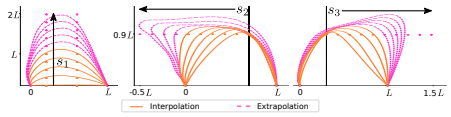
Fig. 7 . Extrapolation ability of3P-2Dfor each of the three task parameter.
원문 · CC BY 4.0 · Dominik Urbaniak, Alejandro Agostini, Pol Ramon, Jan Rosell, Raúl Suárez, Michael Suppa · Obstacle Avoidance using Dynamic Movement Primitives and Reinforcement Learning · 원문 그림 인용 · 원본 PDF 8쪽에서 그림 영역을 추출했습니다.논문 정보
- 저자
- Dominik Urbaniak, Alejandro Agostini, Pol Ramon, Jan Rosell, Raúl Suárez, Michael Suppa
- 학회·저널
- arXiv · 프리프린트
- 최초 공개일
- 2025년 10월 10일
- 등록일
- 2026년 11월 6일
- 수정일
- 2025년 10월 10일
- 버전
- v1
- arXiv
- 2510.09254
- 분류
- cs.RO · cs.AI
- 원문 이용 조건
- CC BY 4.0
- 제공 범위
- 논문 정보, 해설, 허용된 원문 그림
AI 해설은 논문 원문과 별개의 설명이며 오류가 있을 수 있습니다. 원문과 그림은 각 출처의 이용 조건과 따로 표시된 권리를 따릅니다.
초록
Learning-based motion planning can quickly generate near-optimal trajectories. However, it often requires either large training datasets or costly collection of human demonstrations. This work proposes an alternative approach that quickly generates smooth, near-optimal collision-free 3D Cartesian trajectories from a single artificial demonstration. The demonstration is encoded as a Dynamic Movement Primitive (DMP) and iteratively reshaped using policy-based reinforcement learning to create a diverse trajectory dataset for varying obstacle configurations. This dataset is used to train a neural network that takes as inputs the task parameters describing the obstacle dimensions and location, derived automatically from a point cloud, and outputs the DMP parameters that generate the trajectory. The approach is validated in simulation and real-robot experiments, outperforming a RRT-Connect baseline in terms of computation and execution time, as well as trajectory length, while supporting multi-modal trajectory generation for different obstacle geometries and end-effector dimensions. Videos and the implementation code are available at https://github.com/DominikUrbaniak/obst-avoid-dmp-pi2.
원문 인용
Dominik Urbaniak, Alejandro Agostini, Pol Ramon, Jan Rosell, Raúl Suárez, Michael Suppa (2025). Obstacle Avoidance using Dynamic Movement Primitives and Reinforcement Learning. arXiv:2510.09254v1. https://arxiv.org/abs/2510.09254v1
BibTeX
@misc{urbaniak2025obstacle,
  title = {{Obstacle Avoidance using Dynamic Movement Primitives and Reinforcement Learning}},
  author = {Dominik Urbaniak and Alejandro Agostini and Pol Ramon and Jan Rosell and Raúl Suárez and Michael Suppa},
  year = {2025},
  eprint = {2510.09254},
  archivePrefix = {arXiv},
  url = {https://arxiv.org/abs/2510.09254v1}
}