논문 해설
Halting in Recurrent Sequence Models
순환 시퀀스 모델에서의 정지(halting)
- 연구 문제 반복 복사 과제에서 순환 모델이 EOS를 언제 출력할지 은닉 상태가 어떻게 정하는지가 아직 명확하지 않습니다.
- 연구 방법 반복 횟수만 다른 두 궤적의 차이를 RNN과 SSM에서 추적하고, 상태 변환이나 위상 회전으로 정지 시점을 개입합니다.
- 주요 결과 RNN에서는 아핀 상태 변환 T_128이 새 시퀀스에서 완전 시퀀스 정확도 0.944로 정지를 한 복사 앞당겼고, SSM에서는 평면별 독립 회전이 정지 행동 대부분을 없앴습니다.
EOS 정지 문제
순환 시퀀스 모델은 출력이 끝나는 시점을 EOS 토큰으로 알려야 하지만, 학습 중 EOS는 다른 토큰과 같은 어휘 항목일 뿐 별도의 손실 항이나 보상이 없습니다. 이 논문은 이런 조건에서 모델이 언제 EOS를 내보내는지가 아직 잘 이해되지 않았다고 짚으며, 반복 복사 과제를 최소한의 설정으로 삼아 정지 시점의 내부 메커니즘을 묻습니다. 모델은 시퀀스 S를 지시된 K번 반복한 뒤 EOS를 출력하도록 학습되며, 같은 S를 쓰면서 반복 횟수 지시만 바꾼 두 궤적의 은닉 상태 차이가 정지 시점까지 어떻게 전달되는지가 핵심 질문입니다.
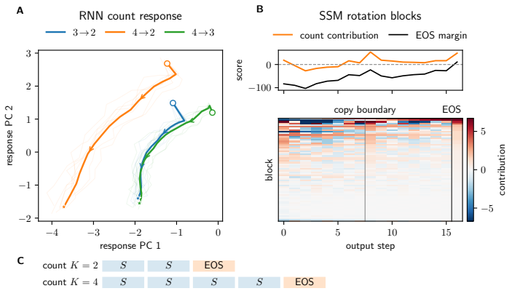
Figure 1 : The count instruction changes the EOS time while the stored sequence remains fixed.A, RNN trajectory differences on held-out sequences projected onto two principal components obtained from separate sequences. Open circles mark the state after the count instruction, stars mark the earlier target EOS, and arrows follow the autonomous recurrence.B, mean contributions of the 64 SSM rotation blocks to the limiting EOS comparison for count change 4→2 . Between copy boundaries the contributions have mixed signs. At the target EOS, most contributions have the same sign and the EOS margin crosses zero.C, repeat-copy examples ending after two or four copies of S. RNN seed 5, the model with the median energy in the two plotted components, and SSM seed 1 are shown.
원문 · CC BY 4.0 · Simon Dräger · Halting in Recurrent Sequence Models · 원문 그림 인용 · 원본 PDF 2쪽에서 그림 영역을 추출했습니다.tanh RNN의 상태 차이 전달
EOS 마진 m_t는 EOS 점수에서 다른 토큰 점수의 최댓값을 뺀 값으로, 양수일 때 EOS가 출력됩니다. 입력이 끝난 뒤 입력은 0이 되고 재귀는 자율적으로 돌아가므로, 정지 시점은 은닉 상태 자체가 운반해야 합니다. RNN에서 두 궤적의 차이 Δ_JK,t는 Δ_JK,t+1 = D_JK,t+1 W_h Δ_JK,t로 전파되며, 여기서 D는 tanh 할선 s(a,b)를 대각에 담은 행렬입니다. 즉 W_h로 섞은 뒤 각 은닉 유닛을 현재 상태에 따라 (0,1] 범위로 줄이는 두 단계가 반복됩니다. 저자들은 Table 1에서 할선을 identity, 무작위 치환, 시간 이동 등으로 바꾸어 보았을 때 유닛 정체성과 시간 순서가 가장 큰 영향을 준다고 보고합니다.
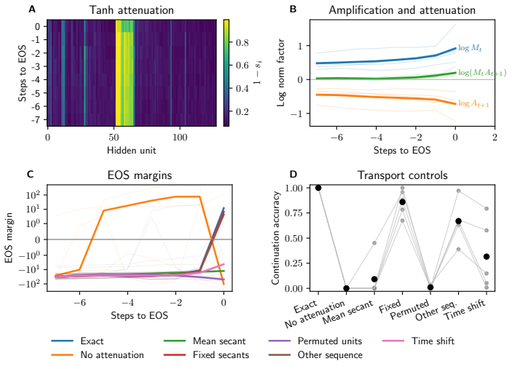
Figure 2 : Transport of the RNN trajectory difference.A, mean tanh secants for model seed 5 and count change 4→2 , with hidden units ordered by the step of strongest attenuation on separate sequences.B, multiplication by Wh expands the trajectory difference before tanh attenuates it. Faint lines denote model means and solid lines denote the cohort mean.C, EOS margins along the two trajectories.D, continuation accuracy under the exact secants and their controlled replacements.
원문 · CC BY 4.0 · Simon Dräger · Halting in Recurrent Sequence Models · 원문 그림 인용 · 원본 PDF 5쪽에서 그림 영역을 추출했습니다.복사 경계에서 남은 횟수 줄이기
RNN 상태는 (n,p)로 색인할 수 있으며 n은 남은 복사 횟수, p는 복사 내 위치입니다. 서로 다른 반복 지시를 받았더라도 같은 (n,p)와 S를 가진 상태는 가까이 모입니다. 저자들은 한 복사의 위치 평균으로 사이클 중심을 만들고, 이 중심들이 PCA 두 축에서 남은 단계 수 τ에 따라 정렬된다고 기록했습니다. 이어 복사 경계에서 남은 복사를 하나 줄이는 아핀 상태 변환 T_k를 별도 시퀀스로 학습했습니다. 이 변환을 적용하면 원래 RNN은 한 복사 일찍 EOS를 출력하고, 그 이전 토큰은 그대로 유지됩니다.
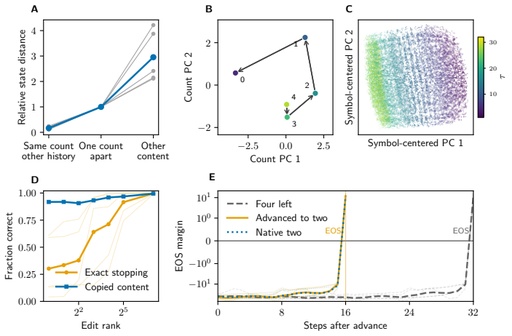
Figure 3 : RNN states indexed by the number of output steps remaining.A, distances between states that share (n, p)and S under different count instructions, between states one copy apart, and between states storing other content, each relative to the distance between states one copy apart. Gray lines denote models and the blue line denotes their mean.B, cycle centers projected onto two principal components obtained from separate sequences. Arrows follow one complete copy.C, evaluation states of model seed 3, the model with the median R2, after subtracting the fitting-set mean state of each emitted symbol, projected onto the first two principal components of the fitting states and colored by τ.D, stopping and content accuracy after the affine state transformation of Equation (7) as a function of its rank.E, EOS margins after the native recurrence advances a state by two copies.
원문 · CC BY 4.0 · Simon Dräger · Halting in Recurrent Sequence Models · 원문 그림 인용 · 원본 PDF 7쪽에서 그림 영역을 추출했습니다.선형 SSM의 회전 평면과 위상 정렬
선형 SSM은 A_q = ρ_q Rot(ω_q) 형태의 64개 2×2 회전 블록으로 구성됩니다. 자율 출력 u단계 뒤 평면 q의 기여는 ρ_q^u와 회전각 φ + uω_q로 쓰이며, 출력 행렬이 이 기여들을 합산해 EOS 비교 Δg를 만듭니다. 복사 중에는 평면 기여들이 상쇄되고 정지 시점 근처에서는 정렬되어 EOS 비교를 키웁니다. 평면별로 위상만 독립 회전하면 진폭과 복사 내용은 보존되지만 정지 행동이 대부분 사라지고, 모든 평면을 같은 각도로 회전하면 상대 위상은 유지되어 정지가 0.268에서 0.316의 롤아웃에서 남습니다.
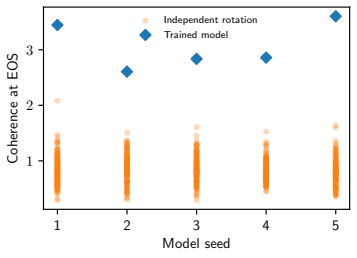
Figure 4 : Coherence of the rotation-plane contributions at EOS in each SSM, compared with independent amplitude-preserving rotations of the planes. Stopping and content accuracy under these rotations are given in Table 2.
원문 · CC BY 4.0 · Simon Dräger · Halting in Recurrent Sequence Models · 원문 그림 인용 · 원본 PDF 9쪽에서 그림 영역을 추출했습니다.개입 실험 결과
RNN에서는 Table 1의 여러 할선 대체를 평가했습니다. 할선을 identity로 두면 연속 정확도가 0.000이었고, 정확한 할선은 1.000이었습니다. 같은 조건에서 목표 상태를 섞거나 평균 상태로 바꾼 통제는 완전 출력을 거의 만들지 못했습니다. SSM에서는 고정 방향 (r−3)ξ를 세 복사 상태의 첫 출력 상태에 더하는 실험을 했고, r=1,2,4,5 목표에 맞춘 방향이 네 모델에서 완전 시퀀스 정확도 기준을 충족했습니다. 다만 r=6에서는 실패했습니다.
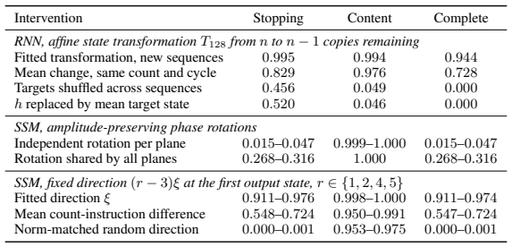
Table 2 : Interventions on the stopping mechanism, evaluated on held-out sequences. All accuracies are computed over every rollout. RNN entries are means over the five models, and SSM entries are ranges across the five models. The fixed-direction rows pool the targets r= 1,2,4,5 , starting from a rollout of three copies. Since the SSM rotations preserve almost all of the copied content, their complete-sequence accuracy rounds to the same range as their stopping accuracy.
원문 · CC BY 4.0 · Simon Dräger · Halting in Recurrent Sequence Models · 원문 그림 인용 · 원본 PDF 8쪽에서 그림 영역을 추출했습니다.한계
L이 고정되어 있으므로 (n,p)와 남은 단계 수 τ=nL−p 사이에는 전단사가 존재합니다. 그래서 이 실험만으로 네트워크가 두 축을 따로 표현하는지는 구분할 수 없습니다. 분석은 작은 tanh RNN과 선형 SSM에 한정되며, gated RNN과 비선형 SSM에서 같은 전달 형태가 나타나는지는 확인하지 않았습니다.
논문 정보
- 저자
- Simon Dräger
- 학회·저널
- arXiv · 프리프린트
- 최초 공개일
- 2026년 11월 16일
- 등록일
- 2026년 11월 17일
- 수정일
- 2026년 11월 16일
- 버전
- v1
- arXiv
- 2611.20377
- 분류
- cs.LG
- 원문 이용 조건
- CC BY 4.0
- 제공 범위
- 논문 정보, 해설, 허용된 원문 그림
AI 해설은 논문 원문과 별개의 설명이며 오류가 있을 수 있습니다. 원문과 그림은 각 출처의 이용 조건과 따로 표시된 권리를 따릅니다.
초록
Recurrent sequence models, such as recurrent neural networks (RNNs) and state space models (SSMs), are often trained to emit an end-of-sequence (EOS) token when their output sequence is complete. During training, EOS is treated as another token without a special loss term or incentive. Although this training paradigm is widely used, it is not understood how models decide to output EOS. We study a minimal version of the EOS halting problem in which networks are trained to emit a given input sequence an instructed number of times, followed by EOS. We train tanh RNNs and linear SSMs on this task, finding that the RNNs encode the number of tokens left to copy in a linear subspace, of which two principal components capture most of the variation. Hidden states with the same remaining count converge to a shared representation regardless of their instructed repeat count. By modulating the hidden state using an affine transformation at the boundary between copied sequences, we shift the RNN's state to the representation shared by states with one fewer copy remaining. The unchanged network emits EOS one copy earlier while reproducing the shortened target sequence in 94.4% of new sequences, revealing that this representation causally determines the stopping time. In the SSMs, the difference between trajectories with different repeat counts is separated across two-dimensional rotation planes whose contributions to the EOS comparison cancel during copying and align near the stopping time. Rotating the planes independently removes most of the intended stopping while preserving the copied content, which shows that the stopping time depends on the planes' relative phases. These results identify two candidate primitives of EOS halting in recurrent models: a shared encoding of the number of remaining tokens in tanh RNNs and phase alignment across fixed rotations in linear SSMs.
원문 인용
Simon Dräger (2026). Halting in Recurrent Sequence Models. arXiv:2611.20377v1. https://arxiv.org/abs/2611.20377v1
BibTeX
@misc{drger2026halting,
  title = {{Halting in Recurrent Sequence Models}},
  author = {Simon Dräger},
  year = {2026},
  eprint = {2611.20377},
  archivePrefix = {arXiv},
  url = {https://arxiv.org/abs/2611.20377v1}
}