논문 해설
Advanced Steel Microstructural Classification by Deep Learning Methods
딥러닝 기법을 이용한 고급 강철 미세구조 분류
- 연구 문제 강철 미세조직 분류는 주로 전문가의 수작업에 의존하며 객체 특징을 자동으로 학습하기 어려웠습니다. 이 논문은 FCNN 픽셀 분할과 max-voting을 결합한 분류 방법을 제안합니다.
- 연구 방법 FCNN으로 패치 단위 픽셀 분할을 수행한 뒤 객체 내 다수결로 클래스를 정하며, 객체 기반 CNN과 비교합니다.
- 주요 결과 SEM 기반 MVFCNN은 미세조정과 균형·증강 데이터 조건에서 93.94%의 정확도를 보고했습니다. 이는 보고된 이전 방법의 48.89%보다 높습니다.
강철 미세조직 분류의 어려움
강철의 기계적 성질은 미세조직에 크게 좌우되지만, 미세조직 분류는 대부분 전문가가 육안으로 판단하는 수작업으로 이루어집니다. 전문가마다 판단이 다를 수 있어 주관성이 생기며, 미세조직이 여러 상과 복잡한 하부구조의 조합일 수 있어 자동 분류도 어렵습니다. 기존 연구는 전문가가 설계한 특징을 추출한 뒤 분류기를 적용하는 방식이었고, 그중 Pauly 등의 방법은 네 개 클래스 데이터셋에서 48.89%의 정확도를 보고했습니다.
이 논문은 특징 추출과 분류를 나누지 않고, 완전합성곱신경망(FCNN)으로 이미지를 픽셀 단위로 분할한 뒤 객체 내 다수결(max-voting)로 객체 클래스를 정하는 방법을 다룹니다. 대상은 저탄소강의 페라이트 기지 위에 놓인 마르텐사이트, 템퍼드 마르텐사이트, 베이나이트, 펄라이트 객체입니다.
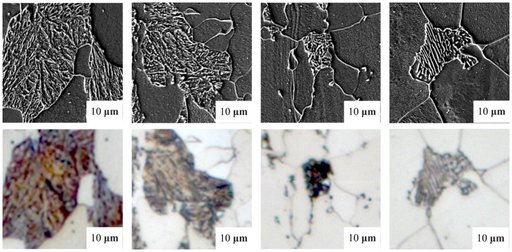
Figure 1 . Some examples of different microstructure classes. In columns from left to right: martensite, tempered martensite, bainite and pearlite phases or rather constituents as “objects” (second-phase) have been illustrated. Ferrite is the matrix phase in these images, having the role of the background. The upper row contains images taken by Scanning Electron Microscopy (SEM) and lower row taken by Light Optical Microscopy (LOM).
원문 · CC BY 4.0 · Seyed Majid Azimi, Dominik Britz, Michael Engstler, Mario Fritz, Frank Mücklich · Advanced Steel Microstructural Classification by Deep Learning Methods · 원문 그림 인용 · 원본 PDF 2쪽에서 그림 영역을 추출했습니다.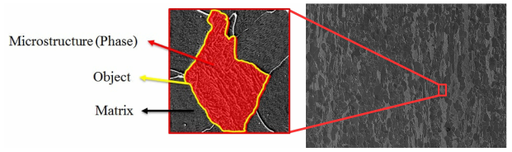
Figure 5 . SEM image of a steel microstructure. The right image is an original SEM image and the left one shows a magnified object. In this example, the substructure (microstructure) is martensitic within a ferritic matrix (background/first phase). The foreground (second/dual phase/constituent) will be considered as “object”.
원문 · CC BY 4.0 · Seyed Majid Azimi, Dominik Britz, Michael Engstler, Mario Fritz, Frank Mücklich · Advanced Steel Microstructural Classification by Deep Learning Methods · 원문 그림 인용 · 원본 PDF 9쪽에서 그림 영역을 추출했습니다.합성곱 신경망과 FCNN의 기본 구조
합성곱 신경망(CNN)은 합성곱, 풀링, 완전연결, 분류기 층을 쌓아 구성합니다. 합성곱 층은 입력에 선형 필터를 적용해 특징 맵을 만들고, 최대 풀링(max-pooling)은 각 부분 영역의 최댓값을 취해 작은 이동에 대한 불변성을 얻습니다. 분류기 층은 소프트맥스 함수로 클래스별 사후 확률 분포를 만들며, 손실은 교차 엔트로피로 측정됩니다.
FCNN은 CNN의 완전연결 층을 제거하고 업샘플링 층을 추가하여 입력과 같은 해상도의 픽셀별 예측을 얻는 구조입니다. 업샘플링 커널은 학습될 수 있으며, skip layer는 서로 다른 풀링 층의 정보를 융합해 세밀한 정보를 보존합니다. 학습은 손실의 기울기를 역전파하고 경사하강법으로 가중치를 갱신하는 방식으로 이루어집니다.
객체 기반 CNN 분류 방법
첫 번째 방법인 객체 기반 CNN은 이진 LOM 이미지로 객체의 위치를 구하고, 등록된 SEM 이미지에서 각 객체를 잘라낸 뒤 224x224 픽셀로 변형(warping)하여 분류합니다. CNN은 고정 크기 입력을 받기 때문에 이 변형 단계가 필요합니다. 논문은 세 가지 학습 전략을 비교합니다. 무작위 초기화에서 처음부터 학습하는 방식, 사전 학습된 네트워크를 미세조정하는 방식, 그리고 DeCAF 특징을 SVM으로 분류하는 방식입니다.
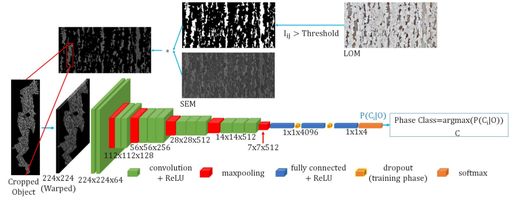
Figure 2 . Workflow of object-based classification approach using CNNs. In this figure one object in the SEM image is cropped and classified using a trained CNN. 224x224px is the fixed input size of the VGG16 network and “C” stands for class.
원문 · CC BY 4.0 · Seyed Majid Azimi, Dominik Britz, Michael Engstler, Mario Fritz, Frank Mücklich · Advanced Steel Microstructural Classification by Deep Learning Methods · 원문 그림 인용 · 원본 PDF 6쪽에서 그림 영역을 추출했습니다.객체 기반 방법에서 저자들은 크기 변형이 객체 내부의 질감 정보를 왜곡할 수 있다고 봅니다. 이 해석은 객체를 224x224 크기로 나눈 추가 실험에서 성능이 높아졌다는 관찰과 연결됩니다.
픽셀 분할과 max-voting을 결합한 MVFCNN
MVFCNN은 원본 SEM 또는 LOM 이미지를 1000x1000 픽셀 패치로 잘라 FCNN에 입력하고, 각 픽셀에 대해 소프트맥스 확률이 가장 높은 클래스를 선택합니다. 원본 이미지는 약 7000x8000 픽셀로 너무 커서 한 번에 처리할 수 없으므로, 슬라이딩 윈도우로 패치를 나누고 분할 결과를 다시 이어 붙입니다. 이후 객체 안의 픽셀 클래스 중 다수를 따르는 max-voting으로 객체의 클래스를 정합니다.
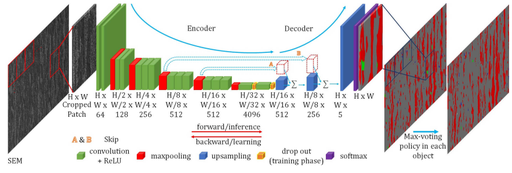
Figure 3 . Workflow of max-voted segmentation-based microstructural classification approach using FCNNs (MVFCNN). In this figure, the input image is an SEM image. The input image is first cropped. Then cropped patches are given to the FCNN part of the MVFCNN algorithm. The segmented crops are stitched together by FCNN. In the last step, the Max-voting policy is applied on the resulting stitched image. The max-voted output is used to classify microstructure objects. H and W represent height and width and the third number is the number of the feature map.
원문 · CC BY 4.0 · Seyed Majid Azimi, Dominik Britz, Michael Engstler, Mario Fritz, Frank Mücklich · Advanced Steel Microstructural Classification by Deep Learning Methods · 원문 그림 인용 · 원본 PDF 6쪽에서 그림 영역을 추출했습니다.클래스 불균형을 줄이기 위해 클래스마다 stride를 다르게 두어 패치 수를 맞추었고, 회전 증강을 적용하여 학습 이미지를 늘렸습니다. 이 방식은 객체를 고정 크기로 변형하지 않으므로, 객체 크기 변형에서 생기는 질감 왜곡을 피하는 것이 저자들의 설계 이유입니다.
데이터셋과 학습 설정의 범위
실험 데이터는 MECS와 MPI에서 제공된 강철 이미지 데이터셋이며, 21개의 등록된 LOM·SEM 이미지와 이진 LOM 이미지로 구성됩니다. 이미지별 분할은 학습 11장, 시험 10장이며 객체 기준으로는 학습 2831개, 시험 2262개입니다. 저자들은 이 데이터셋을 기반으로 한 개념 증명(proof of concept)을 제시하며, 베이나이트의 세부 하위 분류는 이후 과제로 남겨 둡니다.
학습 설정은 Caffe 프레임워크와 NVIDIA GPU에서 수행되었습니다. 객체 기반 CNN은 224x224 입력에 학습률 0.001을 사용했고, 미세조정에서는 학습률 0.0001을 사용했습니다. MVFCNN의 학습률은 FCN-32s, FCN-16s, FCN-8s에 대해 각각 10^-10, 10^-11, 3×10^-12로 설정되었습니다. 이 값들은 해당 MVFCNN 학습 설정에 묶인 것이며, 다른 모델이나 데이터에 그대로 적용되는 공통 설정이 아닙니다.
SEM 기반 분류 결과와 비교
SEM 이미지를 입력으로 한 MVFCNN은 균형 잡히고 증강된 학습 데이터에서 미세조정했을 때 93.94%의 정확도를 보고했습니다. 같은 조건에서 학습 데이터 불균형 상태의 처음부터 학습한 MVFCNN은 55.50%였습니다. 이전 상태기술 방법은 48.89%, 처음부터 학습한 CIFAR-Net 객체 기반 방법은 57.03%, 미세조정된 VGG16 객체 기반 방법은 66.50%로 보고되었습니다.
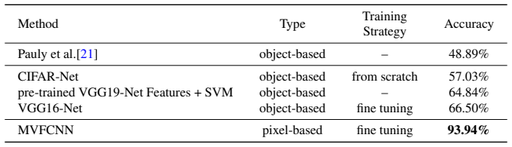
Table 1 . Microstructural classification results using object-based CNN and pixel-based MVFCNN approaches. The results show that object-based classification approaches improve over prior work at most by around 18 percent points. The pixel-based approach has even better performance by around 45 percent points improvement.
원문 · CC BY 4.0 · Seyed Majid Azimi, Dominik Britz, Michael Engstler, Mario Fritz, Frank Mücklich · Advanced Steel Microstructural Classification by Deep Learning Methods · 원문 그림 인용 · 원본 PDF 10쪽에서 그림 영역을 추출했습니다.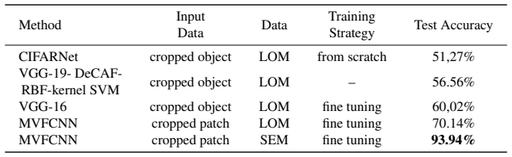
Table 4 . Confusion Matrix of the best MVFCNN approach. The matrix shows the number of samples for each class predicted by the system. Due to an unbalanced multi-class problem, percentage numbers for each class show normalized recall rates. Note: #48 not-segmented objects have not been considered. Overall accuracy is 93.94%.
원문 · CC BY 4.0 · Seyed Majid Azimi, Dominik Britz, Michael Engstler, Mario Fritz, Frank Mücklich · Advanced Steel Microstructural Classification by Deep Learning Methods · 원문 그림 인용 · 원본 PDF 11쪽에서 그림 영역을 추출했습니다.픽셀 분할 지표로는 pixel accuracy 93.92%, mean pixel accuracy 76.70%, mean IU 67.84%, frequency weighted IU 88.81%가 보고되었습니다. 이 수치는 SEM 기반 미세조정 FCNN의 결과이며, 객체 분류 정확도와 다른 지표입니다. 저자들은 픽셀 기반 방법이 객체 기반 방법보다 높은 정확도를 보인다고 해석합니다.
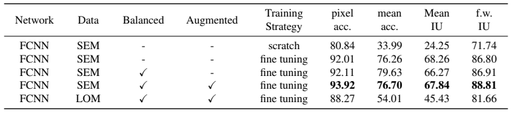
Table 5 . Evaluation of the segmentation-based approach using FCNNs with different training data and training strategies. As the results show, using SEM images, fine tuned networks and augmented data, the best performance can be achieved. However, LOM has an inferior performance compared to SEM.
원문 · CC BY 4.0 · Seyed Majid Azimi, Dominik Britz, Michael Engstler, Mario Fritz, Frank Mücklich · Advanced Steel Microstructural Classification by Deep Learning Methods · 원문 그림 인용 · 원본 PDF 11쪽에서 그림 영역을 추출했습니다.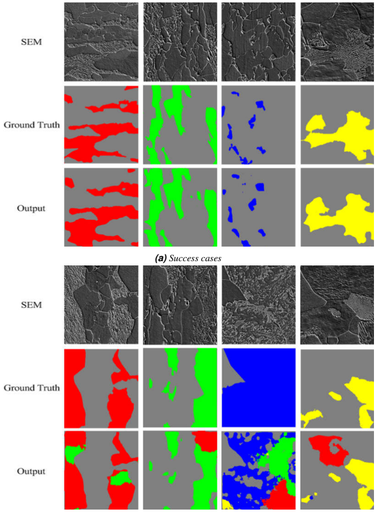
Figure 6 . a)Examples of a)successful and b)failure cases in SEM segmentation using the best MVFCNN approach configuration. The ground truth colors of martensite, tempered martensite, bainite and pearlite are red, green, blue and yellow respectively.
원문 · CC BY 4.0 · Seyed Majid Azimi, Dominik Britz, Michael Engstler, Mario Fritz, Frank Mücklich · Advanced Steel Microstructural Classification by Deep Learning Methods · 원문 그림 인용 · 원본 PDF 12쪽에서 그림 영역을 추출했습니다.LOM 결과와 한계
LOM 이미지 기반 MVFCNN은 최대 70.14%의 정확도를 보고했으며, 이는 SEM 기반 MVFCNN의 93.94%보다 낮습니다. 저자들은 이 차이를 LOM 해상도가 낮아 객체의 특징 크기를 충분히 구분하지 못하기 때문이라고 해석합니다. 또한 LOM 픽셀 정확도 94.11%는 페라이트 기지 분할에서 SEM과 비교 가능한 수준으로 보고되었습니다.
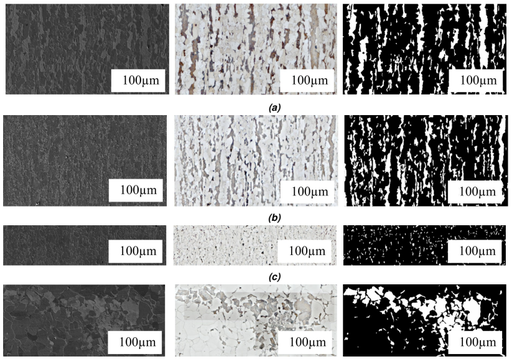
Figure 4 . SEM and LOM example images for each microstructure class with ferrite as matrix and with diameter of up to 100 µm. The columns show SEM, LOM and segmented LOM images from left to right. Size ratios of samples have been preserved. The sub-images are corresponding to (a) martensitic, (b) tempered martensitic, (c) bainitic and (d) pearlitic microstructures.
원문 · CC BY 4.0 · Seyed Majid Azimi, Dominik Britz, Michael Engstler, Mario Fritz, Frank Mücklich · Advanced Steel Microstructural Classification by Deep Learning Methods · 원문 그림 인용 · 원본 PDF 8쪽에서 그림 영역을 추출했습니다.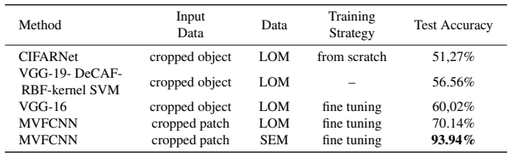
Table 3 . The results of the same experiments with LOM images are provided in this table. The results show inferior performance using LOM instead of SEM images.
원문 · CC BY 4.0 · Seyed Majid Azimi, Dominik Britz, Michael Engstler, Mario Fritz, Frank Mücklich · Advanced Steel Microstructural Classification by Deep Learning Methods · 원문 그림 인용 · 원본 PDF 11쪽에서 그림 영역을 추출했습니다.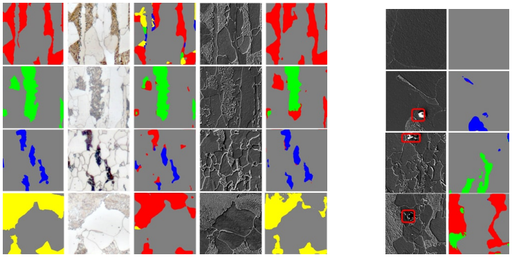
Figure 8 . (a) Comparison of LOM and SEM segmentation using FCNN network. Columns from left to right: Ground truth, LOM, LOM segmentation, SEM and SEM segmentation. (b) Noisy patches segmentation. First top row shows ferrite and the rests is noise. The ground truth colors of martensite, tempered martensite, bainite and pearlite are red, green, blue, and yellow, respectively.
원문 · CC BY 4.0 · Seyed Majid Azimi, Dominik Britz, Michael Engstler, Mario Fritz, Frank Mücklich · Advanced Steel Microstructural Classification by Deep Learning Methods · 원문 그림 인용 · 원본 PDF 14쪽에서 그림 영역을 추출했습니다.한계로는 베이나이트 클래스의 픽셀 정확도가 37.32%로 가장 낮다는 점이 있습니다. 저자들은 베이나이트 객체가 작고, 학습에 쓰이지 않은 transformed bainite 샘플이 시험 집합에 있기 때문이라고 봅니다. 데이터 증강 효과는 2%포인트 정도로 보고되어 크지 않았습니다.

Table 2 . The effect of fine tuning and data augmentation techniques using the MVFCNN approach are depicted. The results show that fine tuning together with data augmentation achieves the best result. However, the effect of data augmentation is not significant.
원문 · CC BY 4.0 · Seyed Majid Azimi, Dominik Britz, Michael Engstler, Mario Fritz, Frank Mücklich · Advanced Steel Microstructural Classification by Deep Learning Methods · 원문 그림 인용 · 원본 PDF 10쪽에서 그림 영역을 추출했습니다.
Table 6 . Pixel-wise accuracy evaluation of the segmentation approach using FCNNs for each microstructure class. The matrix has the highest and bainite the lowest pixel-wise accuracy.
원문 · CC BY 4.0 · Seyed Majid Azimi, Dominik Britz, Michael Engstler, Mario Fritz, Frank Mücklich · Advanced Steel Microstructural Classification by Deep Learning Methods · 원문 그림 인용 · 원본 PDF 13쪽에서 그림 영역을 추출했습니다.결론과 적용 범위
이 논문은 완전합성곱 신경망 기반 픽셀 분할과 max-voting을 결합하면 SEM 이미지의 강철 미세조직 객체를 기존 방법보다 높은 정확도로 분류할 수 있음을 보고합니다. 이 결과는 등록된 21개 이미지와 MECS 데이터셋, 그리고 저자들이 설정한 학습 조건에서 얻은 것입니다. 다른 강종, 다른 현미경 조건, 베이나이트 하위 분류에 대해서는 이 논문의 실험 범위 밖입니다.
논문 정보
- 저자
- Seyed Majid Azimi, Dominik Britz, Michael Engstler, Mario Fritz, Frank Mücklich
- 학회·저널
- arXiv · 프리프린트
- 최초 공개일
- 2017년 6월 20일
- 등록일
- 2026년 11월 6일
- 수정일
- 2018년 2월 15일
- 버전
- v2
- arXiv
- 1706.06480
- DOI
- 10.1038/s41598-018-20037-5
- 분류
- cs.CV · cond-mat.mtrl-sci
- 원문 이용 조건
- CC BY 4.0
- 제공 범위
- 논문 정보, 해설, 허용된 원문 그림
AI 해설은 논문 원문과 별개의 설명이며 오류가 있을 수 있습니다. 원문과 그림은 각 출처의 이용 조건과 따로 표시된 권리를 따릅니다.
초록
The inner structure of a material is called microstructure. It stores the genesis of a material and determines all its physical and chemical properties. While microstructural characterization is widely spread and well known, the microstructural classification is mostly done manually by human experts, which gives rise to uncertainties due to subjectivity. Since the microstructure could be a combination of different phases or constituents with complex substructures its automatic classification is very challenging and only a few prior studies exist. Prior works focused on designed and engineered features by experts and classified microstructures separately from the feature extraction step. Recently, Deep Learning methods have shown strong performance in vision applications by learning the features from data together with the classification step. In this work, we propose a Deep Learning method for microstructural classification in the examples of certain microstructural constituents of low carbon steel. This novel method employs pixel-wise segmentation via Fully Convolutional Neural Networks (FCNN) accompanied by a max-voting scheme. Our system achieves 93.94% classification accuracy, drastically outperforming the state-of-the-art method of 48.89% accuracy. Beyond the strong performance of our method, this line of research offers a more robust and first of all objective way for the difficult task of steel quality appreciation.
원문 인용
Seyed Majid Azimi, Dominik Britz, Michael Engstler, Mario Fritz, Frank Mücklich (2017). Advanced Steel Microstructural Classification by Deep Learning Methods. arXiv:1706.06480v2. https://doi.org/10.1038/s41598-018-20037-5
BibTeX
@article{azimi2017advanced,
  title = {{Advanced Steel Microstructural Classification by Deep Learning Methods}},
  author = {Seyed Majid Azimi and Dominik Britz and Michael Engstler and Mario Fritz and Frank Mücklich},
  year = {2017},
  eprint = {1706.06480},
  archivePrefix = {arXiv},
  doi = {10.1038/s41598-018-20037-5},
  url = {https://arxiv.org/abs/1706.06480v2}
}