논문 해설
DETER: Suppression During Pretraining for Tamper Resistance
DETER: 변조 저항성을 위한 pre-training 중 억제
- 연구 문제 pre-training 필터링과 사후 언러닝은 공개 모델에서 fine-tuning 후 목표 지식이 쉽게 복원될 수 있습니다.
- 연구 방법 pre-training 중 필터링된 코퍼스에 목표 도메인 문서에 대한 gradient ascent 억제 업데이트를 주기적으로 끼워 넣습니다.
- 주요 결과 1030M 설정에서 DETER는 FILTERING보다 PubMed fine-tuning 토큰을 20.36배 요구하는 것으로 기록되었습니다.
공개 모델에서 지식 억제가 어려운 이유
공개 가중치 모델은 가중치를 받은 누구나 미세조정할 수 있으므로, 사후에 특정 지식을 지우는 언러닝은 쉽게 되돌려질 수 있습니다. 이 논문은 목표 도메인으로 의학 지식을 사용하고, pre-training 단계에서 그 지식을 얻기 어렵게 만드는 방법을 다룹니다. 기존 필터링은 목표 도메인 문서를 pre-training 코퍼스에서 제거하지만, 최종 모델이 그 지식을 얻는지는 간접적으로만 통제합니다. 그래서 필터링만으로는 목표 지식을 완전히 차단하지 못한다는 한계가 남습니다.
pre-training 중 억제 업데이트의 구조
필터링된 코퍼스 D_ρ로 표준 pre-training을 하면서, 시작 스텝 t_start 이후 P 스텝마다 목표 도메인 문서 집합 D_F에서 S번의 억제 업데이트를 수행합니다. 억제 목적 함수 L_F는 기본적으로 D_F에 대한 음의 다음 토큰 손실, 즉 gradient ascent입니다. 억제 업데이트는 학습률에 억제 강도 c를 곱한 값으로 같은 파라미터를 갱신하며, pre-training과 억제는 옵티마이저 통계를 따로 유지합니다.
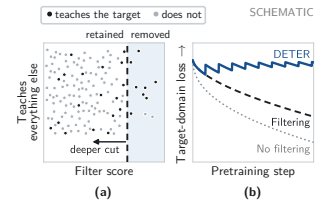
Figure 1 :Conceptual overview.(a) Filtering de- cides before pretraining: its selection still contains data that teach thetarget domainalong withre- tain capabilities, and a deeper cut removes more of both. (b) Adding periodic suppression provides a second layer of defense against target-domain learning.
원문 · CC BY 4.0 · Maria Ios Glarou, Martin Jaggi · DETER: Suppression During Pretraining for Tamper Resistance · 원문 그림 인용 · 원본 PDF 2쪽에서 그림 영역을 추출했습니다.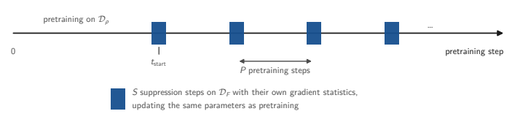
Figure 8 : Schedule of suppression steps during pretraining.
원문 · CC BY 4.0 · Maria Ios Glarou, Martin Jaggi · DETER: Suppression During Pretraining for Tamper Resistance · 원문 그림 인용 · 원본 PDF 14쪽에서 그림 영역을 추출했습니다.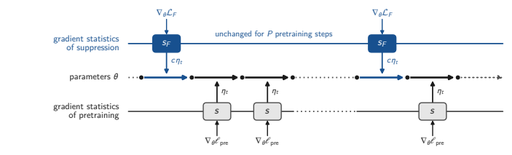
Figure 9 : Optimization states of pretrainer (learner) and suppressor (unlearner) throughout pretraining with interleaved suppression.
원문 · CC BY 4.0 · Maria Ios Glarou, Martin Jaggi · DETER: Suppression During Pretraining for Tamper Resistance · 원문 그림 인용 · 원본 PDF 15쪽에서 그림 영역을 추출했습니다.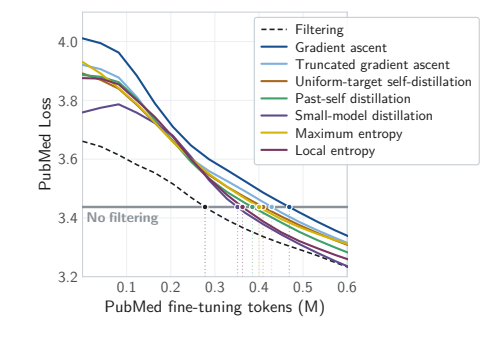
Figure 10 :Gradient ascent slows fine-tuning on PubMed the most among the suppression objectives.We fine-tune each 113MAdamWmodel on PubMed and report held-out PubMed loss. The horizontal line marks the PubMed loss of NO FILTERING. Results are for one fine-tuning seed.
원문 · CC BY 4.0 · Maria Ios Glarou, Martin Jaggi · DETER: Suppression During Pretraining for Tamper Resistance · 원문 그림 인용 · 원본 PDF 17쪽에서 그림 영역을 추출했습니다.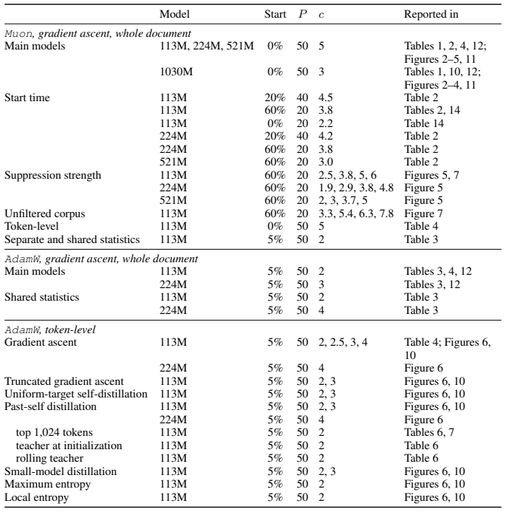
Table 8 : Suppression hyperparameters.
원문 · CC BY 4.0 · Maria Ios Glarou, Martin Jaggi · DETER: Suppression During Pretraining for Tamper Resistance · 원문 그림 인용 · 원본 PDF 18쪽에서 그림 영역을 추출했습니다.FILTERING과 사후 언러닝과의 비교
113M, 224M, 521M, 1030M 모델을 처음부터 사전학습하고, 최종 체크포인트를 PubMed로 미세조정하여 NO FILTERING의 PubMed 손실에 도달하는 데 필요한 토큰 수를 측정했습니다. 비교군은 FILTERING, TOKEN FILTERING, FILTERING 뒤에 적용한 RMU입니다. 이 측정에서 DETER는 모든 모델 크기에서 FILTERING보다 많은 fine-tuning 토큰을 요구했습니다.
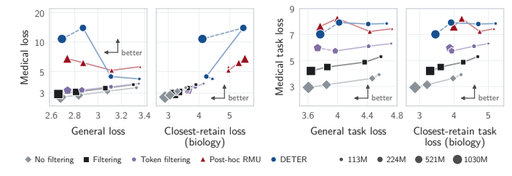
Figure 2 :At larger scale, suppression separates medicine more strongly from retained capabilities.Each panel plots medical loss against retained loss before fine-tuning. The first two panels report corpus loss and the last two task loss. For corpus loss, medical, general, and closest-retain (biology) correspond to PubMed, retained FineWeb-Edu, and bioRxiv; for task loss, they correspond to the medical benchmarks, MMLU STEM and non-STEM, and MMLU biology. Larger markers denote larger models. Upward means stronger sup- pression of medicine; leftward means better preservation of retained capabilities. DETERdenotes suppression during pretraining. Dashed segments mark the 1030M settings (c= 3; 20% token filtering).
원문 · CC BY 4.0 · Maria Ios Glarou, Martin Jaggi · DETER: Suppression During Pretraining for Tamper Resistance · 원문 그림 인용 · 원본 PDF 4쪽에서 그림 영역을 추출했습니다.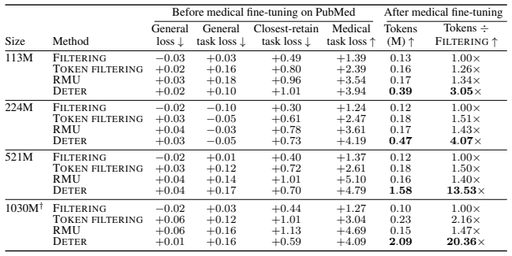
Table 1 :Suppression during pretraining requires substantially more target-domain fine-tuning than fil- tering, token filtering or post-hoc RMU, with little change in general loss.General loss is measured on held-out retained FineWeb-Edu; medical task loss is averaged over MedQuAD, MedMCQA, MedQA-USMLE, and MMLU medicine; general task loss is measured on MMLU STEM and non-STEM; and closest-retain task loss on MMLU biology. All are reported relative to NO FILTERING. The last two columns give the number of PubMed fine-tuning tokens needed to reach the PubMed loss of NO FILTERING, and this number normalized by the corresponding value for FILTERINGat the same model size. Results are averaged over three fine-tuning seeds. DETERdenotes suppression during pretraining. †1030M settings:c= 3; 20% token filtering.
원문 · CC BY 4.0 · Maria Ios Glarou, Martin Jaggi · DETER: Suppression During Pretraining for Tamper Resistance · 원문 그림 인용 · 원본 PDF 5쪽에서 그림 영역을 추출했습니다.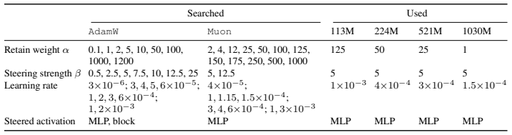
Table 9 : RMU hyperparameters.
원문 · CC BY 4.0 · Maria Ios Glarou, Martin Jaggi · DETER: Suppression During Pretraining for Tamper Resistance · 원문 그림 인용 · 원본 PDF 20쪽에서 그림 영역을 추출했습니다.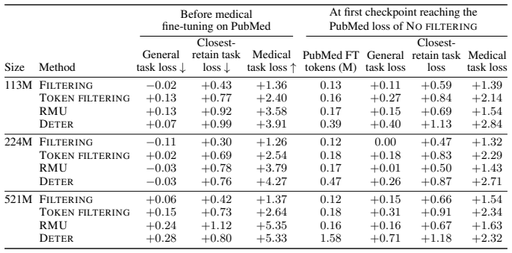
Table 13 :Task losses before fine-tuning and when each method first reaches the PubMed loss of NO FILTERING.We fine-tune each model on PubMed until its held-out PubMed loss first reaches that of NO FILTERING, and report task loss at the final pretraining checkpoint (before) and at that checkpoint (after). All methods in the right block are therefore evaluated at the same PubMed loss, but reach it after different amounts of fine-tuning, reported as PubMed fine-tuning tokens.The right block is not a matched-compute comparison:each method is evaluated at its own checkpoint where PubMed loss first reaches that of NO FILTERING. Figure 12 instead compares task loss after equal amounts of PubMed fine-tuning at 521M. Medical task loss is averaged over MedQuAD, MedMCQA, MedQA-USMLE, and MMLU medicine; general task loss is measured on MMLU STEM and non-STEM; and closest-retain task loss on MMLU biology. All task losses are reported relative to the final checkpoint of NO FILTERING. Results are averaged over three fine-tuning seeds. DETERdenotes suppression during pretraining.
원문 · CC BY 4.0 · Maria Ios Glarou, Martin Jaggi · DETER: Suppression During Pretraining for Tamper Resistance · 원문 그림 인용 · 원본 PDF 24쪽에서 그림 영역을 추출했습니다.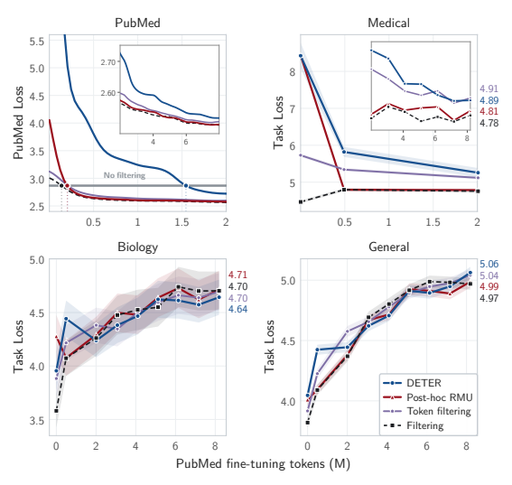
Figure 12 :At 521M, post-hoc RMU returns to the medical task loss of FILTERINGearly in PubMed fine-tuning, while suppression during pretraining keeps medical task loss higher for longer.We fine-tune each model on PubMed and report held-out PubMed loss and task loss on the medical benchmarks (MedQuAD, MedMCQA, MedQA-USMLE, and MMLU medicine), MMLU biology, and MMLU STEM and non-STEM (general). The horizontal line marks the PubMed loss of NO FILTERING. Numbers at the right give the task loss at the end of fine-tuning. Results are for one fine-tuning seed; shaded bands are 95% bootstrap intervals over benchmark items. DETERdenotes suppression during pretraining.
원문 · CC BY 4.0 · Maria Ios Glarou, Martin Jaggi · DETER: Suppression During Pretraining for Tamper Resistance · 원문 그림 인용 · 원본 PDF 25쪽에서 그림 영역을 추출했습니다.대리 도메인과 적용 범위의 한계
따라서 위험 능력이나 다른 도메인, 더 큰 모델로의 일반화는 확인하지 않았습니다. 목표 도메인 집합 D_F는 분류기 점수 기준 상위 5% 토큰으로 정의했으며, 분류기 오류와 억제 집합 구성의 민감도는 체계적으로 검증하지 않았습니다. fine-tuning 공격도 단일 시드 모델에서 PubMed 손실 기준으로만 측정했습니다.
논문 정보
- 저자
- Maria Ios Glarou, Martin Jaggi
- 학회·저널
- arXiv · 프리프린트
- 최초 공개일
- 2026년 11월 11일
- 등록일
- 2026년 11월 13일
- 수정일
- 2026년 11월 11일
- 버전
- v1
- arXiv
- 2611.15479
- 분류
- cs.LG
- 원문 이용 조건
- CC BY 4.0
- 제공 범위
- 논문 정보, 해설, 허용된 원문 그림
AI 해설은 논문 원문과 별개의 설명이며 오류가 있을 수 있습니다. 원문과 그림은 각 출처의 이용 조건과 따로 표시된 권리를 따릅니다.
초록
Open-weight language models can acquire knowledge that could enable biological, chemical, or cyber misuse. Any attempt to limit such knowledge must remain effective after the model weights are released and can be fine-tuned. Unlearning applied after pretraining can be rapidly undone, whereas filtering the pretraining corpus offers greater resistance. We ask whether actively suppressing knowledge during pretraining can further increase the fine-tuning required to acquire it. Even simple gradient ascent interleaved with standard pretraining on the filtered corpus makes medical knowledge harder to acquire through adversarial fine-tuning than filtering alone or post-hoc unlearning. At 1B parameters, reaching the held-out PubMed loss of an unfiltered model requires over 20$\times$ as many PubMed fine-tuning tokens as after filtering alone. Retained knowledge is evaluated using both held-out data and downstream tasks. Across model sizes, varying suppression strength reveals an increasingly favorable trade-off between fine-tuning difficulty and held-out loss on retained pretraining data. These results point to pretraining as an effective stage for making unwanted capabilities harder to acquire through subsequent fine-tuning. Code is available at \href{https://github.com/MEGlr/DETER}{\texttt{github.com/MEGlr/DETER}}.
원문 인용
Maria Ios Glarou, Martin Jaggi (2026). DETER: Suppression During Pretraining for Tamper Resistance. arXiv:2611.15479v1. https://arxiv.org/abs/2611.15479v1
BibTeX
@misc{glarou2026deter,
  title = {{DETER: Suppression During Pretraining for Tamper Resistance}},
  author = {Maria Ios Glarou and Martin Jaggi},
  year = {2026},
  eprint = {2611.15479},
  archivePrefix = {arXiv},
  url = {https://arxiv.org/abs/2611.15479v1}
}