논문 해설
Auditing black-box clinical prediction models with a large language model through queries alone: a blinded test with planted flaws
질의만으로 대규모 언어 모델을 이용해 블랙박스 임상 예측 모델을 감사하기: 심어 둔 결함을 찾는 블라인드 테스트
- 연구 문제 LLM이 블랙박스 임상 예측 모델의 계산 내용과 결함을 설명할 수 있는지는 정답이 미리 알려진 조건에서 검증된 적이 없었습니다.
- 연구 방법 예측값만 조회할 수 있는 계산기 도구로 계획된 결함을 심은 모델을 감사하게 하고, 대리 모델과 보고된 문제를 프로그램으로 검사합니다.
블랙박스 임상 예측 모델을 설명하는 어려움
임상 예측 모델은 어떤 입력이 결과에 얼마나 영향을 주는지 알기 어렵습니다. 모델이 블랙박스이거나 상업용 모델이 예측값만 돌려주는 경우 사후 설명은 오해를 낳을 수 있습니다. 이 논문은 대규모 언어 모델(LLM)이 질의만으로 이런 모델을 얼마나 정확히 설명하고 결함을 찾는지 실제 환자 데이터로 시험합니다. 핵심은 결함을 미리 심어 두고 감사자가 그것을 찾는지 확인하는 것입니다. 또한 감사자가 찾은 관계가 나중에 등록된 환자에서도 성립하는지를 함께 묻습니다.
계획된 결함을 심은 감사 설정
각 깨끗한 모델에서 δ를 log-odds에 더해 부분군 과소예측, 위험 요인 방향 반전, 불연속 계단의 세 가지 결함을 파생했습니다. 감사자인 GPT-6 Astra는 예측값만 반환하는 계산기 도구로 질의했으며, 결함은 도구 안에 주입되었습니다.
대리 모델의 충실도
LLM이 작성한 대리 모델은 테스트 입력에서 감사 대상 모델의 log-odds를 평균 R2 0.976으로 재현했습니다. 분석가 대리 모델은 0.959였습니다. 대리 모델의 항 수는 중앙값 128개로 분석가 모델의 42개보다 많았습니다. 신경망에서 충실도가 가장 낮았고 평균 R2는 0.923이었습니다.
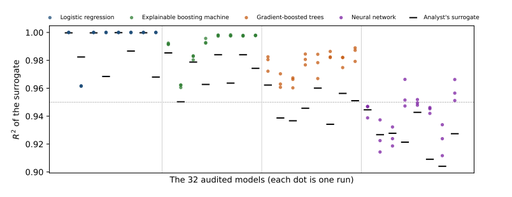
Figure 1 :Faithfulness of every surrogate. Models are grouped by kind (logistic regression, explainable boosting machine, gradient-boosted trees, neural network) and, within a kind, by outcome and flaw. The dotted line is the pre-specified 0.95.
원문 · CC BY 4.0 · Zhiyu Liu, Xinyu Yang · Auditing black-box clinical prediction models with a large language model through queries alone: a blinded test with planted flaws · 원문 그림 인용 · 원본 PDF 7쪽에서 그림 영역을 추출했습니다.계획된 결함 탐지 결과
LLM은 72회 실행 가운데 69회에서 계획된 결함을 찾아 96%를 기록했습니다. 95% 구간은 80%에서 99%입니다. 스크립트는 24개 결함을 모두 찾았습니다. 반전 결함에서는 LLM이 한 번도 찾지 못한 로지스틱 회귀 모델이 있었으며 그 결함의 효과가 가장 작았습니다.
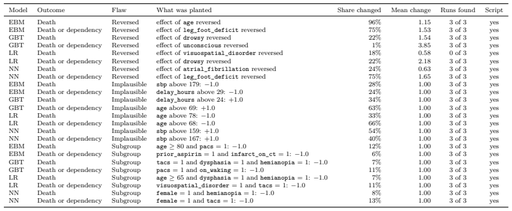
Table 5 :Every planted flaw. EBM, explainable boosting machine; GBT, gradient-boosted trees; LR, logistic regression; NN, neural network. Share changed: the share of training patients whose prediction the flaw changes. Mean change: the mean absolute change in log-odds among them. Runs found: black-box runs in which a reported problem matched the flaw. Script: whether the audit script found it.
원문 · CC BY 4.0 · Zhiyu Liu, Xinyu Yang · Auditing black-box clinical prediction models with a large language model through queries alone: a blinded test with planted flaws · 원문 그림 인용 · 원본 PDF 14쪽에서 그림 영역을 추출했습니다.보고된 문제의 모델 검사
사후 분류에서 412개는 보고된 방향으로 평균 0.25 미만이었고, 79개는 훈련 환자의 최소 5%에서 성립했으며, 164개는 확인되지 않았습니다. 이 사후 분류는 결과를 본 뒤 정한 기준입니다.
후기 환자에서의 관계 성립
LLM이 제시한 601개 관계 가운데 후기 환자에서 성립한 비율은 11%였습니다. 회귀 스캔 후보는 28%, 무작위 쌍은 6%였습니다. 훈련 세트 검사 후에는 LLM 관계 33%, 스캔 30%로 비슷해졌습니다.

Table 4 :Relationships that hold in patients randomised later: number, percentage and 95% interval. The LLM’s relationships are merged over the three runs of each clean model.
원문 · CC BY 4.0 · Zhiyu Liu, Xinyu Yang · Auditing black-box clinical prediction models with a large language model through queries alone: a blinded test with planted flaws · 원문 그림 인용 · 원본 PDF 9쪽에서 그림 영역을 추출했습니다.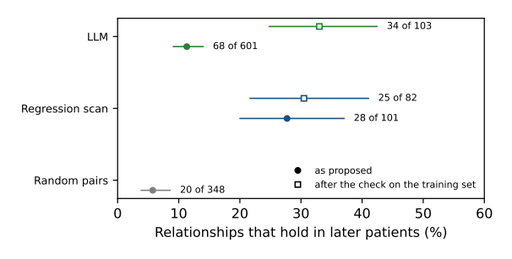
Figure 2 :Relationships that hold in patients randomised later, as proposed and after the check on the training set (95% CI).
원문 · CC BY 4.0 · Zhiyu Liu, Xinyu Yang · Auditing black-box clinical prediction models with a large language model through queries alone: a blinded test with planted flaws · 원문 그림 인용 · 원본 PDF 9쪽에서 그림 영역을 추출했습니다.한계
연구는 하나의 LLM과 하나의 데이터셋만 다뤘고, 결함은 인공적으로 크게 만든 것이었습니다. 사전 지정 검사는 평균 행동과 단일 임계값에 기반해 LLM의 보고와 맞지 않았습니다. 스크립트는 결함 유형을 알고 설계되었으므로 LLM과의 비교는 공정하지 않습니다.
논문 정보
- 저자
- Zhiyu Liu, Xinyu Yang
- 학회·저널
- arXiv · 프리프린트
- 최초 공개일
- 2026년 11월 18일
- 등록일
- 2026년 11월 20일
- 수정일
- 2026년 11월 18일
- 버전
- v1
- arXiv
- 2611.24877
- 분류
- cs.LG · cs.AI
- 원문 이용 조건
- CC BY 4.0
- 제공 범위
- 논문 정보, 해설, 허용된 원문 그림
AI 해설은 논문 원문과 별개의 설명이며 오류가 있을 수 있습니다. 원문과 그림은 각 출처의 이용 조건과 따로 표시된 권리를 따릅니다.
초록
Large language models (LLMs) are used to explain clinical prediction models, on the promise that they can say what a model computes, find its faults and even reveal new knowledge in it. We tested the three promises where the answers could be checked. From the International Stroke Trial we trained four kinds of model (logistic regression, explainable boosting machine, gradient-boosted trees, neural network) for two outcomes on patients randomised earlier, planted one flaw in each of 24 copies (an under-predicted subgroup, a reversed risk factor or an implausible step) and mixed them with the 8 clean models. GPT-6 Astra audited each model three times, blind, through a tool that only returned the model's predictions; the judging rules were committed before any run and applied by program. Its surrogate models, with a median of 128 terms, reproduced the audited models' log-odds with a mean $R^2$ of 0.976 (0.959 for an additive surrogate of 42 terms fitted by an analyst). It found the planted flaw in 69 of 72 runs (96%; 95% CI 80% to 99%); a script written for the purpose found all 24. It also reported many more problems: 60% of 1,089 checkable reports failed the pre-specified check against the model's average behaviour; post hoc, most of these were real but small steps, and 15% of the checkable reports were not found in the model. Of 601 unexpected relationships it read out of the clean models, 11% held in patients randomised later (random pairs 6%; a regression scan's shorter list of its strongest candidates, 28%); after a check on the training data, 33% against 30%. With query access alone, an LLM can describe a black-box model faithfully and find nearly every planted flaw, as a purpose-written script also did; its reports of problems must be checked on the model and its discoveries on data.
원문 인용
Zhiyu Liu, Xinyu Yang (2026). Auditing black-box clinical prediction models with a large language model through queries alone: a blinded test with planted flaws. arXiv:2611.24877v1. https://arxiv.org/abs/2611.24877v1
BibTeX
@misc{liu2026auditing,
  title = {{Auditing black-box clinical prediction models with a large language model through queries alone: a blinded test with planted flaws}},
  author = {Zhiyu Liu and Xinyu Yang},
  year = {2026},
  eprint = {2611.24877},
  archivePrefix = {arXiv},
  url = {https://arxiv.org/abs/2611.24877v1}
}