논문 해설
You Don't Need Feature Learning to Do In-Context Learning
인컨텍스트 학습을 하기 위해 특징 학습이 필요하지는 않다
- 연구 문제 ICL에서 훈련 과제 집합으로 최적화된 모델이 새 과제를 일반화하는 현상을 커널 기계의 학습 동역학으로 설명합니다.
- 연구 방법 회전 불변 커널 회귀를 ICL 선형 회귀에 적용하고, 커널 고유구조로 샘플 수에 따른 일반화와 암기의 전환을 분석합니다.
- 주요 결과 커널 회귀는 먼저 일반화 해의 저차 성분을 학습하고 이후 고차 암기 성분을 학습하며, 일반화 해는 암기 해의 저차 절단으로 근사됩니다.
ICL의 기억과 일반화 역설
이 논문은 대형 언어모델이 문맥의 예시만으로 새 과제를 추론하는 in-context learning(ICL)에서, 훈련 과제 집합만 보고 최적화된 모델이 왜 본 적 없는 과제를 일반화하는지 묻습니다. 훈련 목적의 베이즈 최적 해는 새 문맥을 훈련 과제 중 하나로 해석하는 것이므로, 원문은 이 기대와 실제 관찰 사이의 충돌을 역설로 제시합니다. 논문은 일반화가 훈련 도중 암기 해로 가는 중간 이정표로 나타난다는 가설을 세우고, 이를 선형 회귀 ICL 설정의 커널 회귀로 분석합니다.
커널 고유구조로 본 학습 단계
논문은 회전 불변 커널 회귀를 ICL 선형 회귀에 적용합니다. 원문은 커널을 내적 커널로 근사하고, 차수별 부분공간을 Gram-Schmidt로 직교화한 뒤 대각화하여 고유쌍을 구하는 절차를 제시합니다. 이때 레벨 계수가 빠르게 감소한다는 가정 아래 낮은 차수의 고유함수가 더 큰 고윳값을 가지므로, 커널은 큰 고윳값 성분부터 학습합니다. 암기 해와 일반화 해의 고유계수는 훈련 과제 분포의 누적량으로 표현되며, 일반화 해는 차수 3 성분을 포함하는 저차 절단으로 근사됩니다.
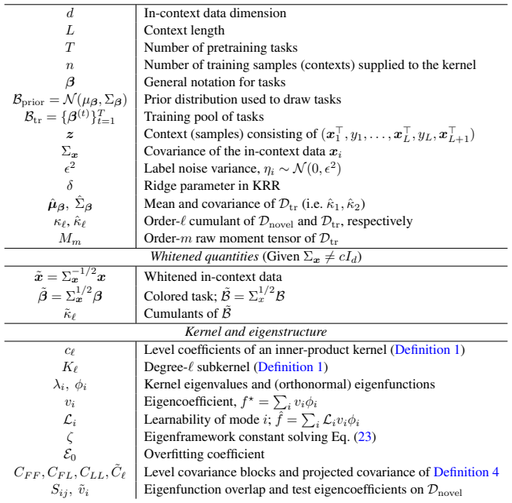
Table 1 :Quantities appearing throughout the main document and appendices.
원문 · CC BY 4.0 · Joseph Turnbull, Jamie Simon · You Don't Need Feature Learning to Do In-Context Learning · 원문 그림 인용 · 원본 PDF 16쪽에서 그림 영역을 추출했습니다.샘플 수에 따른 세 단계와 일반화 해의 근사
논문은 샘플 수 n이 커질수록 커널이 평균 과제, 일반화 성분, 고차 암기 성분의 순서로 학습한다고 보고합니다. 차수 3 성분은 약 L²d²/2개의 샘플에서 학습되며, 이 단계의 커널 함수는 일반화 해를 근사합니다. 이후 더 높은 차수의 성분이 추가되어 암기 해에 도달합니다.
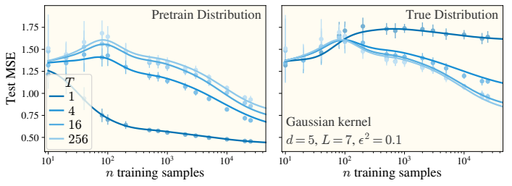
Figure 9 : Gaussian kernel learning curves on ICL Regression data.For four different settings (colors) of the task diversity T , we compute the expected test MSE as a function of the number of training samples n, and compare it to empirical errors obtained across 20 trials. Theoretical learning curve equations are provided in Section D, with validation of the eigensystem the equations are built off of provided in Sections E and F. Our data uses a Gaussian kernel with kernel width σker = √ 3, d= 5, L= 7, ϵ2 = 0.1 where our data is drawn x∼ N(0, Id/(dL)). Additionally, as T→ ∞, we find that the errors on the pretraining distribution match those of the true distribution, as expected. Further experimental details are in Section B.
원문 · CC BY 4.0 · Joseph Turnbull, Jamie Simon · You Don't Need Feature Learning to Do In-Context Learning · 원문 그림 인용 · 원본 PDF 31쪽에서 그림 영역을 추출했습니다.과소적합으로서의 일시적 일반화
논문은 ICL의 일시적 현상, 즉 모델이 먼저 일반화하다가 나중에 암기로 이동하는 현상을 과소적합으로 해석합니다. 모델은 훈련 목적을 계속 최소화하려 하며 그 목적이 암기 해로 이어지는데, 훈련 중 학습 가능한 것은 암기 해의 저차 절단입니다. 저자들은 이 저차 절단이 일반화 해의 근사라고 해석합니다. 따라서 일반화는 암기 해를 충분히 따라가기 전에 멈춘 결과로 설명됩니다. 이 설명은 특징 학습이나 회로 형성을 요구하지 않는다는 점에서 기존 설명과 구분됩니다.
특징 학습 모델에서의 비가우시안 통계
논문은 커널에서 얻은 설명이 특징 학습을 하는 변압기에도 적용되는지 확인합니다. 원문은 12층 GPT-2 유형 모델을 Adam으로 학습하고, 훈련 과제 풀의 대칭성과 4차 누적량을 조절한 실험을 보고합니다. 누적량이 제거된 풀에서는 모델이 일반화 상태를 오래 유지하고, 부분적인 4차 누적량을 가진 풀에서는 더 일찍 암기로 이행합니다. 이 결과는 저자들이 해석하는 바와 같이 암기가 훈련 과제 통계의 고차 성분을 순차적으로 학습하는 과정과 맞습니다.
적용 범위와 남은 질문
논문의 분석은 가우시안 입력을 갖는 선형 회귀 ICL 과제에 한정됩니다. 원문은 비선형 ICL 해, 자연어가 학습 함수에 미치는 영향은 본 연구의 범위 밖이라고 밝힙니다. 또한 커널 고유구조 계산은 레벨 계수의 빠른 감소 가정과 근사 절차에 의존하며, 변압기 실험은 제시된 설정에서 얻은 결과입니다. 따라서 변압기 전반에 대한 일반적 결론으로 읽기보다는, 제시된 조건에서의 관찰로 이해하는 것이 적절합니다.
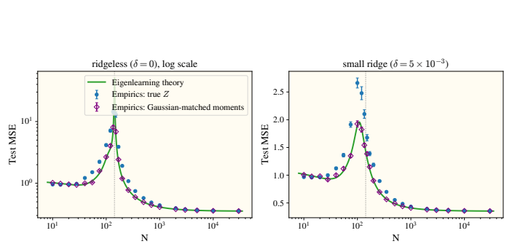
Figure 7 : One-dimensional ICL data breaks Gaussian universality.We compare the eigenframe- work’s predicted test MSE (line) against kernel regression trained on true ICL contexts (circles) and on a Gaussian surrogate with matched moments (diamonds), for T= 4 , d= 1 , L= 8 . We use a Gaussian kernel with kernel width σker = √ 3 and in-context data with covariance Σx ∼I d/(dL). The left panel is ridgeless (δ= 0 ) and the right uses a small ridge (δ= 5×10 −3). The Gaussian surrogate tracks the theory at every n. The true contexts agree away from the interpolation peak but exceed the prediction near it, most visibly at small ridge. Both datasets share the same theoretical curve, so the mismatch comes from the non-Gaussianity of one-dimensional ICL data rather than from the predicted eigenstructure. We observe no such failure ford >1.
원문 · CC BY 4.0 · Joseph Turnbull, Jamie Simon · You Don't Need Feature Learning to Do In-Context Learning · 원문 그림 인용 · 원본 PDF 22쪽에서 그림 영역을 추출했습니다.논문 정보
- 저자
- Joseph Turnbull, Jamie Simon
- 학회·저널
- arXiv · 프리프린트
- 최초 공개일
- 2026년 11월 10일
- 등록일
- 2026년 11월 11일
- 수정일
- 2026년 11월 10일
- 버전
- v1
- arXiv
- 2611.13431
- 분류
- cs.LG · cs.AI
- 원문 이용 조건
- CC BY 4.0
- 제공 범위
- 논문 정보, 해설, 허용된 원문 그림
AI 해설은 논문 원문과 별개의 설명이며 오류가 있을 수 있습니다. 원문과 그림은 각 출처의 이용 조건과 따로 표시된 권리를 따릅니다.
초록
How should we understand memorization vs. generalization in in-context learning (ICL) tasks, and when does one happen vs. the other? To investigate, we study how rotation-invariant kernel machines learn the ICL linear regression task proposed by Raventos et al. (2023). By decomposing the task in the kernel eigenbasis, we obtain a spectral picture of learning in this ICL setting. This picture reveals that as sample size grows, kernel machines learn successively-higher-degree components of the memorizing solution, which depend upon successively-higher-degree statistics of the training task set. The generalizing solution is approximately a low-degree truncation of the memorizing solution, and so the model first generalizes, then degrades into memorization as training proceeds. The takeaways are threefold. First, if this case is indicative, learning a "generalizing" solution on an ICL task is really just underfitting the memorizing solution! Second, the fact that kernel machines can generalize on this task means that feature learning is inessential to ICL. Third, transformers empirically trained to do ICL are shown to memorize tasks through the higher-order statistics of the training tasks that the kernel-based theory predicts, suggesting it applies even to models capable of feature learning.
원문 인용
Joseph Turnbull, Jamie Simon (2026). You Don't Need Feature Learning to Do In-Context Learning. arXiv:2611.13431v1. https://arxiv.org/abs/2611.13431v1
BibTeX
@misc{turnbull2026need,
  title = {{You Don't Need Feature Learning to Do In-Context Learning}},
  author = {Joseph Turnbull and Jamie Simon},
  year = {2026},
  eprint = {2611.13431},
  archivePrefix = {arXiv},
  url = {https://arxiv.org/abs/2611.13431v1}
}