논문 해설
ToolTurns: Benchmarking LLM Agents in Multi-Turn Dialogue
ToolTurns: 다중 턴 대화에서 LLM 에이전트를 벤치마크하기
- 연구 문제 기존 도구 사용 벤치마크는 독립된 요청 중심이라 대화 속 명확화와 후속 요청 완료를 충분히 평가하지 못합니다.
- 연구 방법 넓은 API 카탈로그 위에서 모호한 초기 요청과 두 후속 요청을 사용자 시뮬레이터가 이어 가게 하고, 세 요청의 완료를 함께 측정합니다.
- 주요 결과 Opus 4.8이 서브태스크 성공률 69.6%, 세 요청 모두 성공 39.8%를 기록했습니다. 후속 요청 점수는 모든 모델에서 초기 요청보다 낮았습니다.
도구 사용 대화 평가의 공백
대부분의 도구 사용 벤치마크는 하나의 독립된 요청을 풀게 합니다. 실제 대화에서는 에이전트가 먼저 정보를 되물어야 하고, 첫 답변 이후에도 후속 요청이 이어집니다. 이 논문은 이 공백을 메우기 위해 여러 턴에 걸친 대화를 평가하는 ToolTurns를 만들었습니다. ToolTurns는 2,620개 문제, 1,827개 도구, 11,004개 API 엔드포인트, 47개 카테고리로 구성됩니다. 각 대화는 일부러 덜 명시된 초기 요청으로 시작하고, 두 개의 문맥 의존 후속 요청을 거칩니다. 그래서 명확화 질문, 도구 사용, 대화 문맥 유지를 함께 평가합니다.
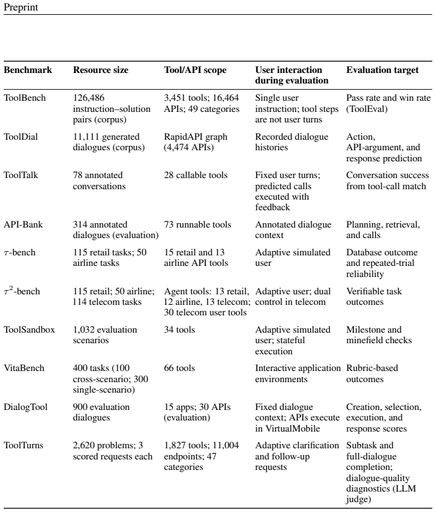
Table 1 : How the evaluation setting differs across benchmarks. ToolTurns combines broad API coverage with adaptive clarification and follow-up dialogue, complementing benchmarks centered on stateful application workflows. Counting conventions for each row are in Appendix A.
원문 · CC BY 4.0 · Milad Gholami, Brendan King, Jeffrey Flanigan · ToolTurns: Benchmarking LLM Agents in Multi-Turn Dialogue · 원문 그림 인용 · 원본 PDF 3쪽에서 그림 영역을 추출했습니다.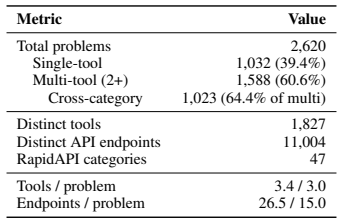
Table 2 : ToolTurns statistics for the 2,620-problem evaluation set. The last two rows report mean / median.
원문 · CC BY 4.0 · Milad Gholami, Brendan King, Jeffrey Flanigan · ToolTurns: Benchmarking LLM Agents in Multi-Turn Dialogue · 원문 그림 인용 · 원본 PDF 4쪽에서 그림 영역을 추출했습니다.사용자 시뮬레이터와 체커–픽서
사용자 시뮬레이터는 문제에 숨겨 둔 문맥을 바탕으로 에이전트의 명확화 질문에 답하고, 대화 기록에서 후속 요청을 만듭니다. 에이전트가 finish를 호출하면 후속 요청 생성기가, message_user를 호출하면 응답 생성기가 활성화됩니다. 옵션인 체커–픽서 파이프라인은 생성된 사용자 메시지를 체커가 위반 여부를 검사하고, 위반이 있으면 픽서가 그 메시지를 고쳐 씁니다. 체커는 열한 가지 위반 유형을 탐지하며, 이 파이프라인은 시뮬레이터의 턴 품질을 높이기 위해 도입되었습니다.
대화 품질과 과제 성공의 평가 방식
대화 품질은 일관성, 관련성, 효율성, 정확성, 적응성의 다섯 측면을 LLM 판정으로 점수화한 뒤 정해진 가중치로 합산합니다. 정확성에는 0.30, 일관성·관련성·효율성에는 각 0.20, 적응성에는 0.10이 주어집니다. 과제 성공은 대화를 초기 요청과 두 후속 요청의 서브태스크로 나누어 각각 판정합니다. 관찰 결과가 문서 자리표시자 설명뿐이면 LLM 호출 없이 실패로 처리하는 결정적 게이트가 먼저 적용되며, 그 뒤 LLM 판정이 이진 성공 여부를 정합니다. 주요 지표는 서브태스크를 합친 pooled subtask pass rate이고, 세 서브태스크가 모두 성공해야 하는 기준도 함께 보고합니다.
아홉 에이전트의 성공률과 한계
아홉 개 에이전트 중 Opus 4.8은 서브태스크 성공률 69.6%를 기록했고, 세 요청이 모두 성공한 대화 비율은 39.8%였습니다. 기존 평가 프로토콜에서는 모든 모델이 초기 요청보다 후속 요청에서 낮은 점수를 받았습니다. 루브릭 순위와 과제 성공 순위의 Spearman 상관은 ρ=0.23으로 낮아, 대화 품질 점수만으로 완료 능력을 판단하기 어렵다는 점을 보여 줍니다.
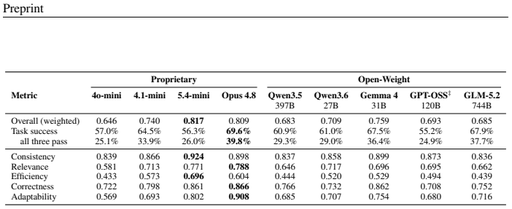
Table 3 : Dialogue quality and task success per agent model, over a shared set of 2,620 problems. Bold denotes the best value per row. Open-weight models are labeled by family with total parameter count below; checkpoints and quantization are in Appendix E. The weighted aggregate, the pooled subtask pass rate, and the stricter all-three-pass rate are defined in §3.4; dialogues and subtasks for which the judge returned an error are excluded. ‡GPT-OSS is also the judge model, so its scores are not judge-independent.
원문 · CC BY 4.0 · Milad Gholami, Brendan King, Jeffrey Flanigan · ToolTurns: Benchmarking LLM Agents in Multi-Turn Dialogue · 원문 그림 인용 · 원본 PDF 7쪽에서 그림 영역을 추출했습니다.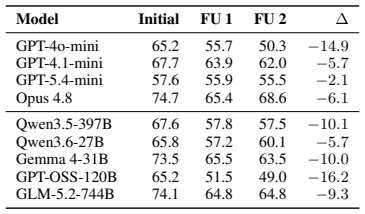
Table 4 : Subtask success rate (%) by position of the main query within the dialogue: the initial query and the two follow-ups (FU 1, FU 2). ∆ is the change from the initial query to the second follow-up. Every model degrades as the dialogue lengthens.
원문 · CC BY 4.0 · Milad Gholami, Brendan King, Jeffrey Flanigan · ToolTurns: Benchmarking LLM Agents in Multi-Turn Dialogue · 원문 그림 인용 · 원본 PDF 8쪽에서 그림 영역을 추출했습니다.체커–픽서가 턴 결함을 줄이는 방식
이 536개 턴에서 결정적 규칙으로 센 결함은 335개에서 197개로 줄어 41.2% 감소했습니다. 턴별 쌍 비교의 평균 변화는 −0.257 결함이며, 95% 부트스트랩 신뢰구간은 [−0.308, −0.207]입니다. 블라인드 인간 비교에서는 120쌍 중 76쌍(63.3%)에서 수정된 턴이 선호되었습니다. 다만 대화 수준 루브릭 점수는 이 턴 단위 개입에 거의 반응하지 않았다고 보고되어, 두 측정은 구분해서 읽어야 합니다.
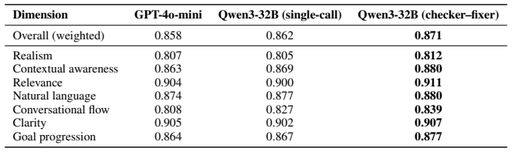
Table 5 : User-simulator quality scores under three conditions (322 dialogues each). Bold denotes the best value per row. Qwen3 refers to Qwen3-32B-AWQ;checker–fixerdenotes the full checker–fixer pipeline (§3.3.1). Dimensions and weights follow Appendix B.1.
원문 · CC BY 4.0 · Milad Gholami, Brendan King, Jeffrey Flanigan · ToolTurns: Benchmarking LLM Agents in Multi-Turn Dialogue · 원문 그림 인용 · 원본 PDF 13쪽에서 그림 영역을 추출했습니다.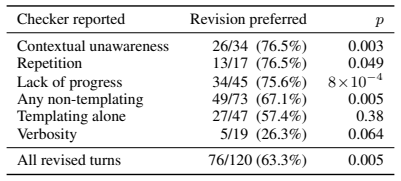
Table 6 : Blind human preference for the revised user turn over the original draft, by the violation type the checker reported. Categories overlap, since a turn may trigger several. Two-sided sign tests.
원문 · CC BY 4.0 · Milad Gholami, Brendan King, Jeffrey Flanigan · ToolTurns: Benchmarking LLM Agents in Multi-Turn Dialogue · 원문 그림 인용 · 원본 PDF 15쪽에서 그림 영역을 추출했습니다.과제 판정의 증거 범위
과제 성공 판정은 현재 서브태스크의 도구 관찰만 참조합니다. 따라서 이전 서브태스크의 증거를 재사용하거나 잘못된 관찰을 바로잡은 에이전트가 불리하게 판정될 수 있습니다. 저자들은 이 제약이 후속 요청의 점수 하락과 모델 순위에 어떤 영향을 주는지는 정량화하지 않았다고 밝힙니다. 사용자 시뮬레이터가 궤적을 함께 결정하므로 측정된 난이도에는 에이전트와 사용자 선택이 섞여 있습니다.
논문 정보
- 저자
- Milad Gholami, Brendan King, Jeffrey Flanigan
- 학회·저널
- arXiv · 프리프린트
- 최초 공개일
- 2026년 11월 11일
- 등록일
- 2026년 11월 13일
- 수정일
- 2026년 11월 11일
- 버전
- v1
- arXiv
- 2611.14925
- 분류
- cs.CL
- 원문 이용 조건
- CC BY 4.0
- 제공 범위
- 논문 정보, 해설, 허용된 원문 그림
AI 해설은 논문 원문과 별개의 설명이며 오류가 있을 수 있습니다. 원문과 그림은 각 출처의 이용 조건과 따로 표시된 권리를 따릅니다.
초록
Tool-using language models are increasingly deployed in conversational settings, yet most large-scale tool-use benchmarks focus on isolated requests. We introduce ToolTurns, a benchmark of 2,620 problems spanning 1,827 tools and 11,004 API endpoints across 47 categories. Each dialogue begins with an intentionally underspecified request and continues through two context-dependent follow-ups, testing clarification, tool use, and retention of conversational context. We also introduce an open-source user simulator that reveals withheld context through dialogue and generates follow-up requests, with a checker--fixer pipeline for improving its turns. Across nine language models, the best agent resolves 69.6% of individual requests but completes only 39.8% of full dialogues. Under this evaluation protocol, every evaluated model receives lower success scores on follow-up requests than on the initial request, and dialogue-quality rubric scores and task success can rank models very differently. Paired turn-level evaluation shows that the checker--fixer reduces detected dialogue defects, and blind human evaluation favors the revised turns. ToolTurns provides a testbed for evaluating whether agents sustain task success across multi-turn dialogue with tools.
원문 인용
Milad Gholami, Brendan King, Jeffrey Flanigan (2026). ToolTurns: Benchmarking LLM Agents in Multi-Turn Dialogue. arXiv:2611.14925v1. https://arxiv.org/abs/2611.14925v1
BibTeX
@misc{gholami2026toolturns,
  title = {{ToolTurns: Benchmarking LLM Agents in Multi-Turn Dialogue}},
  author = {Milad Gholami and Brendan King and Jeffrey Flanigan},
  year = {2026},
  eprint = {2611.14925},
  archivePrefix = {arXiv},
  url = {https://arxiv.org/abs/2611.14925v1}
}