논문 해설
Equivariant Descriptor Fields: SE(3)-Equivariant Energy-Based Models for End-to-End Visual Robotic Manipulation Learning
등변 기술자 필드: 엔드투엔드 시각 로봇 조작 학습을 위한 SE(3)-등변 에너지 기반 모델
- 연구 문제 끝단 간 학습이 가능하고 적은 시연으로 SE(3)-등변성을 얻는 시각 로봇 조작 모델이 필요합니다.
- 연구 방법 키·쿼리 등변 기술자 장과 쌍등변 에너지 기반 모델을 결합하고, MH와 Langevin 동역학으로 자세를 샘플링합니다.
- 주요 결과 미본 인스턴스·자세·방해물 설정에서 EDFs가 SE(3)-TNs보다 높은 성공률을 보였으며, type-0 전용 절제 모델보다 높았습니다.
문제 설정: 적은 시연으로 배우는 시각 조작
엔드투엔드 시각 로봇 조작 학습은 많은 시연이 필요하다는 샘플 비효율 문제를 안고 있습니다. 기존 Transporter Networks는 SE(2) 등변성으로 샘플 효율을 높이지만 평면 과제에 한정되며, Neural Descriptor Fields(NDFs)는 SE(3) 등변성으로 공간 과제에 적은 샘플로 일반화하지만 pre-training과 물체 분할 파이프라인이 필요하고 배치 목표가 고정되어야 합니다. 이 논문은 이러한 제약을 줄이면서 끝단 간으로 학습할 수 있는 SE(3)-등변 모델을 만드는 것을 목표로 합니다.
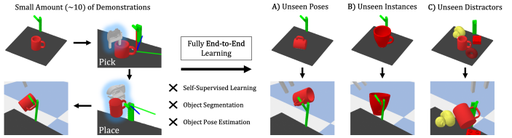
Figure 1 : Given few (5∼10) demonstrations of a mug pick-and-place task, EDFs can be trained fully end-to-end without requiring any pre-training, object segmentation, or pose estimation pipelines. In addition, we show that EDFs can generalize to A) unseen poses, B) unseen instances of the target object category, and C) the presence of unseen visual distractors.
원문 · CC BY 4.0 · Hyunwoo Ryu, Hong-in Lee, Jeong-Hoon Lee, Jongeun Choi · Equivariant Descriptor Fields: SE(3)-Equivariant Energy-Based Models for End-to-End Visual Robotic Manipulation Learning · 원문 그림 인용 · 원본 PDF 2쪽에서 그림 영역을 추출했습니다.
Table 6 : Success rate of NDFs with and without object segmentation
원문 · CC BY 4.0 · Hyunwoo Ryu, Hong-in Lee, Jeong-Hoon Lee, Jongeun Choi · Equivariant Descriptor Fields: SE(3)-Equivariant Energy-Based Models for End-to-End Visual Robotic Manipulation Learning · 원문 그림 인용 · 원본 PDF 32쪽에서 그림 영역을 추출했습니다.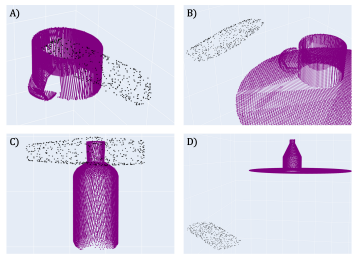
Figure 14 : A) NDFs successfully infer the pick position of a well-segmented mug point cloud. B) NDFs fail to successfully infer the pick position of an unsegmented mug point cloud. C) NDFs suc- cessfully infer the pick position of a well-segmented bottle point cloud. D) NDFs fail to successfully infer the pick position of an unsegmented bottle point cloud. The black dots are the query points attached to the gripper.
원문 · CC BY 4.0 · Hyunwoo Ryu, Hong-in Lee, Jeong-Hoon Lee, Jongeun Choi · Equivariant Descriptor Fields: SE(3)-Equivariant Energy-Based Models for End-to-End Visual Robotic Manipulation Learning · 원문 그림 인용 · 원본 PDF 32쪽에서 그림 영역을 추출했습니다.Equivariant Descriptor Fields와 쌍등변 에너지 모델
EDFs는 키 기술자 장과 쿼리 기술자 장을 SE(3)-등변 벡터 장으로 정의하며, 타입-0뿐 아니라 타입-1 이상의 기술자를 함께 사용합니다. 이 때문에 NDFs가 세 개 이상의 비공선 쿼리 점을 필요로 하는 것과 달리 EDFs는 하나의 점으로 방향을 표현할 수 있다고 설명합니다. 에너지는 쿼리 밀도로 가중된 키 기술자와 변환된 쿼리 기술자의 차이 제곱으로 정의되며, 쿼리 밀도는 SE(3)-등변 비음수 스칼라 장으로 가정됩니다. 쿼리 점은 SVGD로 등변적으로 추출하며, 이 조합은 목표 물체와 배치 대상 모두에 대해 쌍등변인 에너지 기반 모델을 이룹니다. 학습 초기의 불안정성을 줄이기 위해 대리 쿼리 모델을 사용하고, 추론은 IGSO(3) 기반 Metropolis-Hastings로 탐색한 뒤 SE(3) 위의 Langevin 동역학으로 샘플을 다듬습니다.
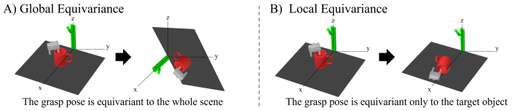
Figure 2 : A) The model is globally equivariant if the grasp pose is equivariant to the transformations of the whole scene (the target object and background). B) The model is locally equivariant to the target object if the grasp pose is equivariant to the localized transformations of the target object.
원문 · CC BY 4.0 · Hyunwoo Ryu, Hong-in Lee, Jeong-Hoon Lee, Jongeun Choi · Equivariant Descriptor Fields: SE(3)-Equivariant Energy-Based Models for End-to-End Visual Robotic Manipulation Learning · 원문 그림 인용 · 원본 PDF 4쪽에서 그림 영역을 추출했습니다.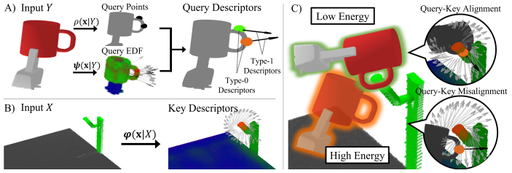
Figure 3 : A) Query points and query EDF are generated from the point cloud of the grasp. Query EDF values at the query points are used as the query descriptors. We visualized three type- 0 de- scriptors in colors (RGB) and type- 1 descriptors as arrows. We only visualized type- 1 descriptors in important locations. We did not visualize higher-type descriptors. B) The key descriptors are generated from the point cloud of the scene. C) The query descriptors are transformed and matched to the key descriptors to produce the energy of the pose. For simplicity, we only visualized the query descriptor for a single query point. Note that the query and key descriptors are better aligned in the low energy case than in the high energy case for both the type-0 and type-1 descriptors (The orange query points are near the orange region, and the black arrow is well aligned to the gray arrows).
원문 · CC BY 4.0 · Hyunwoo Ryu, Hong-in Lee, Jeong-Hoon Lee, Jongeun Choi · Equivariant Descriptor Fields: SE(3)-Equivariant Energy-Based Models for End-to-End Visual Robotic Manipulation Learning · 원문 그림 인용 · 원본 PDF 5쪽에서 그림 영역을 추출했습니다.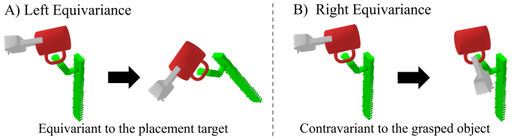
Figure 8 : A) The end-effector should follow the transformation of the placement target to keep the relative pose between the object and the placement target invariant. B) The end-effector should transform contravariantly to compensate for the transformation of the grasped object such that the relative pose between the object and the placement target is invariant.
원문 · CC BY 4.0 · Hyunwoo Ryu, Hong-in Lee, Jeong-Hoon Lee, Jongeun Choi · Equivariant Descriptor Fields: SE(3)-Equivariant Energy-Based Models for End-to-End Visual Robotic Manipulation Learning · 원문 그림 인용 · 원본 PDF 18쪽에서 그림 영역을 추출했습니다.실험 설정과 SE(3)-TNs 비교
실험은 머그-걸기와 그릇/병 집기-놓기 과제에서 수행되었습니다. 학습 시연은 상향 자세의 10개 수준으로 제한되며, 평가는 미본 인스턴스, 미본 자세(누운 자세), 미본 방해물, 임의 자세와 방해물의 네 설정으로 나뉩니다. 기준선인 SE(3)-TNs는 머그-걸기에서 다중 모드 시연 때문에 실패하여 단일 모드 저분산 시연으로만 학습되었습니다. 이 결과에서 미본 인스턴스 설정의 머그 Total 성공률은 EDFs가 0.97, SE(3)-TNs가 0.36이고, 미본 자세 설정에서는 SE(3)-TNs가 0.00, EDFs가 1.00입니다. 원문 분석은 세 과제 모두에서 EDFs가 SE(3)-TNs보다 높다고 보고합니다.

Figure 5 : A) Only ten demonstrations with objects in upright poses are provided during the training. B) The models are evaluated with unseen object instances in unseen poses with unseen distractors.
원문 · CC BY 4.0 · Hyunwoo Ryu, Hong-in Lee, Jeong-Hoon Lee, Jongeun Choi · Equivariant Descriptor Fields: SE(3)-Equivariant Energy-Based Models for End-to-End Visual Robotic Manipulation Learning · 원문 그림 인용 · 원본 PDF 8쪽에서 그림 영역을 추출했습니다.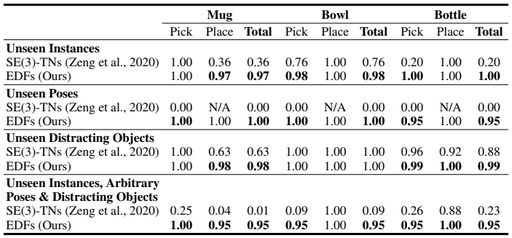
Table 1 : Pick-and-place success rates in various out-of-distribution settings.
원문 · CC BY 4.0 · Hyunwoo Ryu, Hong-in Lee, Jeong-Hoon Lee, Jongeun Choi · Equivariant Descriptor Fields: SE(3)-Equivariant Energy-Based Models for End-to-End Visual Robotic Manipulation Learning · 원문 그림 인용 · 원본 PDF 8쪽에서 그림 영역을 추출했습니다.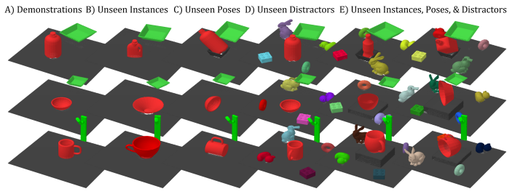
Figure 10 : Test environment for the mug-hanging task, the bowl pick-and-place task, and the bottle pick-and-place task with various unseen setups.
원문 · CC BY 4.0 · Hyunwoo Ryu, Hong-in Lee, Jeong-Hoon Lee, Jongeun Choi · Equivariant Descriptor Fields: SE(3)-Equivariant Energy-Based Models for End-to-End Visual Robotic Manipulation Learning · 원문 그림 인용 · 원본 PDF 30쪽에서 그림 영역을 추출했습니다.type-0 절제 실험과 추론 비용
절제 실험에서 NDF와 유사한 type-0 전용 모델은 머그 Total 성공률이 0.65이고, EDFs(Type-0∼3)는 0.95입니다. 이 절제 모델은 쿼리 점 수를 늘려 추론 시간이 EDFs와 비슷하거나 약간 길도록 조정되었습니다. 저자들은 type-0 기술자는 방향을 단독으로 표현하지 못해 쿼리 점에 의존하며, 고차 기술자는 쿼리 점의 품질과 무관하게 방향 정확도를 유지한다고 해석합니다. 이 비교는 모든 평가가 미본 인스턴스·자세·방해물 설정에서 수행된 결과입니다.
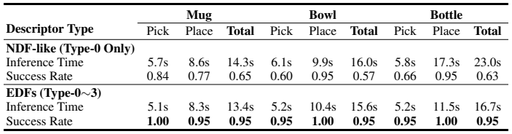
Table 2 : Success rate and inference time of the ablated model and EDFs. All the evaluations are done in the unseen instances, poses & distracting objects setting.
원문 · CC BY 4.0 · Hyunwoo Ryu, Hong-in Lee, Jeong-Hoon Lee, Jongeun Choi · Equivariant Descriptor Fields: SE(3)-Equivariant Energy-Based Models for End-to-End Visual Robotic Manipulation Learning · 원문 그림 인용 · 원본 PDF 9쪽에서 그림 영역을 추출했습니다.적용 범위와 한계
저자들은 EDFs가 목표 물체가 상당히 가려지는 과제를 대상으로 하지 않는다고 밝힙니다. 또한 빠른 샘플링이 실시간 조작에 필요하며, 궤적 수준의 문제는 해결하지 못하고 이는 NDFs와도 공유되는 문제라고 밝힙니다. 이 결과들은 제시된 과제와 설정에 한정되며, 다른 물체군이나 실시간 조건으로 일반화된다는 주장은 원문에서 확인되지 않습니다.
논문 정보
- 저자
- Hyunwoo Ryu, Hong-in Lee, Jeong-Hoon Lee, Jongeun Choi
- 학회·저널
- arXiv · 프리프린트
- 최초 공개일
- 2022년 6월 16일
- 등록일
- 2026년 11월 4일
- 수정일
- 2023년 2월 27일
- 버전
- v3
- arXiv
- 2206.08321
- 분류
- cs.RO · cs.AI
- 원문 이용 조건
- CC BY 4.0
- 제공 범위
- 논문 정보, 해설, 허용된 원문 그림
AI 해설은 논문 원문과 별개의 설명이며 오류가 있을 수 있습니다. 원문과 그림은 각 출처의 이용 조건과 따로 표시된 권리를 따릅니다.
초록
End-to-end learning for visual robotic manipulation is known to suffer from sample inefficiency, requiring large numbers of demonstrations. The spatial roto-translation equivariance, or the SE(3)-equivariance can be exploited to improve the sample efficiency for learning robotic manipulation. In this paper, we present SE(3)-equivariant models for visual robotic manipulation from point clouds that can be trained fully end-to-end. By utilizing the representation theory of the Lie group, we construct novel SE(3)-equivariant energy-based models that allow highly sample efficient end-to-end learning. We show that our models can learn from scratch without prior knowledge and yet are highly sample efficient (5~10 demonstrations are enough). Furthermore, we show that our models can generalize to tasks with (i) previously unseen target object poses, (ii) previously unseen target object instances of the category, and (iii) previously unseen visual distractors. We experiment with 6-DoF robotic manipulation tasks to validate our models' sample efficiency and generalizability. Codes are available at: https://github.com/tomato1mule/edf
원문 인용
Hyunwoo Ryu, Hong-in Lee, Jeong-Hoon Lee, Jongeun Choi (2022). Equivariant Descriptor Fields: SE(3)-Equivariant Energy-Based Models for End-to-End Visual Robotic Manipulation Learning. arXiv:2206.08321v3. https://arxiv.org/abs/2206.08321v3
BibTeX
@misc{ryu2022equivariant,
  title = {{Equivariant Descriptor Fields: SE(3)-Equivariant Energy-Based Models for End-to-End Visual Robotic Manipulation Learning}},
  author = {Hyunwoo Ryu and Hong-in Lee and Jeong-Hoon Lee and Jongeun Choi},
  year = {2022},
  eprint = {2206.08321},
  archivePrefix = {arXiv},
  url = {https://arxiv.org/abs/2206.08321v3}
}