논문 해설
Causality extraction from medical text using Large Language Models (LLMs)
대규모 언어 모델(LLM)을 이용한 의학 텍스트의 인과관계 추출
- 연구 문제 임신성 당뇨 진료지침에서 원인, 결과, 조건, 행동 구절을 자동으로 추출하는 과제를 BERT 계열 모델, GPT-4, LLAMA2로 비교합니다.
- 연구 방법 임신성 당뇨 진료지침 일곱 문서를 주석하고, BERT 계열은 토큰 분류로, GPT-4와 LLAMA2는 구절 수준 추출로 평가합니다.
- 주요 결과 BioBERT가 토큰 분류에서 평균 F1 0.72를 보였습니다. GPT-4는 10-shot 레이블 F1 0.60을, LLAMA2는 10 epoch에서 교차 검증 F1 0.76을 보였으나 누락 예측 문제가 있었습니다.
임상 진료지침에서 인과 구절을 자동으로 추출하는 문제
임신성 당뇨 진료지침에는 임신부의 위험 요인, 합병증, 권고 행동이 원인과 결과, 조건과 행동의 형태로 서술되어 있습니다. 이 구절들을 자동으로 찾아내면 여러 학회 지침을 비교하고 의사결정을 지원하는 데 도움이 될 수 있습니다. 그러나 기존 연구는 의료 진료지침에 특화된 인과 구절 주석 데이터가 거의 없었습니다. 이 논문은 임신성 당뇨 진료지침 일곱 문서를 주석하여 원인, 결과, 조건, 행동 구절을 추출하는 과제를 다룹니다. 이 과제에서 BERT 계열 모델, GPT-4, LLAMA2가 어느 정도 성능을 내는지 비교합니다.
주석 코퍼스와 주석자 일치도
연구진은 미국당뇨병학회, 미국예방서비스작업반, 미국산부인과학회, 미국가정의학회, 내분비학회 등의 임신성 당뇨 진료지침 일곱 문서를 주석했습니다. 주석자 두 명은 원인(C), 결과(E), 조건(CO), 행동(A) 태그를 문서에 표시했습니다. 주석자 간 일치도는 전통적인 카파 대신 정확 일치와 완화된 일치로 계산했으며, 완화된 일치에는 Levenshtein 거리와 Jaccard 거리가 쓰였습니다. 보고된 평균 Levenshtein 거리는 0.41, 평균 Jaccard 거리는 0.34이고, 레이블 일치의 평균 F1은 0.78입니다.
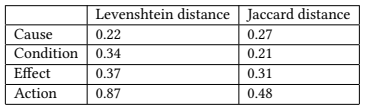
Table 1 . Relaxed match between the annotated phrases. Levenshtein distance is the minimum number of edits required to transform one phrase to another, whereas Jaccard distance is the amount of non-overlap between phrases. The lower the distance, the agreement is higher. The distance is higher for action. In most of the cases where there is a mismatch, the length of the phrase by both the annotators was different.
원문 · CC BY 4.0 · Seethalakshmi Gopalakrishnan, Luciana Garbayo, Wlodek Zadrozny · Causality extraction from medical text using Large Language Models (LLMs) · 원문 그림 인용 · 원본 PDF 5쪽에서 그림 영역을 추출했습니다.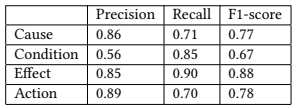
Table 2 . For a given phrase, the labels annotated by annotators 1 and 2 are compared. An average F1 score of 0.78 was obtained. From the F1-score, we can understand that both the annotators agree on most of the categories except the signal for which the F1-score is low.
원문 · CC BY 4.0 · Seethalakshmi Gopalakrishnan, Luciana Garbayo, Wlodek Zadrozny · Causality extraction from medical text using Large Language Models (LLMs) · 원문 그림 인용 · 원본 PDF 5쪽에서 그림 영역을 추출했습니다.BERT 계열 토큰 분류 결과
BERT 계열 실험은 토큰 분류 과제로 수행되었습니다. 검증 손실을 기준으로 DistilBERT는 18 epoch, BERT는 20 epoch, BioBERT는 16 epoch으로 미세조정되었습니다. 테스트 데이터에서 DistilBERT의 평균 F1-score는 0.57이었고, BERT는 0.60, BioBERT는 0.61로 보고되었습니다. 요약 표에서는 BioBERT의 평균 F1이 0.72로 제시되며, 이 값은 같은 BioBERT의 토큰 수준 결과로 함께 읽어야 합니다. 따라서 BioBERT가 이 코퍼스에서 가장 높은 성능을 보인 모델입니다.
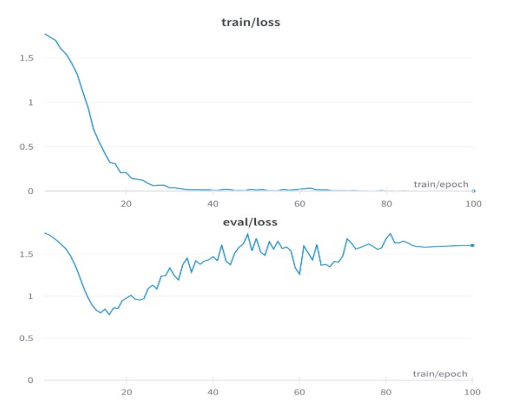
Fig. 2 . Graph showing the train and validation loss when fine-tuning on BioBERT. Looking at the graph, we can understand that with the increase in the number of epochs, the training loss is constantly decreasing and approaching 0. The validation loss decreases till 16 epochs and then starts to increase. Based on this, we fine-tuned BioBERT for 16 epochs.
원문 · CC BY 4.0 · Seethalakshmi Gopalakrishnan, Luciana Garbayo, Wlodek Zadrozny · Causality extraction from medical text using Large Language Models (LLMs) · 원문 그림 인용 · 원본 PDF 6쪽에서 그림 영역을 추출했습니다.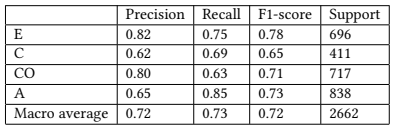
Table 3 . Causality extraction results on the medical data using BioBERT, the highest performing model. Each token in the text was assigned a label Effect(E), Cause(C), Condition(CO), and Action(A). The results are obtained by splitting the manually annotated data into train and test data.
원문 · CC BY 4.0 · Seethalakshmi Gopalakrishnan, Luciana Garbayo, Wlodek Zadrozny · Causality extraction from medical text using Large Language Models (LLMs) · 원문 그림 인용 · 원본 PDF 7쪽에서 그림 영역을 추출했습니다.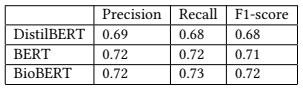
Table 4 . Summary of the results of causality extraction on medical text using the Pre-trained Language Model (BERT) and its variants. The gestational diabetes data is split into train and test data. All the models are fine-tuned on train data and tested on test data.
원문 · CC BY 4.0 · Seethalakshmi Gopalakrishnan, Luciana Garbayo, Wlodek Zadrozny · Causality extraction from medical text using Large Language Models (LLMs) · 원문 그림 인용 · 원본 PDF 7쪽에서 그림 영역을 추출했습니다.GPT-4 프롬프트 설정과 평가의 어려움
GPT-4-0314는 구절 수준 프롬프트로 사용되었고, 0, 4, 6, 8, 10, 20-shot 설정이 비교되었습니다. 처음에는 토큰마다 레이블을 예측하게 했으나 모델이 입력보다 많은 레이블을 만들어 존재하지 않는 non-causal 레이블을 생성하는 환각이 나타났습니다. 이후 인과 구절을 추출하고 이를 토큰 수준으로 바꾸어 평가했습니다. 그러나 태그 위치와 공백 차이 때문에 정답과 예측의 토큰 수가 맞지 않았고, 이 때문에 토큰 수준 F1 비교가 어려웠습니다. 이 논문은 이 한계를 근거로 구절 수준의 Jaccard 유사도와 Universal Sentence Encoder 기반 코사인 유사도를 함께 사용했습니다.
GPT-4 few-shot 결과 해석
구절 수준 비교에서 Jaccard 유사도는 10-shot에서 0.57로 가장 높았고, 레이블 F1은 10-shot에서 0.60으로 가장 높았습니다. 코사인 유사도는 프롬프트 크기에 따라 큰 차이가 없었습니다. 10-shot의 레이블별 F1은 Action 0.69, Cause 0.66, Condition 0.29, Effect 0.76으로 보고되었으며, 조건 레이블이 낮고 많은 조건이 원인으로 예측되었습니다. 토큰 수준 four-shot F1은 0.39로 보고되었습니다. 따라서 GPT-4는 원인, 결과, 행동 구절에서 상대적으로 나은 결과를 보였지만 조건 구절에서는 약했습니다.
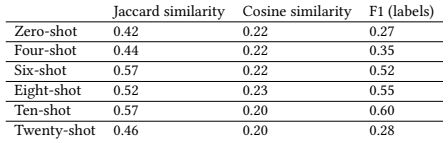
Table 5 . The phrase level comparison results of few-shot prompting using GPT-4. We tried various prompt sizes (zero, four, six, eight, ten, and twenty-shot prompting). From the results, we can understand that the Jaccard similarity at ten-shot prompting is higher (higher the similarity, higher overlap between the gold and predicted spans), cosine similarity is lower (lower the similarity, higher the gold and press are related), and the F1-score between the labels is higher, after which the similarity and F1 decreases at twenty-shot. The cosine similarity, which gives the semantic similarity between gold and predictions, remains the same with all the prompt sizes. Here the F1-score is computed by comparing the gold labels and the predicted labels.
원문 · CC BY 4.0 · Seethalakshmi Gopalakrishnan, Luciana Garbayo, Wlodek Zadrozny · Causality extraction from medical text using Large Language Models (LLMs) · 원문 그림 인용 · 원본 PDF 9쪽에서 그림 영역을 추출했습니다.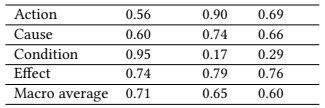
Table 6 . Summary of the results of the GPT-4 predictions of ten-shot prompting on our medical data. Here the F1-score is computed by comparing the gold labels and the predicted labels. The F1 score for cause, effect, and action is higher compared to the condition. Many of the conditions are predicted as causes.
원문 · CC BY 4.0 · Seethalakshmi Gopalakrishnan, Luciana Garbayo, Wlodek Zadrozny · Causality extraction from medical text using Large Language Models (LLMs) · 원문 그림 인용 · 원본 PDF 9쪽에서 그림 영역을 추출했습니다.LLAMA2 fine-tuning과 누락 예측
LLAMA2 7B는 HuggingFace autotrain으로 구절 수준 instruction 형식으로 미세조정되었습니다. 처음 테스트 데이터에서는 59개 중 29개에 대해서만 레이블이 예측되어 평균 F1-score 0.36을 보였습니다. 데이터가 작아 4-fold 교차 검증을 수행했으며, 3, 5, 10 epoch에서 F1-score는 각각 0.70, 0.75, 0.76으로 보고되었습니다. 같은 실험에서 레이블이 누락된 비율은 3, 5, 10 epoch에서 각각 38%, 21%, 26%였고, 이 결과는 레이블이 생성된 예측만으로 계산되었습니다.

Table 7 . The phrase level comparison results of LLAMA2 using 4 fold cross validation. Jaccard similarity and cosine similarity indicate the average similarity between the gold and the predictions. The F1 score is the comparison between the gold labels and predicted labels.
원문 · CC BY 4.0 · Seethalakshmi Gopalakrishnan, Luciana Garbayo, Wlodek Zadrozny · Causality extraction from medical text using Large Language Models (LLMs) · 원문 그림 인용 · 원본 PDF 11쪽에서 그림 영역을 추출했습니다.적용 범위와 한계
LLAMA2의 높은 F1은 레이블이 생성된 예측에만 적용된 값이므로, 누락된 예측까지 포함한 성능으로 해석할 수 없습니다. GPT-4의 토큰 수준 평가도 정답과 예측의 정렬 문제 때문에 결과가 제한됩니다. 이 실험은 임신성 당뇨 진료지침 일곱 문서라는 작은 코퍼스에서 수행되었으므로, 다른 질환이나 다른 지침으로 일반화하려면 추가 주석과 검증이 필요합니다. 저자들은 작은 데이터 규모가 LLAMA2의 누락 예측에 영향을 주었을 수 있다고 해석합니다.
논문 정보
- 저자
- Seethalakshmi Gopalakrishnan, Luciana Garbayo, Wlodek Zadrozny
- 학회·저널
- arXiv · 프리프린트
- 최초 공개일
- 2024년 7월 13일
- 등록일
- 2026년 11월 6일
- 수정일
- 2024년 7월 13일
- 버전
- v1
- arXiv
- 2407.10020
- 분류
- cs.CL · cs.AI · cs.IR
- 원문 이용 조건
- CC BY 4.0
- 제공 범위
- 논문 정보, 해설, 허용된 원문 그림
AI 해설은 논문 원문과 별개의 설명이며 오류가 있을 수 있습니다. 원문과 그림은 각 출처의 이용 조건과 따로 표시된 권리를 따릅니다.
초록
This study explores the potential of natural language models, including large language models, to extract causal relations from medical texts, specifically from Clinical Practice Guidelines (CPGs). The outcomes causality extraction from Clinical Practice Guidelines for gestational diabetes are presented, marking a first in the field. We report on a set of experiments using variants of BERT (BioBERT, DistilBERT, and BERT) and using Large Language Models (LLMs), namely GPT-4 and LLAMA2. Our experiments show that BioBERT performed better than other models, including the Large Language Models, with an average F1-score of 0.72. GPT-4 and LLAMA2 results show similar performance but less consistency. We also release the code and an annotated a corpus of causal statements within the Clinical Practice Guidelines for gestational diabetes.
원문 인용
Seethalakshmi Gopalakrishnan, Luciana Garbayo, Wlodek Zadrozny (2024). Causality extraction from medical text using Large Language Models (LLMs). arXiv:2407.10020v1. https://arxiv.org/abs/2407.10020v1
BibTeX
@misc{gopalakrishnan2024causality,
  title = {{Causality extraction from medical text using Large Language Models (LLMs)}},
  author = {Seethalakshmi Gopalakrishnan and Luciana Garbayo and Wlodek Zadrozny},
  year = {2024},
  eprint = {2407.10020},
  archivePrefix = {arXiv},
  url = {https://arxiv.org/abs/2407.10020v1}
}