논문 해설
Why Units Die in the Layer After a Frozen Random Encoder, and What the Number of Live Units Measures
고정 인코더 뒤 죽은 유닛의 원인을 입력 오프셋으로 설명
- 연구 문제 고정된 무작위 인코더 뒤 ReLU 층에서는 많은 유닛이 죽어 학습이 안 됩니다. 죽는 원인이 분명하지 않아 살아 있는 유닛 수를 게임 복잡도로 읽었습니다.
- 연구 방법 저자들은 입력이 0에서 떨어진 정도를 오프셋으로 재고, 크면 평균 화면을 빼서 입력을 중심에 맞춥니다.
- 주요 결과 Pong에서 평균 화면을 빼자 64개 가운데 3에서 6개이던 살아 있는 유닛이 59에서 63개로 늘었습니다.
고정 인코더 뒤에서 유닛이 죽는 까닭
고정된 무작위 인코더 뒤에 놓인 ReLU 층은 학습이 끝나도 많은 유닛이 살아 남지 않습니다. Atari 에이전트는 Pong과 Breakout에서 전문가 수준의 플레이에 도달하지만, 학습은 훨씬 오래 걸리고 인코더 뒤 첫 학습 층의 64개 유닛 가운데 소수만 살아 있습니다. 이전 연구는 살아 있는 유닛 수를 게임의 복잡도를 재는 값으로 읽었습니다. 이 논문은 그 해석을 다시 검토하고, 유닛이 죽는 원인을 먼저 찾아야 한다고 봅니다.
저자들은 죽은 유닛이 어떤 상태인지부터 정의합니다. 입력합이 모든 화면에서 음수이면 유닛은 항상 0을 내보내고 학습 신호도 받지 못합니다. 따라서 살아 있는 유닛 수는 이 상태가 얼마나 많이 생겼는지를 보여 주지만, 그 원인이 과제의 복잡도라고 단정할 근거는 아직 없습니다. 이 논문은 이 공백을 메우려고, 입력이 0에서 얼마나 떨어져 있는지를 나타내는 오프셋과 학습 한 번에 입력합이 얼마나 움직이는지를 나타내는 스텝 크기를 함께 봅니다.
오프셋을 입력에서 바로 재는 공식
오프셋은 고정된 화면 묶음을 인코더에 통과시킨 출력을 표로 쌓아 잽니다. 분자는 표의 각 행인 점들의 평균 벡터 길이로, 점들의 중심이 0에서 얼마나 떨어져 있는지를 나타냅니다. 저자들은 분모인 출력 분산 합의 제곱근을 spread라고 부르며, 이것은 행들이 서로 얼마나 다른지를 나타냅니다. 같은 비율을 Simon, Adams and Zou(2026)는 outlier-severity ratio라고 불렀습니다. 묶음은 미리 저장해 둔 화면들로, 무작위 행동으로 플레이한 Breakout 화면 50,000장과 여기에 5만 장을 더한 혼합 묶음이 그 예입니다.

Table 3 : What the offset in each game depends on (Atari agents). The first four number columns come from the raw pixels of the mixed sets of screens with exact duplicate screens removed; the squared pixel offset is the energy divided by the product of the next two. The encoder columns use 10,000 of those screens (Supplement S2.7). The counts come from other runs and other screens than the offsets beside them (Table S6 in Supplement S2.6). The Pong count covers the earlier study’s runs with and without sticky actions, and the runs without them had 3 to 8.
원문 · CC BY 4.0 · Scott M. Norton · Why Units Die in the Layer After a Frozen Random Encoder, and What the Number of Live Units Measures · 원문 그림 인용 · 원본 PDF 17쪽에서 그림 영역을 추출했습니다.인코더는 4프레임, 84 x 84 픽셀 화면을 세 개의 컨볼루션 층에 통과시켜 화면마다 3,136개의 숫자를 내보내며, 가중치는 무작위로 정해 고정합니다. 이 무작위 인코더는 입력의 오프셋을 대체로 보존하므로, 밝고 거의 변하지 않는 Pong 화면의 점들은 0에서 먼 좁은 뭉치를 이룹니다.
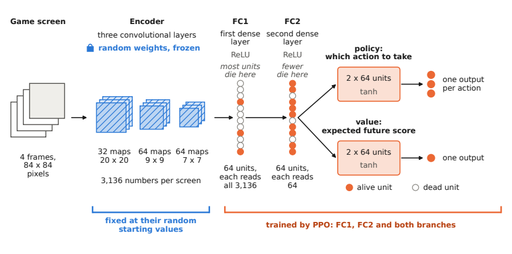
Figure 2 : The network of our agents. Four stacked greyscale frames of 84 by 84 pixels pass through an encoder of three convolutional layers whose random weights are never trained, which gives 3,136 numbers for each screen. These feed the first dense layer (FC1) and then the second (FC2), of 64 units each, and after FC2 a policy branch and a value branch, each with two more layers of 64 units. Everything after the encoder is trained. The filled and open circles illustrate alive and dead units and are not counts.
원문 · CC BY 4.0 · Scott M. Norton · Why Units Die in the Layer After a Frozen Random Encoder, and What the Number of Live Units Measures · 원문 그림 인용 · 원본 PDF 9쪽에서 그림 영역을 추출했습니다.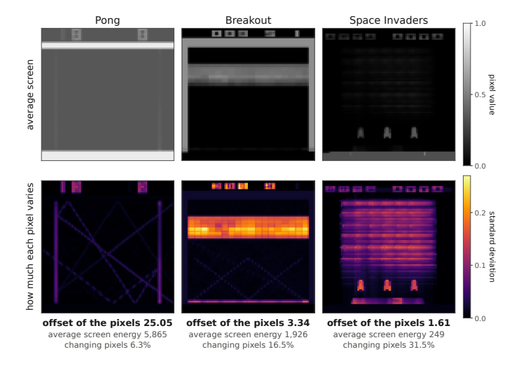
Figure 5 : The average screen of each game (top) and how much each pixel varies from screen to screen (bottom), with pixel values scaled from 0 to 1. In Pong the thin lines are the paths of the ball. In Breakout the brightest band is the bricks, present in some screens and gone in others.
원문 · CC BY 4.0 · Scott M. Norton · Why Units Die in the Layer After a Frozen Random Encoder, and What the Number of Live Units Measures · 원문 그림 인용 · 원본 PDF 18쪽에서 그림 영역을 추출했습니다.오프셋이 중요한 까닭은 ReLU가 입력을 나누는 방식에 있습니다. 각 유닛은 무작위로 놓인 경계의 한쪽에서는 켜지고 반대쪽에서는 꺼집니다. 점들이 0 둘레에 흩어져 있으면 경계는 대개 양쪽에 점을 남기지만, 점들이 0에서 먼 좁은 뭉치를 이루면 경계는 대개 뭉치를 통째로 빗겨 갑니다. 그러면 유닛은 모든 화면에서 켜지거나 모든 화면에서 꺼지고, 모든 화면에서 꺼진 유닛은 학습 신호를 받지 못해 죽은 채 남습니다. Simon, Adams and Zou(2026)는 이 과정을 sparse autoencoder에 대해 계산하고 공식을 내놓았습니다. 저자들은 Pong 화면에 대한 무작위 인코더 출력의 중앙 오프셋이 27.54였고, GPT-2 활성값의 오프셋은 0.904였다고 비교합니다.
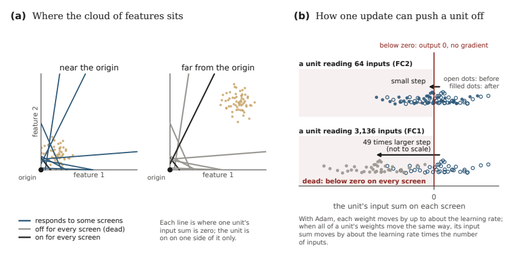
Figure 1 : How a unit of the first dense layer dies, drawn as a schematic and not from data. (a) Dots are screens, and each line marks where one unit’s input is zero. On the left the screens form a cloud near the origin, and most lines cut through it. On the right the cloud is far from the origin compared with its spread, most lines miss it, and a unit that is off for every screen is dead. (b) One update moves a unit’s input on every screen at once, and a unit with more inputs can move further.
원문 · CC BY 4.0 · Scott M. Norton · Why Units Die in the Layer After a Frozen Random Encoder, and What the Number of Live Units Measures · 원문 그림 인용 · 원본 PDF 3쪽에서 그림 영역을 추출했습니다.이 공식은 인코더를 만들지 않고 입력 표본과 층의 크기만으로 출력의 오프셋을 계산합니다. 무작위 가중치를 가진 ReLU 유닛에서 두 입력에 대한 출력 곱의 평균은 두 입력의 길이와 사이각만으로 쓸 수 있다는 Cho & Saul(2009)의 결과를 씁니다. 이 계산을 컨볼루션 층마다 위치를 하나씩 옮기며 반복합니다. 33개 조건에서 무작위 인코더 24개의 중앙 오프셋과 비교했고, 미리 정한 기준은 25퍼센트 이내 27개 조건이었지만 실제로는 33개 모두 들어왔으며 중앙 오차는 1.3퍼센트, 최대 오차는 11퍼센트였습니다(Figure 6). 결과를 본 뒤 추가한 검사도 실행 전에 같은 25퍼센트 기준을 정했고, 게임 화면 여섯 묶음에서는 2.8퍼센트 이내였으며, CIFAR-10 사진을 이미지 분류기 인코더에 통과시킨 다섯 조건에서는 4퍼센트 이내였습니다.
44개 조건 전체의 중앙 오차는 1.4퍼센트였습니다.
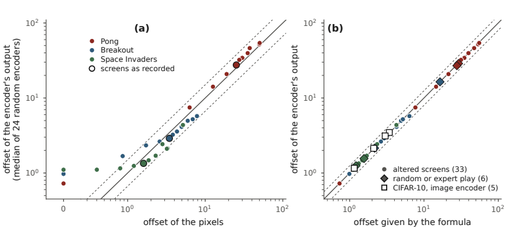
Figure 6 : The output of a random encoder has roughly the same offset as the pixels, and a formula predicts it. (a) Median encoder offset over 24 random encoders against the offset of the raw pixels, for the 33 conditions of Table S7 (Supplement S2.7); dashed lines mark a factor of 1.5. (b) The same offsets against the formula, with dashed lines at 25 percent. Diamonds are the random-play and expert-play screens of each game, squares are CIFAR-10 (Tables S8 and S9 in Supplement S2.7).
원문 · CC BY 4.0 · Scott M. Norton · Why Units Die in the Layer After a Frozen Random Encoder, and What the Number of Live Units Measures · 원문 그림 인용 · 원본 PDF 19쪽에서 그림 영역을 추출했습니다.평균 화면 빼기가 Pong에서 살아 있는 유닛을 늘리는 방법
centring은 저장된 Pong 화면 50,000장의 평균 화면을 먼저 구하고, 각 화면에서 그 평균을 빼서 다음 층에 넘기는 조작입니다. 인코더와 게임은 그대로 두고 입력만 바뀌기 때문에, 입력의 오프셋이 얼마나 줄었는지를 다른 요인과 섞이지 않게 따로 볼 수 있습니다. 이 조작으로 오프셋은 22.94에서 32.56 사이였던 값에서 0.691에서 0.764 사이로 줄었습니다. 같은 기준으로 살아 있는 유닛을 세면, 25,000장의 무작위 플레이 화면에서 1퍼센트 규칙으로 64개 중 3에서 6개였던 수가 59에서 63개로 늘었습니다.
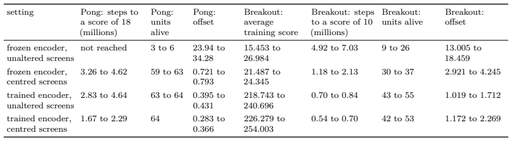
Table 4 : The same six networks in four settings, after 50 million agent steps with sticky actions off. Each cell gives the lowest and the highest of the six encoders. Steps are the agent step, in millions, at which the training score first reached 18 in Pong or 10 in Breakout. Units alive, of 64, are by the 1 percent rule, and offsets are those at 50 million steps, which for a frozen encoder are its offsets throughout. Both are measured with each model’s own encoder on random-play screens, the first 25,000 Pong screens or the 50,000 Breakout screens. Each setting has one run of 50 million steps per encoder, except the frozen encoder on unaltered Breakout screens, which has three. For it the score and the step are medians of the three runs, and the count spans all 18. Supplement S4.6 gives every encoder’s values.
원문 · CC BY 4.0 · Scott M. Norton · Why Units Die in the Layer After a Frozen Random Encoder, and What the Number of Live Units Measures · 원문 그림 인용 · 원본 PDF 21쪽에서 그림 영역을 추출했습니다.Pong에서 frozen encoder에 미가공 화면을 주었을 때는 50백만 에이전트 스텝 안에 학습 점수 18에 도달한 에이전트가 없었습니다. 같은 frozen encoder에 중심화한 화면을 주자 에이전트들은 3.26에서 4.62백만 스텝 만에 18에 도달했고, 이는 학습을 허용한 trained encoder가 미가공 화면에서 2.83에서 4.64백만 스텝 만에 도달한 속도와 비슷했습니다. 이 '비슷하다'는 기준은 실험 전에 정해 두었습니다. 인코더마다 중심화한 frozen encoder가 18에 처음 도달한 스텝을 미가공 trained encoder의 스텝으로 나눈 비율이 1.5 이하여야 하며, 이 조건을 여섯 인코더 가운데 적어도 5개가 만족해야 한다는 것이었습니다.
실제로는 5개가 이 기준을 만족했고, 인코더와 설정마다 실행은 한 번뿐이었습니다.
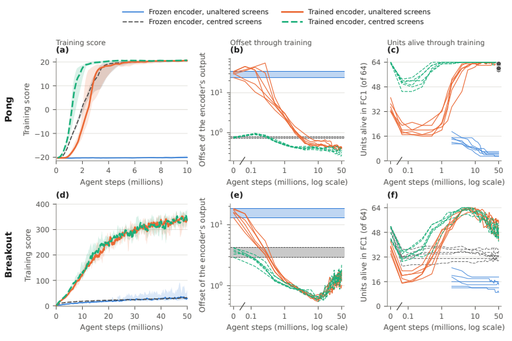
Figure 7 : The same six networks in four settings, in Pong (top) and Breakout (bottom): encoder frozen or trained, screens unaltered or centred (dashed). Left: training score, the median of the six agents with a band from the lowest to the highest, each curve smoothed over 25 logged points. Middle: the offset of the encoder’s output on random-play screens. Lines are trained encoders and bands the range of the frozen ones, which do not change. Right: FC1 units alive by the 1 percent rule, one line per agent. The dots in the top right panel are the frozen-encoder agents on centred screens, which were counted only at the end.
원문 · CC BY 4.0 · Scott M. Norton · Why Units Die in the Layer After a Frozen Random Encoder, and What the Number of Live Units Measures · 원문 그림 인용 · 원본 PDF 21쪽에서 그림 영역을 추출했습니다.Breakout에서는 중심화가 살아 있는 유닛을 30에서 37개로 늘렸지만, 학습 점수는 달라지지 않았습니다. 미가공 화면의 frozen encoder는 평균 학습 점수가 15.453에서 26.984였고, 중심화한 쪽은 21.487에서 24.345였습니다. 학습을 허용한 trained encoder는 218.743에서 240.696이어서 격차가 그대로 남았습니다. 저자들은 이 결과를 보고 살아 있는 유닛 수를 그 자체로 늘릴 목표로 삼지 않았습니다. Breakout의 중심화 화면에는 여전히 2.921에서 4.245 사이의 오프셋이 남아 있었는데, 그 나머지 오프셋을 없앴을 때 격차가 줄어드는지는 확인하지 않았습니다.
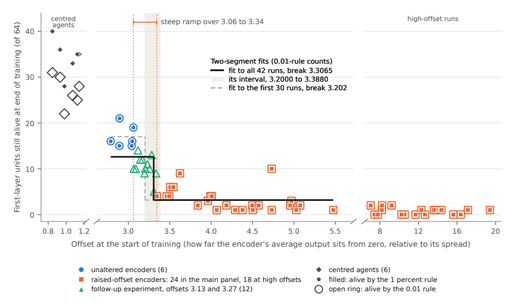
Figure 3 : Final FC1 units alive in each Breakout agent against its encoder’s offset before training. Blue circles are unaltered encoders, orange squares raised-offset encoders, green triangles the 12 follow-up runs and grey diamonds centred agents. Filled markers use the 1 percent rule, open ones the 0.01 rule. The black and dashed steps are two-segment fits (Supplement S2.1). The bracket marks the ramp from 3.06 to 3.34.
원문 · CC BY 4.0 · Scott M. Norton · Why Units Die in the Layer After a Frozen Random Encoder, and What the Number of Live Units Measures · 원문 그림 인용 · 원본 PDF 13쪽에서 그림 영역을 추출했습니다.남은 한계
이 결과가 보여 주는 범위는 몇 가지로 좁습니다. 중심화와 평균 빼기는 오프셋을 바꾸면서 입력의 전체 크기도 함께 바꾸므로, 오프셋 효과와 입력 크기 효과를 완전히 나누지 못했습니다. 또한 Breakout에서는 살아 있는 유닛이 늘어도 평균 학습 점수 격차가 남았습니다.
학습률을 FC1에서만 49로 나눈 실험에서는 Breakout의 활성 유닛이 36에서 46개로 늘었지만 에이전트의 점수는 오히려 낮았습니다. 저자들은 작은 학습률이 학습 자체를 느리게 했을 수 있다고 봅니다. 그래서 살아 있는 유닛 수를 그 자체로 올리는 것이 도움이 된다고 결론 내리지 않습니다.
논문 정보
- 저자
- Scott M. Norton
- 학회·저널
- arXiv · 프리프린트
- 최초 공개일
- 2026년 11월 22일
- 등록일
- 2026년 11월 24일
- 수정일
- 2026년 11월 22일
- 버전
- v1
- arXiv
- 2611.29752
- 분류
- cs.LG · cs.AI
- 원문 이용 조건
- CC BY 4.0
- 제공 범위
- 논문 정보, 해설, 허용된 원문 그림
AI 해설은 논문 원문과 별개의 설명이며 오류가 있을 수 있습니다. 원문과 그림은 각 출처의 이용 조건과 따로 표시된 권리를 따릅니다.
초록
Reinforcement-learning agents can learn Atari games through a convolutional encoder whose random weights are never trained. They reach expert play in Pong and, without random action repeats, in Breakout, but training takes far longer and few ReLU units in the layer after the encoder stay alive. A dead unit outputs zero for every input and cannot learn. In earlier work we took the number of live units to measure the game's complexity. Here we ask why units die and correct that conclusion. We find that more units die as the layer's inputs lie farther from zero relative to how much they vary. We call this ratio the offset. Earlier work showed this in sparse autoencoders at the start of training. We saw it after training in agents, image classifiers, a reservoir computer and sparse autoencoders on GPT-2. A random encoder leaves the offset of its input roughly unchanged, and a formula predicted its median offset within 25 percent in all 44 cases. So a game with a bright, mostly unchanging screen gives the next layer a large offset. In Pong, subtracting the average screen raised the number of live units from between 3 and 6 of 64 to between 59 and 63, so the number alone cannot show a game's complexity. On unaltered screens none of the agents reached a training score of 18 in 50 million steps. With the subtraction all did within 5 million, about as fast as a trained encoder on unaltered screens. In Breakout the subtraction left more units alive, but average training scores did not clearly improve, and a large gap to a trained encoder remained. So we do not treat their number as something to raise for its own sake. The evidence is from small networks and three games, and in agents and image classifiers changing the offset also changed the size of the inputs. We suggest measuring the offset before training a layer on a fixed front end and, if it is large, trying to subtract the mean input.
원문 인용
Scott M. Norton (2026). Why Units Die in the Layer After a Frozen Random Encoder, and What the Number of Live Units Measures. arXiv:2611.29752v1. https://arxiv.org/abs/2611.29752v1
BibTeX
@misc{norton2026units,
  title = {{Why Units Die in the Layer After a Frozen Random Encoder, and What the Number of Live Units Measures}},
  author = {Scott M. Norton},
  year = {2026},
  eprint = {2611.29752},
  archivePrefix = {arXiv},
  url = {https://arxiv.org/abs/2611.29752v1}
}