논문 해설
NIFT-SQL: Customer-Supervised Table Scoring for Enterprise Text-to-SQL Retrieval
NIFT-SQL: 고객 감독 기반 테이블 점수화를 활용한 기업용 텍스트-투-SQL 검색
- 연구 문제 기업 환경에서 필요한 테이블을 상위 K개 안에 모두 찾는 문제를 다룹니다.
- 연구 방법 고객별 질문으로 학습한 교차 인코더 점수기와 미세 조정 검색기를 학습된 융합으로 결합합니다.
- 주요 결과 BEAVER, LiveSQLBench, LiveSQLBench-Large에서 complete@15가 기성 검색보다 크게 높고 미세 조정 검색기 기준선보다도 높게 보고됩니다.
기업 text-to-SQL에서 테이블 찾기의 어려움
기업 데이터베이스에서 text-to-SQL 시스템이 올바른 질의를 쓰려면 먼저 질문에 필요한 테이블을 찾아야 합니다. 원문은 여러 데이터베이스에 걸쳐 수백 개의 난해한 이름을 가진 테이블이 있는 환경을 문제로 제시합니다. 테이블 이름, 열 이름, 선언된 키만 사용할 수 있고 설명이나 샘플 값이 없는 조건에서 일반 임베딩 검색이 어려워집니다. 평균 질의가 4.4개 테이블을 쓰고 31%는 5개 이상을 사용하므로 일부만 찾는 것으로는 부족합니다. 이 논문은 고객별 예시 질문으로 학습한 점수기를 하이브리드 검색과 결합하는 방식을 검토합니다.
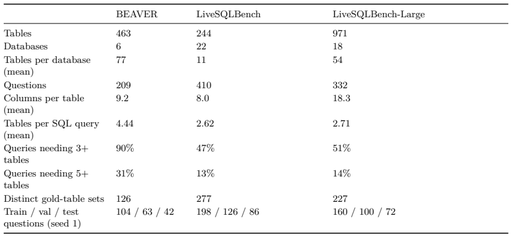
Table 1 . Datasets, schema cards in the names-and-keys setting.
원문 · CC BY 4.0 · Arjun Rao, Nishant Gopinath · NIFT-SQL: Customer-Supervised Table Scoring for Enterprise Text-to-SQL Retrieval · 원문 그림 인용 · 원본 PDF 6쪽에서 그림 영역을 추출했습니다.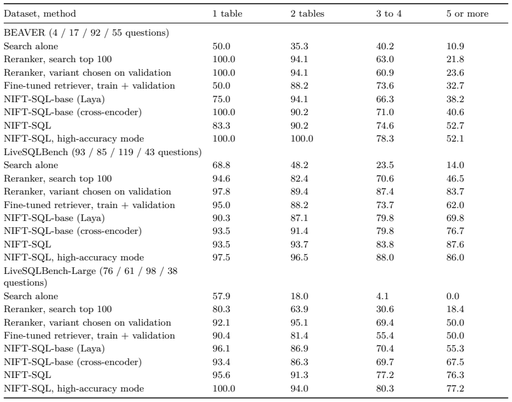
Table 7 . Complete@15 by number of gold tables, %, test questions of seeds 1 to 4 pooled. Trained methods are means over their training runs (three for the cross-encoder pipelines; NIFT-SQL-base with Laya, one). Question counts in the dataset rows. Bold: highest on five or more tables.
원문 · CC BY 4.0 · Arjun Rao, Nishant Gopinath · NIFT-SQL: Customer-Supervised Table Scoring for Enterprise Text-to-SQL Retrieval · 원문 그림 인용 · 원본 PDF 13쪽에서 그림 영역을 추출했습니다.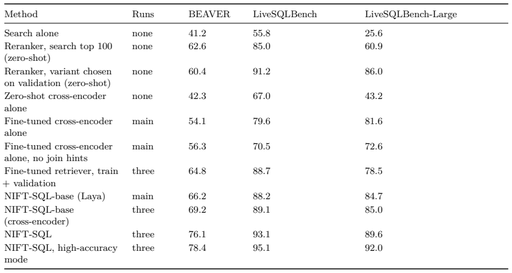
Table 8 . Gold tables whose names share no word with the question: share ranked in the top 15, %, test questions of seeds 1 to 4 pooled. “Runs”: training runs averaged (main = the main training run only). Bold: highest per collection.
원문 · CC BY 4.0 · Arjun Rao, Nishant Gopinath · NIFT-SQL: Customer-Supervised Table Scoring for Enterprise Text-to-SQL Retrieval · 원문 그림 인용 · 원본 PDF 14쪽에서 그림 영역을 추출했습니다.NIFT-SQL의 구성: 검색, 점수기, 학습된 융합
NIFT-SQL은 세 부분으로 이루어집니다. 첫째, 하이브리드 검색은 BGE 임베딩의 코사인 점수와 이름 토큰에 대한 BM25 점수를 각각 전체 테이블에 대해 최소-최대 정규화한 뒤 0.6 대 0.4로 결합합니다. 고객별 미세 조정 검색기는 학습 질문의 정답 테이블과 어려운 음성 예시로 대조 손실을 사용해 BGE를 학습합니다. 둘째, 점수기는 질문, 테이블 카드, 선언된 조인 힌트를 입력받아 해당 테이블이 정답 SQL에 필요한지를 확률로 추정합니다. 주 점수기는 BAAI/bge-reranker-large를 학습 행으로 미세 조정한 교차 인코더입니다. 셋째, 학습된 융합은 점수기 순위와 검색 순위 등 여덟 개 특징을 검증 질문으로 적합한 정규화 로지스틱 회귀에 넣어 후보를 재정렬합니다.
후보는 점수기 상위 50개와 검색 상위 50개의 합집합입니다.
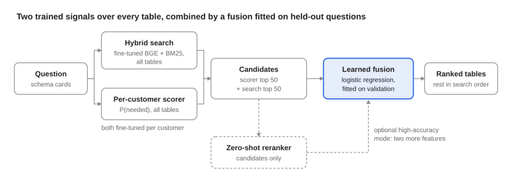
Figure 1 : NIFT-SQL at inference: hybrid search with a retriever fine-tuned per customer, a per-customer scorer over every table, and a fusion fitted on held-out questions; the optional high-accuracy mode adds two features from a zero-shot reranker over the candidates
원문 · CC BY 4.0 · Arjun Rao, Nishant Gopinath · NIFT-SQL: Customer-Supervised Table Scoring for Enterprise Text-to-SQL Retrieval · 원문 그림 인용 · 원본 PDF 4쪽에서 그림 영역을 추출했습니다.평가 설계와 주요 결과
평가는 BEAVER, LiveSQLBench, LiveSQLBench-Large에서 네 개의 무작위 분할과 세 번의 학습 실행으로 수행되었습니다. 주 지표는 complete@K이며, 정답 테이블 집합 전체가 상위 K개에 포함된 질문의 비율입니다. 원문은 K를 8과 15로 보고하며 이 값이 하류 SQL 생성기에 최적임을 검증하지 않았다고 밝힙니다. NIFT-SQL은 complete@15에서 BEAVER 69.2%, LiveSQLBench 89.5%, LiveSQLBench-Large 85.6%를 보고합니다. 같은 조건에서 기성 검색은 30.4%, 41.0%, 21.8%입니다. 고정밀 모드는 두 재순위 특징을 추가하여 complete@15가 72.4%, 92.5%, 88.6%입니다.
제로샷 교차 인코더를 쓴 NIFT-SQL-base는 미세 조정된 경우보다 complete@15가 약 21포인트 낮습니다.
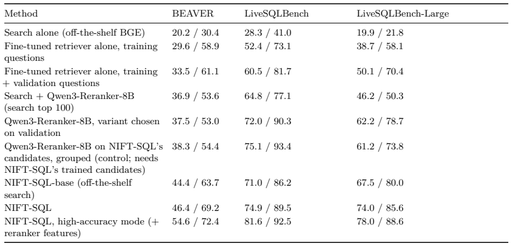
Table 2 . NIFT-SQL, test, complete@8 / complete@15 in %, mean over seeds 1 to 4 and, for trained methods, over three training runs. The reranker variant is chosen per collection and seed on validation questions (Section 6.5). Intervals for these differences are in Table G7 and its note.
원문 · CC BY 4.0 · Arjun Rao, Nishant Gopinath · NIFT-SQL: Customer-Supervised Table Scoring for Enterprise Text-to-SQL Retrieval · 원문 그림 인용 · 원본 PDF 8쪽에서 그림 영역을 추출했습니다.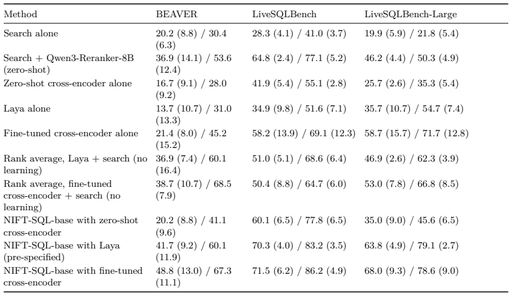
Table 3 . Test results, complete@8 / complete@15 in %, mean (standard deviation) over seeds 1 to 4. All K and N are in Appendix F.
원문 · CC BY 4.0 · Arjun Rao, Nishant Gopinath · NIFT-SQL: Customer-Supervised Table Scoring for Enterprise Text-to-SQL Retrieval · 원문 그림 인용 · 원본 PDF 9쪽에서 그림 영역을 추출했습니다.절제와 비교 기준선에서 드러난 기여
Qwen3-Reranker-8B는 제로샷으로 검색 상위 100개를 재정렬하는 기준선으로 쓰였습니다. 고정밀 모드는 재순위 점수를 융합 특징으로 더하며, 이 결과는 데이터베이스 묶음과 학습된 가중치의 기여를 분리하는 통제 실험과 함께 읽어야 합니다. 원문은 학습된 융합이 순위 융합보다 LiveSQLBench에서 우세하지만 BEAVER에서는 해석이 달라진다고 보고합니다.
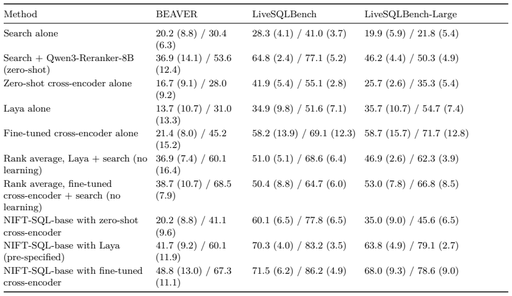
Table 4 . NIFT-SQL-base with the fine-tuned cross-encoder minus other methods, complete@8 / complete@15 in points, all four test sets pooled, 95% interval clustered by gold-table set across seeds. Bold: interval excludes zero.
원문 · CC BY 4.0 · Arjun Rao, Nishant Gopinath · NIFT-SQL: Customer-Supervised Table Scoring for Enterprise Text-to-SQL Retrieval · 원문 그림 인용 · 원본 PDF 9쪽에서 그림 영역을 추출했습니다.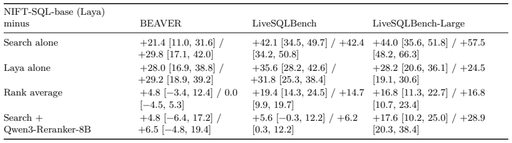
Table 5 . NIFT-SQL-base with Laya minus each baseline, same format. This pre-specified compari- son isolates the method’s components.
원문 · CC BY 4.0 · Arjun Rao, Nishant Gopinath · NIFT-SQL: Customer-Supervised Table Scoring for Enterprise Text-to-SQL Retrieval · 원문 그림 인용 · 원본 PDF 10쪽에서 그림 영역을 추출했습니다.적용 범위와 한계
원문은 이 연구가 테이블 검색의 커버리지를 측정하며 하류 SQL 실행 정확도는 측정하지 않는다고 명시합니다. 신규 BEAVER 릴리스의 실제 질문 평가에서는 합성 질문만으로 학습한 교차 인코더 단독 성능이 검색보다 낮게 보고되며, 미세 조정된 검색기가 더 잘 전이됩니다. 따라서 NIFT-SQL의 이득은 고객별 감독 데이터가 있는 조건에서 확인된 것입니다. 교차 인코더와 Laya 사이의 차이는 학습 재실행에 따라 불확실하며, 주 결과 표의 구간이 최종 구성의 선택 과정을 모두 반영하지는 않습니다.
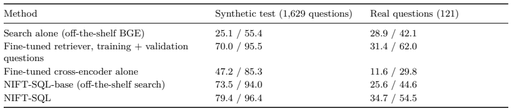
Table 9 . Frozen-method holdout on the current BEA VER release, seed 1, scored once, complete@8 / complete@15 in %.
원문 · CC BY 4.0 · Arjun Rao, Nishant Gopinath · NIFT-SQL: Customer-Supervised Table Scoring for Enterprise Text-to-SQL Retrieval · 원문 그림 인용 · 원본 PDF 21쪽에서 그림 영역을 추출했습니다.논문 정보
- 저자
- Arjun Rao, Nishant Gopinath
- 학회·저널
- arXiv · 프리프린트
- 최초 공개일
- 2026년 11월 9일
- 등록일
- 2026년 11월 11일
- 수정일
- 2026년 11월 9일
- 버전
- v1
- arXiv
- 2611.12731
- 분류
- cs.IR
- 원문 이용 조건
- CC BY 4.0
- 제공 범위
- 논문 정보, 해설, 허용된 원문 그림
AI 해설은 논문 원문과 별개의 설명이며 오류가 있을 수 있습니다. 원문과 그림은 각 출처의 이용 조건과 따로 표시된 권리를 따릅니다.
초록
Enterprise text-to-SQL starts with finding the tables a question needs, which is hard when a schema spans several databases and hundreds of cryptic tables. We ask whether models trained separately on each customer's example questions, reading only table names, column names, and declared keys, improve table retrieval. NIFT-SQL (Necessity-Informed Fusion for Text-to-SQL) fuses hybrid search over a retriever fine-tuned on the customer's questions with a fine-tuned 560M cross-encoder that scores every table for whether the query needs it, through a logistic regression fitted on held-out questions. On BEAVER, LiveSQLBench, and LiveSQLBench-Large (244 to 971 tables; four splits, three trainings), NIFT-SQL places every reference table in the top 15 for 69.2%, 89.5%, and 85.6% of test questions, against 30.4%, 41.0%, and 21.8% for hybrid search and 61.1%, 81.7%, and 70.4% for the fine-tuned retriever with the same labels. With off-the-shelf search, the cross-encoder without fine-tuning is 21 points lower. A zero-shot 8B reranker needs no labels and, routed by database, shows no resolved complete@15 difference on two collections; adding its scores as two fusion features gives a high-accuracy mode that reaches 72.4%, 92.5%, and 88.6%, ahead of the validation-selected zero-shot reranker variant on two collections, with no resolved difference on the third. Rank fusion of the two trained parts, grouped by database, shows no resolved difference from the learned fusion. Scored once on a newer BEAVER release, NIFT-SQL beats search and leads the label-matched retriever at top 8 on the synthetic test, but trails it at top 15 on real questions.
원문 인용
Arjun Rao, Nishant Gopinath (2026). NIFT-SQL: Customer-Supervised Table Scoring for Enterprise Text-to-SQL Retrieval. arXiv:2611.12731v1. https://arxiv.org/abs/2611.12731v1
BibTeX
@misc{rao2026nift,
  title = {{NIFT-SQL: Customer-Supervised Table Scoring for Enterprise Text-to-SQL Retrieval}},
  author = {Arjun Rao and Nishant Gopinath},
  year = {2026},
  eprint = {2611.12731},
  archivePrefix = {arXiv},
  url = {https://arxiv.org/abs/2611.12731v1}
}