논문 해설
Reinforcement Learning Decoders for Fault-Tolerant Quantum Computation
내결함성 양자 계산을 위한 강화학습 디코더
- 연구 문제 표면 부호의 내결함 디코딩은 오류 syndrome이 모호하고 측정 자체도 오류를 가지므로 기존 방식만으로는 어렵습니다.
- 연구 방법 디코딩을 강화학습 환경으로 재구성하고, deepQ 네트워크로 학습한 agent가 Pauli 정정과 새 syndrome 요청을 선택하도록 합니다.
- 주요 결과 d = 5 표면 부호에서 bit-flip 잡음은 p < 1.3×10⁻², depolarizing 잡음은 p < 1.1×10⁻² 부근에서 논리 큐빗 수명이 단일 faulty 큐빗보다 긴 agent가 존재한다고 보고됩니다.
내결함 설정의 디코딩 문제
표면 부호(surface code)는 격자 위 데이터 큐빗과 안정자 연산자로 하나의 논리 큐빗을 부호화하며, 오류를 진단하고 정정하려면 측정된 syndrome으로부터 정정을 제안하는 디코더가 필요합니다. 이 디코딩 문제에서는 여러 오류 배열이 같은 syndrome을 만들 수 있어 가장 그럴듯한 오류를 추정해야 합니다. 특히 syndrome 추출 회로 자체에 오류가 있는 faulty syndrome measurements 상황에서는 단일 측정을 신뢰할 수 없으므로 여러 번의 syndrome을 함께 다뤄야 합니다. 기존의 최소 가중 완전 매칭 기반 알고리즘과 신경망 기반 디코더는 각각 속도나 유연성 면에서 장점이 주장되었지만, 본문은 이들이 내결함 설정의 요구를 모두 만족한다고 확인되지 않았다고 설명합니다.
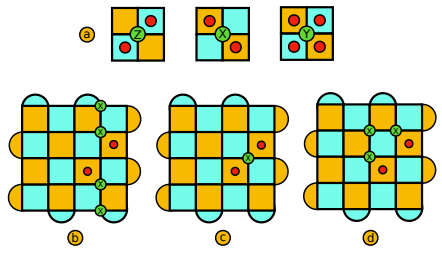
FIG. 2 . (a) Single qubit Pauli flips violate surrounding stabilizers. (b-d) Strings of Pauli flips only violate stabilizers at the endpoint of the string. Multiple error configurations can give rise to the same syndrome. They can differ by stabilizers, as for example in (c) and (d), or by logical operators, see (b) and (c).
원문 · CC BY 4.0 · Ryan Sweke, Markus S. Kesselring, Evert P. L. van Nieuwenburg, Jens Eisert · Reinforcement Learning Decoders for Fault-Tolerant Quantum Computation · 원문 그림 인용 · 원본 PDF 3쪽에서 그림 영역을 추출했습니다.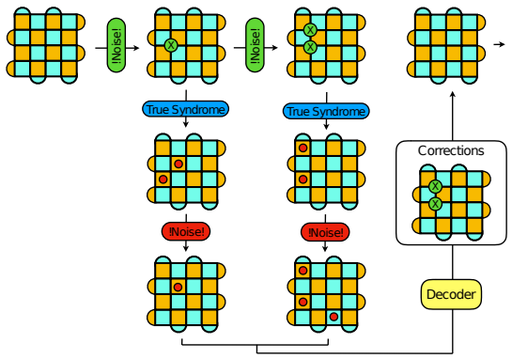
FIG. 3 . A typical decoding cycle is illustrated for the simplified faulty measurements scenario in which one imagines each time step consisting of an initial physical error process generating errors on the data qubits, followed by a second measurement error process which corrupts the true syndrome. The decoding algorithm then has access to a sequence of potentially faulty syndromes.
원문 · CC BY 4.0 · Ryan Sweke, Markus S. Kesselring, Evert P. L. van Nieuwenburg, Jens Eisert · Reinforcement Learning Decoders for Fault-Tolerant Quantum Computation · 원문 그림 인용 · 원본 PDF 4쪽에서 그림 영역을 추출했습니다.디코딩을 강화학습 환경으로 재구성
이 논문은 디코더를 환경에서 이산적인 행동을 순차적으로 수행하는 agent로 해석합니다. 환경은 숨은 상태(hidden state), 오류 모델(error model), 참조 디코더(referee decoder)로 구성됩니다. 숨은 상태는 적용된 모든 Pauli 뒤집기의 목록이며, 오류 모델은 이 상태로부터 faulty syndrome volume을 생성합니다. 참조 디코더는 perfect syndrome을 받아 현재 상태가 terminal state인지 판정하는 single-shot 디코더입니다. agent의 상태는 faulty syndrome volume과 그 이후 수행한 action history로 정의되며, 행동은 단일 큐빗의 X 또는 Z 뒤집기 또는 새 syndrome 요청입니다.
새 정정이 오류를 제거하고 논리 상태를 보존하면 보상 1을 받고, 참조 디코더가 실패하면 에피소드가 끝납니다.
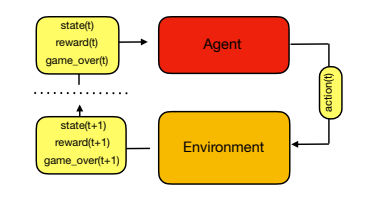
FIG. 4 . An illustration of the signals passed between an agent and the environment through the duration of a sequential turn based episode.
원문 · CC BY 4.0 · Ryan Sweke, Markus S. Kesselring, Evert P. L. van Nieuwenburg, Jens Eisert · Reinforcement Learning Decoders for Fault-Tolerant Quantum Computation · 원문 그림 인용 · 원본 PDF 5쪽에서 그림 영역을 추출했습니다.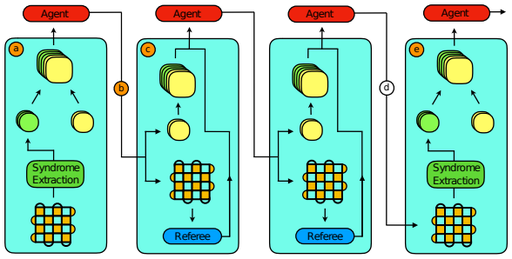
FIG. 5 . An illustration of the various steps occurring within a single episode. (a) In an initial step, a faulty syndrome volume is extracted from a state initially in the code space. This faulty syndrome volume is combined with an initially empty action history and passed to the agent as the initial state. Given an input state, the agent must decide on an action, which it passes to the environment. If the action is a Pauli flip which is not already in the action history (b), then the procedure illustrated in box (c) occurs, if the agent requests a new syndrome or repeats an action (d), then the procedure illustrated in box (e) occurs. (c) The chosen action is applied to the underlying quantum state. From this state the reward for the applied action is determined, while simultaneously a referee decoder decides whether or not the episode is now over - i.e. whether the underlying quantum state is now in a terminal state. Additionally, the applied action is appended to the action history, which is concatenated with the non-updated syndrome volume and provided to the agent, in conjunction with the reward and terminal state indicator. (e) Once again, the underlying quantum state is first updated, and from this updated state both a reward and terminal state indicator are determined (not shown). However, the trivial or repeated action of the agent triggers a new round of faulty syndrome measurements. After this new round of syndrome extraction, the new syndrome volume is combined with a reset action history and provided to the agent, from which it can once again choose another move.
원문 · CC BY 4.0 · Ryan Sweke, Markus S. Kesselring, Evert P. L. van Nieuwenburg, Jens Eisert · Reinforcement Learning Decoders for Fault-Tolerant Quantum Computation · 원문 그림 인용 · 원본 PDF 6쪽에서 그림 영역을 추출했습니다.deepQ 네트워크와 학습 절차
본 논문은 이 환경에서 deepQ learning을 구체적인 예로 사용합니다. Q-function은 신경망으로 근사되며, 학습 시에는 ε-greedy 탐색으로 생성한 경험 튜플을 experience memory에 저장하고 여기서 batch를 샘플링합니다. 상태는 faulty syndrome 슬라이스와 action history 슬라이스를 쌓아 다채널 이미지 형태로 인코딩되며, 합성곱 층 세 개와 완전연결 층을 거쳐 각 행동의 Q값을 출력합니다. 학습은 여러 오류율을 순서대로 높이면서 각 단계에서 하이퍼파라미터 격자 탐색을 수행하는 반복 절차로 진행됩니다. 이 절차에서 이전 단계의 최적 agent의 가중치와 경험 memory가 다음 오류율의 초기값으로 이어집니다.
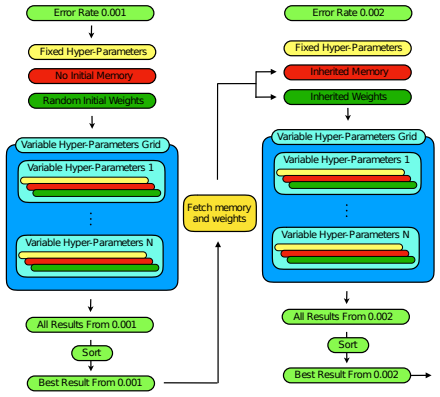
FIG. 9 . Iterative training procedure, via a hyper-parameter grid search at each error rate. After training multiple decoding agents at a given error rate, one for each point in the specified hyper-parameter grid, the results are sorted. The weights and experience memory from the optimal decoding agent are then used as the initial weights and experience memory for a new round of training procedures, again one for each point in the hyper-parameter grid, but at an increased error rate.
원문 · CC BY 4.0 · Ryan Sweke, Markus S. Kesselring, Evert P. L. van Nieuwenburg, Jens Eisert · Reinforcement Learning Decoders for Fault-Tolerant Quantum Computation · 원문 그림 인용 · 원본 PDF 12쪽에서 그림 영역을 추출했습니다.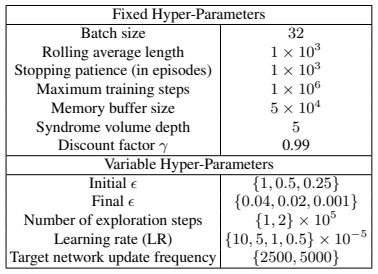
원문 그림 TABLE I. Training Hyper-Parameters.
원문 · CC BY 4.0 · Ryan Sweke, Markus S. Kesselring, Evert P. L. van Nieuwenburg, Jens Eisert · Reinforcement Learning Decoders for Fault-Tolerant Quantum Computation · 원문 그림 인용 · 원본 PDF 13쪽에서 그림 영역을 추출했습니다.평가 조건과 잡음 모델
평가는 d = 5 표면 부호에서 bit-flip 잡음과 depolarizing 잡음을 대상으로 수행됩니다. 두 잡음 모델 모두 측정 한 번을 두 단계의 오류 채널로 모델링합니다. 첫 채널은 물리 데이터 큐빗의 오류이고, 둘째 채널은 참 syndrome의 측정값을 확률 p_meas로 뒤집습니다. bit-flip 잡음에서는 X 뒤집기만 사용하므로 행동 공간 크기가 d²+1이며, depolarizing 잡음에서는 X와 Z 뒤집기만 허용하여 2d²+1입니다. 평가에서는 학습된 Q-function을 탐욕적으로 사용하고, 참조 디코더로 terminal state를 판정하며, 최소 10⁶개의 syndrome이 관측되도록 에피소드 수를 정합니다.
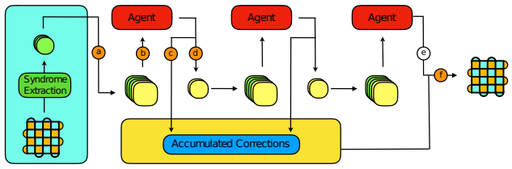
FIG. 6 . The procedure for decoding with a trained agent. (a) Given a faulty syndrome volume generated by some experiment, this volume is concatenated with an empty action history to produce a suitable input state for the decoding agent. (b) The decoding agent takes in the combined faulty syndrome volume and action history and chooses an action. This action is simultaneously (c) added to a list of accumulated corrections and (d) used to update only the action history component of the input state to the agent. This updated input state is then given to the agent and procedures (b-d) continue until the agent (e) repeats an action or requests a new syndrome. (f) At this stage the corrections could be applied to the lattice state, although in practice they would be tracked through the entire computation.
원문 · CC BY 4.0 · Ryan Sweke, Markus S. Kesselring, Evert P. L. van Nieuwenburg, Jens Eisert · Reinforcement Learning Decoders for Fault-Tolerant Quantum Computation · 원문 그림 인용 · 원본 PDF 8쪽에서 그림 영역을 추출했습니다.평균 논리 큐빗 수명 결과
평가 지표는 에이전트가 능동적으로 디코딩한 논리 큐빗의 평균 수명이며, 이는 에피소드 길이의 평균으로 정해집니다. 이 값을 단일 faulty 큐빗의 평균 수명과 비교합니다. 보고된 결과에서 bit-flip 잡음은 p < 1.3×10⁻²(약 0.013) 부근, depolarizing 잡음은 p < 1.1×10⁻²(약 0.011) 부근에서, 논리 큐빗 수명이 단일 faulty 큐빗보다 긴 디코딩 agent가 존재합니다. 저자들은 이를 엄밀한 임계값이 아니라 원리 증명(proof-of-principle) 결과로 해석합니다. 학습 기록은 부록의 Fig. 10과 11, 그리고 Table II에서 확인할 수 있으며, 이 결과는 본 논문이 사용한 d = 5 설정과 deepQ 구조에 한정됩니다.
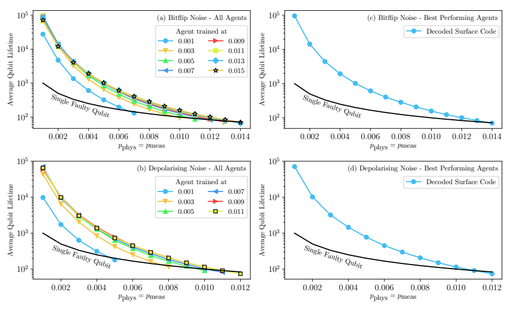
FIG. 8 . (a,b) Performance of all agents obtained during the iterative training procedure. Each agent was evaluated at increasing error rates, until the average lifetime of the logical qubit actively decoded by the agent became less than the average lifetime of a single faulty qubit. (c,d) Results obtained by using the best performing decoding agent for each error rate.
원문 · CC BY 4.0 · Ryan Sweke, Markus S. Kesselring, Evert P. L. van Nieuwenburg, Jens Eisert · Reinforcement Learning Decoders for Fault-Tolerant Quantum Computation · 원문 그림 인용 · 원본 PDF 10쪽에서 그림 영역을 추출했습니다.적용 범위와 한계
본 논문은 신경망 구조와 강화학습 알고리즘이 최신 연구에 비해 비교적 단순하므로 더 정교한 구조와 학습 알고리즘으로 결과가 개선될 가능성이 있다고 밝힙니다. 또한 제안된 framework는 참조 디코더가 물리 데이터 큐빗의 상태에 접근해야 하므로 실험 데이터만으로 학습할 수 없으며, 실제로는 먼저 오류 모델을 추정해야 합니다. 저자들은 단일 샷 에피소드와 같은 수정으로 이 제약을 줄이는 방향을 제안하지만, 이 논문에서 그 방법을 검증하지는 않았습니다. 학습된 decoder는 특정 격자 크기에 맞춰 다시 학습해야 하며, 다양한 형태의 격자와 회로 수준 잡음에 대한 검증은 본 논문에서 다루지 않습니다.
논문 정보
- 저자
- Ryan Sweke, Markus S. Kesselring, Evert P. L. van Nieuwenburg, Jens Eisert
- 학회·저널
- arXiv · 프리프린트
- 최초 공개일
- 2018년 10월 16일
- 등록일
- 2026년 11월 6일
- 수정일
- 2018년 10월 16일
- 버전
- v1
- arXiv
- 1810.07207
- DOI
- 10.1088/2632-2153/abc609
- 분류
- quant-ph · cs.AI · cs.LG
- 원문 이용 조건
- CC BY 4.0
- 제공 범위
- 논문 정보, 해설, 허용된 원문 그림
AI 해설은 논문 원문과 별개의 설명이며 오류가 있을 수 있습니다. 원문과 그림은 각 출처의 이용 조건과 따로 표시된 권리를 따릅니다.
초록
Topological error correcting codes, and particularly the surface code, currently provide the most feasible roadmap towards large-scale fault-tolerant quantum computation. As such, obtaining fast and flexible decoding algorithms for these codes, within the experimentally relevant context of faulty syndrome measurements, is of critical importance. In this work, we show that the problem of decoding such codes, in the full fault-tolerant setting, can be naturally reformulated as a process of repeated interactions between a decoding agent and a code environment, to which the machinery of reinforcement learning can be applied to obtain decoding agents. As a demonstration, by using deepQ learning, we obtain fast decoding agents for the surface code, for a variety of noise-models.
원문 인용
Ryan Sweke, Markus S. Kesselring, Evert P. L. van Nieuwenburg, Jens Eisert (2018). Reinforcement Learning Decoders for Fault-Tolerant Quantum Computation. arXiv:1810.07207v1. https://doi.org/10.1088/2632-2153/abc609
BibTeX
@article{sweke2018reinforcement,
  title = {{Reinforcement Learning Decoders for Fault-Tolerant Quantum Computation}},
  author = {Ryan Sweke and Markus S. Kesselring and Evert P. L. van Nieuwenburg and Jens Eisert},
  year = {2018},
  eprint = {1810.07207},
  archivePrefix = {arXiv},
  doi = {10.1088/2632-2153/abc609},
  url = {https://arxiv.org/abs/1810.07207v1}
}